

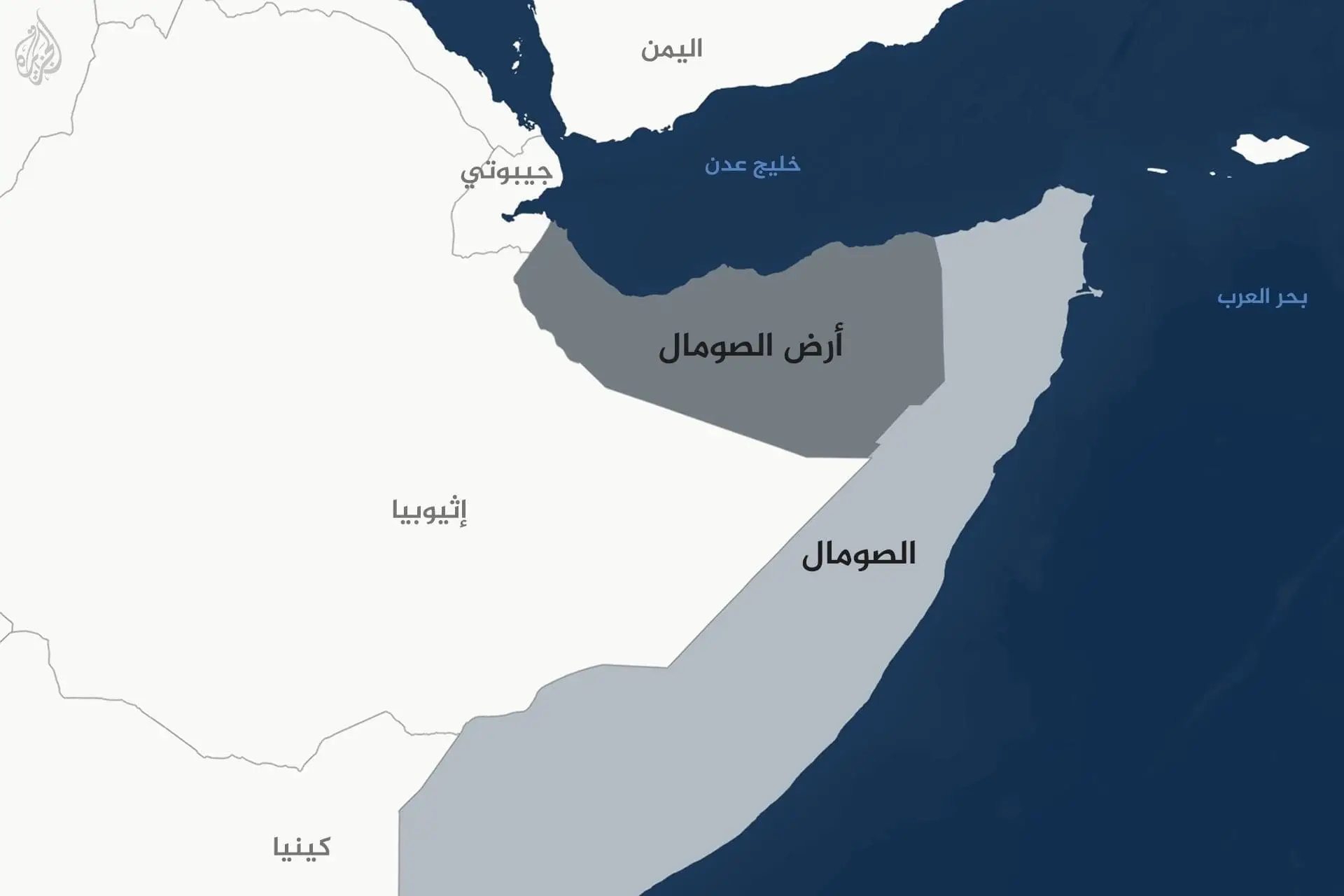
Israel's Recognition of the "Separatist Region of Somaliland": Motives, Repercussions, and Their Danger to Somalia, the Arab World, and the Islamic World
Amid sensitive global and regional upheavals, the Horn of Africa is witnessing a critical and highly dangerous event: the official announcement by the Zionist entity of its recognition of the separatist region of "Somaliland." This development raises fundamental questions about the reasons for this recognition at this precise moment, its effects on the future of the Somali state, and the extent of its danger to Arab and Islamic national security.
First: The General Somali Landscape
Since the collapse of the central government, Somalia has been in a chronic state of armed conflict and political disputes, which have negatively affected security, stability, and development. The Somali reality continues to suffer from ongoing deterioration that has affected all aspects of life.
As for the region of "Somaliland," it is a separatist entity that declared its secession more than three decades ago, without receiving any notable international or regional recognition, except for this recent Israeli recognition, which came at a moment of extreme regional sensitivity.
The separatist region remained relatively stable and did not witness the bloody conflicts experienced by other regions, particularly the central and southern regions.
At the end of 1443 AH (2022 CE), the region entered a phase of acute internal tension as a result of increasing practices of authoritarian repression against the population. The dispute quickly escalated into a fierce and bloody war unprecedented in the Somali context, which ended in 1445 AH (August 2023 CE) with a new geopolitical reality represented in the separation of the eastern regions, which later gained the recognition of the Somali government as a region independent of the separatist region.
Second: Motives Behind the Israeli Recognition
- The strategic importance of the Red Sea and the Bab al-Mandab Strait:
The aftershocks of the Al-Aqsa Flood war continue to produce profound geopolitical shifts in the region. The war marked a turning point in the security equations of the Red Sea and the Gulf of Aden, especially after the Houthi movement Ansar Allah imposed a maritime blockade on shipping linked to the Zionist entity.
During the war, Israel was compelled to change the flags of some ships linked to it in order to pass through the Bab al-Mandab Strait, and it faced direct threats from ballistic missiles and drones. Neither the American and British military operations nor the Israeli strikes succeeded in securing Israeli navigation or neutralizing the missile threats.
In light of this failure, the Zionist entity sought to impose a new security reality in the Red Sea, considered a vital artery for its national security. In coordination with the UAE, Israeli early-warning and surveillance systems were deployed in Bentlandt (Puntland), in an attempt to monitor threats coming from Yemen.
- The failure of geopolitical alternatives:
Israel attempted, through Ethiopia, to gain a direct foothold on the Red Sea, but this effort collided with a regional and international diplomatic wall and ended in a dead end. Moreover, Djibouti, which holds a highly sensitive strategic location, still has not normalized relations with the Zionist entity.
Faced with the blocking of these options, Israel turned to the shortest path, through recognizing the administration of "Somaliland," in an attempt to create a loyal ally in a strategic location overlooking one of the most important maritime corridors in the world.
- Fears of repeating the Afghanistan scenario:
Over the past two years, international fears have grown of a possible repetition of the Afghanistan scenario in Somalia, in the event of the collapse of the central state or the withdrawal of international support. This scenario is seen as a direct threat to the security of international navigation and to Israeli national security in particular.
These fears are heightened by some reports discussing possible rapprochement or indirect understandings between Ansar Allah and al-Shabaab, which pushes the Zionist entity toward adopting a policy of "preemptive strikes," meaning neutralizing sources of threat before they fully take shape.
- Turkish competition in the region:
This alleged recognition comes amid intensifying competition among the powers involved in the Somali file, especially with the growing Turkish presence in the region following recent agreements signed by the Somali government in the fields of exploration and security. This expansion has raised Israel's concern, as its entity had previously warned against this growth and hinted at recognizing the separatist region before eventually declaring it.
Third: The Impact of Recognition on Somalia
This recognition carries serious repercussions for the unity of the Somali state and its future, most notably:
- Deepening separatist tendencies: The Israeli recognition encourages other regions, such as Puntland and Jubaland, which are currently threatening secession, threatening the complete fragmentation of the Somali state.
- Expanding popular support for al-Shabaab: If al-Shabaab exploits this event skillfully, it may stir Islamic and national sentiment among young people and portray the conflict as an existential struggle, facilitating the expansion of its influence and control.
- Weakening the federal government in Mogadishu: The government's failure to handle this file with firmness and seriousness may accelerate the collapse of state institutions and erode what remains of public trust amid a general sense of powerlessness and loss of sovereignty.
Fourth: The Danger of This Step to Arab and Islamic Peoples
The danger of this position is not limited to Somalia alone; it represents the beginning of a redrawing of new maps in the Arab and Islamic world, at a time when Arab peoples still suffer under the burdens of the unjust, artificially imposed borders that were previously imposed on them. Under this course, the Islamic world may become an indirect guardian of the Israeli occupation rather than standing in confrontation with it.
This scenario could be repeated in other countries, such as Yemen, which has recently witnessed rising separatist tensions; Syria, which suffers from the problem of the "SDF"; and Sudan, which still faces the risks of partition and fragmentation.
On another level, the Arab Sea and the Red Sea may become two areas subject to growing Israeli influence, which imposes a new reality in the existential conflict between Arabs and the Zionist entity. Any future confrontation with Israel will not be like its predecessors, and the Israeli presence in this region will constitute a direct threat to all states overlooking the Red and Arabian seas.
Finally, the Israeli recognition of the "separatist region of Somaliland" is not an isolated step, but part of a course that aims to exploit the fragility of states to redraw the maps of the Horn of Africa and the Arab and Islamic worlds. It threatens Somalia's unity, encourages separatist tendencies, and opens the door to increasing Israeli influence in the Red Sea and the Arabian Sea.
Its real danger lies in the possibility that some parts of the Islamic world could be turned into tools serving the security of the occupation rather than confronting it. Hence, confronting this course becomes a collective responsibility, requiring strategic awareness, support for the unity of states, and a firm rejection of legitimizing fragmentation, in defense of the region's sovereignty and future.


