

Israeli Incursions in the Quneitra Countryside.. School Entered, Military Checkpoints Set Up and Civilians Searched
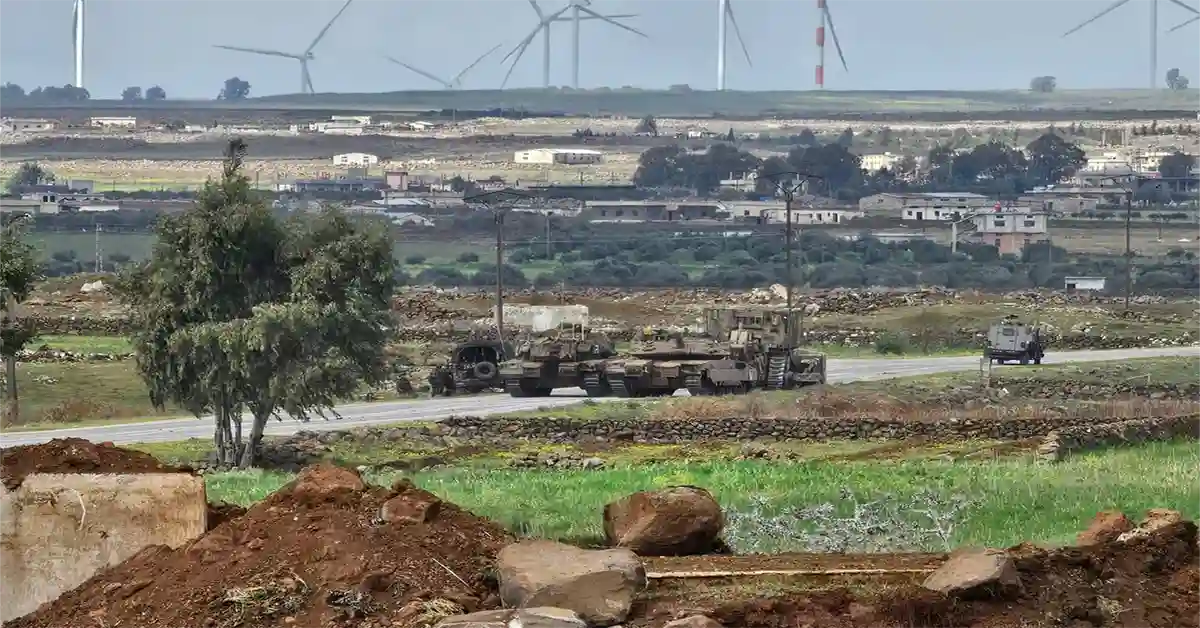
Israeli occupation forces escalated their military movements in the Quneitra countryside, near the occupied Syrian Golan, through a series of incursions and field deployments that included entering villages, setting up temporary checkpoints and closing roads, in addition to searching pedestrians and vehicles, in a new violation of the freedom of movement and security of residents in the area.
In the central Quneitra countryside, occupation forces carried out an incursion with 14 military vehicles into the village of al-Samdaniya al-Gharbiya, where the forces broke open the gate of a school and entered its yard, in a scene that raises concern over the safety of civilian facilities and reveals the extension of Israeli military movements into inhabited areas.
The entry of educational facilities heightens residents' fears, as schools are supposed to remain safe places for learning and the protection of children, not grounds for military intrusion and incursions. These practices also raise questions about the repercussions they may leave on educational and social life in the affected villages.
Israeli Incursion into Ofania and Withdrawal Towards al-Hurriya
In the northern Quneitra countryside, a patrol of the Israeli occupation forces, comprising four military vehicles, entered the village of Ofania before withdrawing towards the village of al-Hurriya, with no arrests recorded during the operation.
This coincided with the occupation forces setting up temporary military checkpoints at the Al-Kassarat junction towards the town of Jubata al-Khashab, and near the Jubata al-Khashab petrol station, where they cut off roads, spread out in the area, stopped pedestrians and vehicles and subjected them to searches.
These measures impose restrictions on the movement of residents and obstruct their travel between villages and towns, in addition to the state of vigilance and anxiety that military checkpoints leave among civilians, especially as it is unclear how long they will remain or what measures the forces may take at inspection points.
New Checkpoint on the Mazari' al-Amal – Tarnaja Road
In a later development, occupation forces set up a temporary checkpoint on the Mazari' al-Amal – Tarnaja road, near Bir al-Sarbukh, and began searching pedestrians, thus continuing Israeli military movements in the Quneitra countryside.
This checkpoint adds to the deployment points the forces have established in the area, reflecting the widening scope of field measures, and compounding the difficulties for civilians who rely on these roads for their daily travel and to meet their needs.
Continued Violations Add to the Suffering of Quneitra's Residents
These movements are a source of concern for the people of the Quneitra countryside, who find themselves facing a tense security reality due to repeated incursions, road closures and searches at temporary checkpoints. The effects of these measures are not limited to disrupting vehicle traffic; they extend to the details of daily life, from reaching workplaces and services to travelling between villages and agricultural areas.
The storming of schools and civilian facilities also doubles residents' fears regarding the safety of public property and the continuity of essential services, and increases residents' sense of instability in their areas.
These developments come in the context of continued tension in the Syrian areas bordering the occupied Golan, where incursions and military movements raise fears of new facts being imposed on the ground, with negative repercussions on the lives and stability of residents.
The facts from the Quneitra countryside confirm that the Israeli movements included the entry of military vehicles into villages, the setting up of checkpoints, the cutting of roads, and the stopping and searching of pedestrians. These are practices that affect civilians' lives and freedom of movement, and call for respect for the sovereignty of Syrian territory and for ensuring the protection of residents and their public facilities.
The people of Quneitra remain to face the repercussions of these movements, amid demands to halt the incursions and attacks, to avoid exposing civilians, their property and institutions to danger, and to guarantee residents' right to live in safety and move freely in their villages and towns.


