

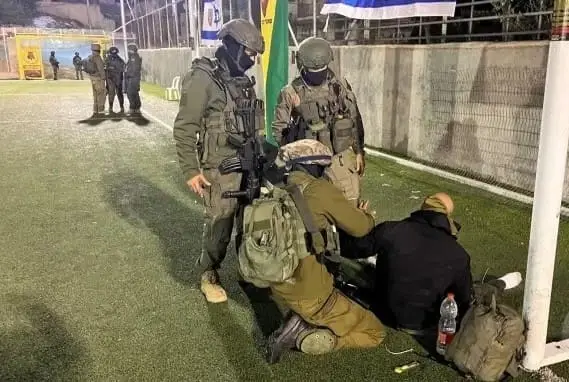
Israeli forces continue violations in the occupied West Bank
Between 25 November and 1 December, Israeli forces killed four Palestinians, including a child, raising the number of Palestinians killed by Israeli forces or settlers in 1446 AH-1447 AH (2025 CE) to 227. Nearly half of this year's victims were recorded in the governorates of Jenin and Nablus. During the same period, Israeli forces and settlers injured 212 Palestinians across the West Bank, including East Jerusalem. More than 75 per cent of all injuries (163) occurred during the operation carried out by Israeli forces in the governorate of Tubas, including 107 people injured by live fire and 56 as a result of physical assaults or inhalation of tear gas. Also this week, an Israeli soldier was injured in a ramming attack carried out by a 17-year-old Palestinian boy in the city of Hebron, before Israeli forces opened fire on him and killed him. The following are details of the incidents that resulted in fatalities:
On 26 November 2025, Israeli forces shot and killed a Palestinian during a raid by Israeli forces on homes and shops in the town of Qabatiya in the governorate of Jenin. According to local sources, Palestinians threw stones at Israeli forces, and the forces responded with live fire. The Israeli army stated that it shot the man after he threw a locally made explosive device towards them, and that it destroyed other explosive devices found in his vehicle.
On 27 November, Israeli forces killed two unarmed Palestinians and detained their bodies, after shooting them at close range in the city of Jenin during a raid concentrated on the eastern side of the Jenin refugee camp, particularly in the Jabal Abu Dhahir neighbourhood. A television channel documented the incident on video. The Israeli army stated that it is investigating the incident. In a statement issued on 28 November, the spokesperson for the United Nations High Commissioner for Human Rights said the office was "appalled by the brazen killing" of the two Palestinians, describing what happened as "a clear extrajudicial execution." The office stressed that impunity for Israeli forces' "unlawful use of force, and the escalating violence of settlers, must end," calling for prompt, independent and effective investigations and for those responsible to be held accountable.
On 1 December, a Palestinian carried out a ramming attack at a checkpoint on Route 35 near Farsh al-Hawa leading to the city of Hebron, resulting in the injury of an Israeli soldier. Israeli forces closed the entrances to the city of Hebron, deployed flying checkpoints, and conducted raids across the city, including in the courtyards of four hospitals, in search of the perpetrator. On 2 December, Israeli forces announced that they had killed the perpetrator in the city of Hebron. It was later established that he was a Palestinian boy from the city, and Israeli authorities have detained his body.
On 2 December, Israeli forces shot and killed a Palestinian near the village of Umm Safa in the governorate of Ramallah, after he stabbed and injured two soldiers when the forces stopped him for inspection at a flying checkpoint on Route 465. The forces then closed checkpoints and nearby road gates in western Ramallah governorate. They also stormed the village of Beit Rima, the man's hometown, and searched his family's home.
Between 25 November and 1 December, the United Nations Office for the Coordination of Humanitarian Affairs (OCHA) documented the demolition of 11 Palestinian-owned structures on the grounds that they lacked Israeli building permits, which Palestinians are almost impossible to obtain. Six of these structures were in four residential communities in Area C of the West Bank, while five structures were in Beit Hanina and Silwan in East Jerusalem. Among the structures demolished in Area C was a three-storey residential building under construction in the village of al-Khader in the governorate of Bethlehem, and a 1,200-square-metre cattle farm in the village of Jinsafut in the governorate of Qalqilya. In total, five people, including a child, were displaced in a single incident in East Jerusalem, and 48 other people were affected, including 20 children.
On 1 December, Israeli forces raided and closed the offices of the Union of Agricultural Work Committees (UAWC) in the cities of Ramallah and Hebron, and posted military closure orders on the gates of both offices. During the raids, Israeli forces vandalised the contents of the offices, confiscated all electronic devices and documents, and detained staff blindfolded and handcuffed, including several women who were released after hours. In the city of Ramallah, Palestinians threw stones at the forces, which responded with rubber-coated bullets and tear gas canisters, resulting in the injury of four Palestinians. The Union of Agricultural Work Committees is a Palestinian non-governmental organisation that has supported farmers and rural communities in the West Bank since the late 1980s. The United Nations Office of the High Commissioner for Human Rights in the occupied Palestinian territory said the raid "comes amid escalating Israeli targeting of Palestinian civil society and human rights defenders, particularly in the context of the olive harvest season."
Israeli forces' operations in the northern West Bank
- Israeli forces continue to carry out large-scale operations in various areas of the northern West Bank, particularly in parts of the governorates of Jenin and Tubas, where they impose curfews, seize residential buildings and convert them into military positions, and impose tight restrictions on movement and on Palestinians' access to basic services. On 28 November, the organisation Save the Children stated that these operations had forced it to "suspend remedial education classes and child protection activities, including mental health support, in these areas, with no indication of when programmes will resume," affecting more than 700 children.
Between 25 November and 1 December, the expanded operations led to new waves of displacement, restrictions on movement, school closures, and disruption of access to basic services, affecting more than 95,000 Palestinians and compounding the humanitarian impact on communities already facing repeated military operations since 1446 AH (early 2025 CE). In some cases, displaced families have remained displaced. For example, at least 11 families, comprising around 55 people, have been displaced since 7 November after Israeli forces converted their homes into military positions in the town of Ya'bad (population around 16,000) in the governorate of Jenin, where Israeli forces have continued to conduct extensive raids, particularly in the south-western part of the town.
On 26 November, Israeli forces carried out a large-scale operation lasting four days in the city of Tubas and the towns of Tammun, Aqaba, Tayasir and Wadi al-Far'a, whose combined population exceeds 58,000 Palestinians. The operation involved the use of drones, warplanes and bulldozers, and the imposition of tight restrictions on movement. It resulted in the injury of 163 Palestinians, caused extensive damage to homes and infrastructure, displaced residents, and caused prolonged disruption to their access to basic services. On 28 November, Israeli forces withdrew from Tammun, where some homes that had been converted into military positions suffered serious damage, and a 1,700-metre road was destroyed. As a result, the main water line between eastern Tammun and the communities of Khirbet Atuf and Khirbet Ras al-Ahmar was destroyed, causing a three-day water outage affecting around 17,000 people and agricultural plastic greenhouses.
On the same day, the operation extended to the Far'a refugee camp, where Israeli forces raided or occupied at least 10 homes, forcing at least 20 families to leave their homes, imposed a curfew, and detained and interrogated dozens of Palestinians before withdrawing.
On 27 November, Israeli forces shot and injured two Palestinian children (aged 14 and 16) with live fire in the Jenin refugee camp, shortly after the Palestinian Civil Affairs Committee coordinated a two-hour window to enable 12 displaced families to temporarily return to collect belongings from their homes, which they had been unable to access for around ten months. According to the United Nations Relief and Works Agency for Palestine Refugees (UNRWA), around 32,000 Palestinians, including more than 12,000 children, remain displaced from three refugee camps in the northern West Bank.
Since 30 November, Israeli forces have carried out extensive operations in several villages in the governorate of Salfit. In the village of al-Zawiya, Israeli forces blocked the main entrance with an earth mound, affecting around 7,000 Palestinians, searched homes, confiscated surveillance cameras, and arrested more than 30 people. An elderly man was physically assaulted and injured by Israeli forces. Five schools were forced to close, affecting around 1,300 students. In the neighbouring village of Masha, Israeli forces closed the only road to the village using military vehicles, carried out several home raids, detained residents for several hours, and closed the road gates leading to the villages of Deir Balut and Rafat.
On 1 December, a day after Israeli forces withdrew from the town of Tammun following a four-day operation, Israeli forces launched another large-scale operation lasting three days in the city of Tubas and the surrounding towns and villages, including Aqaba, and imposed an open-ended curfew. During the operation, Israeli forces closed five main roads with earth mounds, three of them in the city of Tubas and two in Aqaba, in addition to several side roads, significantly restricting the movement of around 30,000 Palestinians. In both towns, Israeli forces converted at least eight residential buildings, each comprising several homes, into military positions, forcing at least 11 families to leave their homes against their will.
In the afternoon of 2 December, Israeli forces launched a three-day operation in the southern outskirts of the city of Jenin, imposing an open-ended curfew that initially covered the town of Qabatiya (~28,000 residents), and then expanded on 3 December to include the village of Maslia (~3,300 residents). According to the Municipality of Qabatiya, Israeli forces searched more than 20 homes, intermittently occupied the roofs of some of them and turned them into observation points, forcibly displaced at least two families from their homes, and converted homes into military positions and field interrogation centres for the duration of the operation. In the village of Maslia, where the curfew was announced less than an hour before it took effect, one school was abruptly evacuated. The Palestinian Civil Affairs Committee reported that ambulances were allowed to move without prior coordination in both communities.
Attacks by Israeli settlers
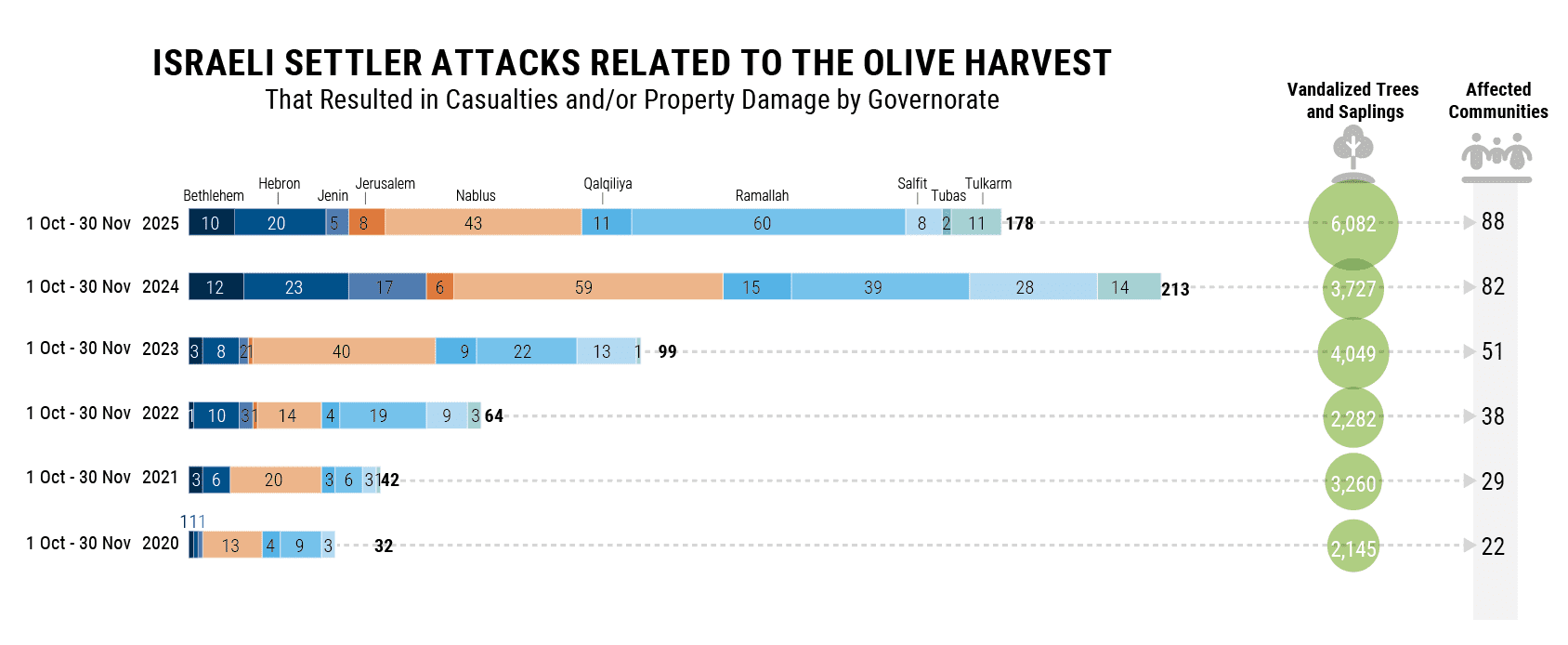
As the olive harvest season draws to a close, the 2025 season has seen widespread settler violence, severe restrictions on access, and reduced yields. Between 1 October and 30 November 2025, the United Nations Office for the Coordination of Humanitarian Affairs (OCHA) documented 178 settler attacks linked to the olive season, resulting in injuries, property damage, or both. These incidents included assaults on farmers inside olive groves or on their way to them, theft of crops and harvesting tools, and vandalism of olive trees and other trees and saplings. Although this number is lower than the 213 attacks recorded during the same period in 2024, it remains far higher than levels before 2023, when annual totals for the same period ranged from roughly 30 to 60 incidents. The geographic scope of the attacks has expanded, with 88 Palestinian towns and villages affected this year, the highest number recorded since 2020, more than double the number of communities affected in 2022, and four times the number affected in 2020. Damage to olive trees and saplings reached its highest level in six years, with more than 6,000 trees and saplings vandalised in 2025, nearly double the number of trees and saplings damaged in 2024 and three times the number documented in 2020.
Between 25 November and 1 December, OCHA documented 35 settler attacks against Palestinians resulting in injuries, property damage, or both across the West Bank, including East Jerusalem. These attacks resulted in the injury of 29 Palestinians, 20 by settlers and nine by Israeli forces. More than 150 Palestinian trees and saplings, most of them olive trees, were also vandalised. The number of settler attacks during this week is consistent with the weekly average of around 35 attacks recorded since the beginning of 2025. OCHA has so far documented 1,680 settler attacks in more than 270 communities across the West Bank during 2025, at an average of roughly five incidents per day.
Settler attacks, threats and harassment continued this week in several governorates, mostly targeting communities located near the sites of old or new settlements. Incidents included repeated assaults, raids, and damage to agricultural and water infrastructure, including in communities from which some families have been displaced due to settler violence. Among the key incidents that resulted in injuries and property damage are the following:
- In Bethlehem Governorate, residents of the village of Khallet al-Lawza, which has a population of approximately 700, have faced continuous attacks by Israeli settlers since September 2023, following the establishment of a settlement on the village's land. The situation worsened after additional settlement structures, including new huts (ḥuraf), were installed in August 2024. OCHA has documented 21 settler attacks on the village since the settlements were established and expanded, compared with only three attacks recorded between January 2017 and August 2023. This week, on 29 November, 10 Palestinians, including one woman, were injured when settlers attacked a family after the landowner asked a settler who was grazing his sheep on his land to leave. The settlers summoned additional settlers from a nearby settlement and began stoning the house, injuring nine people and damaging a vehicle and two surveillance cameras. During the attack, settlers opened live fire, shooting and injuring one person. Palestinian Red Crescent Society teams treated six people at the scene and transported four others, including the person shot, to hospital.
- As in Bethlehem Governorate, Israeli settlers attacked Palestinian farmers while they were ploughing their land on 27 November in the Bedouin community of Arab al-Rashayida, injuring nine people, including four children. When the farmers refused the settlers' demands to leave, clashes broke out. Israeli forces intervened by firing tear gas canisters, one of which landed in the yard of a kindergarten, causing children to inhale gas. In total, nine people were injured and received treatment from a Palestinian Red Crescent Society team. On 14 September, four families comprising 31 people, including 23 children, were forcibly displaced from this community after repeated raids by settlers and threats to burn their homes and property.
- In Jericho Governorate, in the village of Ein al-Deyuk al-Fauqa, settler attacks have escalated over the past two months. The perpetrators are believed to be settlers from a settlement established in August 2024 near three settlements that have been established in the area since 2012. Residents report almost daily raids and harassment by settlers from this settlement, which further heightens the sense of insecurity. Settlers from this settlement are also believed to have carried out attacks on the nearby Bedouin community of al-Mu'arrajat al-Sharqiya, whose residents were fully displaced after two major settler attacks in October 2024 and July 2025. On 27 November, settlers stormed Ein al-Deyuk al-Fauqa on quad bikes, moved among the homes and harassed residents. On 30 November, settlers raided a house housing four international activists who were present to support the community amid repeated settler attacks. They broke down the door and physically assaulted the activists, who were injured, and pelted the house with stones, smashing windows and solar panels. All four were taken to hospital.
- In Ramallah Governorate, in the village of Rantis, settler attacks have sharply increased since the establishment of a new settlement in September 2024, contributing to the displacement of two herding families in 2024 and 2025 and imposing ongoing restrictions on access to agricultural and grazing land. Since the settlement was established in September 2024, OCHA has documented 17 settler attacks in Rantis, compared with only one incident recorded between 2017 and the period before the settlement was established. This week, at least three settler attacks on the village were documented. On 25 November, settlers entered private agricultural land, destroyed some 20 olive saplings, damaged two water tanks and cut a metal fence. On 26 November, settlers physically assaulted a Palestinian farmer while he was working on his land, striking him with a stick and injuring his hand, then expelled him and prevented him from returning. On 28 November, settlers again raided the area, destroyed dozens of olive saplings, damaged a stone fence and caused damage to an agricultural water network.
- Also in Ramallah Governorate, on 30 November, Israeli settlers damaged vital water infrastructure in Ein Samiya, where the Bedouin community was fully displaced due to settler violence in May 2024. Settlers attacked the Ein Samiya area and damaged connection cables linking the well to the main monitoring and supply system, which serves approximately 100,000 Palestinians in 20 villages. Although the Jerusalem Water Undertaking (JWU) managed to keep water flowing without interruption, it reported repeated daily incursions by settlers targeting the facility, which poses a significant risk to the continuity and security of the water supply. So far in 2025, OCHA has documented at least 10 attacks in which settlers entered the spring area, sabotaged surveillance cameras, stole equipment belonging to the Jerusalem Water Undertaking, and assaulted the maintenance crew who came to carry out repairs.
Source: OCHA.


