

Israel has become the first country in the world to officially recognise Somaliland, a significant diplomatic achievement for the separatist region in the Horn of Africa.
Prime Minister Benjamin Netanyahu announced on Friday that Israel and Somaliland had signed a joint declaration to establish full diplomatic relations, describing it as "in line with the spirit of the Abraham Accords", a set of agreements mediated by the United States to establish formal relations between Israel and Arab states.
The Somali government issued a statement hours after Israel's announcement, describing the move as an "attack" on its sovereignty and an "illegal act", and affirming that Somaliland is an "inseparable" part of the country.
Somaliland declared independence from Somalia in 1991, but has not been recognised by any member state of the United Nations.
Somaliland controls the north-western part of what was formerly the British Protectorate in northern Somalia.
Somalia has never recognised the independence of Somaliland.
Somali Foreign Minister Abdisalam Abdi Ali took part in a phone call with the foreign ministers of Egypt, Turkey and Djibouti, during which they affirmed their support for Somalia's unity.
The Egyptian Ministry of Foreign Affairs said the senior diplomats of the four countries discussed how recognising the independence of a region within a sovereign state constitutes a "dangerous precedent" that violates the United Nations Charter.
The ministry added: "Respect for the unity, sovereignty and territorial integrity of states is a fundamental pillar of the stability of the international system, and it may not be violated or circumvented under any pretext."
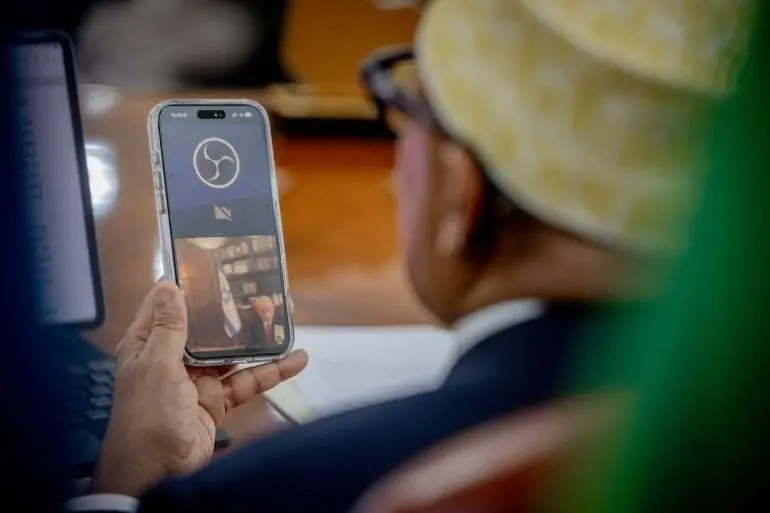
During a video call, Netanyahu congratulated the president of Somaliland, Abdirahman Mohamed Abdullahi, known as Abdirahman Irro, praising "his leadership and commitment to promoting stability and peace", and invited him to visit Israel.
Israeli Foreign Minister Gideon Saar announced that the agreement came after a year of intensive dialogue between the two governments, and was based on a joint decision by Netanyahu and Irro to establish full relations, including the appointment of ambassadors and the opening of embassies in both countries.
Saar wrote on social media: "We will work together to strengthen relations between our countries and peoples, and to achieve regional stability and economic prosperity", adding that he had instructed his ministry to act immediately to institutionalise relations in various fields.
Irro welcomed the development and described it as a "historic moment", expressing Somaliland's readiness to join the Abraham Accords.
The president of Somaliland said that this step "represents the beginning of a strategic partnership that enhances shared interests, supports regional peace and security, and delivers mutual benefits to all parties concerned".
A 'Complex' Issue
This recognition represents a radical shift in Somaliland's trajectory after years of diplomatic isolation. The region separated from Somalia during a brutal civil war that followed decades of authoritarian rule under Siad Barre, whose forces devastated the north.
While large parts of Somalia slid into chaos, Somaliland stabilised by the late 1990s, and developed a political identity distinct from Somalia, with its own currency, flag and parliament.
However, its eastern regions remain disputed between communities that do not support the separatist project in the capital, Hargeisa.
In recent years, Somaliland has strengthened its ties with the United Arab Emirates – one of the signatories of the Abraham Accords – and Taiwan, in pursuit of international recognition.
Prominent figures in the Republican Party to which US President Donald Trump belongs, including Senator Ted Cruz, have been among the strongest advocates of deepening relations between Somaliland and Israel. Cruz has repeatedly urged the United States to recognise Somaliland.
In August, Trump indicated his readiness to take action on the Somaliland issue during a White House press conference, when he was asked about it. He said: "It's another complex situation, but we're working on it, the Somaliland issue"; the United States has not changed its position on this issue so far.
This announcement comes amid declining American interest in Somalia, with Trump continuing to launch repeated verbal attacks on the country and its president.
Earlier this year, reports emerged linking the possibility of recognising Somaliland to plans for the ethnic cleansing of Palestinians in Gaza and their forcible transfer to an African region.
The foreign ministers of Egypt, Turkey, Somalia and Djibouti warned against this step during their previous phone call. The Egyptian Ministry of Foreign Affairs added: "The participants affirmed their categorical rejection of any plans to displace the Palestinian people from their land, plans that the majority of countries around the world reject absolutely, in form and substance."
In 2024, Ethiopia also sought to reach an agreement with Somaliland, offering recognition in exchange for granting Addis Ababa access to the sea, but backed down under diplomatic pressure.
Jeeteh Norman, an expert on Somali affairs at the Danish Institute for International Studies, told Al Jazeera that it is unclear whether this development will push other countries to follow suit, but that it may "encourage other separatist forces" in a politically fragmented state.
Somalia applies a federal system that grants its states wide self-rule. The two major states, Puntland and Jubaland, have withdrawn from this system amid constitutional and electoral disputes.
In a post on X, the interior minister of Puntland said patience pays off, indicating that he views this development positively.
Juha Farah said: "Puntland needs to think strategically." He added: "Basically, you already have a series of de facto states, and Israel's message is that if you provide strategic value, recognition becomes just a deal rather than a matter of principle."
Al Jazeera


