


Ghazni was not merely a city in eastern Afghanistan. It was the capital of an Islamic state whose influence extended from Afghanistan and Khurasan to large parts of the Indian subcontinent. At the height of its power, it became a centre of government, the army, literature and the sciences, and its court welcomed poets and scholars who left a notable mark on the history of Islamic and Persian culture.
From Ghazni, the campaigns of Sultan Mahmud of Ghazni set out for India. There, a political and cultural experience took shape that combined the Turkic origins of the state, Persian administrative traditions, and the Sunni Islamic identity that characterised Ghaznavid rule. What remains of its minarets and monuments to this day recalls a city whose influence went beyond its geographical boundaries.
In the early Islamic period, Ghazni was not among the great cities that rivalled Baghdad or Damascus, but it gained growing importance thanks to its location on the route linking Kabul and Kandahar, and from there to the passes leading to India.
In around 351 AH/962 CE, the Turkish commander Alp Tigin arrived in Ghazni after leaving Khurasan following a political struggle within the Samanid state. He succeeded in consolidating his authority there, beginning a new phase in which the city gradually became the base of an independent military and political power.
Then came Sebuktigin, who took power in 366 AH/977 CE and laid the foundations on which the Ghaznavid state was built. After his death in 387 AH/997 CE, he was succeeded by his son Mahmud, who expanded the state's influence and made Ghazni the capital of an empire that extended over wide areas of Afghanistan, Khurasan and northern India.
Sultan Mahmud of Ghazni: The Golden Age of the City
Ghazni reached the peak of its power during the reign of Sultan Mahmud of Ghazni, who ruled between 388 and 421 AH/998 and 1030 CE. He combined military strength with the building of institutions of government, obtained recognition of the legitimacy of his rule from the Abbasid Caliphate, and adopted sultanic titles that strengthened his standing in the Islamic world.
Mahmud led repeated military campaigns into the Indian subcontinent and extended his state's influence to distant regions to the east. Ghazni was the centre of planning and supply for these campaigns; from it the armies set out, and caravans returned laden with the spoils and resources that helped finance the court and building projects.
Yet reducing Mahmud's experience to his military campaigns alone does not explain Ghazni's historical standing. Under his rule, the city became a centre of Persian literature, administration and architecture, and attracted people of knowledge and skill from many regions.
The state's resources and the expansion of its commercial and military networks were among the factors that helped build a city whose standing exceeded its geographical size.
Ghazni: Capital of Islamic Persian Literature
Among the features that distinguish Ghazni in the history of Islamic civilisation is that it was one of the most important centres where the Persian language flourished as a language of literature, culture and administration.
The court of Mahmud of Ghazni witnessed broad literary activity, and his name is linked with the poet Ferdowsi, author of the Shahnameh, and with court poets who praised the sultans and recorded their victories and glories.
This cultural environment should not be seen as a purely local product. The movement of scholars and poets between Khurasan, Ghazni and India helped form a wide cultural space through which books, ideas and literary traditions travelled.
Ghazni thus became one of the essential stations in the history of Islamic Persian culture, alongside major centres such as Nishapur, Bukhara and Merv.
Al-Biruni: The Scholar Who Connected Ghazni with India
Abu Rayhan Muhammad ibn Ahmad al-Biruni stands out as one of the most celebrated scholars associated with the Ghaznavid era.
Al-Biruni was born in 362 AH/973 CE in Khwarazm and lived in various scholarly settings before becoming associated with the court of Mahmud of Ghazni. His presence within the Ghaznavid political sphere gave him the opportunity to study the knowledge of India; he studied its languages, religious traditions and intellectual life, and wrote his well-known book Tahqiq ma li-l-Hind min maqula maqbula fi l-'aql aw mardhula (Investigation of What Is Said About India, Whether Acceptable to Reason or Rejected).
The importance of al-Biruni lies in the fact that he did not merely transmit information about India; he sought to study its beliefs, sciences and society through an approach based on comparison and analysis.
Thus Ghazni, through its connection with al-Biruni, became part of the story of the transmission of knowledge between Islamic and Indian civilisations, and its importance was no longer limited to armies and politics.
Ferdowsi: The Poet Immortalised by Language
The name of Ferdowsi is closely tied to the history of Persian literature, thanks to his great epic Shahnameh, which reshaped the mythical and historical memory of ancient Iran in a vast poetic form.
Literary accounts state that Ferdowsi went to the court of Mahmud of Ghazni, but the details of his relationship with the sultan and the extent of the patronage he received have remained a matter of debate among researchers.
Nevertheless, the existence of the Shahnameh within the Ghaznavid context shows how the Islamic state was able to embrace literary production in the Persian language, and to make its court one of the centres of that language's development.
Persian culture in Ghazni was not separate from Islamic civilisation. It arose within a Muslim society and under a state politically linked to the Abbasid Caliphate, while retaining clear Persian administrative and literary traditions. This interplay between Islamic identity and the Persian language is one of the most prominent features of the Ghaznavid experience.
Markets and Caravans: Ghazni as India's Commercial Gateway
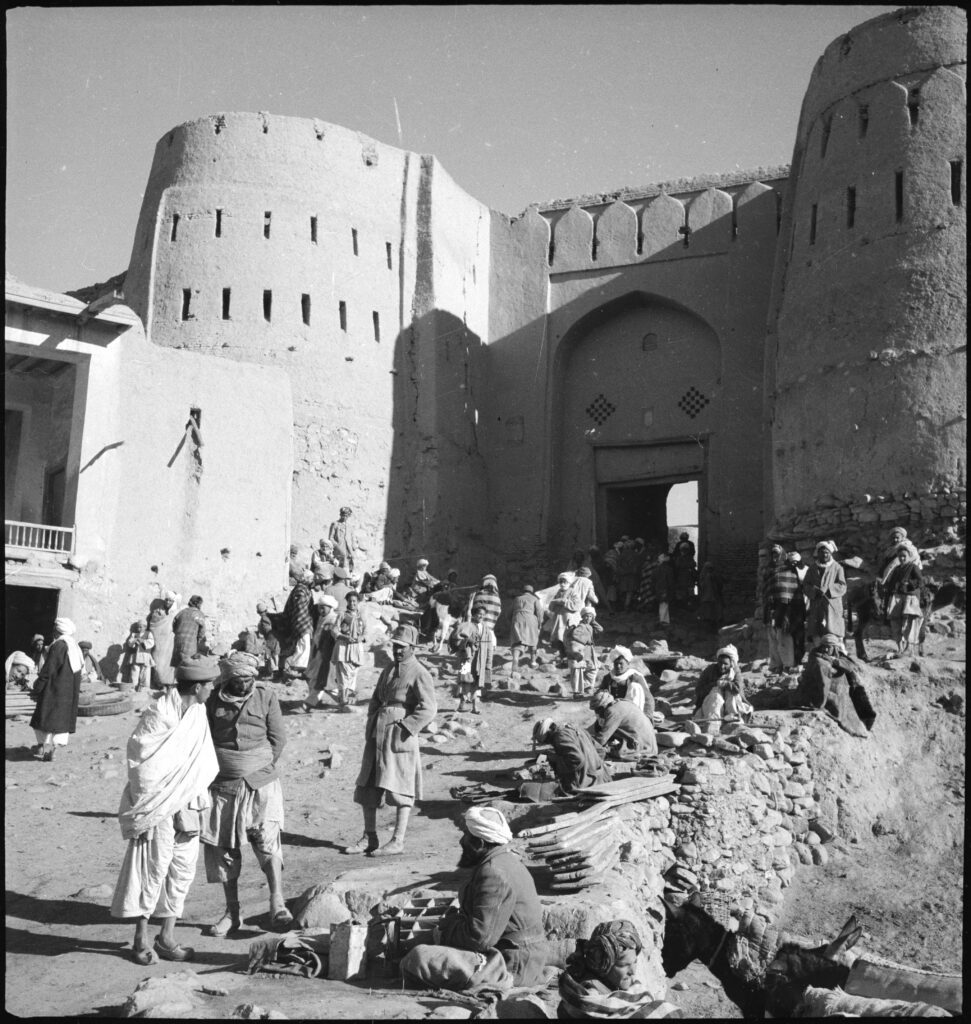
Ghazni's economic importance was tied to its location on the trade routes between Central Asia, Iran and India. Muslim geographers of the fourth century AH/tenth century CE described the city as an active commercial centre, where goods arriving from different regions gathered and where Indian merchants came. Some geographical descriptions even likened it to a port of India, in reference to its role in receiving and distributing goods despite being far from the coast.
As it became the capital of the Ghaznavid state, the importance of its markets and caravanserais increased, and trade became linked to the movements of armies, officials and craftsmen.
The city also needed to organise its water resources and secure the agricultural lands that supplied its inhabitants with food, so dams and water installations were built to provide water and irrigation.
These details show that Ghazni's prosperity did not rest on military expansion alone; it also depended on a network of trade, agricultural production and infrastructure.
Ghaznavid Architecture: Brick Turned into Art
Only a limited part of Mahmud of Ghazni's old urban fabric has survived, but the remaining monuments reveal an advanced level of architectural craftsmanship.
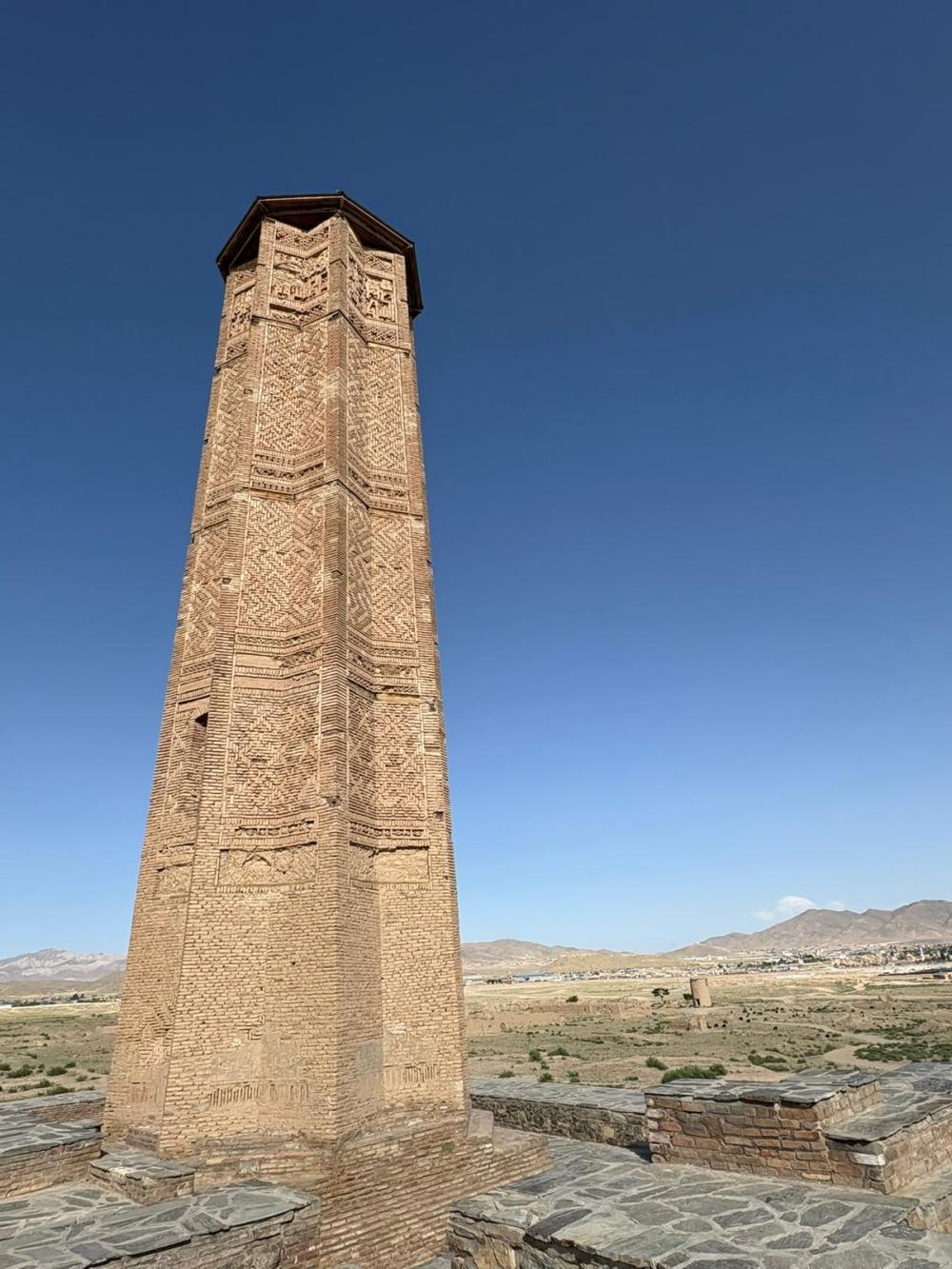
The two minarets were built of brick, and their bases take the form of multi-sided star shapes. Cylindrical sections once crowned them, of which only limited traces remain today. Their façades were decorated with precise geometric patterns, Kufic inscriptions and carvings bearing the names and titles of the sultans.
These structures show that Ghaznavid architecture was not merely functional building; it was a means of displaying the authority and artistic taste of the state. They also reveal the interaction between architectural traditions in Iran, Khurasan and Afghanistan.
The two minarets remain among the most important surviving witnesses to the architectural development Ghazni achieved in the medieval Islamic period.
Masud III and Bahram Shah: The Continuation of Glory After Mahmud
After the death of Mahmud of Ghazni in 421 AH/1030 CE, his son Masud I succeeded him, but the state faced growing military and political challenges.
The defeat by the Seljuks at the Battle of Dandanqan in 431 AH/1040 CE was a major turning point: the Ghaznavids lost most of their areas of influence in Khurasan, and their political sphere contracted towards eastern Afghanistan and parts of India.
Nevertheless, Ghazni's civilisational role did not end immediately. The city witnessed periods of relative stability, and the activity of the court, literature and architecture continued under later sultans, among them Masud III and Bahram Shah.
The minaret of Masud III is linked to his reign between 492 and 508 AH/1099 and 1115 CE, while the other minaret bears the name of Bahram Shah, who ruled between 511 and 552 AH/1117 and 1157 CE approximately.
These monuments indicate that Ghazni retained its architectural and cultural standing even after the military power of the state had declined.
The Ghurids: The End of the Ghaznavid Capital
Ghazni entered a period of severe turmoil in the sixth century AH/twelfth century CE, as the conflict between the Ghaznavids and the Ghurids escalated.
In around 545 AH/1150–1151 CE, the Ghurid sultan Ala al-Din Husayn Jahansoz attacked the city, burning large parts of it and destroying a number of its buildings, an event that left a profound mark on Ghazni's history.
The Ghaznavids later returned to the city, but they could not regain their former strength. As Ghurid pressure grew, their last sultan moved to Lahore, which became their final stronghold in the Punjab.
Then the Mongol invasions in around 618 AH/1221 CE dealt another blow to Ghazni, its urban role declined, and the city gradually shifted from an imperial centre to a regional one.
Ghazni Today: Monuments That Summarise an Empire's Story
Present-day Ghazni does not resemble the city described by Muslim geographers in its years of prosperity, and many of its old buildings have been destroyed or have disappeared through war and the passage of time.
Yet the two Ghaznavid minarets, along with remnants of the citadel and other historic structures, remain witnesses to an important stage in the history of Islamic civilisation in Afghanistan.
Ghazni's value lies in the fact that it combined political power, economy and culture, and helped shape a wide Islamic world whose ties extended from Khurasan to India.
Through its history, it is possible to understand how a city located on mountain and caravan routes became the capital of a major state, and how it gave Persian Islamic literature and medieval Islamic architecture some of their most prominent monuments.


