


In the far northwest of Algeria, close to the Moroccan border, lies Tlemcen, a city historically known for its strategic position between the coast of the Central Maghreb and the caravan routes heading south toward the Sahara, and between the Far Maghreb and Africa.
Tlemcen was not the creation of a single state. Various Islamic authorities succeeded one another over it, but the city gained its great prominence when it became the capital of the Zayyanid state, or Banu Abd al-Wad, from the seventh century AH / thirteenth century CE onward. Over the following centuries it became one of the outstanding political, economic and scholarly centres of the Islamic Maghreb.
From the Ancient City to the Islamic Metropolis
The area had towns and urban centres before Tlemcen took the form it would later have. Among the most important were Agadir and Tagrart. In the Almoravid era, the growth of Tagrart was linked to the major political and urban transformations that the Islamic Maghreb and al-Andalus were witnessing.
Sources indicate that Yusuf ibn Tashfin was associated with the founding of Tagrart at the end of the fifth century AH / eleventh century CE. At this stage the Islamic urban face of Tlemcen began to appear, foremost among its landmarks being the Great Mosque.
Here one of Tlemcen's important characteristics becomes apparent: the city was not merely a military station on the route of the conquests. It gradually became a city of the mosque, the market, learning and administration, and later a political capital with regional influence.
The Great Mosque: Architecture that Tells of the Transfer of Power
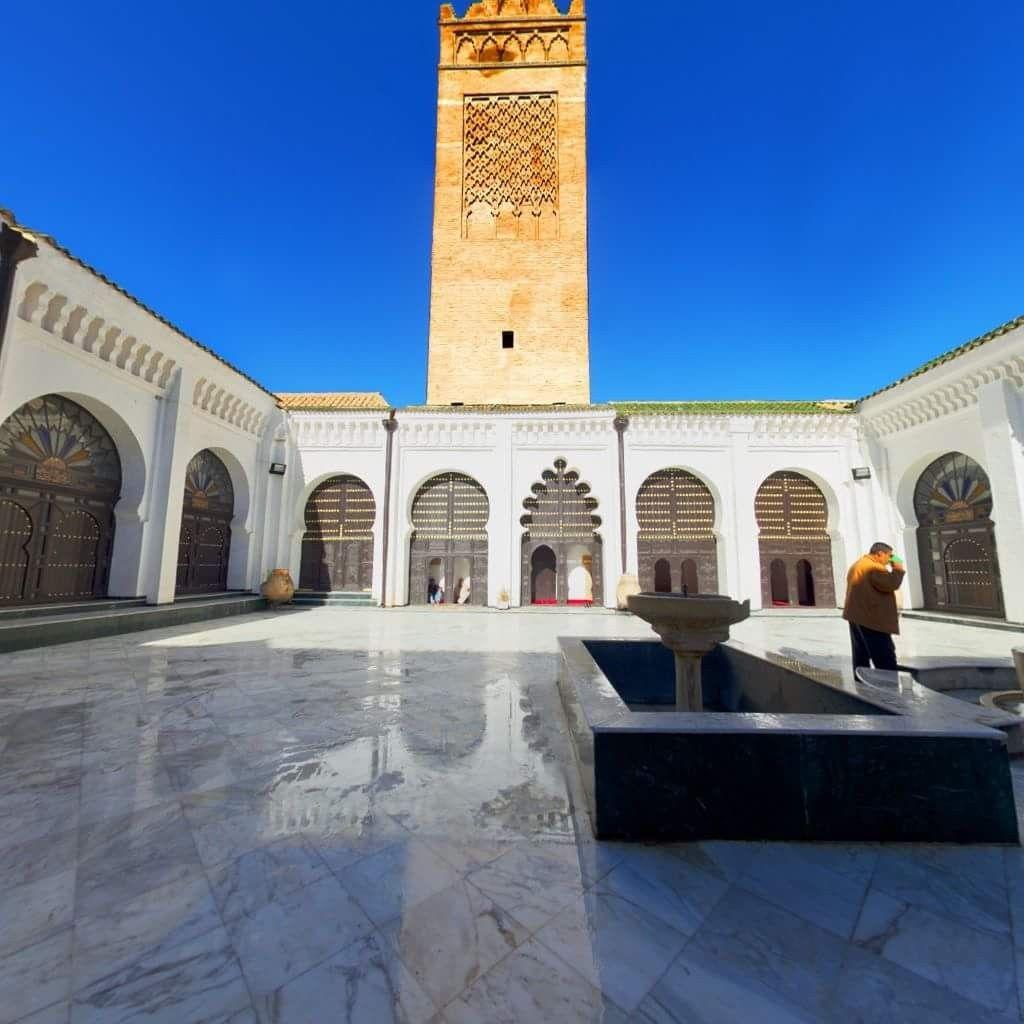
The Great Mosque of Tlemcen is one of the most important monuments of Islamic architecture in the Maghreb. Its foundations are linked to the Almoravid era, while some of its most prominent features were completed in later phases.
In the year 530 AH / 1136 CE, the mosque underwent an expansion and notable decoration during the reign of Ali ibn Yusuf ibn Tashfin. Among its most famous elements is the dome above the mihrab, with its finely worked plaster decoration and interlacing ribs, which is one of the striking examples in the development of Islamic architecture in the Islamic West.
The Zayyanid state then added to the city's architectural landscape, including elements in the mosque and its minaret.
Thus the architecture of the mosque itself became a silent historical record: Almoravid in origin, then Zayyanid in some additions, and Maghrebi-Andalusian in its artistic style.
Zayyanid Tlemcen: When the City Became a Capital
With the decline of the Almohad state in the seventh century AH / thirteenth century CE, the Zayyanid state emerged, taking Tlemcen as its capital from approximately 633 AH / 1235 CE.
Yaghmurasen ibn Zayyan was the most prominent founder of the state. He managed to unite the two centres of Agadir and Tagrart into a single urban and political entity, and then made Tlemcen the base for the rule of the Banu Abd al-Wad.
Under the Zayyanids the city acquired a clear political character. Fortifications were built, markets developed, and religious and educational institutions flourished, and Tlemcen came to rival Fez and Tunis in standing within the Islamic Maghreb.
Yet its location also made it a constant object of conflict. It found itself between the Marinids in the Far Maghreb and the Hafsids in Africa, and consequently its history witnessed repeated sieges and occupations.
A City of Caravans, Gold and Learning
Tlemcen's economic strength was tied to its position on a wide trade network. From the north it connected with the ports of the Mediterranean; to the east and west it was linked by roads to Fez and Tunis; while caravans arriving from the south brought the products of the Sahara and beyond, foremost among them gold coming from the regions of Western Sudan.
For this reason its markets became a meeting place for merchants, and traders arriving from various regions found dedicated commercial facilities there. The city was also connected with the trade in gold, leather, textiles and goods arriving by sea and across the desert. Historical sources indicate that in the first half of the eighth century AH / fourteenth century CE, Tlemcen reached an economic and cultural peak, with numerous schools, religious institutions and endowments appearing in it.
Here it becomes clear that the city's prosperity was not separate from learning. In the great Islamic cities, the market moved alongside the mosque and the madrasa, and trade routes also helped the movement of scholars, books and ideas.
The Siege of al-Mansura: When Rivalry Became War
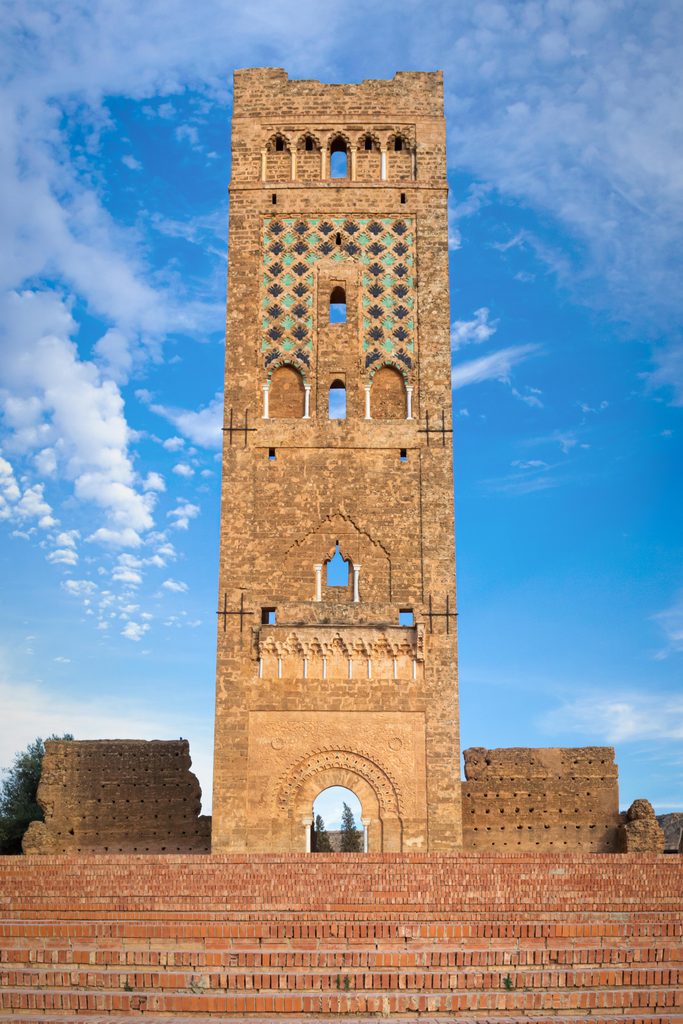
The struggle between Tlemcen and the Marinids reached one of its most notable stages in the eighth century AH / fourteenth century CE, when the Marinids besieged the city and established, near it, the city of al-Mansura.
The mosque of al-Mansura is associated with the sultan Abu Yaqub Yusuf, who began its construction in the early eighth century AH / fourteenth century CE, after which Abu al-Hasan al-Marini continued the work. What remains of the mosque today, foremost among it the massive minaret, gives an impression of the scale of the architectural project erected around Tlemcen during the siege.
Yet Tlemcen did not disappear under this pressure. The Zayyanid state regained its influence in later phases, and the city returned to playing its political and cultural role.
Tlemcen's Scholars: From the Maghreb to the Mashriq
Scholars who left traces beyond the city's borders came out of Tlemcen. Among the most prominent is the orator Ibn Marzuq al-Tilimsani, born in 710 AH / 1310 CE and died in 781 AH / 1379 CE. He was a jurist, traditionist, linguist and Maliki preacher, who travelled in his scholarly journeys between the Maghreb and the Mashriq, and whose life ended in Cairo.
Another of its sons is Ahmad al-Maqqari al-Tilimsani, born in 986 AH / 1578 CE and died in 1041 AH / 1632 CE, author of the book "Nafh al-Tib min Ghusn al-Andalus al-Ratib" ("The Fragrance of Perfume from the Moist Branch of al-Andalus"), one of the most important Arabic works that preserved a broad portion of the news, literature and biographies of the notable figures of al-Andalus. He received the beginnings of his education in Tlemcen before his scholarly journey to Fez and then to the Mashriq.
From the Zayyanids to the Ottoman Era
The Zayyanid state entered phases of weakness during the ninth and tenth centuries AH / fifteenth and sixteenth centuries CE, as a result of internal conflicts and the pressure of regional powers and of Spanish and Ottoman interventions.
Around 958 AH / 1551 CE, Tlemcen came under Ottoman control, and its position within the Ottoman sphere was settled in the middle of the tenth century AH / sixteenth century CE, thus ending a long period of Zayyanid state independence.
Yet the fall of the state did not mean that the city fell from memory. Its mosques, madrasas, markets and walls remained witnesses to centuries in which Tlemcen was one of the jewels of Islamic civilisation in the West.
What Remains of Tlemcen?
Tlemcen still preserves a group of the most important Islamic monuments in Algeria, foremost among them the Great Mosque, the Sidi Abu Madyan complex, the remains of al-Mansura, and the mosques and madrasas of the Zayyanid and Marinid periods.
Most importantly, these monuments do not belong to a single period. They reveal the succession of the Almoravids, Almohads, Zayyanids and Marinids, and show how the architectural elements of the Maghreb and al-Andalus blended in the Islamic Maghreb, while preserving the religious and educational function of the mosque and the madrasa.


