


How Ali Izzetbegovic Presented Islam as a Unique Solution to the Dilemmas of Modernity Between Spirituality and Materialism?
Key Points of the Book
- Islam as the "Third Way": Bosnian thinker Ali Izzetbegovic argues that Islam is not merely a religion but a complete civilisational system representing the "third way" that balances Eastern spirituality and Western materialism.
- Balance of Body and Spirit: The book stresses that the human being is a dual entity combining body and spirit, and that any civilisation that neglects one of these two dimensions is doomed to failure or crisis.
- A Comparative Intellectual Encyclopaedia: The book offers a deep philosophical analysis and wide-ranging comparisons between global ideas and currents, making it an important reference for understanding Islam's place in world thought.
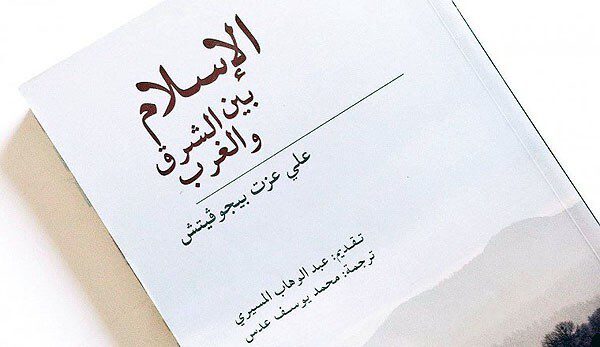
In his seminal book "Islam Between East and West", the Bosnian thinker Ali Izzetbegovic presents a comprehensive philosophical vision that seeks to define Islam's place amid the intellectual and civilisational struggle between East and West. Izzetbegovic does not see East and West as mere geographical regions, but as two distinct civilisational orientations: the East symbolises spirituality and moral values, while the West symbolises materialism, science and technology. The book calls for a deep understanding of Islam as a civilisational model capable of transcending the contradictions between these two orientations, offering a unique solution that combines the demands of the spirit with the needs of the body.
In his book Islam Between East and West, Ali Izzetbegovic presents a comprehensive philosophical vision in which he places Islam as the "third way" between Eastern spirituality and Western materialism. He sees the East as symbolising spiritual values and the unseen world, while the West symbolises science, technology and materialism. In his view, Islam combines the two in an inner balance: it unites the purity of religiosity with the purity of materiality, focusing on the human being who lives in the worlds of conscience and nature together.
Accordingly, Izzetbegovic explains that in the past Islam acted as an intermediary between ancient cultures and the West, and today it must once again play this role in a divided world; this is the meaning of the "third way" that the book proposes.
At the heart of this conception stands the human being as a dual nature: spirit and body. Izzetbegovic notes that the human being is not merely a spirit or merely a body, but an integrated whole combining the two. He says that Islam expresses a "dual unity" similar to the duality of the human being itself: "Just as the human being is a unity of spirit and body, Islam is a unity of religion and the social order... and this unity, foreign to both Christianity and materialism, is the most important and most distinctive feature of 'Islam'."
In other words, Islam, in Izzetbegovic's conception, takes into account the demands of the spirit, moral norms and the requirements of practical life. The book has been described as a comparative intellectual encyclopaedia that combines deep philosophical arguments and divergent views; it compares major ideologies (from Christianity and socialism to atheism) and shows the strengths and shortcomings of each. These broad comparisons have made the book an important reference for understanding Islam's place in world thought and how it transcends the prevailing intellectual dualities.
Structure of the Book and Main Content
The book is divided into two complementary parts. The first part ("Preliminaries and Basic Human Questions") addresses the great questions about the nature of the human being and the world; it treats topics such as creation and evolution, culture versus civilisation, the phenomenon of art, ethics, and history, literature and utopia.
For example, it begins with the question of creation versus evolution, where Izzetbegovic criticises materialist theories that confine the human being to its biological form alone, affirming that the human being is a spiritual entity that is complete only through divine creation. Izzetbegovic holds that atheism "denies the human being", and that Islam alone is able to connect the elements of the human spirit and body and explain them logically. He also distinguishes between culture (religious and artistic values that refine the human being) and civilisation (material technical skill), stressing that any civilisation that marginalises the spiritual dimension will lose its inner balance. This part aims to clarify that religion is not in hostility with the sciences or with modernity, but can serve as an ethical and cultural framework that balances the demands of scientific thought and the needs of the spirit.
The second part ("Islam, the Dual-Pole Unity") presents Islam as an integrated intellectual and civilisational system. It opens with a historical survey that brings together the three revelations: Moses, Jesus and Muhammad, peace be upon them, as "three primitive answers" to the human confrontation with history, highlighting that the Qur'an combines the realism of the Torah with the idealism of the Gospel.
The book then dismantles the basic Islamic principles and clarifies the "dual unity" within them. For example, it analyses the Five Pillars of Islam from the perspective of linking the material and the spiritual, and notes that prayer ("Prayer is the abbreviation of all of Islam", as Izzetbegovic says) embodies this duality by combining material purity with spiritual address. It also devotes a section to discussing Islamic law (Shari'ah), explaining how it balances ethical teachings with practical and social regulations; Islamic law combines the spiritual dimension with social responsibility. It also addresses the concept of a "third way outside Islam" in a study of Anglo-Saxon culture, showing that peoples such as the English achieved a relative perfection in integrating Christianity and the state, and that this achievement may parallel what the spirit of Islam seeks in terms of unity. This part concludes by referring to the concept of submission to God as "the spirit of Islam", which summarises the book's vision that Islam offers reconciling solutions to the great contradictions between contemporary ideologies.
Method, Style and Contemporary Significance
Izzetbegovic's style combines a profound civilisational vision with precise philosophical analysis. He adopts a comprehensive comparative methodology, drawing on literature, philosophy, sociology and history to clarify his thought.
The book has been noted for its fluent language, supported by evidence and multiple logical arguments, which makes its complex concepts easier to grasp. The work has indeed been regarded as an organised and coherent "intellectual encyclopaedia", linking global issues with everyday examples and using statistics, religious texts and philosophical references to support its propositions. For example, Izzetbegovic stresses the importance of continually re-examining fundamental ideas in light of the decline of materialist and atheist theories before the weight of Islamic values. He also emphasises that a correct understanding of the world requires identifying the sources of the governing ideas and their authentic meanings.
The importance of the book lies in its aim to help the world recognise Islam's place in contemporary human thought. It does not limit itself to explaining belief, but offers an analytical framework that links the human being and the cosmos, the body and the spirit, freedom and responsibility, as one cultural event marking the centenary of Izzetbegovic's birth noted.
"The book rejects both religious ideological closure and extreme materialism, and presents Islam as an intellectual perspective that embraces the full complexity of human existence: reason and revelation, freedom and responsibility, body and spirit..." Amid the contradictions of today's world, the book offers an integrated solution in which Islam appears as a balanced model that honours every dimension of the human being.
In summary of this reading, the essential concepts of Islam between East and West can be outlined in the following points:
Islam as an integrated third way: Islam is not merely a metaphysical religion, but a civilisational system that centrally addresses both spiritual and material needs.
Balance of spirit and matter: Izzetbegovic affirms that the human being is a dual-sided creature, and that any civilisation that neglects one side of it faces a crisis; therefore Islam seeks to preserve a "unity" that nurtures spirit and body at once.
Encyclopaedic intellectual approaches: The book is analytical and philosophical, relying on comparing major ideas (secularism, Christianity, communism and others), which makes it a reference for understanding the dynamics of global thought and Islam's place within it.
Critique of Western materialism: Izzetbegovic criticises Western materialism, which grants a superficial freedom that makes the individual a slave to desires, and highlights that Islam provides an ethical and spiritual dimension that restores the value of true freedom in servitude to God.
A balanced methodological style: It combines clear language, logical arguments and varied references, and it has been described as an "encyclopaedic" work that explains Islam in a manner that unites modernity and heritage.
Thus, the book Islam Between East and West represents an integrated intellectual project that reformulates the understanding of human civilisation. It is a call to recognise Islam as a balanced way of life capable of meeting the challenges of the age, rather than a mere rigid inheritance from the past.
The work of Ali Izzetbegovic has had a lasting impact on cultural and intellectual circles, and today it invites readers to reflect on his rich ideas about the relationship between religion and civilisation.


