

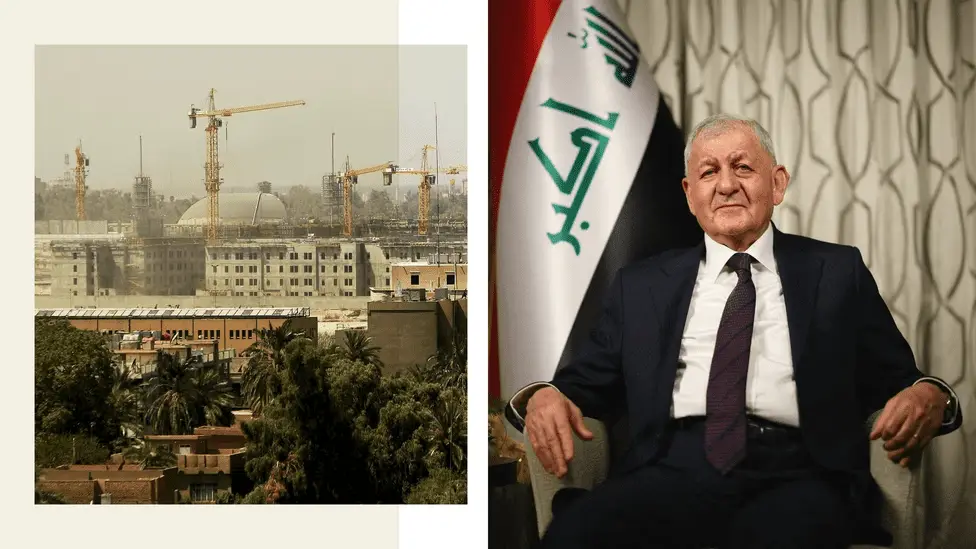
Iraq, rich in oil and filled with renewed reconstruction activity, remains unable to break free from the influence of the United States and Iran.
For more than three years, Iraq has managed to stay out of the headlines. While wars and turmoil have swept other parts of the Middle East, Baghdad has remained shielded from those catastrophes.
Yet many Iraqis have told me they fear this calm may not last long. Over the past year, Iran has been struck hard by the United States and Israel, and the so-called "Axis of Resistance" it led has fallen apart. Iraq finds itself in a critical position, as Iran's last major ally in the region and a vital economic lifeline for its regime, which is suffering from a crippling financial crisis. President Donald Trump has made no comment on this relationship, despite his continued attempts to strangle Iran's economy through sanctions.
Today, elections are approaching, with Iraqis set to vote on November 11 to choose a new parliament, while the current prime minister, Mohammed Shia al-Sudani, boasts of the relative calm and prosperity the country is experiencing. He has made the "crane of construction" his election slogan, a reference to the reconstruction boom of recent years. Over the past year, he created more than one million public-sector jobs, easing the unemployment crisis, but on the other hand this has increased the likelihood of the state going bankrupt.
Despite this atmosphere of optimism, fears remain that Iraq could once again become an arena of conflict between the United States and Iran.
Al-Sudani presided over a period that saw a huge surge in oil prices due to the war in Ukraine, alongside an unprecedented spread of corruption. It is difficult to determine how much money was siphoned into private pockets, but a number of government officials and businessmen told me the problem worsened dangerously from 1443 AH (2022 CE), when a shocking theft of $2.5 billion in tax revenues came to light, known locally as the "Theft of the Century," which marked the peak of corruption in Iraq. Most of this money ended up in the coffers of oligarchs and Iran-backed militias that dominate the country's political scene.
This is exactly what happened in October 1440 AH (2019 CE), when protests against corruption and unemployment broke out across Iraq, turning into violent street clashes that left hundreds dead. Two years of political turmoil followed, in which then-prime minister Mustafa al-Kadhimi tried in vain to curb the Iran-backed Shia militias known as the "Popular Mobilization Forces."
These militias first emerged in 1435 AH (2014 CE) to support the Iraqi army in confronting the ISIS insurgency. Unlike al-Kadhimi, al-Sudani embraced these groups and supported them financially and morally. He showered them with government contracts at a frenzied pace and established a state-owned entity called "Al-Muhandis General Company," which has been described as the Iraqi version of Iran's Islamic Revolutionary Guard Corps. Earlier this month, the US Treasury Department imposed sanctions on "Al-Muhandis," describing it as a front for terrorist groups. These militias and their allies still benefit from the "dollar auction" that the Iraqi government runs daily, a mechanism long used for widespread corruption.
Al-Sudani has presented himself as a man of pragmatism and realism, since Iraq shares an easily penetrable border of 994 miles with Iran, which requires the prime minister to balance the interests of this powerful neighbor with those of a far more powerful partner in Washington. Some observers believe he deserves credit for his attempts to tame and contain the Shia militias. Maria Fantappiè, director of the Middle East program at the Italian Institute for International Affairs in Rome, says: "These are still fighters, but today they wear official uniforms and have become part of state institutions. Some see this as better than having them outside, firing rockets at American bases."
Nevertheless, in awarding government contracts, al-Sudani has bypassed many of the commonly accepted procedures and safeguards. This may have helped him build more bridges and roads compared with some of his predecessors, but the concessions he has made to these militias raise troubling questions.
Earlier this year, the Iraqi Ministry of Communications signed direct contracts, without competition or tender, with the "Popular Mobilization Forces" and "Al-Muhandis General Company" for the maintenance of Iraq's fiber-optic network and the construction of a new alternative network. These contracts, never previously disclosed, gave the militias what they had long sought: control over the country's national data network. A number of Iraqi officials and telecommunications workers have confirmed that the danger of these contracts lies not only in the opportunities they offer for illicit enrichment, but in the serious security threat they pose; with this control, the militias, or their patrons in Tehran, could eventually be able to monitor anyone inside Iraq.
In a similar vein, al-Sudani recently attempted to push through an exclusive fifth-generation mobile network contract for another group linked to the "Popular Mobilization Forces." A Supreme Court judge blocked the contract's implementation, noting that it raises national security concerns, but it may not be possible to halt it indefinitely.
Those who defend al-Sudani say he is working within the limits of the sectarian power-sharing system established after 2003, known as "muhasasa," which was designed to protect pluralism but has become a machine for patronage and favoritism. Some point out that al-Sudani, a Shia from a small party, seeks to build a multi-sectarian coalition that could achieve good results in the elections. Even so, even if he wins a large bloc of votes, he will likely remain politically hostage to the dominant Shia faction known as the "Coordination Framework," which is backed by Iran and has strong ties to the militias, which limits the scope for genuine political change.
Former US presidents reluctantly accepted the limits of Iraq's political system, pressing Iraqi leaders to distance themselves from Tehran, but avoided taking steps that would plunge the country back into open conflict. Trump, known for his impatience with diplomatic compromises, may take a different approach.
Since returning to the presidency in January, Trump has shown little interest in Iraq. However, the recent decision by the US Treasury Department to impose sanctions on "Al-Muhandis General Company" and two prominent Iraqi oligarchs has sparked tense whispers among Baghdad's corrupt elite.
A former official told me: "They are scared. As long as the United States does not reach an agreement with Iran, the maximum pressure campaign will continue, and that could mean targeting them inside Iraq."
The Atlantic


