


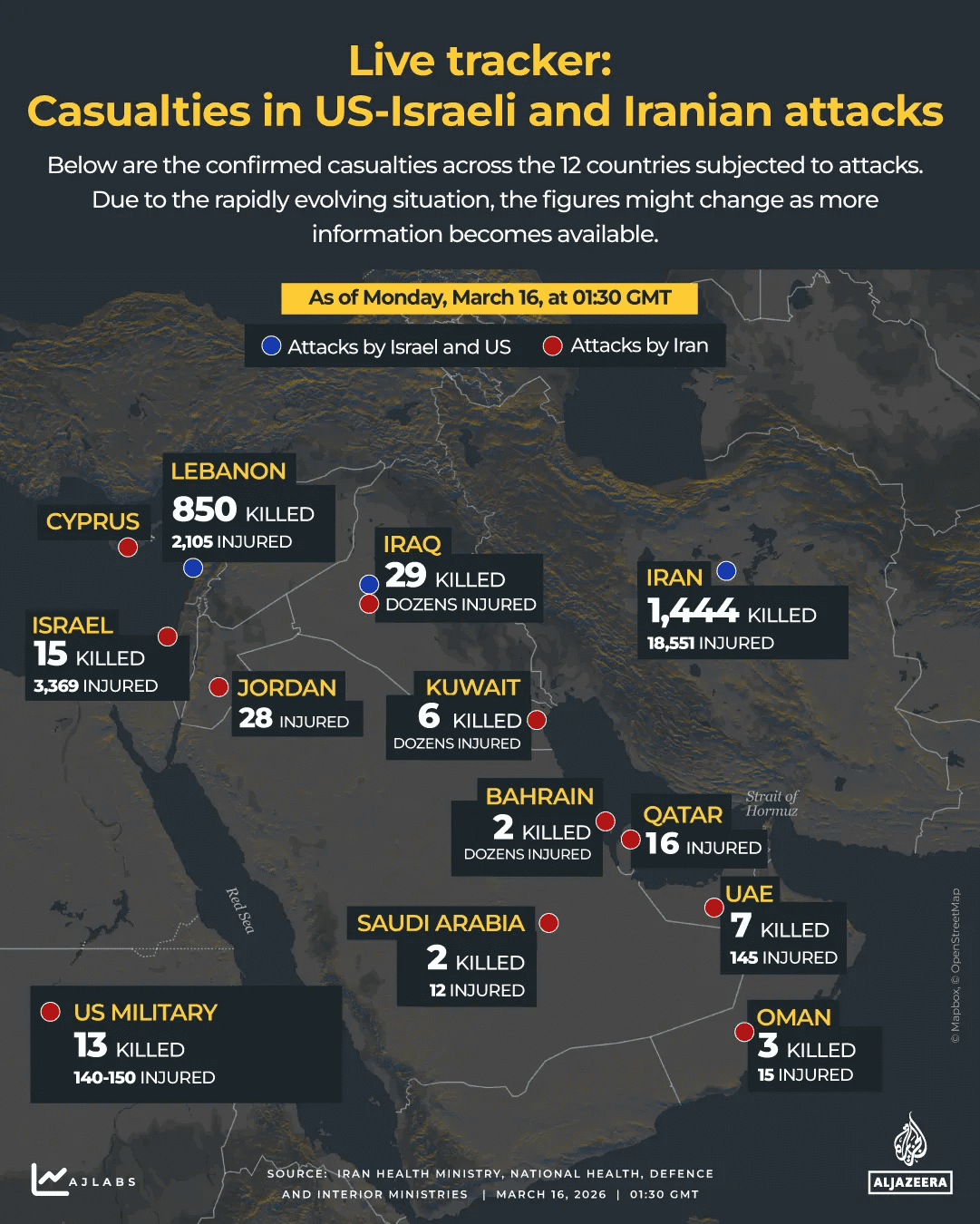
The war launched by the United States and Israel against Iran has killed more than 1,400 people in the country and prompted retaliatory attacks from Tehran targeting Gulf states and Israel, pushing global oil prices above $100 a barrel.
Now, 18 days into the conflict, aid organisations and countries neighbouring Iran are growing concerned about a potential refugee crisis.
The UN High Commissioner for Refugees estimates that 3.2 million people have already been displaced within Iran since the US-Israeli strikes began on 28 February. So far, the number of people crossing Iran's borders remains relatively modest. But in anticipation of a mass exodus from Iran, its neighbours appear to be on high alert.
Iran borders seven countries: Afghanistan, Armenia, Azerbaijan, Iraq, Pakistan, Türkiye and Turkmenistan. Iraq shares its longest border with Iran, stretching for nearly 1,600 kilometres (994 miles).
Each of these countries faces its own political pressures, economic constraints and security concerns.
But the pressure on the ground inside Iran is mounting. The Iranian Red Crescent Society has reported damage to more than 10,000 civilian sites since the war began, including 65 schools and 32 medical facilities. Residential areas in Tehran, Shiraz and Isfahan have come under attack.
Meanwhile, commercial flights departing from Iran have been suspended as airspace has closed.
Eldaniz Guseynov, head of research at Nightingale International Geopolitical Consulting, noted that because attacks so far have been concentrated heavily on Tehran and western and south-western Iran, other parts of the country, particularly the provinces bordering Turkmenistan, Afghanistan and Pakistan, are absorbing a significant share of internal displacement.
The Almaty-based analyst told Al Jazeera: "If the pattern of strikes continues as it is, internally displaced people will increasingly concentrate in provinces close to those countries, setting the conditions for cross-border movement."
Matters could worsen if Tehran, a city of around 10 million people, loses its electricity grid or water supply in a US-Israeli attack, for example, which could force residents to leave the city en masse.
Guseynov said: "Infrastructure destruction does not produce gradual, manageable flows as happened in the Syrian war at the beginning. It produces sudden, large-scale displacement, driven by the collapse of essential urban services."
Türkiye fears a repeat of the Syrian migration crisis.
Among Iran's neighbours, only Türkiye, Iraq and Pakistan have extensive experience hosting large numbers of refugees.
Imtiyaz Baloch, an independent researcher specialising in conflicts in Pakistan and Central Asia, said that if the crisis in Iran worsens, many Iranians may seek refuge in neighbouring countries, especially Iraq and Türkiye.
Analysts say Türkiye is the one country facing greater political risks.
Baloch said: "Türkiye currently hosts many refugees from Syria and other countries. A new influx of Iranian migrants is likely to worsen the humanitarian situation and create new challenges for both host states and international relief agencies in the coming days."
Türkiye shares a 530-kilometre (329-mile) border with Iran and allows Iranian citizens to enter without a visa. Türkiye already hosts the largest number of refugees in the world, including some 3.6 million Syrians, and anti-migrant sentiment has intensified in domestic politics over the past decade.
Turkish Interior Minister Mustafa Çiftçi said earlier in March that the government had prepared three contingency plans in light of the war in Iran.
The first plan involves intercepting migration flows inside Iranian territory before they reach the border. The second proposes establishing buffer zones along the border. The third allows refugees to enter Türkiye under specific conditions as a last resort.
Turkish authorities have said they have already reinforced their border with Iran, adding 380 kilometres (236 miles) of concrete wall, 203 watchtowers and 43 observation posts.
At border locations, these measures were taken, according to a statement from the Turkish Ministry of National Defence in January, in parallel with the United States' reinforcement of its fleet in the Gulf late last year.
On 15 January, the ministry stated: "Although no mass migration has been detected at our borders at present, additional measures have been taken along the border line, and these measures will be implemented when needed."
So far, these measures have not been necessary. According to Turkish government data on the movement of people from Iran, 5,010 people entered Türkiye between 1 and 3 March, while 5,495 left.
But Türkiye has felt the effects of the war's spread in other ways. On 9 March, NATO confirmed it had intercepted an Iranian ballistic missile over Turkish airspace. Fragments of the missile fell near Gaziantep, in the far west of the country, about 50 kilometres (31 miles) from the Syrian border. Iran denied responsibility for the attack on Türkiye.
An unprecedented crisis?
Analysts say what makes the current situation in Iran extremely dangerous is the size of its population.
Syria's population was around 21 million when its civil war broke out, while Iran has a population of about 90 million. The Syrian conflict displaced more than 13 million people, of whom around six million fled the country.
A similar displacement from Iran would represent a humanitarian crisis rarely seen in the modern era. To illustrate, if a country with a population of 90 million experienced a crisis similar to Syria's, some 56 million people would have been forced to flee their homes, and around 26 million of them would have become international refugees.
Guseynov said this scale of displacement far exceeds the capacity of international aid organisations.
Furthermore, Iran itself hosts one of the largest refugee populations in the world: some 3.7 million displaced people, most of them from Afghanistan.
He added: "Any mass exodus from Iran creates a double crisis: Iranian civilians fleeing abroad, and Afghan and Iraqi refugees who were already in Iran being displaced for a second time or forcibly returned to countries that cannot absorb them."
Hamed Shirmohammadzadeh, 35, who arrived in Türkiye from Iran, shows his passport while staying at a hotel in Van province, Türkiye, 5 March 2026. Reuters/Dilara Sinkaya. Search for "Sinkaya, Iran, crisis, Turkey, border" to view this story. Search for "wider image" to view all stories.
Iraq and the South Caucasus face difficult choices
Although most population movement is still taking place inside Iran rather than across its borders, Iran's neighbours have cause for concern, according to analysts.
Guseynov told Al Jazeera: "Iran's neighbours are facing their own crises, which limits their capacity to absorb a potential flow of refugees. Countries such as Syria, Iraq, Azerbaijan, Pakistan and Afghanistan face varying economic, political and security challenges. These internal pressures make it difficult for them to absorb a large influx of refugees."
Iraq, which shares the longest border with Iran, faces an extremely complex situation.
Iraq is not only a potential destination for Iranian refugees; it is also caught up in military skirmishes between Washington and Tehran. US forces have targeted armed groups operating from Iraqi territory, while Iran and Iran-aligned armed groups have carried out, or attempted to carry out, attacks on US military and diplomatic sites inside Iraq.
The UN International Organization for Migration says disruption on the Iranian side of the border has led to the closure of several crossings, although Iraqi crossings remain technically open. Meanwhile, the UN High Commissioner for Refugees says it is monitoring developments closely and that the Iraqi government will lead any emergency refugee response.
The semi-autonomous Kurdistan Region in northern Iraq, which, unlike the rest of the country, still allows holders of Iranian passports to enter without a visa, adds another layer of complexity.
The region hosts several Kurdish armed groups, some of which are reportedly in talks with Washington about receiving military support in exchange for joining the war against Iran. This development has prompted the Islamic Revolutionary Guard Corps to launch attacks on Kurdish sites inside Iraqi territory.
Baghdad has publicly stated that it will not allow its territory to be used for incursions into Iran, but regional experts say its ability to enforce this position is limited.
To the north, the South Caucasus countries of Armenia, Azerbaijan and Georgia have expressed concern as they seek to balance their relations with Washington and Tehran.
Azerbaijan has closed its land borders to regular traffic and made any crossing subject to government approval, while Armenia's border with Iran, which is no more than 44 kilometres (27 miles) long, remains closed.
The road remains open (stretching for miles).
Guseynov said: "Armenia is a small economy that already absorbs Russian and Ukrainian migrants."
Pakistan and Afghanistan face overlapping crises
Pakistan and Afghanistan lie to Iran's east, and each faces existing pressures related to refugees.
According to the UN High Commissioner for Refugees, since October 2023, around 5.4 million Afghans have returned to Afghanistan from Iran and Pakistan, many of them not by choice.
Following the withdrawal of US forces from Afghanistan and the return of the Taliban to power in August 2021, large numbers of Afghans moved towards the borders, fearing economic collapse and security threats.
The United Nations and international migration agencies estimate that between one million and one and a half million Afghans fled to Iran directly after the US withdrawal, raising the total number of Afghans in Iran to more than five or six million.
At the same time, hundreds of thousands of newly displaced Afghans crossed into Pakistan to join a long-established refugee community there, raising the total number of Afghans in the country to more than three million.
In response to this influx, and citing domestic economic and security pressures, Pakistan and Iran carried out intensive mass deportation campaigns that forced millions to return to Afghanistan. It is believed that between late 2023 and the end of 2025, between 2.8 million and 3.5 million Afghans were deported.
Pakistan's strict resettlement plans led to the deportation of more than 1.3 million people, while Iran significantly accelerated deportations, expelling nearly two million people in 2025 alone.
According to the UN High Commissioner for Refugees, more than 232,500 Afghans have returned to their country so far this year, including 146,206 from Pakistan and 86,253 from Iran.
The main concern now is that the war in Iran could accelerate this return movement, pushing people into communities that already struggle to cope and potentially leading to further migration. The commission has also warned that large-scale, hasty returns of refugees could lead to further instability in the region.
Adding to the complexity, Pakistan and Afghanistan are engaged in fighting, with Islamabad alleging that Afghanistan provides a safe haven for armed groups that carry out attacks in Pakistan. Kabul has consistently denied that any such groups operate on its territory.
Another round of hostilities in October 2025 led Pakistan to close its border with Afghanistan. Since then, trade and economic ties between Afghanistan and Iran have deepened.
Guseynov said: "Therefore, destabilising the Iranian economy affects Afghanistan through two channels at once: declining trade flows and refugee return flows."
Meanwhile, Pakistan faces its own geographical and security challenges.
Its border with Iran runs through Balochistan, the country's largest and most turbulent province, where separatist sentiment has simmered for decades. The province has seen a rise in attacks by armed groups seeking independence from Pakistan. In February of this year, the Pakistani army concluded a week-long security operation in the province, claiming to have killed 216 militants in targeted attacks.
While officials in Balochistan say they have sufficient resources to absorb refugees should large numbers cross the southern border, Baloch said the reality is more complicated. He added that any refugee crisis could make the situation in Balochistan difficult for Islamabad to manage.
Baloch said: "Balochistan's open border lies along Iran's Sistan and Baluchestan province, an area that has long been home to various separatist groups. Any large influx of refugees across this border could impose additional security and economic costs on Pakistan."
Al Jazeera English


