

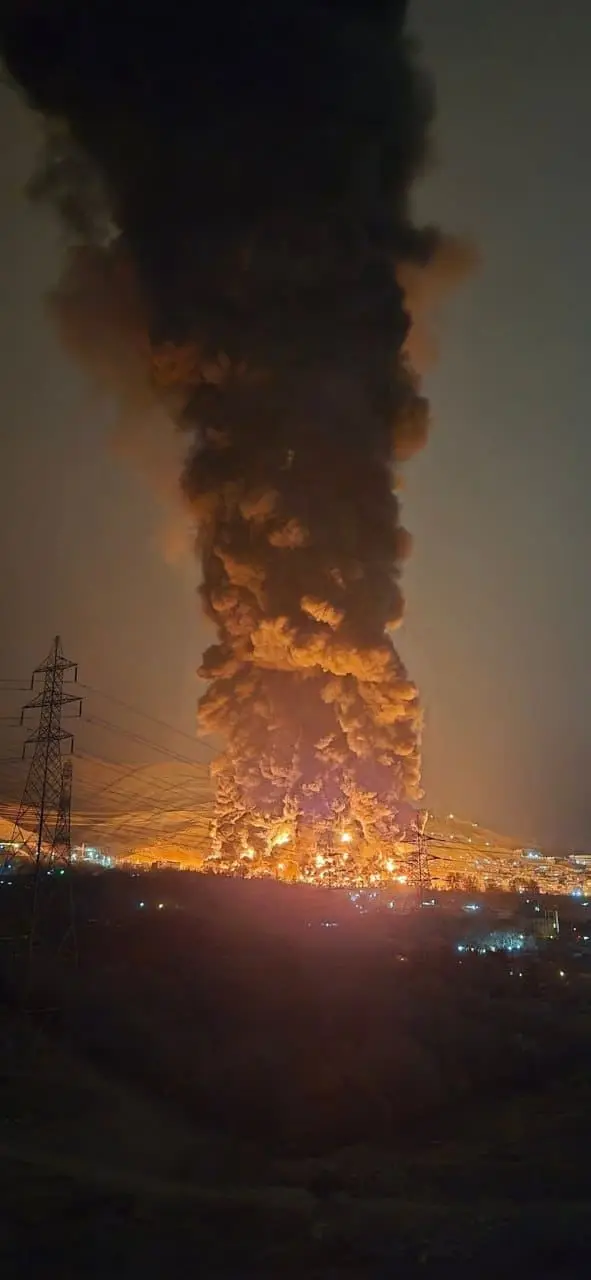
Iran has threatened to attack oil facilities in neighbouring countries after Israel struck at least five energy sites in and around Tehran, causing black smoke to rise over the city and deepening fears that the conflict could lead to major disruption to the global economy. A spokesperson for the Islamic Revolutionary Guard Corps said on Sunday: "If you can bear an oil price exceeding $200 per barrel, then continue with this game."
The United States sought to calm markets as oil prices rose, pledging not to target Iran's energy infrastructure.
Yet balls of flame and thick columns of smoke rose over Tehran on Sunday after Israeli airstrikes targeted four oil depots. The Iranian oil distribution company announced that four of its employees had been killed, while a dark haze hung over the city and the smell of burning oil spread through the air. Explosions echoed in the city of Karaj, adjacent to the capital, across the area, leaving thick smoke.
A spokesperson for the Islamic Revolutionary Guard Corps stated that Iran would respond if attacks on energy infrastructure continued. Official media quoted the spokesperson as accusing the United States and Israel of targeting civilians and fuel facilities, saying Gulf states should pressure them to halt these attacks or "similar measures will be taken in the region."
For its part, US Energy Secretary Chris Wright said the attacks on Iranian oil facilities were carried out by Israel, and that Washington would not target Iran's energy infrastructure. In an interview with CNN, Wright claimed that the disruption to oil and gas supplies would be short-term, "a few weeks" at worst.
Tensions escalated with the selection of Mojtaba Khamenei, the second son of the late Iranian Supreme Leader Ali Khamenei, as his successor. Members of the religious body responsible for choosing Iran's highest authority announced the decision on Sunday evening, calling on Iranians to rally around him and preserve national unity.
In a statement published by official media, the body said Khamenei had been selected through what it described as a "decisive vote." It urged citizens across the country, "especially the elites and intellectuals in the seminaries and universities," to pledge allegiance to the new leadership and maintain unity at this critical moment for Iran.
The move could lead to a further escalation of the war, after Donald Trump acknowledged that Mojtaba Khamenei was the most likely to succeed his father, and stated that he considers such an outcome unacceptable.
The election of Mojtaba Khamenei is the first time since the Iranian Revolution of 1979 that the supreme leadership in Iran has passed from father to son. This development is likely to spark debate within the country about the emergence of a hereditary system in a state founded explicitly to overthrow hereditary rule after Mohammad Reza Pahlavi.
Earlier on Sunday, Trump said the next Iranian Supreme Leader "will not last long" if he does not first obtain Tehran's approval.
Earlier the same day, the Israeli army announced, in a post on X in Persian, that it would continue to pursue anyone who nominates a successor to Ali Khamenei, and would pursue anyone who seeks to appoint a successor to him.
The religious meeting to appoint a new leader took place amid a sharp escalation of fighting between Israel and Iran over the weekend. Iranian strikes targeted energy infrastructure across the Gulf, while Israeli attacks targeted oil depots and fuel facilities inside Iran.
Iran launched a new wave of attacks on the Gulf region on Sunday, with Saudi Arabia, the UAE, Qatar, Bahrain and Kuwait all announcing that attacks had taken place. Saudi Arabia said it had intercepted 15 drones, while attacks in Bahrain caused material damage to an important desalination plant. Saudi Arabia's Civil Defence reported that two people were killed and 12 others injured on Sunday after a projectile fell on a residential area in the Saudi city of Al-Kharj.
The US military announced on Sunday evening the death of a US soldier from wounds sustained during an Iranian attack on US forces in Saudi Arabia, bringing the number of American deaths from the war to seven. According to reports published by The Washington Post, Fox News and other US media, Russia is providing Iran with intelligence that could help it target US military sites in the region. The Guardian has not been able to confirm this information.
The recent attacks on Gulf states appear to highlight divisions within the Iranian leadership, contrasting with statements by President Masoud Pezeshkian on Saturday, who apologised to the states of the Arabian Peninsula and hinted that air strikes against them would stop, on condition that their airspace and US bases not be used against Iran.
Analysts believe Pezeshkian's pledge not to strike Gulf states revealed rare, open divisions within the ruling elite, with the Iranian leadership appearing tense, as regime officials hurried to explain and interpret the president's words, which angered the more hardline factions in the country.
Nevertheless, the Iranian army continued shelling neighbouring countries. Throughout the day, Iran launched intermittent barrages of ballistic missiles towards Tel Aviv and central Israel. The Israeli emergency medical service Magen David Adom reported that at least one person was seriously injured after a residential building was hit.
Israeli air defences intercepted most of the missiles, and there were no casualties.
Meanwhile, the Israeli war continued on several fronts, with the Israeli Defence Forces carrying out intensive strikes on Lebanon, where the Iranian-backed Hezbollah is based. The attack on Lebanon killed four people in a hotel explosion in Beirut, and 12 others in strikes on southern areas of the country.
Israel announced that it was targeting "prominent commanders" in the Quds Force of the Iranian army. Lebanon's Ministry of Health announced that at least 394 people had been killed in the conflict. The Norwegian Refugee Council said some 300,000 people had been displaced from their homes.
At the same time, violence escalated in the occupied West Bank and the Gaza Strip. Three people were killed by Israeli settlers in the occupied West Bank on Sunday, bringing the number of Palestinians killed in recent days to six. Local health officials reported that an Israeli airstrike killed at least two Palestinians in Gaza City on Sunday, in the most violent incident in the area since Israel and the United States began their war on Iran a week earlier.
Sources: Agence France-Presse + The Guardian.


