


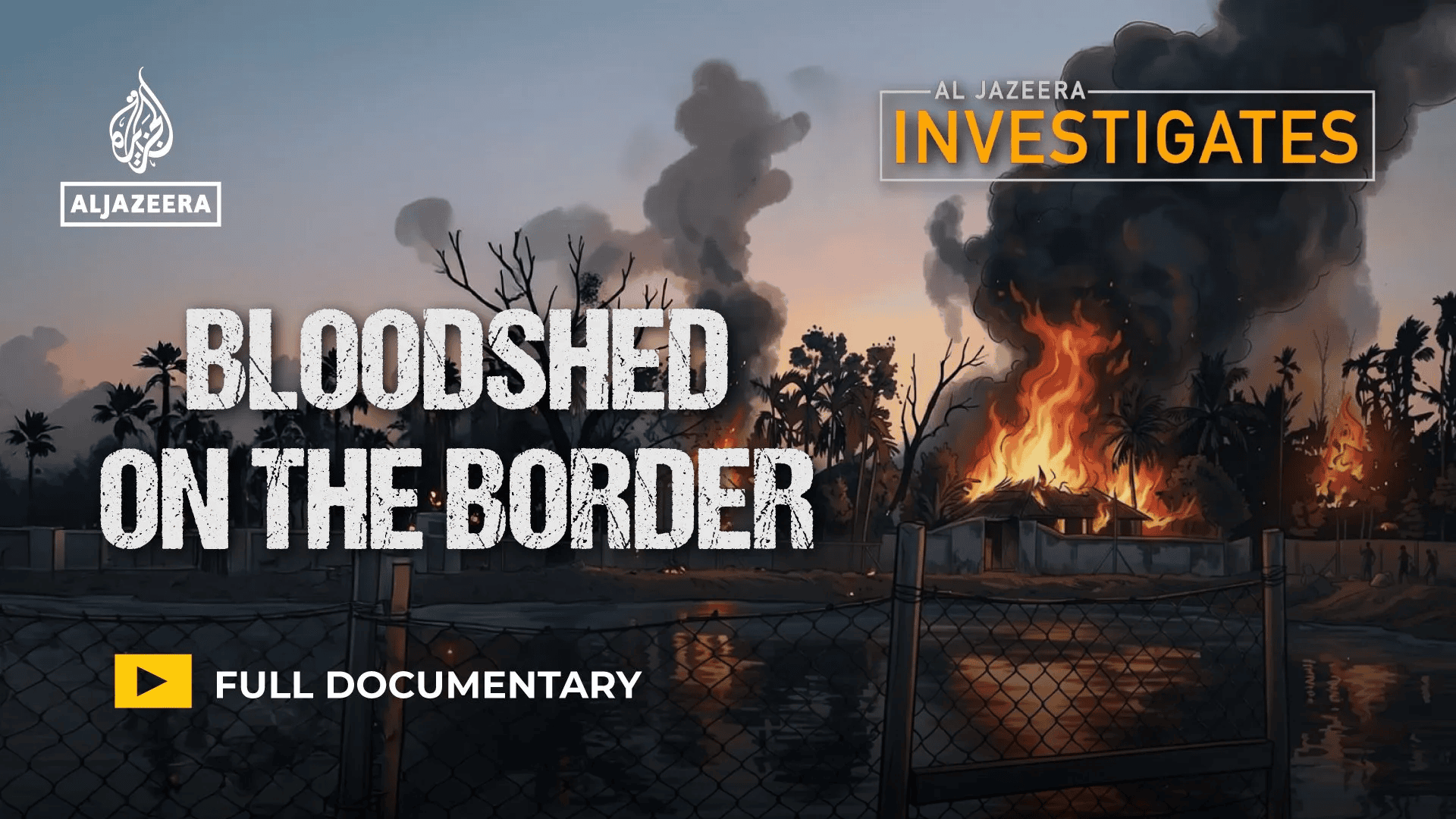
An new investigation by Al Jazeera's Investigations Unit sheds light on a more complex phase of the crisis facing the Rohingya Muslims in Myanmar, revealing testimonies and documentary material on forced displacement, recruitment, abuses and human trafficking in Rakhine State, at a time when the Rohingya find themselves caught between the ruling military and the Arakan Army, which has extended its control over large parts of their historic homeland.
The investigation, published by Al Jazeera on Thursday, 20 August 2026, corresponding to 7 Rabi' al-Awwal 1448 AH, as part of the "Myanmar Exposed" series, drew on leaked documents, covert filming and exclusive interviews, in addition to investigations carried out by the Myanmar Witness network and citizen journalists from the Rohingya community, in an attempt to document what has happened to the Muslim minority as the map of military control in Rakhine has changed.
More than 150,000 Rohingya in a new wave of displacement
According to Al Jazeera's investigation, the civil war that escalated after the military coup in Myanmar in 2021 has displaced more than 150,000 Rohingya from their homes, pushing them to seek refuge in other Asian countries.
This wave adds to the massive displacement that followed the military campaign launched by the Myanmar army in 2017, which led more than 700,000 Rohingya to flee to Bangladesh.
Today, around one million Rohingya live in overcrowded camps in Bangladesh, most of them in the Cox's Bazar district, amid extremely difficult humanitarian conditions, declining funding and aid, and limited prospects for safe return to their homeland.
However, the difference in the current wave is that the source of danger, according to testimonies gathered by the investigation, is no longer limited to the army that carried out the 2017 operations; the Rohingya now find themselves in the middle of a war between the army and its strongest rival in Rakhine, the Arakan Army.
The Rohingya between the army and the Arakan Army
The Arakan Army currently controls vast areas of Rakhine State, including areas where a large number of Rohingya historically lived.
Al Jazeera's investigation presented testimonies from Rohingya who accuse members of the Arakan Army of committing abuses including attacks targeting civilians, displacement and coercion, while some witnesses said that what they experienced under the group's control recalled the abuses that accompanied the army's campaign in 2017.
These allegations remain disputed; leaders of the Arakan Army have previously denied targeting civilians or responsibility for massacres attributed to them.
Allegations of massacres whose sites are difficult to reach
Verifying abuses in Rakhine faces particular difficulties due to severe restrictions on access to conflict zones.
Myanmar Witness previously investigated reports of the killing of large numbers of Rohingya in the village of Htan Shauk Khan in Buthidaung Township in May 2024. Investigators were able to identify the locations of some human remains using imagery and geolocation analysis, but they stated that they had not been able to independently determine the identities of the dead. The Arakan Army also denied allegations relating to the killing of Rohingya civilians.
This difficulty in access and verification makes the war in Rakhine one of the least visible fronts of the conflict in Myanmar to the outside world, despite the scale of the changes the region is witnessing.
Forced recruitment and use of the Rohingya in the war
Among the most significant dimensions of the new crisis is the entry of the Rohingya themselves into the cycle of military recruitment.
Al Jazeera's investigation addresses testimonies about members of Rohingya families who were subjected to forced recruitment as the war between the army and the Arakan Army widened.
UN reports had previously documented the recruitment by the Myanmar army of Rohingya men, despite most members of this minority having been denied citizenship rights for decades. According to the United Nations, a mix of coercion and inducements was used, including promises of obtaining citizenship and other benefits that were not fulfilled, while some who refused were beaten, arrested or expelled from their villages.
Reports have also spoken of the activity of armed Rohingya groups within the conflict. Al Jazeera's investigation says that the increased activity of armed Rohingya groups, some of which are believed to be fighting against the Arakan Army alongside or in coordination with the ruling army, has added a new layer of complexity to the scene.
However, the Arakan Rohingya Salvation Army (ARSA) denied to Al Jazeera allegations that it burned civilians' homes, carried out activities harming Rohingya villages, or encouraged refugees to join the fighting against the Arakan Army.
Human trafficking: the escape route turns into another danger
Al Jazeera's investigation does not stop at the abuses inside Rakhine; it also traces trafficking networks that move Rohingya fleeing Myanmar.
The investigation says it found evidence and testimonies relating to links between individuals associated with the Arakan Army and the smuggling of Rohingya out of the country, including women and children, with some fleeing people subjected to violence and sexual exploitation during smuggling journeys. The Arakan Army did not provide a detailed response to these allegations raised in the film.
Concerns about women and children are consistent with broader UN warnings. In early 2026 the United Nations said that the continuing violence in Rakhine has been accompanied by reports of Rohingya women and girls being subjected to sexual violence, both inside conflict areas and during flight to neighbouring countries, in addition to the risks of trafficking and sexual exploitation.
For thousands of Rohingya, this means that fleeing conflict zones does not necessarily lead to safety, as after leaving their villages a further journey may begin through trafficking networks, overcrowded boats and dangerous sea routes towards Bangladesh, Malaysia and Indonesia.
Bangladesh wants them back, but to where?
The investigation raises a more pressing question about the fate of nearly one million Rohingya living in Bangladesh.
Dhaka wants refugees returned to Myanmar, while the Myanmar side recently announced that it had verified that 308,797 people on lists submitted by Bangladesh were residents of Rakhine State, in one of the most significant developments concerning the repatriation file in recent years.
Bangladesh had submitted data on around 828,824 refugees, while Myanmar's authorities said they had not verified the eligibility of 113,507 people and linked 4,241 others to what they described as "terrorist" activities. At the same time, Myanmar's authorities continue to refuse to recognise the Rohingya as an indigenous ethnic group and use other designations to refer to them.
Accepting the names of hundreds of thousands does not mean that return is close; Myanmar itself says that the repatriation process will not begin until the security situation in Rakhine improves.
The 2017 crisis has not ended, but its actors have changed
The importance of Al Jazeera's investigation lies in the fact that it reframes the image of the Rohingya crisis, which for years has been associated globally with the events of 2017 and the Myanmar army.
The army, which was accused of carrying out an ethnic cleansing campaign against the Rohingya, remains a principal party to the crisis, but the war that followed the 2021 coup has changed the balance of power in Rakhine, and other armed groups now effectively control large areas that were previously under government authority.
Thus, the Rohingya crisis has not ended with the army losing territory in Rakhine; rather, it has entered a new and more complex phase: an army that refuses to recognise their rights and recruits some of them into its war, a rising rebel force that itself faces major challenges on the ground and in the media, armed Rohingya groups engaged in the conflict, trafficking networks profiting from desperation, and one million refugees in Bangladesh waiting for a return for which the conditions of safety are not yet in place.
Nearly nine years after the major wave of displacement in 2017, the current picture shows that the Rohingya crisis is no longer merely a refugee file stuck in the past; it is a crisis that renews itself with every shift in the war in Myanmar, while Rohingya civilians remain the party most exposed to paying the price of a conflict whose course they do not control.


