


Mohammad Ali had already lost everything once. On 22 March 2021, a volunteer with the Disaster Management unit rushed toward the flames consuming Camp 9 in Ukhiya, Cox's Bazar – the largest refugee settlement in Bangladesh – carrying his extinguisher as a weapon against the inevitable. He recalls later: "While we were trying to put it out, the fire trapped us from the other side. When the extinguishers ran out, we rushed to our homes. We could not take any belongings, we only carried our children and ran."
By evening, as the fire subsided, 15 people had been killed, 45,000 refugees had been displaced, and more than 10,000 shelters had disappeared, turned to ash and memory. What stands out in the humanitarian records is not only this catastrophe, but its continuous recurrence: between May 2018 and December 2025, 2,425 documented fires struck the world's largest refugee settlement in south-east Bangladesh, affecting more than 100,000 people and destroying more than 20,000 shelters.
These are not stories of incidental accidents, but a record of how the refugee crisis has turned into something more insidious: "infrastructure for permanent crises."
The Arithmetic of Fragility
Consider the spatial layout of Camp 5 in Ukhiya, where on 7 January 2024 fire consumed some 900 shelters within hours, displacing approximately 5,000 refugees, including 3,500 children. The fire did not merely challenge responders with its intensity, but also with the design of the settlement itself: strong winds channelled the flames through narrow passages, water taps ran dry within minutes, access roads were far too narrow for fire engines, and families resisted demolishing their shelters to create firebreaks even as the flames approached.
Rashida (42), a mother of five, told Save the Children after losing her home in the January fire: "We were sleeping when the fire broke out. I quickly woke my husband, my elderly mother-in-law and my children, and we left the shelter, and that saved our lives. We could not rescue anything, and we have nothing to wear in this winter."
Inside Cox's Bazar, fire is not a hazard to be managed but has become an "engineering" inevitability in the settlement's genes. Every shelter is made of bamboo, tarpaulin and plastic rope, with no fire-resistant materials. Population density exceeds 95,000 people per square kilometre in some sectors, and most families cook over open flames inches from their neighbours, in structures that become dry and quick to ignite like straw every winter.
Fire as a Weapon: The Economy of Arson
Nevertheless, not all fires result from structural inevitability. Flames have increasingly become tactical tools in a shadow war for control of territory. In March 2023, an investigation by the Bangladeshi Ministry of Defence concluded that the fire that destroyed 2,800 shelters and displaced 12,000 people was "a planned sabotage."
Htway Lwin, a Rohingya leader, described how the fires were preceded by armed clashes between rival factions: "There was fighting between two gangs. Once the huts were set on fire, one of the gangs prevented the refugees from putting out the fire."
The Cox's Bazar police superintendent confirmed that several Rohingya sources reported that men from the "Arakan Rohingya Salvation Army" (ARSA) were the ones who set the fire.
Killings of refugees by armed groups rose from 22 cases in 2021 to 90 in 2023. At the same time, kidnappings increased about fourfold, with more than 700 abductions in the first nine months of 2023 alone.
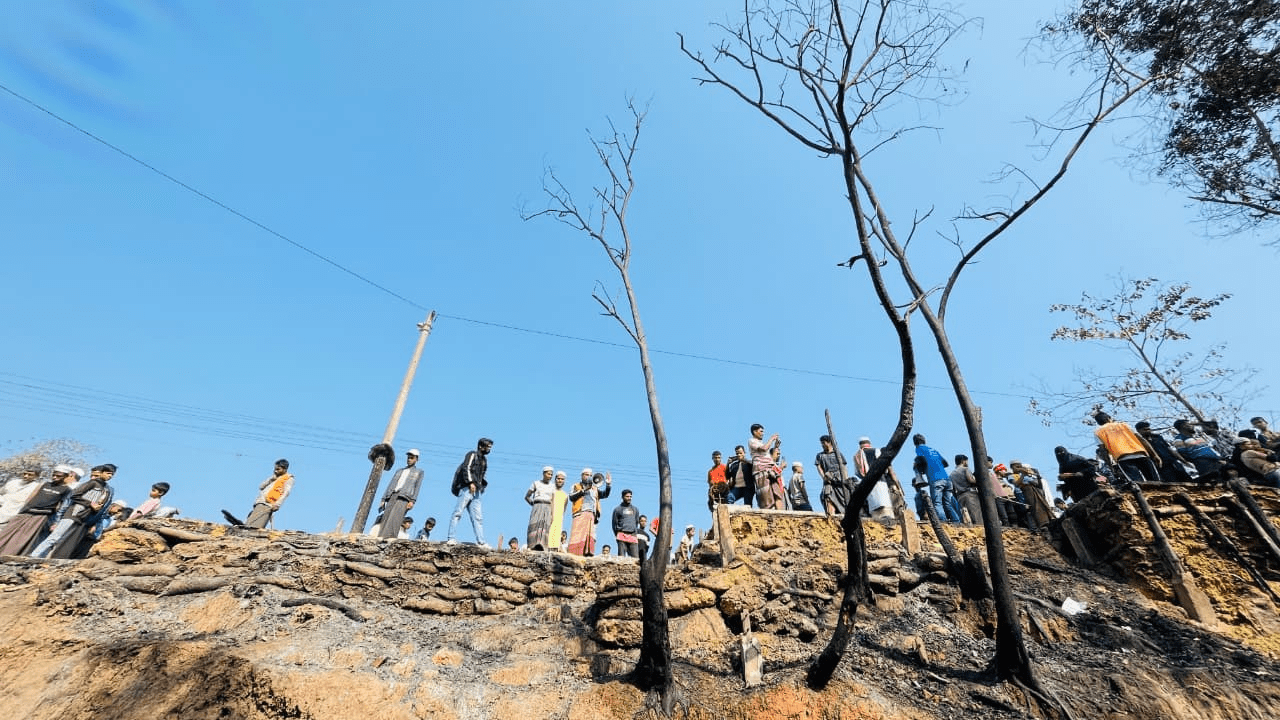
Residents stand along a high embankment overlooking the charred remains of shelters after a fire broke out in Camp 11 in the early hours of 13 February 2026, at around 3:20 a.m. Photo by Mong Thein Myint, human rights defender, refugee advocate and documentary researcher.
Nurul, a resident of Block "C", told The New Humanitarian: "Just ten days earlier, a member of the Arakan Rohingya Salvation Army (ARSA) threatened the residents of Camp 11. We filed a complaint with the police, who advised us to be careful and to patrol at night." Ten days later, the fire engulfed his block.
Groups such as the Arakan Rohingya Salvation Army and the Rohingya Solidarity Organisation (RSO) wage influence struggles using fire, turning the camps into what one humanitarian official described as a "city of a million people – affluent neighbourhoods and deteriorated ones." These are not natural urban divisions, but military zones where forced recruitment, extortion and enforced disappearance have become routine practices.
The Political Economy of Ash
Understanding the fires in Cox's Bazar requires mapping their economic structure. When fire swept through Camp 11 on 5 March 2023, the cost of the immediate humanitarian response included emergency shelter materials, non-food item kits, water trucking, medical services, and food distribution to 16,000 affected refugees.
Each fire sets off a chain of hidden costs: families lose their identity documents and are forced into prolonged bureaucratic battles lasting months to obtain replacements. Children miss out on education when learning centres burn – in January 2024, at least 1,500 students were suddenly deprived of their right to education. Medical records disappear, complicating disease management. Social networks fragment as families move to different residential blocks.
This troubling picture of fire safety exposes the system's fundamental paradox. Humanitarian actors focus on emergency response – training volunteers, placing fire extinguishers, and running awareness campaigns – which rarely arrive in time, while the root cause of the fires remains unaddressed. Plans to build 50,000 semi-permanent, fire-resistant shelters, announced with great enthusiasm, are now stalling for lack of funding following international aid cuts in early 2025.
Barbed Wire and Closed Exits
The contradiction of fire safety nowhere manifests more deadly than in the barbed-wire fences surrounding the camps. Ostensibly erected for security purposes, these barriers became death traps during the massive March 2021 fire. At least 15 people lost their lives, and hundreds were injured while attempting to climb or cut through the wires as the flames approached.
The fences still stand. They prevent unauthorised movement in order to maintain camp security. Yet what this security system actually provides is protection of the population to the point of maximum vulnerability – they are contained enough to prevent their escape, but not protected enough to ensure their survival when disaster strikes.
The Mirage of a Sustainable Solution
How many more times will these refugees watch fire consume their lives? This question haunts every humanitarian briefing, every donor appeal, and every investigative report.
Omar Khan, a 35-year-old teacher in Camp 5, held the camp administration directly responsible for the fire that broke out in January 2024, saying: "The camp administration is responsible for the scale of the destruction." Others accused officials of failing to ensure that basic aid and emergency services were adequately provided, despite the camps having experienced more than 300 fires over six years.
Following the March 2021 disaster, Antonio Vitorino, Director General of the International Organization for Migration, stated: "This disaster is a terrible setback that compounds humanitarian needs. We will need to start from scratch to rebuild." Yet starting from scratch is precisely what the humanitarian architecture in Cox's Bazar has mastered – not as a failure, but as an operating system.
Kaiser Rijvi, Programme Head at CARE Bangladesh, described the organisation's response to the January 2026 fire, which displaced 2,185 people, saying: "Alongside the immediate response, we are committed to strengthening prevention efforts. We will include dedicated fire-safety sessions within shelter development and maintenance programmes to raise awareness and promote safe practices."
This troubling picture of fire safety reveals the fundamental paradox of the system. Humanitarian actors concentrate on theoretical emergency responses – training volunteers, placing fire extinguishers, and running awareness campaigns – while the underlying conditions that ensure fires keep breaking out remain unchanged.
Sustainable solutions exist in theory: relocating families to less dense areas, building fire-resistant shelters using concrete and metal, creating adequate firebreaks, removing barbed wire, and providing professional firefighting services within the camps.
Yet each of these interventions collides with political reality. The Government of Bangladesh does not intend for these settlements to be permanent, although they have housed people for eight years and continue, so any large long-term investment faces serious political obstacles.


