


The English Channel between France and Britain witnessed one of the largest crossings of migrants, an incident that has once again reignited debate over the dangers of irregular migration routes, after a small boat carrying 165 migrants arrived on the British coast, the largest number of people recorded on board a single boat crossing the Channel so far.
The boat, which some media reports described as a "giant boat", arrived at the British coastal town of Dover on Thursday, 23 July, after a perilous sea journey that set off from the French coast.
Boat the size of a bus carries dozens of people
The boat was about 13 metres long, roughly the length of an ordinary British bus, but the striking increase was not in the size of the boats so much as in the number of people packed into them by human trafficking networks.
The previous record for the number of people on a single boat was 128 migrants, according to British media reports, before Thursday's crossing far exceeded that figure.
The British Press Association took photographs of border security forces towing the boat after it arrived in Dover, where passengers underwent procedures by the competent authorities.
Sudanese young man charged with piloting the boat
After the boat's arrival, the National Crime Agency in Britain announced charges against a 19-year-old man holding South Sudanese nationality, on suspicion of piloting the boat during the sea journey from France to Britain.
Authorities said the young man is charged with "endangering the lives of others during the crossing", and that he remained in detention before appearing before Margate Magistrates' Court on 27 July.
The authorities accuse human trafficking networks of using migrants themselves to pilot small boats, due to the difficulty of finding smugglers willing to undertake these dangerous journeys.
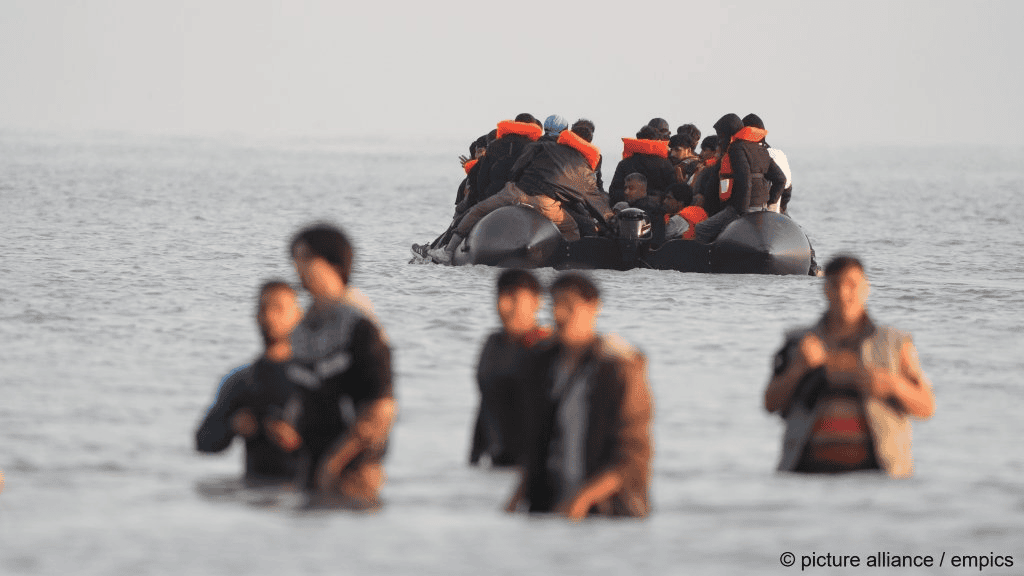
Warnings that the Channel is becoming a more dangerous route
Care4Calais, an organisation that assists refugees, warned that the English Channel route has become more dangerous as increasing numbers of people are transported in single boats that are unsuitable for sailing.
Officials of the organisation said that the government's focus on security measures alone has failed to halt the crossings, and has instead contributed to pushing smugglers towards more dangerous means.
The organisation added that opening safe and legal migration routes could reduce people's reliance on trafficking networks and limit deaths at sea.
Calm weather increases crossing attempts
The record crossing came during a period in which the area saw more stable weather conditions, with warm temperatures and a relatively calm sea, which encouraged more migrants to attempt the crossing.
British Home Office data indicated that 366 people arrived on Thursday on three boats, while 103 migrants arrived on Friday, and 240 people on Saturday.
Crossing attempts had been halted for about 11 days due to strong winds, before resuming as weather conditions improved.
British government: smugglers are risking people's lives
A spokesperson for the British Home Office said that smuggling gangs are increasingly risking migrants' lives by packing large numbers of people into boats unfit for sailing.
The government confirmed that it is working with France to strengthen beach surveillance and prevent departures, noting that more than 45,000 crossing attempts have been foiled since the last election.
Figures decline despite the ongoing crisis
Despite the record incident, British Home Office data indicates that the number of arrivals across the Channel this year has reached about 13,007 people so far, a decrease of 45% compared with the same period last year, and 18% compared with 2024.
However, the continuation of the journeys confirms that the English Channel remains one of the most prominent irregular migration routes into Europe, particularly for people fleeing wars, political turmoil or economic crises in their countries.
An ongoing humanitarian and security crisis
The latest crossing reflects the complex challenge facing Britain and France. On one hand, both governments seek to tighten border controls and combat trafficking networks; on the other, large numbers of people continue to attempt to reach Britain by dangerous sea routes because many of them lack safe alternatives.
Observers believe that addressing the Channel crisis is not only linked to borders and security measures, but also requires tackling the causes that push people to undertake these perilous journeys.


