


The rise and fall of major powers is a central theme in the study of international relations, given its profound impact on shaping the international system and redistributing the balance of power among international actors. In this context, a growing intellectual current has emerged in recent decades debating the future of the American position and examining whether the United States can continue to hold its place as the dominant power in the international system.
Since the end of the Cold War, the United States has enjoyed an unprecedented superiority at the military, economic and political levels. However, a number of internal and external transformations have increasingly raised questions about the ability of this superiority to endure, in light of the emergence of competing international powers and the growing structural challenges the country faces.
What follows seeks to analyse the most prominent economic, political, geopolitical and social indicators on which this argument rests, while discussing their potential implications for the future of the United States and the structure of the international system. It relies on reputable scholarly references and studies, in order to provide a balanced analytical treatment of this complex phenomenon.
Indicators of Decline
Indicators of the decline of the international standing of the United States can be observed across a set of key areas that reflect the erosion of the elements of its comprehensive power. These indicators include economic, political, geopolitical and social dimensions. They do not necessarily mean the fall of the United States as a great power; rather, they point to cumulative transformations that have affected its ability to sustain the level of dominance it enjoyed after the end of the Cold War.
A. Economic and Financial Indicators
Economic and financial indicators are among the most prominent areas on which observers rely to assess the decline of American standing. The United States has seen a relative decrease in its share of global gross domestic product, alongside rising public debt and a widening federal budget deficit. A number of researchers argue that the exorbitant cost of maintaining global influence, under the concept of "imperial overstretch," has become an increasing burden on the American economy. The United States also faces growing challenges in preserving its competitive edge in some manufacturing industries and advanced technologies, in light of the rapid economic and industrial rise of competing powers, foremost among them China.
B. Political and Institutional (Domestic) Indicators
Domestic political and institutional developments are among the most prominent indicators that researchers use in assessing the decline of American standing. Reports from several specialised international institutions, such as the Varieties of Democracy (V-Dem) Institute, Freedom House, and the Economist Intelligence Unit (EIU), have shown a notable decline in indicators of the quality of American democracy in recent years, particularly in 2025.
The V-Dem liberal democracy index for the United States fell to 0.57 in 2025, its lowest level since 1965, which led to its reclassification from a "liberal democracy" to an "electoral democracy." The United States' score in the Freedom House report also declined to 81 points in the same year, one of the largest declines among countries classified as "Free," reflecting growing challenges related to political polarisation, trust in institutions, and the quality of democratic practice.
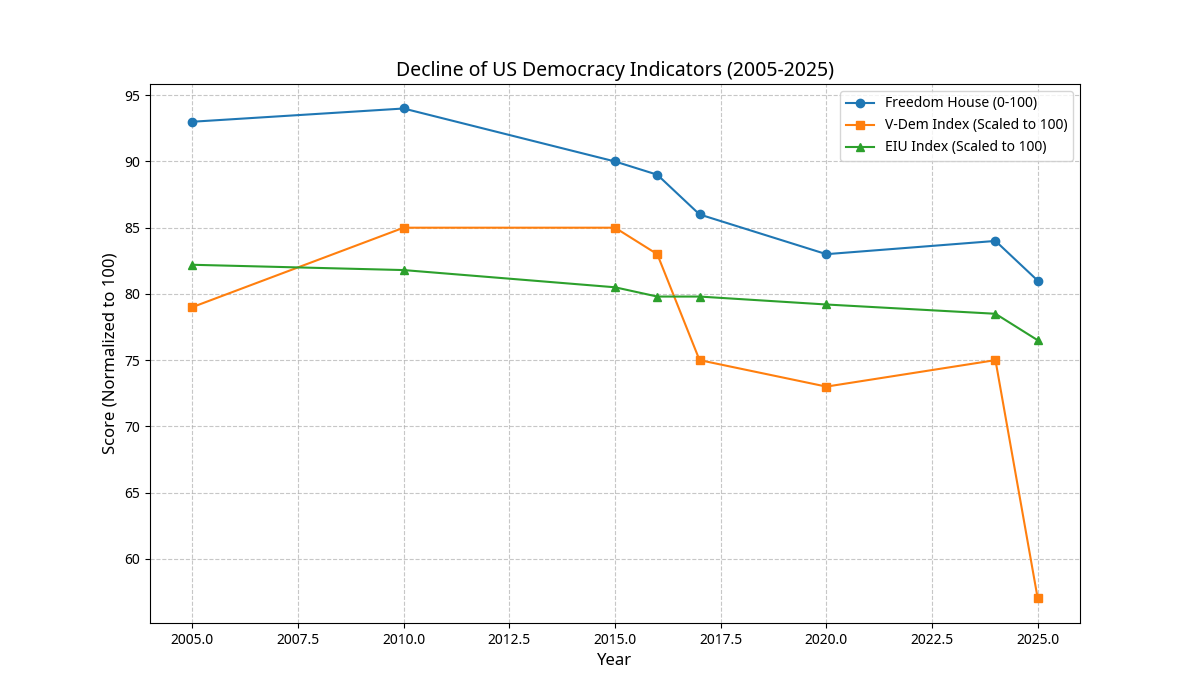
Decline in indicators of American democracy (2005–2025)
C. Geopolitical and Military (External) Indicators
The international environment is undergoing rapid shifts toward a more multipolar balance of power, after decades of American dominance that followed the end of the Cold War. The growing rise of international and regional powers, foremost among them China and Russia, is among the most significant challenges to American influence at the geopolitical and strategic levels. A number of researchers also point to a relative decline in the effectiveness of American soft power, that is, its capacity to influence others through attraction and persuasion rather than coercion, which has affected its ability to shape international orientations and alliances to the extent it once did.
In this context, some analysts argue that the United States faces a challenge stemming from the widening gap between its global ambitions and its actual capabilities, which has led some of them to describe it as "an empire in denial of its decline," in reference to its continued assumption of growing international burdens despite increasing domestic economic and political constraints.
D. Social and Cultural Indicators
Social and cultural transformations represent an important dimension in assessing the international standing of the United States. Multiple studies and reports point to the rise of political polarisation and social division, and the resulting decline in trust in public institutions and erosion of social cohesion. The United States also faces domestic challenges in education and healthcare, alongside persistent income inequality and high crime rates in some areas compared with a number of advanced countries. A number of researchers argue that these factors together affect the ability of the United States to maintain its political and social model as a source of soft power and international influence.
E. Demographic Indicators
Some researchers argue that demographic transformations represent a long-term challenge for the United States, whether in terms of population ageing, declining fertility rates, or the growing debate over immigration and social integration. These transformations are reflected in the labour market, public spending, political stability, and the state's capacity to sustain economic growth.
F. Scientific and Technological Indicators
Although the United States continues to lead in many fields of scientific research and innovation, it faces growing competition, particularly from China, in strategic sectors such as artificial intelligence, semiconductors, quantum computing, and military technology. Some analysts argue that intensifying competition in these fields could affect one of the most important sources of American superiority over the long term.
G. Indicators of Allies and International Influence
Assessing the standing of major powers is not limited to the elements of their own strength; it also includes their capacity to lead alliances and shape international rules. A number of studies have noted that some American policies over the past two decades have generated tensions with several allies, at the same time as competing powers have grown in influence within international institutions and blocs. Some researchers regard this as an indicator of a relative decline in American capacity to lead the international system.
Repercussions of Decline
If the decline of the international standing of the United States continues, its effects will not be confined to the American domestic sphere; they will extend to the structure of the international system and the global balance of power. Researchers differ on the scale of these repercussions and the speed with which they will materialise, but they agree that any shift in the position of the world's leading power will have wide-ranging implications at the political, economic and security levels.
- On the international system
The decline of American hegemony is expected to accelerate the transition from a unipolar system to a more multipolar one, reshaping the international balance of power. Some researchers argue that this shift may generate a state of strategic uncertainty and increase the likelihood of competition and conflict among major powers seeking to expand their influence.
- On international alliances
These transformations are expected to prompt traditional American allies, particularly in Europe, the Middle East, and East Asia, to reassess their security and foreign policies, diversify their strategic partnerships, and seek new balances that reduce unilateral reliance on the American security umbrella.
- On the global economy
A decline in the relative weight of the United States is expected to accelerate efforts to reduce reliance on the US dollar in trade and international reserves, and to promote the use of national currencies or the creation of alternative financial arrangements. This could contribute to a more multipolar economic and financial order, although the dollar is likely to retain its dominant position in the foreseeable future.
- On regional stability and security
The receding American influence may encourage some regional and international powers to expand their spheres of influence or reconsider existing balances, which could lead to intensified geopolitical rivalry and a greater likelihood of crises and conflicts in some regions of strategic importance.
- On the United States domestically
The decline in international standing is expected to pose domestic challenges related to re-ordering priorities between foreign spending and economic and social needs. It may also deepen political debate over the role of the United States in the world, the limits of its international commitments, and the most suitable strategy for safeguarding its interests in an increasingly competitive international environment.
Conclusion
The economic, political, geopolitical and social indicators examined in this study show that the United States no longer enjoys the degree of dominance it held alone after the end of the Cold War, and that its international standing is experiencing a relative and gradual decline, driven by cumulative internal and external transformations. Foremost among these are the rise of competing powers, growing economic burdens, widening domestic divisions, and the weakening effectiveness of traditional instruments of influence.
This decline does not necessarily mean the fall of the United States or the loss of its standing as a great power. Rather, it reflects the transition of the international system into a phase in which American capacity to make international decisions unilaterally is diminishing, alongside the emergence of more multipolar features in the balance of power.
If current trends continue without effective remedies, the decline of American influence is likely to accelerate, affecting its ability to lead alliances, maintain the dollar's dominance, and manage international crises. This would give rising powers greater room to reshape the international system in ways that serve their interests.
References
- Abd al-Hay, Walid. Tayyar al-Tarajju' al-Amriki fi al-Makana al-Dawliyya [The Current of American Decline in International Standing]. Al-Zaytouna Centre for Studies and Consultations, 2020.
- Thomas, Victor Bulmer. Empire in Retreat. Arab Center for Research and Policy Studies (Arabic translation).
- Nye, Joseph S. Is the American Century Over? Polity Press, 2015.
- Fukuyama, Francis. Political Order and Political Decay: From the Industrial Revolution to the Globalization of Democracy. Farrar, Straus and Giroux, 2014.
- Varieties of Democracy (V-Dem) Institute. Democracy Report 2026.
- Kennedy, Paul. The Rise and Fall of the Great Powers. Random House, 1987.
- Freedom House. Freedom in the World 2026.
- Pew Research Center. Multiple Indicators Show a Decline in the Health of America's Democracy in 2025. 2026.


