

India Targets Muslims With Doctorates, Master's Degrees, and IIT Graduates Without Any Real Reason!
The Unlawful Activities (Prevention) Act (UAPA) is the most effective legal tool in the state's counter-terrorism arsenal. The law was originally enacted in 1967 to prevent unlawful activities that threaten India's sovereignty, and was substantially amended in 2019 to broaden the definition of "terrorism."
Under this law, the government can also designate organisations and individuals as terrorists. Arrests can be made on suspicion alone, bail is almost impossible to obtain, and detainees are often held for long periods without trial. The 2019 amendment, in particular, blurred the lines between political activity, criticism of the state, and terrorism itself, leaving countless innocent citizens in legal limbo.
Since the Bharatiya Janata Party government came to power in 2014, Muslims in India have become easy targets for state agencies and right-wing groups.
The atmosphere of suspicion and prejudice has intensified, to the point that educated, law-abiding young Muslims face persecution. Many have been arrested under the harsh UAPA, often without reliable evidence, and forced to remain in prison for years while trials proceed at an extremely slow pace. Their bail applications have been rejected more than 90 times. The misuse of this stringent law has not only destroyed individual lives but also instilled fear and despair in the community.
Rather than targeting actual threats, the UAPA is applied selectively against Muslims, human rights activists and dissenting voices, turning it into a tool of political repression rather than justice. This troubling trend raises serious questions about equality, due process and the rule of law in a democratic state.
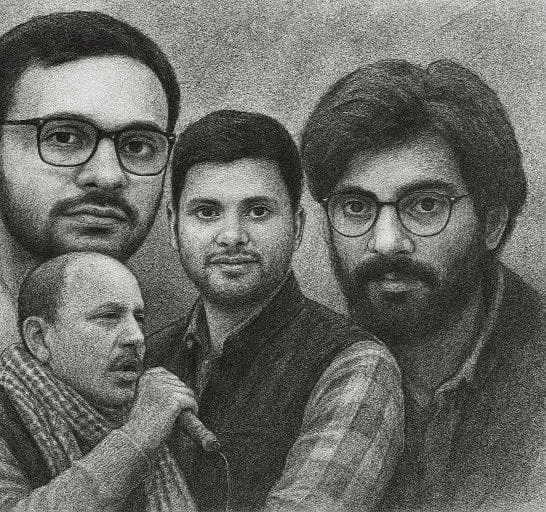
After the Delhi riots in 2019, student activists Umar Khalid, Sharjeel Imam, Meeran Haider, Shifa-ur-Rehman and Gulfisha Fatima found themselves in the crosshairs of the UAPA. They were arrested on charges widely described as fabricated, and all have spent more than five years behind bars.
These individuals have high levels of education and intellectual talents, and could have made significant contributions to society; they could have become university professors, researchers or other professionals. Yet they have spent more than five years in prison on charges that many believe are false and politically motivated. This case highlights a stark paradox: the qualities that should have elevated them were used as evidence of their alleged crimes.
Umar Khalid, perhaps the best known member of the group, holds a PhD in Political Science from Jawaharlal Nehru University (JNU). His doctoral thesis, titled "Challenging the Claims and Possibilities of Tribal Rule in Jharkhand," reflects his commitment to advancing the most marginalised communities in India.
Beyond the bounds of academic research, Khalid was deeply engaged in student activism, frequently taking part in debates, seminars and discussions that challenged conventional narratives.
Sharjeel Imam, one of the movement's faces, completed his schooling at a missionary school in Patna and then at the Government Vasant Kunj School in Delhi.
He is a graduate of the Indian Institute of Technology in Bombay. He earned a bachelor's and a master's degree in Computer Engineering before pursuing a master's in Modern History and a master of philosophy in Modern Indian History.
What distinguishes him is not only his academic qualifications but also his use of them to engage in public dialogue, often confronting entrenched social and political beliefs.
Meeran Haider completed his education at Jamia Millia Islamia (JMI) in Delhi. He studied Mechanical Engineering for his bachelor's degree.
He then obtained a master's in International Business Management, followed by a master of philosophy in West Asian Studies, all from the same university. He is reportedly a PhD scholar at the university's Centre for Management Studies.
His knowledge of political theory and social dynamics has informed his leadership of these movements, reflecting a rare combination of scholarly research and practical engagement with the community.
Gulfisha Fatima excelled in her studies, earning a bachelor's and a master's degree in Urdu Literature from Kirori Mal College at the University of Delhi. She then pursued a master's in Business Administration from the Institute of Management Education in Ghaziabad. Interestingly, she also worked as a presenter at All India Radio (Urdu). Her academic background qualified her to contribute effectively to education, policy and social activism.
Shifa-ur-Rehman holds a master's degree in Commerce from Jamia Millia Islamia (JMI) and heads the Association of Alumni of Jamia Millia Islamia (AAJMI). He is among the earliest accused in the Delhi riots conspiracy case.
The irony here is hard to overstate. In a society that often emphasises education as a path to professional success, public service and scholarship, the imprisonment of these educated young people on terrorism-related charges raises profound questions. Are we now witnessing the punishment of opposition, or the suppression of intellectual expression? In these cases, the designation of "terrorist" under the counter-terrorism law does not appear to target conventional violence, but rather critical, articulate and openly dissenting intellectual voices.
Remarkably, Umar Khalid, described as the mastermind of the Delhi riots in 2020, was not even in the city when the sectarian violence broke out. In fact, his last public speech before the riots, in Amravati, drew on the principles of Mahatma Gandhi.
Of the 751 complaints filed regarding the Delhi riots, Umar Khalid's name appeared in only one. Yet even after five years, his trial has not yet begun, highlighting the protracted and opaque nature of the legal proceedings against him.
Notably, in the same case, Natasha Narwal and Devangana Kalita were arrested alongside Khalid, Imam and others under the provisions of the UAPA.
Both, however, were released within a year. This selective application raises questions about consistency, fairness and the implicit biases that may influence judicial and investigative discretion.
One cannot help but notice a clear pattern: prolonged detention appears to be linked less to evidence of wrongdoing than to markers of identity, including religious background and political expression. The narrative is clear: educated, outspoken young Muslims are met with suspicion, while others are granted their freedom.
Education, at its best, aims to equip individuals with the capacity for rational debate, ethical decision-making and conscious action.
Yet under the counter-terrorism law as it is applied, these qualities have become liabilities. By labelling scholars as terrorists, the law turns academic excellence into a threat, mocking the principle of intellectual freedom. Are we part of a society that values education, yet punishes its brightest minds for thinking?
Muslim Mirror


