

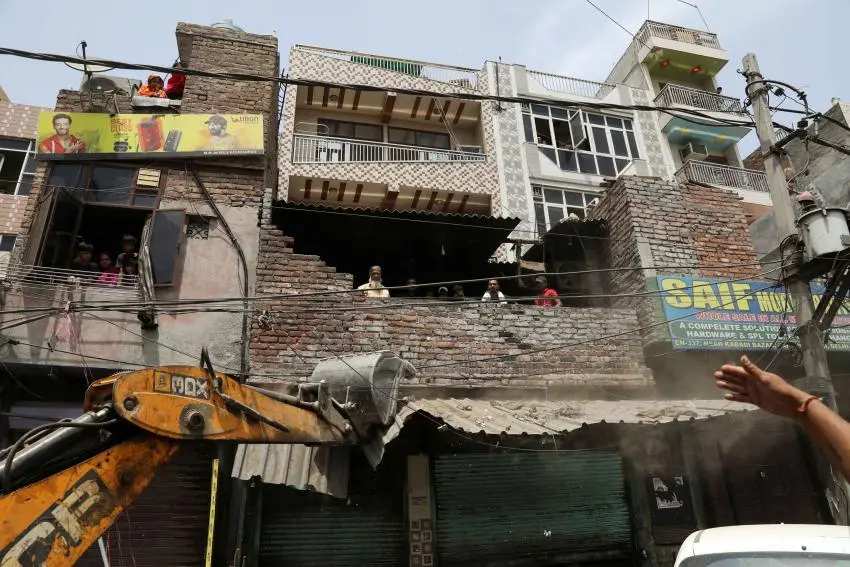
A large-scale demolition campaign carried out by Indian authorities in the state of Assam has displaced more than 4,000 people from the village of Alamganj in Dhubri district, most of them Bengali-speaking Muslims, after the homes of hundreds of families were removed using dozens of bulldozers under heavy security deployment. While the authorities maintain that the operation targets the removal of encroachments on government land, residents say they have lived in the area for decades and now face an uncertain future after losing their homes.
On Sunday, 1 November 2026, a large-scale eviction and demolition operation took place in Alamganj – Part-IX, under the Gauripur circle of Dhubri district in the northeastern Indian state of Assam, affecting residential settlements inhabited by Bengali-speaking Muslim families.
According to a report published by the Indian outlet Scroll, the operation displaced more than 4,000 people after the homes of more than 640 families were demolished. The Indian American Muslim Council documented the incident in its human rights bulletin issued on 7 November, warning of the worsening impact of eviction drives targeting Muslim residents in the state.
The operation covered approximately 650 bighas of land, or nearly 215 acres, out of a total of 800 bighas for which the authorities had previously issued eviction notices. Estimates of the number of affected families differ between news organisations and official sources, a difference that should not be overlooked when assessing the scale of the campaign.
Dozens of bulldozers and hundreds of homes
The removal operation began early in the morning, with the participation of a large contingent of police, local officials and heavy-machinery teams.
Quoting the Gauripur... [Note: the source names the Dhubri district commissioner as Dibakar Nath]: the Press Trust of India (PTI) reported that the Dhubri district commissioner, Dibakar Nath, said the administration used around fifty excavators, along with transport vehicles and other equipment, to recover what it describes as government land that had been encroached upon.
The agency estimated the number of families covered by the eviction at around 550, while Scroll referred to more than 640 Bengali-speaking Muslim families. The NDTV network reported that the number of families removed from the area reached about 750, and that nearly sixty excavators were used in the operation.
These are different estimates of the same campaign, and they should not be combined to arrive at a new overall figure. As for the number of affected people, it exceeded four thousand according to the coverage published by Scroll, which the human rights report also relied upon.
Local officials said that most residents had left the site before the bulldozers arrived after receiving eviction notices, and that the operation was carried out without significant resistance. However, this account does not erase the humanitarian concerns associated with the loss of homes, nor does it resolve the dispute over the rights of residents on the land where their homes were demolished.
Government land or homes built decades ago?
The Assam government says the measure targeted structures built without legal authority on state-owned land, and that residents were notified of the eviction and went through administrative procedures before implementation.
However, testimony reported by the Indian press shows that some of those affected insist they have lived in the area for decades. Some families even say they moved there after losing their original homes due to flooding of the Brahmaputra River and erosion of its banks.
Among them is an eighty-year-old man who told Scroll that he moved to the area in 1962 after his previous home was damaged by the river. Other residents spoke of possessing receipts or documents proving payment of fees or land revenue in previous years.
These testimonies do not, on their own, settle the legal ownership of all the land, but they show that the case goes beyond a simple administrative description and raises questions about the situation of families who have lived in the place for many years, and about the possibility of providing them with suitable housing alternatives.
Local reports confirmed that some residents demanded resettlement and compensation, while others said they had bought their land through intermediaries before discovering that the authorities considered it government property.
150 bighas temporarily excluded due to court cases
The bulldozers did not cover the entire area targeted in the eviction notices.
The Dhubri commissioner explained that the authorities had issued notices concerning around 800 bighas, but refrained from carrying out demolition on the remaining area, amounting to nearly 150 bighas, due to cases pending before the courts.
According to coverage by the Sentinel Assam, a new court hearing is expected on 13 November 2026 to consider the dispute over the excluded land, leaving the fate of the families living there undetermined for now.
This exclusion reveals the continuation of the legal dispute over some sites, and the presence of residents trying to resort to the courts before losing their homes.
The importance of ensuring that those affected have the right to effective judicial appeal, sufficient time to submit documents, and that eviction procedures do not leave families without housing and essential services without suitable alternatives, becomes clear here.
Religious structures and disagreement over what the bulldozers reached
Media coverage did not limit itself to homes; differing accounts emerged regarding the fate of some religious and community structures in the area.
NDTV reported that the eviction work included sites containing mosques, places of worship and graveyards, and its coverage showed a state of grief and protest among residents who gathered near some of the sites.
On the other hand, local reports quoted officials as saying the administration avoided demolishing a shrine and an adjacent graveyard after a request from a local committee, while other sources spoke of some places of worship and public facilities not being touched.
Therefore, based on the available accounts alone, it cannot be determined with certainty how many mosques or religious structures were actually demolished in the operation. This aspect requires independent field documentation identifying the affected sites and their condition before and after removal.
A campaign within a broader eviction policy in Assam
The Dhubri incident does not represent an isolated event; in recent years Assam has witnessed repeated campaigns to remove homes and structures that the authorities say were built on government land.
Such measures often affect Bengali-speaking Muslim communities, some of whom have for years faced political accusations of irregular migration and of belonging to Bangladeshi origins.
The government maintains that its measures aim to protect public land and enforce the law, while critics and human rights activists argue that the repetition of evictions in settlements with large Muslim populations raises concerns about discrimination and disproportionate targeting.
Human Rights Watch had warned in previous years of discriminatory demolitions that affected the property of Muslims in various Indian states, and called for respect for legal procedures and for ensuring that demolition is not used as collective punishment.
This earlier documentation does not establish that every eviction in Assam is automatically unlawful, but it provides an important human rights background for assessing the risks associated with large-scale demolition campaigns.
Political statements add to concerns
The controversy over the Dhubri operation grew after the Chief Minister of Assam, Himanta Biswa Sarma, posted on the platform "X" a message in a celebratory tone about the removal of what he described as encroachments in the area.
Terms such as "infiltrators" and "encroachers" were used in political discourse linked to the campaign, while residents and activists consider this language may place entire population groups under suspicion without examining the individual legal status of each family.
It is important to distinguish between the authorities' claim regarding the status of the land and buildings, and proof of the legal status of the people living there; lacking a land ownership deed does not, in itself, prove that a family is an irregular migrant or has lost its right to humane treatment.
Families without homes and calls for protection
Regardless of the dispute over ownership or the number of families covered, the direct impact of the campaign is the loss by thousands of people of their homes and of the stability, services and livelihoods connected to them.
Residents' accounts indicate that some families were forced to move in with relatives or seek temporary shelter, while others are still demanding that their situation be regularised and that they be resettled in suitable locations.
Displacement becomes more difficult when it affects poor families who already live in areas exposed to flooding and river-bank erosion, as clearing the site alone is not sufficient to find a safe and sustainable alternative.
The campaign raises fundamental questions about the soundness of notification procedures, the possibility of judicial appeal, and the availability of compensation or resettlement solutions, especially for families who have lived in the place for decades.
The Dhubri incident reveals that the land dispute in Assam is not limited to ownership maps and administrative records, but extends to the future of thousands of Muslim families who find themselves facing the risk of losing their housing and repeated uprooting.
While awaiting the outcome of the court proceedings, there remains an urgent need to ensure the protection of those affected, to independently verify the scale of the damage, and to prevent the use of the label "encroachment" or identity-linked accusations as a pretext for disregarding the basic rights of civilian residents.


