

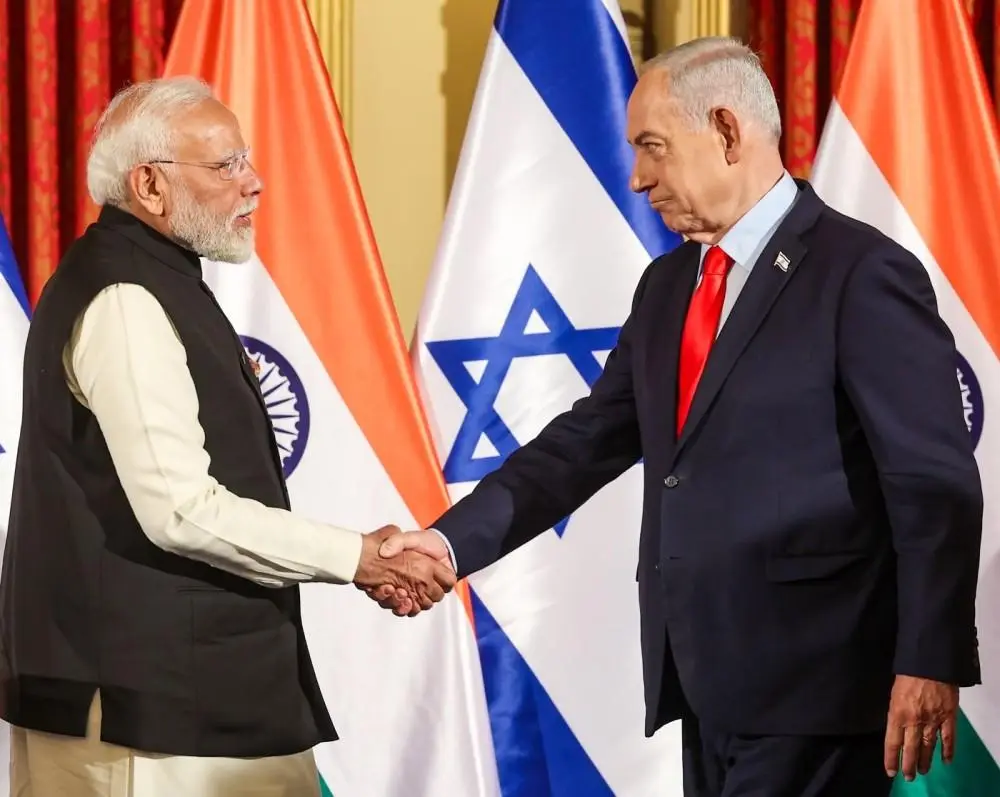
In the third instalment of the series "Israeli Military and Security Influence Around the World," in which Wasl sheds light on the reach of Israeli military and security relations across the globe, we examine one of the most prominent strategic partnerships Israel has built in Asia: its partnership with India.
This relationship is of particular importance given India's geographic location, its demographic and military weight, the ongoing dispute with Pakistan over Kashmir, and the rise of Hindu nationalism alongside violations against Muslims documented by human rights organisations.
Unlike relations confined to the import of weapons and military technology, the Indian-Israeli partnership has evolved to include joint military manufacturing and cybersecurity, and has expanded into the fields of media and influence over public opinion, through programmes that host Indian journalists, influencers and delegations.
First: From Undeclared Relations to Strategic Partnership
India officially recognised Israel in 1950, but did not establish full diplomatic relations with it until January 1992, and for decades remained among the states supportive of the Palestinian cause.
Military relations, however, preceded full diplomatic normalisation. Indian studies indicate that New Delhi received Israeli military assistance during some of its confrontations with China and Pakistan.
The Kargil War between India and Pakistan in 1999 marked an important stage in the development of military relations between the two countries, after Israel provided military assistance to India during the confrontation, which contributed to strengthening its position within India's arms procurement system.
In September 2003, Ariel Sharon became the first Israeli prime minister to visit India, a step that strengthened political and security ties between the two sides.
The most evident shift, however, came after Narendra Modi, leader of the Hindu nationalist Bharatiya Janata Party, became head of the Indian government in 2014, when relations moved to a more open and broader level.
Second: Reciprocal Visits Shape the Alliance

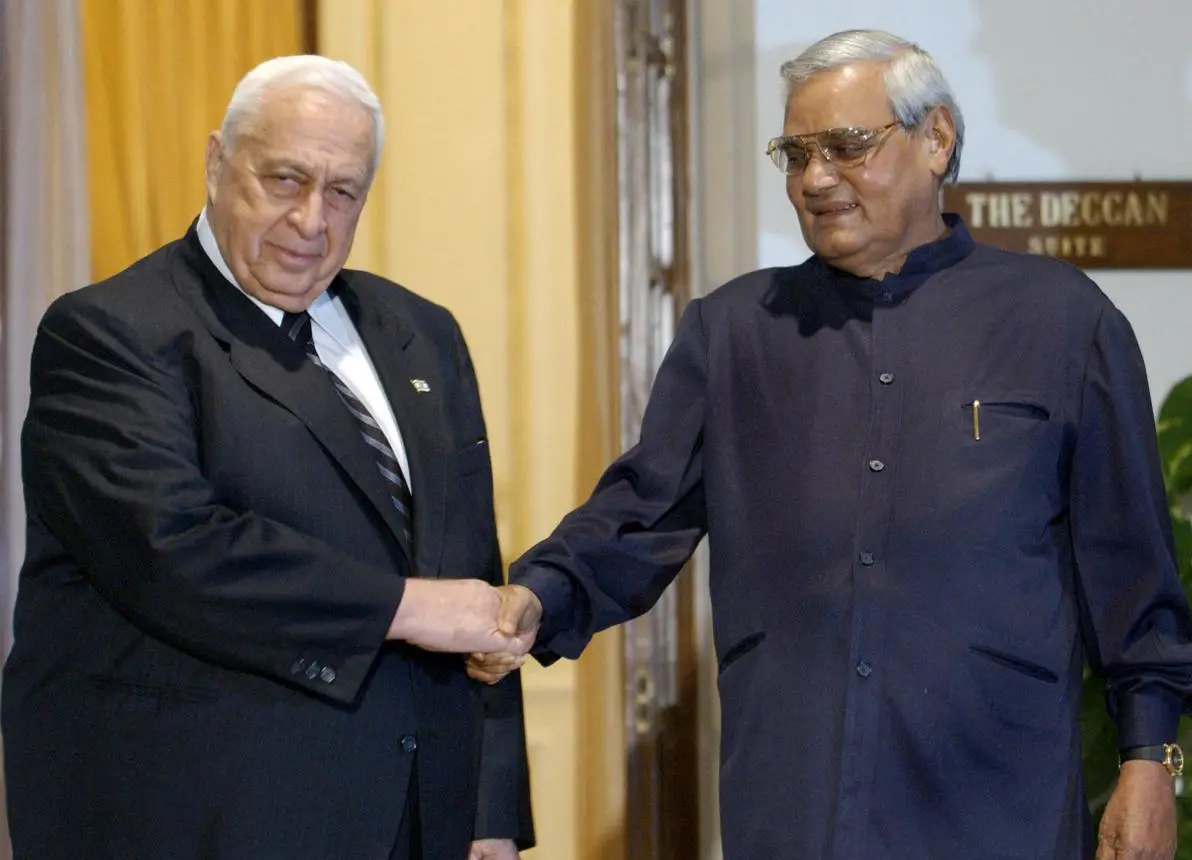
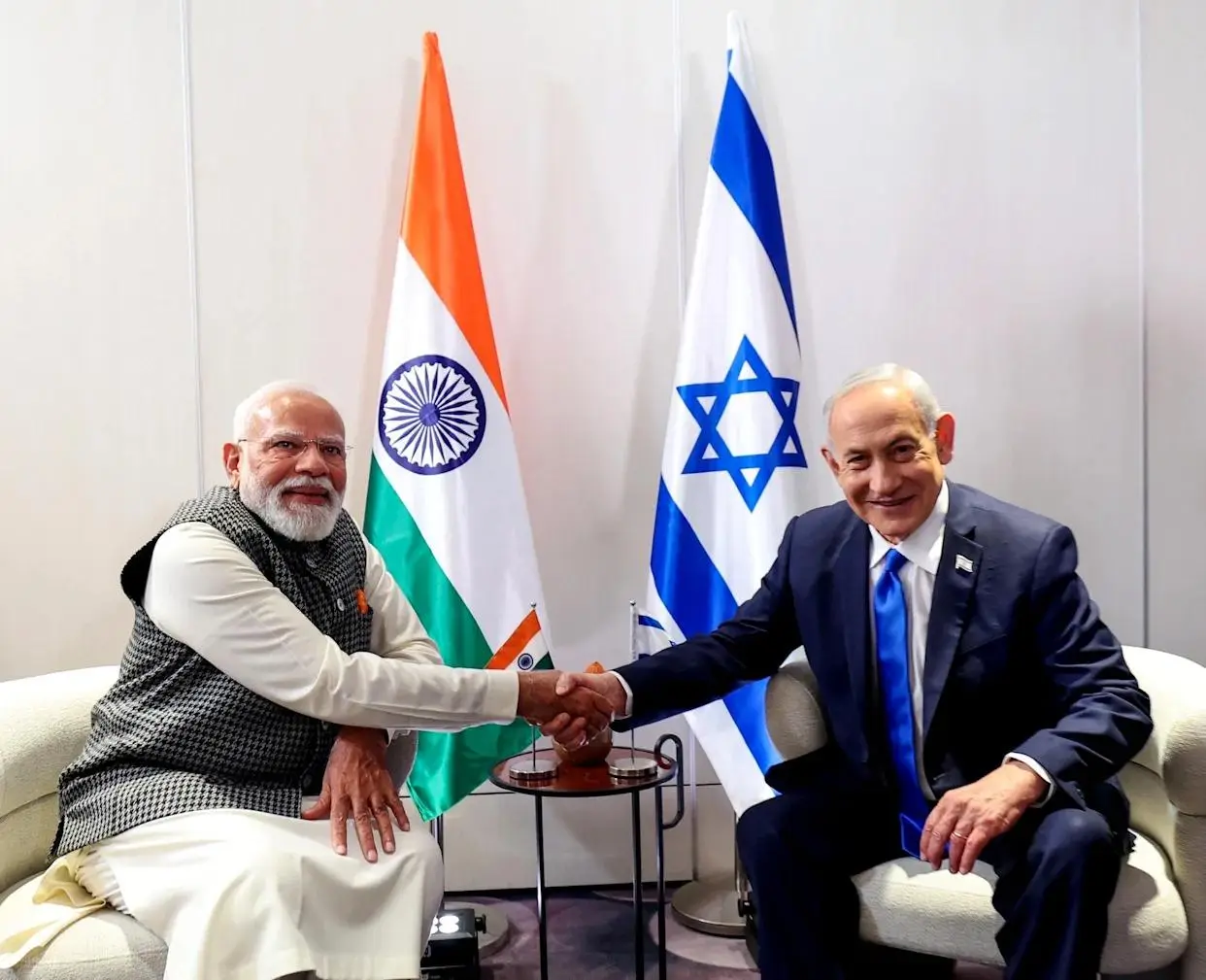
The development of Indian-Israeli relations was not the result of scattered deals, but part of a sustained course of visits, agreements and official meetings.
- September 2003: Israeli Prime Minister Ariel Sharon visits India.
- July 2017: Narendra Modi undertakes the first visit by an Indian prime minister to Israel.
- January 2018: Benjamin Netanyahu visits India.
- March–April 2023: Knesset Speaker Amir Ohana visits and signs a memorandum on parliamentary cooperation.
- November 2025: A new memorandum of understanding on defence cooperation is signed.
- February 2026: Modi's second visit, and relations are raised to a special strategic partnership.
- June 2026: An Israeli defence delegation headed by Amir Baram visits India.
- November 2026: A new contract is signed to upgrade an air defence system belonging to the Indian Navy.
During Modi's visit on 25 and 26 February 2026, the two countries announced the elevation of relations to a "special strategic partnership for peace, innovation and prosperity," covering defence, security, technology, cybersecurity and investment.
On 22 June 2026, Israel's Ministry of Defence announced that its Director General, Amir Baram, held a series of meetings with the Indian Minister of Defence, the Defence Secretary, the Chief of Defence Staff and other officials to discuss expanding defence and industrial cooperation.
These visits reflect the continued development of institutional relations between the two countries, even amid the war on Gaza and international human rights criticism directed at Israel.
Indo-Israeli joint statement | Israeli Ministry of Defence statement on the delegation's visit
Third: India, the Largest Importer of Israeli Weapons
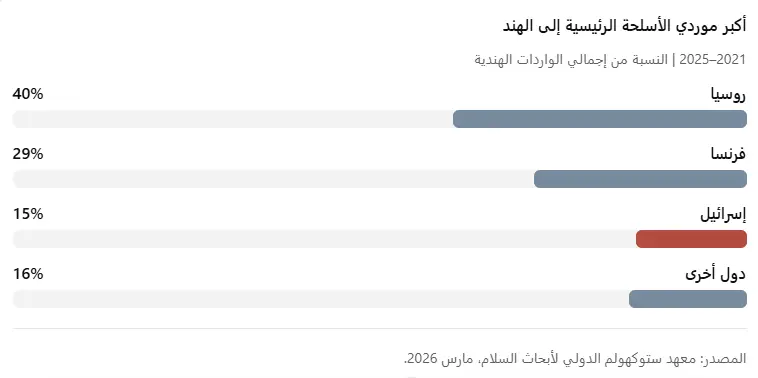
Data from the Stockholm International Peace Research Institute (SIPRI), published in March 2026, reveal the extent of mutual dependence reached in military relations between the two countries.
In the period from 2021 to 2025, India ranked second globally among major arms importers, while Israel became the third largest supplier of arms to India, after Russia and France.
India's imports of major arms during this period were distributed as follows:
- Russia: 40%.
- France: 29%.
- Israel: 15%.
- Other countries: 16%.
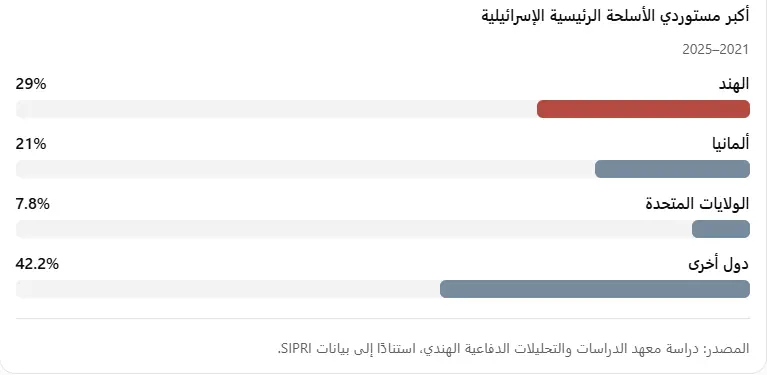
In the opposite direction, during the same period India accounted for 29% of Israel's major arms exports, ahead of Germany at 21% and the United States at 7.8%, while other countries accounted for 42.2%.
These figures show that the relationship is not important to India alone: Israel's military sector in turn relies on the Indian market as one of its most significant external markets.
It should be noted that SIPRI's percentages measure the volume of major arms transfers according to its own methodology, and do not necessarily reflect the financial value of all military deals.
SIPRI report for 2025 | Indian study on Israeli arms exports.
Fourth: From Arms Imports to Military Industrial Partnership
Indian-Israeli defence relations are no longer limited to purchasing ready-made military equipment; they now include research and development, joint manufacturing and technology transfer.
On 4 November 2025, the seventeenth meeting of the Joint Defence Working Group was held in Tel Aviv, chaired by the Indian Defence Secretary Rajesh Kumar Singh and the Director General of Israel's Ministry of Defence, Amir Baram.
The meeting witnessed the signing of a memorandum of understanding to strengthen defence cooperation, with the participation of officials from the planning, research and development, international defence cooperation and security directorates of the Israeli military institutions.
Ahead of Modi's visit in February 2026, Israel's Ministry of Defence organised meetings between Indian and Israeli military industry companies, aimed at expanding industrial partnerships and exploring cooperation opportunities within India's new defence procurement policy.
On 18 November 2026, India announced the signing of a new contract worth approximately $211.5 million with Israel Aerospace Industries (IAI) to upgrade one of the defence systems belonging to the Indian Navy.
Indian government statement on the Defence Working Group meeting | Israeli Ministry of Defence statement on the industrial meetings.
Fifth: India as a Source of Weapons Destined for Israel
On 30 July 2026, Amnesty International published a report titled "Made in India: Supplying Arms and Ammunition to Israel," which reveals the role played by Indian companies in the supply chains of Israeli military industries.
The organisation's investigators analysed data on 2,596 shipments of weapons, ammunition, equipment and military components transported from India to Israel since 7 October 2023.
The report addressed the activities of nine companies in India, and the continuation of export operations despite international warnings of war crimes, crimes against humanity and genocide in Gaza.
Amnesty said that the continuation of these exports could expose India and the companies concerned to the risk of complicity in crimes committed against Palestinians, and called for a comprehensive embargo on the supply of weapons, military equipment, components and related technology to Israel.
The findings of the investigation reveal an important shift in the nature of the partnership: India no longer only receives Israeli military technology, but some of its companies have become part of the supply network that supports Israel's defence industries.
The human rights warning concerns the risks of continuing supply under the documented conditions and crimes.
Original Amnesty International report.
From Political Support to Offers to Fight in Gaza
Support for Israel from some Hindu nationalist organisations has not been limited to political positions and media campaigns; it has reached the level of announcing readiness to take part in fighting against Palestinians.
On 12 October 2023, the organisation Akhil Bharatiya Hindu Mahasabha announced its readiness to send thousands of volunteers to fight against Hamas, while Vishnu Gupta, head of the Hindu Sena organisation, announced that he and some 200 others had volunteered to fight in the ranks of the Israeli army. These statements were cited in the annual report of the United States Department of State on international religious freedom in India for 2023.
The Israeli Embassy in New Delhi also witnessed a gathering of dozens of people who offered to travel to Israel to take part in the war on Gaza.
Alongside these offers, Indian and Israeli sources documented the participation of Israeli soldiers of Indian origin belonging to the Jewish community of Bnei Menashe in military operations inside the Gaza Strip.
These facts show that support for Israel among some Hindu nationalist groups has reached a level that goes beyond political and media solidarity to expressions of readiness for direct military participation, although no independent evidence has yet been available confirming that the Hindu volunteers who declared readiness to fight joined the Israeli army.
Sixth: Training the Indian Police and Cooperation on Internal Security
Security cooperation has not been limited to the armed forces, but has extended to police agencies, internal security and border management.
On 27 February 2014, the Indian Ministry of Home Affairs announced the signing of three security agreements with Israel, covering:
- Cooperation on internal security and public security.
- Protection of classified materials and information.
- Mutual legal assistance in criminal matters.
Since 2015, delegations of Indian police trainee officers have visited Israel's National Police Academy as part of programmes to learn about Israeli security expertise.
The annual report of the Indian Ministry of Home Affairs for 2016–2017 documented the participation of 132 trainee officers from three batches in a training programme with the Israeli police.
In February 2018, the two countries held a meeting of the Joint Steering Committee on internal security and public security, which addressed the development and modernisation of Indian police capabilities and border management.
An official response by the Indian government to Parliament in March 2018 also addressed Israeli offers to train Indian police officers in several security fields.
These programmes are of particular importance because they move cooperation from the level of equipment purchases to the level of training human cadres and developing the institutions tasked with dealing directly with civilian populations.
The three security agreements – Government of India | Joint security committee meeting, 2018.
Seventh: Kashmir at the Heart of Security Relations
Indian-Israeli security relations raise particular questions regarding Kashmir, which for decades has witnessed a wide Indian military and security deployment and violations documented by international human rights organisations.
In an academic study published by Global Studies Quarterly, a journal of Oxford University Press, in 2025, researchers examined the transfer of military expertise and technology between India and Israel, and the influence of training programmes and knowledge exchange on the development of military and security practices.
The study pointed to the participation of elements of the Indian Air Force in military training inside Israel in 2017, as well as repeated visits by high-level Indian military delegations since the early 2000s.
The study also addressed the case in which Israel's Supreme Court, in 2020, rejected a petition by human rights activists seeking to subject the training of Indian police personnel implicated in violations in Kashmir to oversight and to halt their training.
This case shows that concerns about the use of Israeli security cooperation in Kashmir were raised inside Israel itself.
Documenting security cooperation and training alone is not sufficient to establish the responsibility of Israeli trainers for every violation committed by Indian forces, which would require independent investigations linking training programmes to specific field incidents.
The academic study published by Oxford University Press.
Eighth: Digital Espionage and the Pegasus Programme
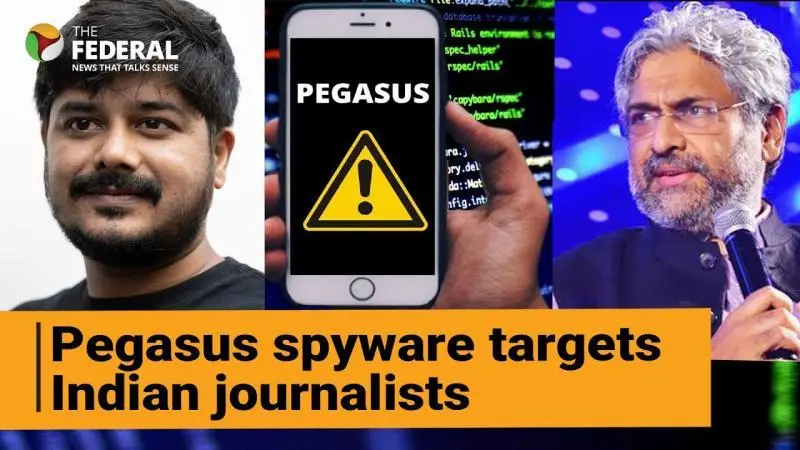
Cooperation in the field of security technology and digital surveillance is one of the most controversial aspects of Indian-Israeli relations.
In December 2023, Amnesty International, in cooperation with The Washington Post, revealed the findings of a technical investigation documenting the targeting of prominent journalists in India using the Pegasus spyware, developed by the Israeli company NSO Group.
Among the journalists covered by the investigation was Siddharth Varadarajan, a co-founder of the Indian outlet The Wire, whose phone the organisation had previously documented being infected with the spyware in 2018.
These facts raise concerns about the use of commercial surveillance technology against journalists and human rights defenders, especially in light of restrictions imposed on journalistic work in India.
However, proving the use of the programme against specific victims does not automatically identify the operator in every case, and official security cooperation between the two countries does not reveal all details of relations between their intelligence agencies.
Agreements on protecting classified information, internal security and cyber cooperation remain public evidence of an institutional framework for this cooperation, while the details of joint intelligence operations remain outside the scope of published information.
Amnesty International investigation into Pegasus in India.
Ninth: Intelligence Cooperation, Relations That Preceded Formal Normalisation
Academic studies of the history of Indian-Israeli relations point to contacts between India's external intelligence service, known as the Research and Analysis Wing (RAW), and Israel's Mossad since the 1970s, that is, about two decades before full diplomatic relations were established between the two countries.
These studies indicate that intelligence contacts continued even during phases in which Indian foreign policy was marked by open support for the Palestinian cause.
The bilateral diplomatic relations established in full in 1992, followed by the development of military and security cooperation, provided a broader framework for cooperation between the security institutions of the two countries.
In February 2026, the agreements signed between the two sides included an agreement on the protection of classified information, according to the Indian Ministry of Defence's annual report for 2025–2026.
However, the secret nature of intelligence work makes it difficult to verify the scale of joint operations, their geographic scope and their objectives through open sources alone.
Tenth: The Media Battle.. Courting Indian Journalists and Influencers
Alongside military and security relations, another avenue of cooperation has emerged, based on hosting Indian media figures, political figures and influencers, within programmes aimed at strengthening popular relations and improving the image of "Israel" among the Indian public.
This activity has gained additional importance since the outbreak of the war on Gaza in October 2023, amid growing international criticism of Israeli military operations.
January 2024.. Hosting Journalists and Influencers from India and Kashmir
The organisation Sharaka, a body established following the Abraham Accords, organised a week-long media visit for a delegation of Indian journalists and influencers, including Hindu and Muslim figures, among them three Muslim writers from Kashmir.
The Israeli website JNS reported on 16 January 2024, citing the organisation's head, Amit Deri, that the aim of hosting the delegation is to convey the narrative that participants become acquainted with during their visit to millions of readers and followers in India.
These statements reveal the importance of the Indian public in Israeli media outreach programmes, and the use of figures with a media presence to reach different segments of Indian society.
January 2025.. Launch of the Indian-Israeli Friendship Project "Maitri"
In January 2025, Sharaka launched a programme under the name "the Indian-Israeli Maitri Project", which hosted a delegation of diverse religious and professional backgrounds, including former Indian political, media, academic and military figures.
Among the prominent participants:
- Swapan Dasgupta, former member of the Indian Rajya Sabha and member of the national executive of the Bharatiya Janata Party.
- Retired General Satish Kumar Dua.
- Retired General Rajinder Ramrao Nimbhorkar.
- Makarand Paranjape, writer, academic and influencer.
- Yusuf Tahir Unjhawala, researcher at the Takshashila Institution.
- Sneehesh Alex Philip, Indian journalist specialising in defence affairs.
The visit lasted six days, concluding on 31 January, and included meetings with experts, public figures and Israeli institutions.
The organisation stated that the project represents an extension of the popular outreach programmes it launched in Arab countries following the Abraham Accords, and which it is working to expand to include South Asia.
Source: Hindustan Times, citing the Press Trust of India.
August 2025.. A Media Trip Funded by the Israeli Embassy
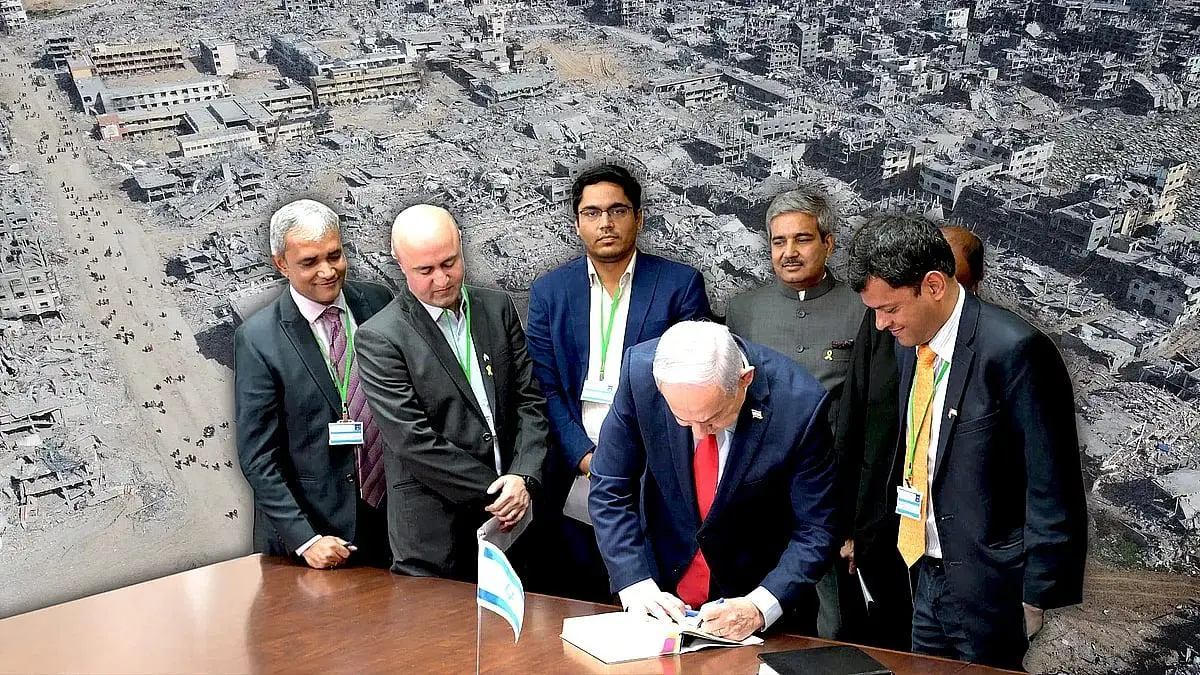
In August 2025, the Israeli Embassy in New Delhi organised a visit for a delegation including journalists from a number of major Indian media organisations.
The Indian website Newslaundry, in an investigation published on 12 August, documented the participation of journalists representing widely distributed media organisations, among them:
- Aditya Raj Kaul (TV9).
- Zaka Jacob (CNN-News18).
- Vishnu Som (NDTV).
- Abhishek Kapoor (Republic TV).
- Siddhant Sibal (WION).
- Manash Pratim (PTI news agency).
- Shubhajit Roy (The Indian Express).
The delegation was accompanied by the Israeli Embassy's spokesperson in India, Guy Nir, and the participants met Israeli Prime Minister Benjamin Netanyahu.
The investigation criticised the limited attention that the coverage of a number of journalists gave to the situation of Palestinians in Gaza, in contrast to the focus on statements by Israeli officials and the Israeli narrative of the war.
On 17 October 2025, the Reuters Institute for the Study of Journalism at the University of Oxford published an article addressing the controversy raised by the Israeli-funded trip, and the professional issues relating to the independence of journalistic coverage when a state party to an armed conflict bears the costs of hosting journalists.
This incident offers a documented example of Israeli public relations activity directed at Indian media organisations, while participation in the trip alone should not be taken as evidence that every journalist is subject to Israeli political direction.
Indian Newslaundry investigation | Reuters Institute for the Study of Journalism.
May 2026.. The Indian-Israeli Friendship Club Hosts Influencers and Political Figures
In May 2026, the "Indian-Israeli Friendship Club" (IIFC) organised a visit for a delegation including Indian political figures, media figures, businesspeople, activists and influencers.
Delegation members met Israeli Minister of Diaspora Affairs Amichai Chikli, and visited the Israeli Knesset, Jerusalem and other areas.
Among the prominent figures covered by media reports on the visit:
- Anshul Saxena: an Indian influencer whom the newspaper Israel Hayom describes as one of the most prominent voices supporting "Israel" on social media platforms.
- Nikhil Chandwani: founder of the organisation "Sindhi Hindu", who had around two million followers on Instagram at the time the report was published.
- Vijeeth Umbalagodu: a specialist in international cooperation who works with a member of the Indian parliament.
The Jerusalem Post, on 27 May 2026, quoted one of the club's founders speaking about the immense potential that the Indian public represents for efforts to improve "Israel's" image globally, particularly in light of declining support for it in some Western societies.
Statements by a number of delegation members also showed a tendency to portray India and "Israel" as civilisational partners facing similar security challenges, particularly concerning Pakistan and Palestinian armed groups.
This visit differs from traditional diplomatic meetings in that it aims to build direct relationships with figures capable of influencing public opinion, rather than with government officials alone.
Jerusalem Post report – 27 May 2026 | Israel Hayom report – 24 May 2026 | Official website of the Indian-Israeli Friendship Club.
Eleventh: Convergence Between Hindu Nationalism and Zionism
The popular and political dimension of Indian-Israeli relations cannot be understood without addressing the rise of Hindutva, which represents the ideological framework of the Hindu nationalist current and is distinct from Hinduism as a religion followed by hundreds of millions of people.
The ruling Bharatiya Janata Party, the Rashtriya Swayamsevak Sangh (RSS), and other organisations associated with the Hindu nationalist current are among the most influential forces in this landscape.
Studies and media reports have addressed points of convergence between Hindu nationalist discourses and some Zionist currents, particularly in conceptions of national identity, security, and the relationship with religious minorities.
On 21 October 2023, activists and leaders of the Vishwa Hindu Parishad (VHP) and Bajrang Dal organised a gathering in the city of Mumbai to condemn the Hamas attack and call for support for "Israel", according to the Press Trust of India.
In November of the same year, the Associated Press published a report addressing restrictions imposed by Indian authorities on some pro-Palestinian events, alongside the widening expressions of support for "Israel" among Hindu nationalist circles.
On the other hand, the Indian government has continued to officially affirm its support for the establishment of an independent Palestinian state, which highlights the need to distinguish between the publicly stated diplomatic position, the actual military relations, and the ideological discourse of Indian political forces.
Coverage of the VHP and Bajrang Dal gathering | Associated Press report.
Hindu-Jewish Religious Meetings
Among the tracks that preceded the current phase of relations is the organisation of meetings between Hindu and Jewish religious leaders.
In February 2007, the first summit of Hindu and Jewish leaders was held in New Delhi, with the participation of the then Chief Rabbi of Israel, Yona Metzger.
In February 2008, a delegation of some 20 Hindu religious figures travelled to Jerusalem, as part of a meeting organised in cooperation with the American Jewish Committee and the Israeli Ministry of Foreign Affairs.
The declared aim of these meetings was to promote religious dialogue and understanding. They represent an additional track of societal relations between the two sides, but their declared religious nature does not in itself make them evidence of military or intelligence cooperation.
Documentation of the Hindu-Jewish summits – World Council of Religious Leaders.
Contradictions of Convergence.. Manifestations of Racism and Insult Towards Hindus
Despite the expansion of Indian-Israeli relations, and the warm welcome that some Hindu nationalist supporters extend to "Israel", this convergence has not prevented the emergence of racist positions and religious insults directed at Indians and Hindus.
On 28 October 2026, the Israeli-American rabbi Yosef Mizrachi provoked a wide wave of criticism after a lecture broadcast from the United States in which he mocked Hindu religious beliefs and practices, particularly the veneration of cows, and his ridicule extended to Indian doctors. His statements caused resentment in Indian and Israeli circles, and the Israeli diplomat Yaniv Rivlin condemned them and apologised for them.
Discrimination was not limited to religious discourse. In February 2026, the Israeli broadcaster Kan revealed an assault on Indian workers in the city of Ashkelon, which it described as a premeditated assault with racist motives. The Israeli Embassy in India condemned it, while an investigation by the Indian website The Quint reported that the assault took place in December 2025, two months before it was publicised in the media.
Discrimination has even extended to some Jews of Indian origin: in 2020, the Israeli magazine +972 documented the exposure of members of the Bnei Menashe community to racist practices, despite their adherence to Judaism and their move to live in "Israel".
These facts reveal the limits of ideological convergence between Hindu nationalist currents and Zionism, and show that political and military partnerships and strategic interests do not necessarily eliminate racial and religious prejudices or achieve mutual social acceptance. The phenomenon remains worthy of monitoring in the context of studying relations between the two sides.
Twelfth: Indian Media Disinformation Regarding the War on Gaza
Among the phenomena documented by fact-checking organisations since October 2023 is the spread of misleading information targeting Palestinians through Indian accounts supportive of "Israel", some of which belong to Hindu nationalist right-wing circles.
The Indian platform Alt News published an extensive investigation addressing the role of Indian right-wing influencers and accounts in spreading inaccurate information about the war, benefiting from follower networks they built in previous years.
The Indian platform BOOM also documented cases of circulating old video footage or footage taken from different contexts, and presenting it as scenes from events in Palestine.
Examples revealed by fact-checking organisations include:
- Circulation of footage of Egyptian military training as scenes of the Hamas attack of October 2023.
- Publication of misleading claims accusing Palestinians of staging scenes of children being injured and killed.
- Use of old footage of injured Palestinian children, accompanied by inaccurate accounts of the war.
- Rebroadcasting of footage of the 2023 bombardment of Gaza on Indian channels, presented as scenes from the Indian military operation against Pakistan in May 2025.
These facts reveal the extension of media disinformation across borders, and the intersection of the discourse of some Hindu nationalist influencers with narratives supporting Israeli military operations.
The consistency of the discourse and the sharing of content raise the possibility of a joint media operations room or direct Israeli funding for the accounts concerned, similar to the Israeli-funded media hosting programmes, for which there is declared evidence.
Alt News investigation into media disinformation | BOOM Indian platform investigation.
Thirteenth: Joint Companies.. Transferring Israeli Military Industries to Indian Territory
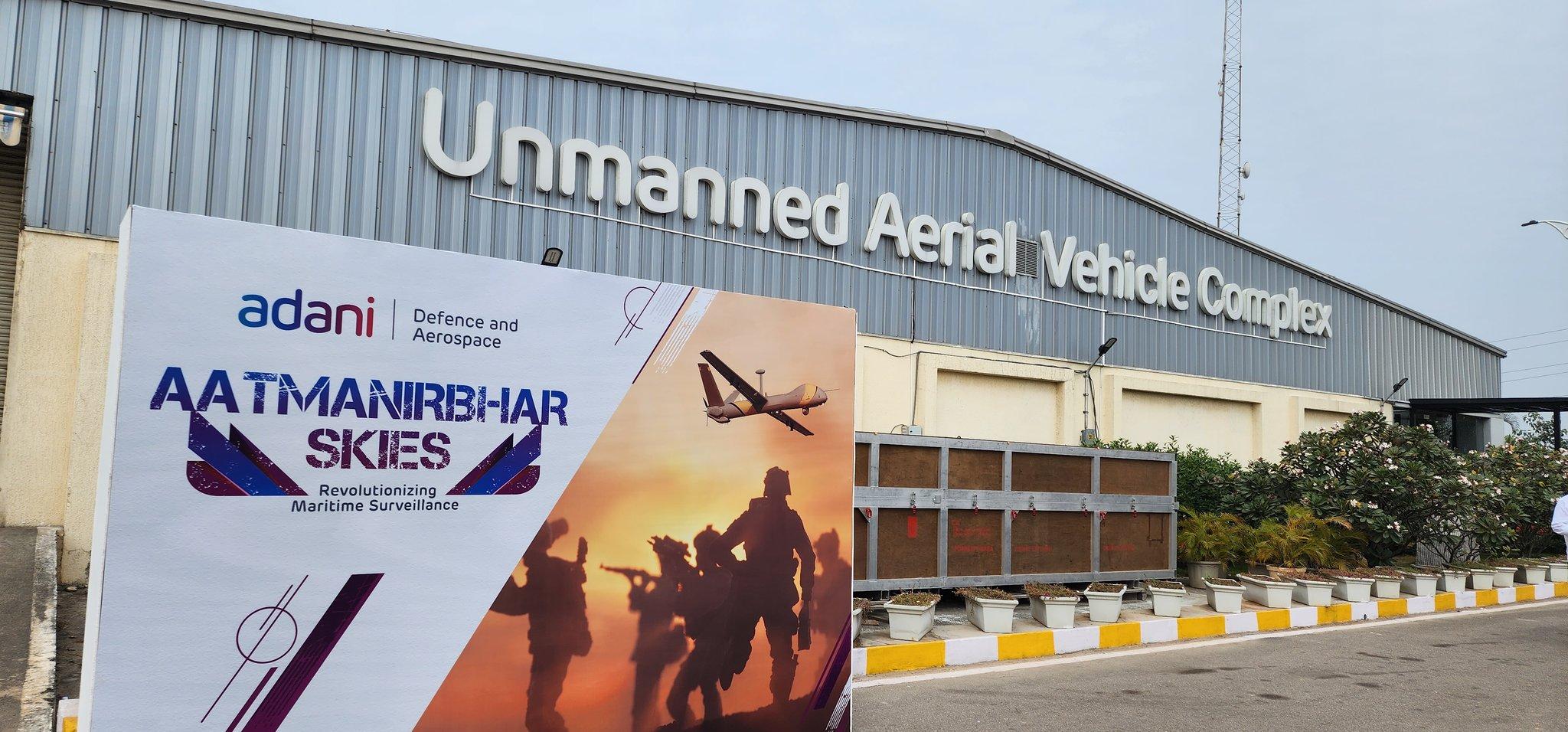
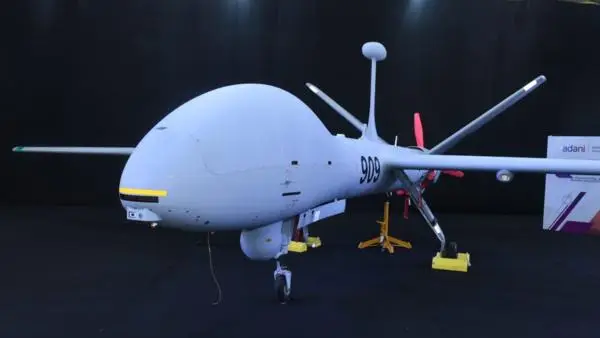


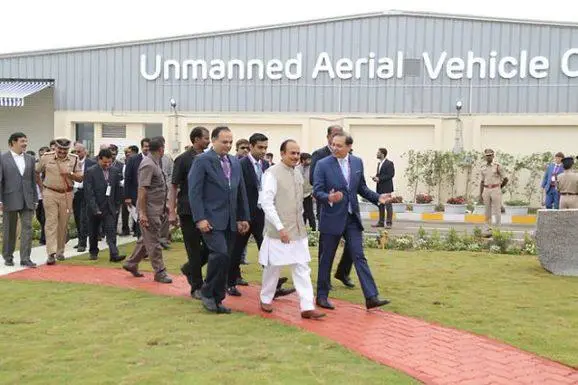

On 14 December 2018, the Indian group Adani and the Israeli company Elbit Systems inaugurated a joint facility for manufacturing drones in the Indian city of Hyderabad.
According to the official announcement by the Adani group, the facility was the first private drone manufacturing plant in India, and the first facility outside "Israel" to manufacture the Hermes 900.
Industrial cooperation between the two countries has also included the development of joint air defence systems between the Defence Research and Development Organisation (DRDO) and Israel Aerospace Industries (IAI), as well as partnerships between other companies in the military industries sector.
These projects serve mutual interests for both sides: India seeks to localise military industries and reduce its reliance on imports, while Israeli companies benefit from Indian industrial capacities, the domestic market and export opportunities.
The importance of these partnerships grows in light of the Amnesty International report issued in July 2026 on the continued flow of military supplies from India to "Israel" during the war on Gaza.
Official announcement by the Adani group on the opening of the facility.
Fourteenth: The Reality of Muslims in India and Kashmir Amid the Expansion of Security Cooperation
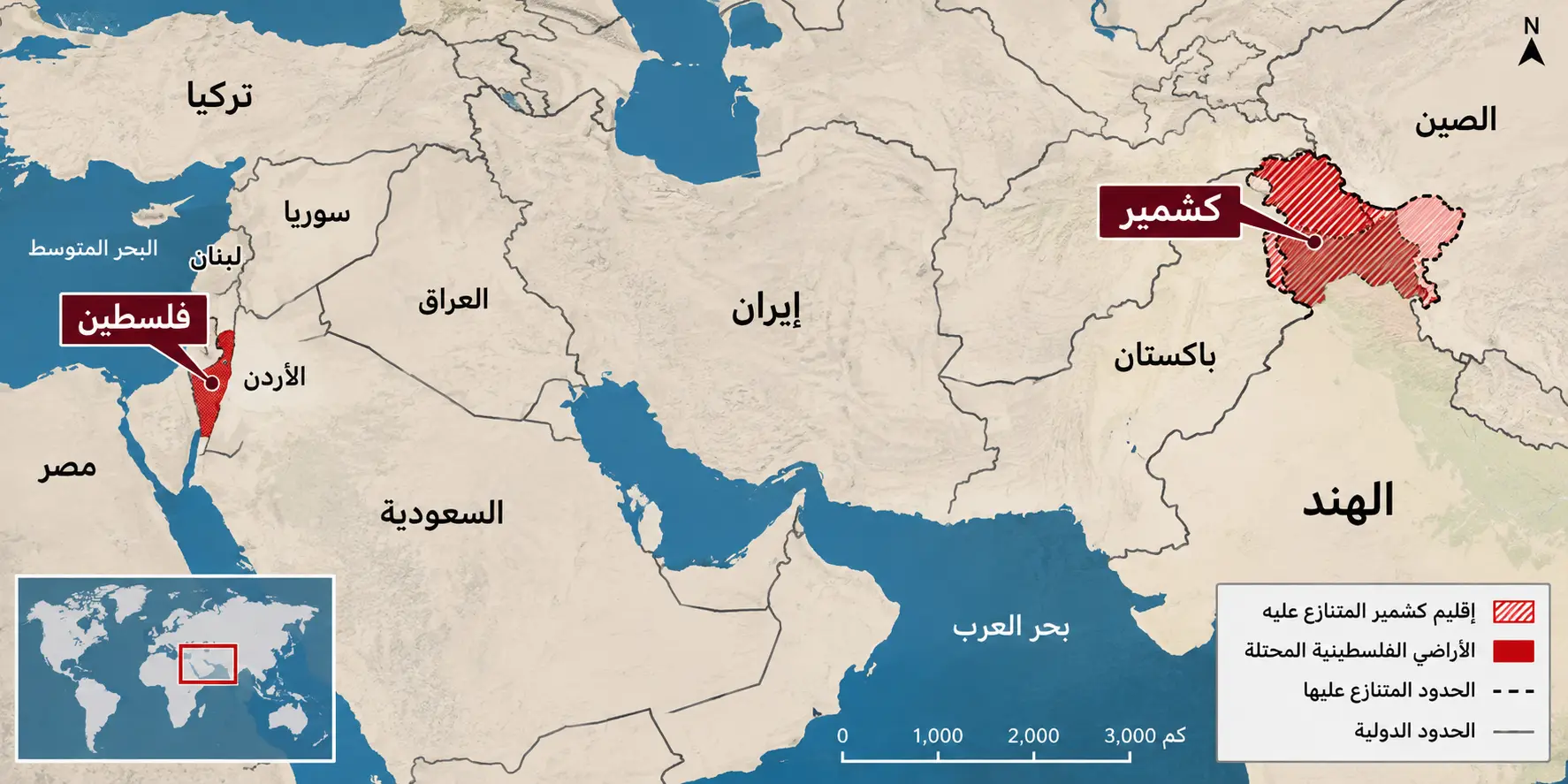
This growing partnership coincides with deteriorating human rights conditions for Muslims in India and Kashmir, according to reports by international human rights organisations.
On 23 November 2026, Human Rights Watch issued an extensive report on the state of democratic and human rights institutions in India under Narendra Modi, based on research and interviews conducted between January 2025 and September 2026.
The report also addressed the restrictions imposed on civil society and the media, statements by government officials and leaders of the Bharatiya Janata Party targeting Muslims and other religious minorities, and impunity in some cases of mass violence.
In its annual report for 2025–2026, Amnesty International also documented large-scale forced evictions affecting Muslims in the state of Assam, the continued use of punitive demolitions in the state of Maharashtra and in Jammu and Kashmir, as well as the prosecution of journalists and activists.
These reports document a critically important human rights context when studying exports of Israeli surveillance technologies and security training programmes to India, as they highlight the need for safeguards that prevent these technologies and expertise from being used to violate the fundamental rights of the population.
The coincidence of these violations with the expansion of security cooperation does not mean that every violation was a direct result of that cooperation. It does, however, raise questions about the responsibility of suppliers of technology, equipment and training for assessing the risks of their use.
Human Rights Watch report – 23 November 2026 | Amnesty International's annual report on India.
Fifteen: A map of the institutions active in Indian-Israeli relations
The entities covered by this monitoring can be classified according to the nature of their activity:
- Government cooperation: the Indian and Israeli ministries of defence.
- Intelligence: Mossad and India's Research and Analysis Wing (RAW), according to historical studies.
- Security training: the Israeli police and the Indian National Police Academy.
- Defence industries: IAI, Elbit Systems, Adani, and the DRDO.
- Digital surveillance: the Israeli group NSO.
- Media relations: the Israeli Embassy in New Delhi.
- Hosting of influencers: the Shraddha Foundation and the Indo-Israel Friendship Club.
- Political and ideological activity: the Bharatiya Janata Party and Hindu nationalist currents.
- Pro-Israel popular mobilisation: organisations such as the VHP and Bajrang Dal.
These entities do not represent a single organisation or a network under unified leadership; rather, they operate along different tracks, and some of their activities intersect in strengthening relations between the two countries.
From Palestine to India: The bulldozer as a tool of punishment and displacement, paid for by Muslims

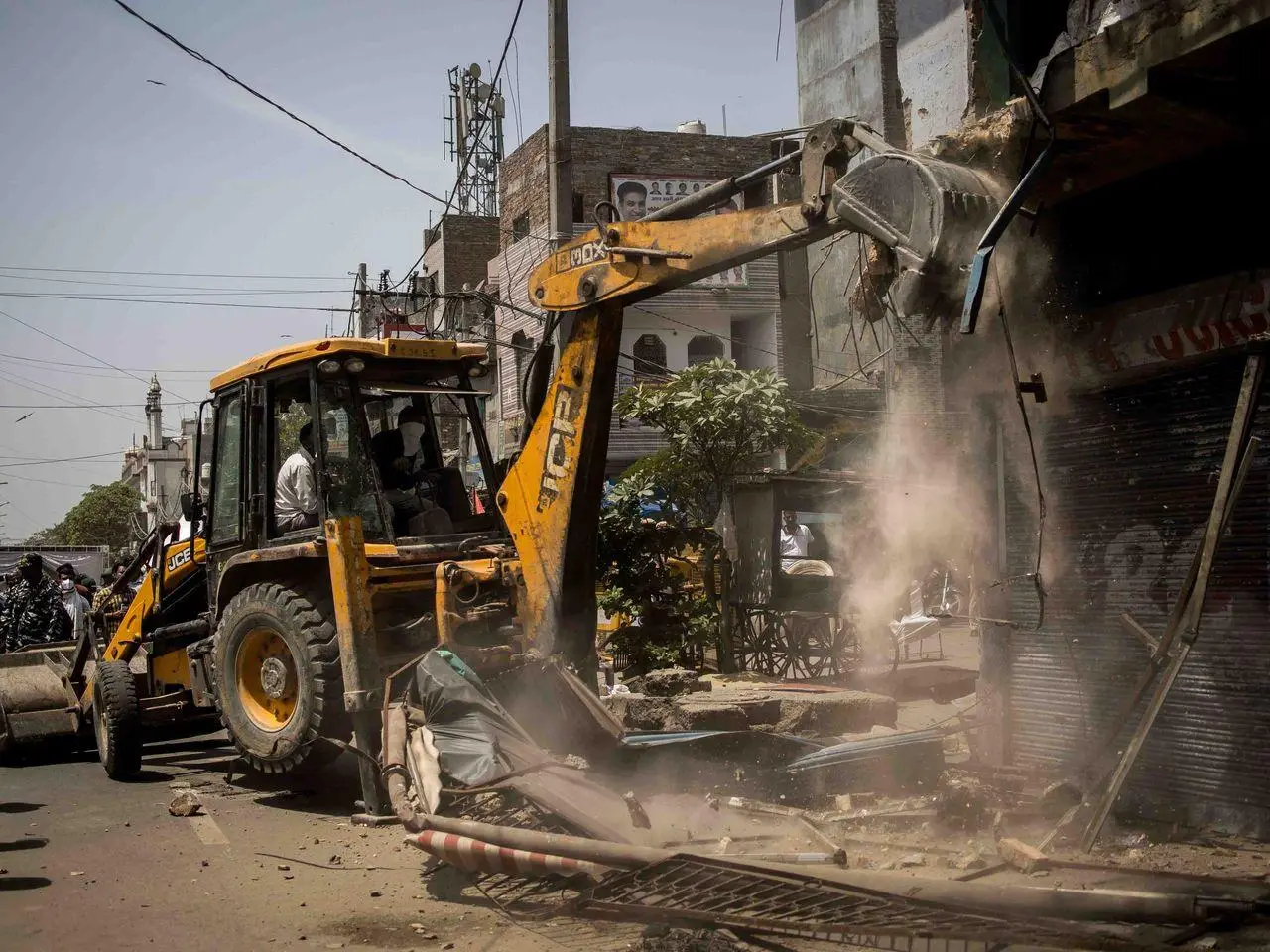
An Israeli bulldozer demolishing a Palestinian home in occupied Jerusalem. And a Hindu bulldozer demolishing property in the Jahangirpuri neighbourhood of New Delhi.
The policy of demolishing homes with bulldozers is among the most prominent points of similarity between Israeli practices against Palestinians and the practices of Indian authorities against Muslims, what is known in India as "Bulldozer Justice", a practice that has received the backing of leaders and supporters within the Hindu nationalist Bharatiya Janata Party.
In a report issued by Amnesty International on 7 February 2024, the organisation documented punitive demolitions that affected 128 properties in five Indian areas during the period from April to June 2022, considering that these practices constitute forced eviction, collective punishment and arbitrary action. On 13 November 2024, the Indian Supreme Court issued a ruling rejecting the use of property demolition as a means of punishing accused persons outside judicial procedures.
In Palestine, the Israeli human rights organisation B'Tselem documented the policy of demolishing the homes of families of Palestinians accused of carrying out attacks, and described it as collective punishment, while the Israeli authorities justify this policy on grounds of security deterrence.
Thus, points of similarity emerge in the use of the bulldozer as a tool of punishment and intimidation, such that the penalty is not limited to the accused individual but extends to his family, depriving them of their shelter, property and the means of their stability.
Despite the differences in the legal and political frameworks of the two cases, the similarity in practice and in human impact is clear, and it reveals how Indian authorities align with a well-known policy of persecution used by "Israel".
Conclusion
The study of Indian-Israeli relations reveals a multidimensional model of Israeli influence in India, in which military, economic and security interests intertwine with political, media and societal relations.
India represents one of the largest markets for Israeli arms, hosts facilities for joint military manufacturing, and its companies have become part of the supply chains directed to "Israel". At the same time, the relations extend to police training, security cooperation and digital surveillance technologies.
On the media level, Israeli efforts are no longer limited to communication with the Indian government; they now include hosting journalists, influencers, and political and religious figures, in an openly declared endeavour to strengthen popular support and improve the image of "Israel" among an audience exceeding one billion people.
As for rapprochement with Hindu nationalist forces, it adds an ideological dimension to this relationship that is evident in political discourse, popular mobilisation and digital activity.
The convergence between Hindu nationalism (Hindutva) and Zionist currents is manifest in a discourse that links religious and national identity with the concept of the state and security, and that justifies policies of exclusion and restriction against Muslims. From India to Kashmir and Palestine, manifestations of suffering are similar in displacement, house demolition, confiscation of land, restriction of freedoms and security prosecutions. This rapprochement acquires a dimension that goes beyond the ideological discourse with the widening of military, security and media cooperation between India and "Israel", although the historical and legal contexts of each case differ.
The importance of following this file lies in the fact that the effects of military and security cooperation do not stop at the borders of the states that sign the agreements; they may extend to the communities where the weapons, technologies and security expertise are used, which makes holding accountable the suppliers and users of these tools a human rights necessity.
From Gaza to Kashmir, there is a need for independent investigations that determine the responsibility of each party for the violations, trace the paths of weapons, technology and training, and reveal what is proven of the forms of cooperation, far from exaggerations and unsubstantiated accusations.
Key references
- Indian-Israeli joint statement – February 2026: The bilateral agreements and the strategic partnership.
- Stockholm International Peace Research Institute (SIPRI) – March 2026: Trends in international arms transfers and the volume of India's imports of Israeli weapons.
- Israeli Ministry of Defence – June 2026: The visit of the Israeli defence delegation to India and the strengthening of military cooperation.
- Amnesty International – July 2026: The "Made in India" report on Indian arms and ammunition exports to "Israel".
- Academic study published by Oxford University Press – 2025: The transfer of technology and military expertise between India and "Israel".
- Amnesty International – December 2023: An investigation into the use of the Israeli spyware "Pegasus" to target Indian journalists.
- Human Rights Watch – 23 November 2026: Human rights violations and the decline of democratic institutions in India under Narendra Modi.
- Newslaundry, Indian news website – 12 August 2025: An investigation into the visit of the Indian media delegation to "Israel", the names of the participants and the nature of their coverage.
- Reuters Institute for the Study of Journalism, University of Oxford – 17 October 2025: The funding of Indian media trips and the debate over the independence of journalistic coverage.
- The Jerusalem Post – 27 May 2026: Hosting influencers and Indian figures within programmes to strengthen popular and media relations.
- The Week, Indian magazine – 12 October 2023: A Hindu nationalist organisation's announcement that it is prepared to send volunteers to fight alongside "Israel".
- Al Jazeera – 25 October 2023: Pro-"Israel" gatherings in India and the restrictions imposed on events in solidarity with Palestine.
- U.S. Department of State – International Religious Freedom Report for India, 2023: Documentation of statements by Hindu nationalist organisations regarding volunteering to fight alongside the Israeli army.
- Shavei Israel – 10 January 2024: The participation of Israeli soldiers of Indian origin belonging to the "Bnei Menashe" community in the war.
- +972 Magazine, Israeli publication – 2020: Manifestations of racism and discrimination against Jews of Indian origin.
- The Quint, Indian news website: An investigation into the assault on Indian workers in the city of Ashkelon and the racist motives of the incident.
- NDTV, Indian channel – 30 October 2026: Offensive statements by the Israeli-American rabbi Yossi Mizrachi about Hindus.
- India Today – 30 October 2026: The insult to Hindu beliefs and Indian doctors, and the reactions to those statements.
- Amnesty International – 7 February 2024: A report on punitive bulldozer demolitions targeting the property of Muslims in India.
- Reuters – 13 November 2024: The Indian Supreme Court's ruling on punitive demolitions and the controls on property demolition.
- B'Tselem, Israeli human rights organisation: Documentation of the policy of demolishing Palestinian homes as a form of collective punishment.
- Amnesty International – September 2024: An investigation into the wanton destruction of property in the Gaza Strip.
- United Nations – Punitive demolition of Palestinian homes in the West Bank
- Indian Ministry of Defence – statement on the military deal of 18 November 2026
- Reuters – India's deal with Israel Aerospace Industries
- Stockholm International Peace Research Institute – full report (PDF)
- ThePrint – The historical relations between Indian and Israeli intelligence
- Annual report of the Indian Ministry of Home Affairs 2016–2017


