

India deports Muslims, including its own citizens, after violence in Kashmir
For the past decade, Mustafa Kamal Sheikh set up a temporary stall opposite a police station in a working-class suburb of Mumbai. His specialty was jalmuri, a spicy snack made of puffed rice and spices. Police officers often came to him to eat and chat.
On a day in Dhul-Hijjah (June), two police officers came to his home and asked for his identity. He showed them four cards, including one identifying him as a voter in Indian elections. Kamal says the officers accused him of forging it and detained him. Mustafa denies this charge.
Mustafa Kamal, 52, was not given any phone call or lawyer. Over the following five days, he says, police and a team from the Border Security Force flew him more than a thousand miles to the Indian-Bangladeshi border.
At midnight, Kamal says: "The border guards gave us 300" taka - less than $3 - "and ordered us to cross." He recalls the guard saying: "If you come back, we will shoot you." He says he was part of a group of several dozen people - all Muslims who had been arrested in Mumbai.
He says Indian border guards allowed him to return to India two days later, after videos spread on Indian social media showing him and two Indian Muslims who had been expelled weeping near the border, recording their Indian addresses, along with their postal codes.
The Maharashtra state police, accused of detaining Kamal, did not respond to NPR's requests for an interview.
The crackdown came after attacks in Kashmir.
Human Rights Watch, which has been monitoring these expulsions, says an intensive crackdown began in Dhu al-Qadah (May). At the time, local media reported that the Hindu nationalist government of Prime Minister Narendra Modi had ordered the deportation of "illegal immigrants" after gunmen opened fire on tourists in Pahalgam in the Indian-administered part of Kashmir in Shawwal (April). India blamed Pakistan for the attack, which killed 26 people, leading to four days of fighting in Dhu al-Qadah (May). Pakistan denies any involvement in any wrongdoing.
India has not published any figures on the deportations, but a Human Rights Watch report, citing Bangladeshi border guards, said Indian authorities expelled more than 1,500 people to neighbouring Bangladesh and Myanmar between 9 Dhu al-Qadah and 19 Dhu al-Hijjah (7 May and 15 June). This included Indian citizens and around 100 Rohingya refugees, a mostly Muslim minority that fled ethnic cleansing in Myanmar.
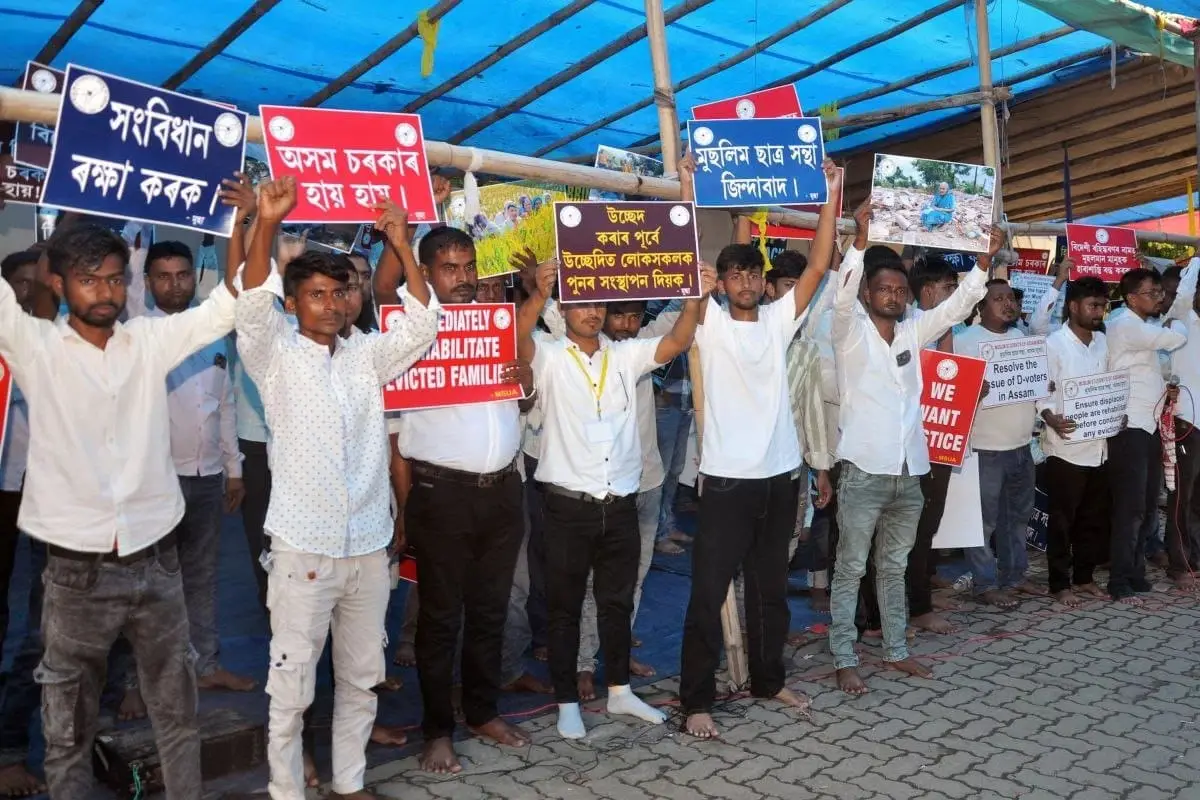
The human rights organisation says Indian authorities expelled people without any legal procedures. Reuters and local media reported that authorities in the Indian states of Assam and Gujarat demolished homes of Muslim families with bulldozers, and arrested many of them in other states across India.
As with Mustafa, most of the people targeted by the authorities were working class and Bengali-speaking, a language shared by the Indian state of West Bengal and neighbouring Bangladesh.
Meenakshi Ganguly, deputy Asia director at Human Rights Watch, says the shared language made them easy targets, because Bengalis migrate to more prosperous India, largely for work.
This is the latest step in a campaign that has lasted for years by Modi's government to target Muslims. In 1440 AH (2019 CE), Modi's Hindu nationalist Bharatiya Janata Party (BJP) used the controversial Citizenship Amendment Act to target and expel Muslim citizens from the state of Assam. In the same year, the party's leader Amit Shah, who now heads the powerful Ministry of Home Affairs, promised at an election rally that if his government were elected, they would find the "infiltrators" and "throw them into the Bay of Bengal."
During the months-long crackdown that followed the armed attack on 17 Shawwal (April), some Rohingya refugees said this is exactly what the Indian government did.
Rohingya targeted
For more than a decade, the Sheram Vihar neighbourhood of New Delhi has been a refuge for dozens of Rohingya families. They live in dilapidated houses, propped up by bamboo poles and tarpaulin, with rats scurrying in and out.
In the first week of May, police came and asked them to attend for biometric verification.
Nooruddin, a resident who uses only one name, says: "My parents and my brother went with more than a dozen others, but they did not come back." Four days later, his brother called him from a phone number in Myanmar.
Nooruddin recalls his brother saying that Indian security personnel flew them to the Andaman Islands in eastern India, forced them onto a warship, and took them near the Myanmar coast before dawn. They gave them life jackets and ordered them to jump into the sea.
Nooruddin's brother said during the call that a rebel army fighting against the military council in Myanmar was providing shelter for his brother and parents.
Nooruddin says: "They would have died had a group of Burmese fishermen not spotted them and rescued them shortly afterwards. The police only spared me because my wife had recently miscarried."
Rohingya residents said a similar crackdown broke out in the Autam Nagar neighbourhood of New Delhi at roughly the same time.
The number of Rohingya living in India is estimated at around 40,000. Many are registered with the United Nations High Commissioner for Refugees. Until 1439 AH (2018 CE), their registration with the commission enabled them to access government schools and hospitals. But the situation has changed since then.
Ahead of the local legislative elections held in New Delhi earlier this year, the BJP, which governs at the federal level, promised to deport Rohingya refugees within two years if it won. The party won a majority of more than two-thirds.
Last month, the official X account of the BJP in one of these states posted an AI-generated video warning of a large influx of Muslims wearing skullcaps and niqabs unless the party returned to power in the elections.
For those who were forcibly expelled, such as Mustafa Kamal, memories of the forced expulsion remain vivid.
He is now in his mother's village in West Bengal. He says he wants to return to selling jalmuri in Mumbai, where he can earn a much higher income than he does working on a farm in his homeland. If police come to arrest him, he will feed them too.
He says there will be no choice, citing an Indian proverb meaning "when you live in the sea, do not make crocodiles your enemies."
NPR.


