


Four years ago, the United States recognised the genocide my people had suffered, and countries around the world rushed to help us. Today, we are calling on the world to uphold that commitment. What do we need to save lives, protect the local environment, and even save money for Rohingya refugees?
Cooking gas.
I am Ajas Khan, from Rakhine State, Myanmar. As a child, I played football with my friends, we laughed together, and we dreamed of our future. But when I was thirteen years old and studying at the village school, the Rohingya faced unspeakable horrors at the hands of the Myanmar army. The military junta's terrorists burned our villages, killed families, and tried to erase generations of my people. My family fled, along with more than 750,000 Rohingya, on foot to Bangladesh, carrying nothing but pain and loss. It is now impossible to contact those friends with whom I once lived and dreamed.
This crisis drew wide international attention in 2017. Relief organisations poured hundreds of millions of dollars into funding our basic survival needs in the Cox's Bazar camps for two years. But no organisation provided cooking fuel. We cooked food using plastic bags, donated clothing, and firewood cut from trees in the nearby Teknaf forest. This destroyed the forest, fuelled tensions with local residents, and kept Rohingya children from going to school because they were busy collecting firewood. However, in 2018, when the United Nations High Commissioner for Refugees and the International Organization for Migration agreed to provide cooking fuel in all the camps in the form of liquefied petroleum gas, many of these problems subsided.
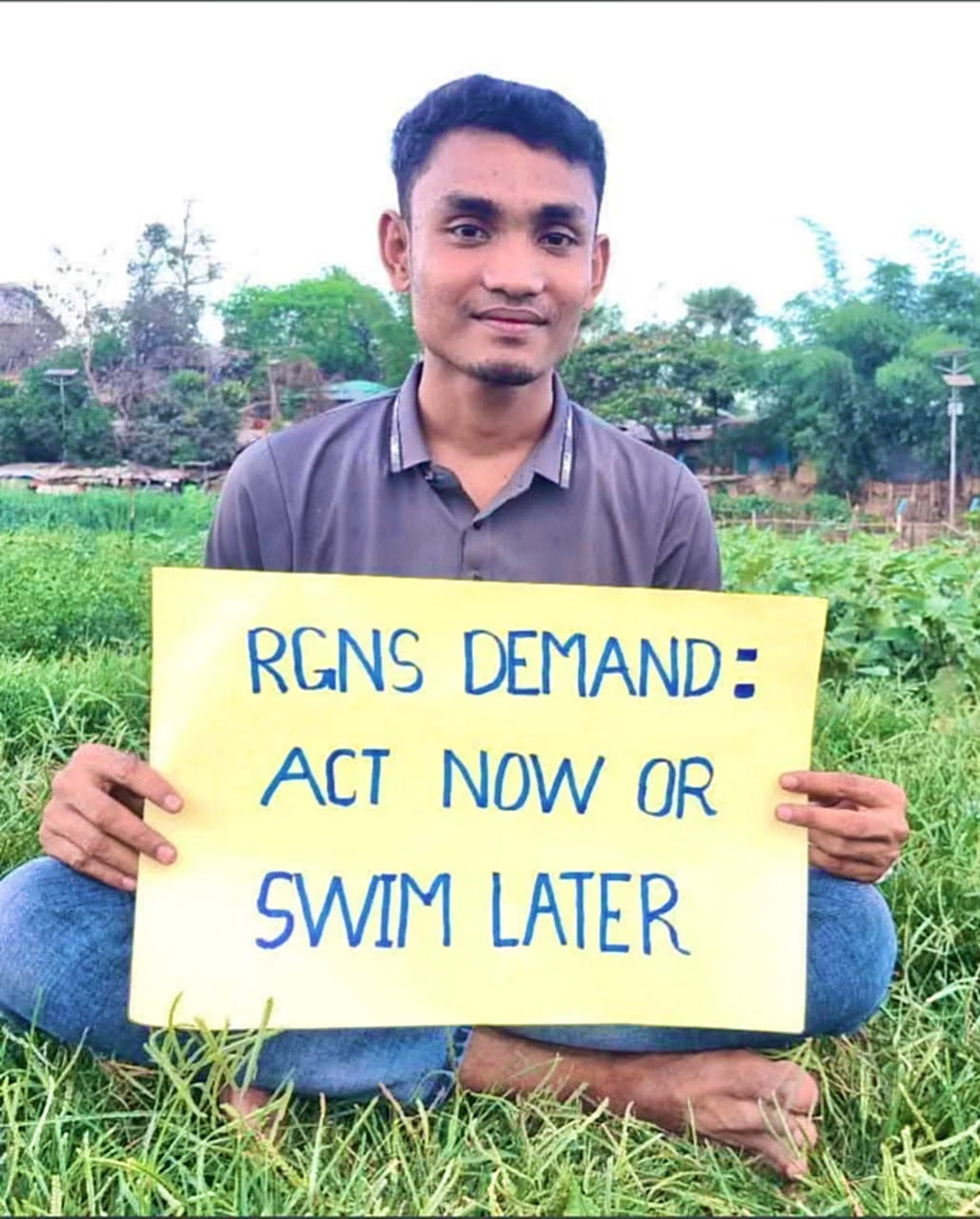
Ajas Khan holds a sign that reads: RGNS demand: act now or you will regret it later.
Ajas Khan says: "The financial importance of investing in the Rohingya people goes far beyond simply saving money."
But today, with shrinking international aid funding, fuel funding has once again declined, threatening the food security of the Rohingya and the safety of what remains of their forests. In 2024, the United States was the largest donor to the Joint Response Plan for the Rohingya, contributing approximately $145 million (£110 million). Despite our people's needs, the United States cut nearly a third of its spending to $100.7 million in 2025, and funding for the Rohingya plan fell from 68% to 46%. Life-saving services were given urgent priority, which drained liquefied petroleum gas funding.
Last July, Babar Baloch, a spokesperson for the United Nations High Commissioner for Refugees, said that without an immediate injection of funds, liquefied petroleum gas would run out. Since then, countries such as China and South Korea have provided aid. However, the Chinese scheme only continues until October and excludes more than 80,000 households. The Korean scheme provides assistance to only 17 camps out of 33. We welcome all kinds of assistance, but all Rohingya need fuel, and without additional support, my people will be forced to search for firewood, plastic or other waste to heat their food.
These problems can only be avoided by resuming the liquefied petroleum gas programme. Before last year, the camps were greener and people were more optimistic. But it seems the United States has decided that providing this hope is not in its interest. This could not be further from the truth.
There is no escaping the harshness of life in the camps, and it is made worse by the prohibition on Rohingya working or pursuing higher education in Bangladesh. In these harsh conditions, refugees have to rely on aid to meet their most basic needs.
Many types of fuel can be used, such as electricity and biogas, but redistributing liquefied petroleum gas remains the most feasible option. Some refugee camps around the world use biogas and electricity systems, but a study conducted by the International Centre for Diarrhoeal Disease Research in Bangladesh and Stanford University in the United States in 2025 concluded that these solutions are difficult to implement in camps given limited land and infrastructure. Small-scale electricity grids and small-scale biogas cooking solutions could reduce dependence on fossil fuels, but they are costly and have not been tested in humanitarian contexts. Distributing liquefied petroleum gas is not free of pollution, but its emissions are minimal compared with large-scale deforestation and the toxic burning that occurs when refugees are left to cook with residue and waste.
The financial importance of investing in the Rohingya people goes far beyond simply saving money in the short term. Last year's funding cuts have destabilised an already fragile natural and social environment, greatly increasing the cost of restoring stability later. And while crises and disasters have become routine for Rohingya refugees, the decline in humanitarian aid is creating a new state of instability that could cost lives. Emergencies such as severe weather or difficult economic conditions are inevitable.
Joe Phillips, the country director of Amida, an American development charity, said: "Shocks will always cause serious harm to people on the ground, but with donor funding drying up… the shocks will be harsher." For the Rohingya, the continued drying up of funding will determine how harsh future shocks will be.
When my family and I finally left danger and tragedy behind us in our homeland, Myanmar, it was humanitarian aid that enabled us to find safety in the Bangladeshi camps. I was able to complete my secondary education after just three years, and although little progress has been made towards the dignity of my people, my education has enabled me to work on behalf of my community. Since then, I have founded the Rohingya Green Nature Society to promote environmental sustainability and education for my people. The same support that enabled me to start my work can ensure that the next generation does not have to choose between collecting firewood and going to school.
Restoring liquefied petroleum gas to my people is simple; sometimes the simplest ideas can bring about the greatest change.
A report from the British newspaper The Guardian by Ajas Khan.


