


The following is a background of the complex conflict in Mali, beginning with its historical roots in the repeated Tuareg rebellions, passing through the emergence and development of the Group to Support Islam and Muslims (JNIM), and arriving at the current developments, the main parties to the conflict, their doctrines, objectives and alliances.
The historical roots of the conflict in Mali
The conflict in Mali goes back to deep roots reaching into the post-independence period, when the national state inherited borders drawn by colonial powers without regard for the social and cultural structure of the desert north. Since then, the relationship between the central government in Bamako and Tuareg communities has been marked by a chronic state of tension and mistrust, fed by policies of marginalisation and weak "national" integration.
The Tuareg, a Berber desert people with a traditional way of life that crosses borders, regard Azawad as their vital historical domain, not merely an administrative region. Accordingly, their demands were not limited to improved services or political representation; they took on an identity-based and sovereignty-based character, ranging between self-government and full independence.
This tension manifested itself in a series of successive rebellions, which almost form a cyclical pattern reflecting a structural failure in the state's management of the northern file:
- The 1962–1964 rebellion: the first armed eruption after independence, led by traditional tribal leaders, but it was met with harsh military retaliation that deepened feelings of estrangement rather than containing them.
- The 1990–1996 rebellion: it came in the context of broader internal unrest, was linked to the fall of Moussa Traoré's regime, and ended with "peace" agreements that were not fully implemented, keeping the roots of the crisis alive.
- The 2006 rebellion: it was shorter in duration but qualitatively significant, as it saw the emergence of Iyad Ag Ghaly, who would later become one of the most prominent jihadist actors in the region, indicating the beginning of the overlap between the local dimension and transnational ideologies.
- The 2012 rebellion: it marked the most significant turning point, as state control over the north collapsed for a period, in parallel with the repercussions of the fall of the Libyan regime, which unleashed a wave of weapons and fighters flowing into the region and reshaped the balance of power in the Sahara.
It is noteworthy that these rebellions do not erupt from a vacuum; they often result from the accumulation of grievances, corrupt and unjust policies, the continuation of political and economic marginalisation, the exploitation of the country in favour of foreign agendas, and external domination. With each round of conflict the gap deepens further, and the region becomes more receptive to new actors, whether local rebel movements or transnational jihadist groups.
The emergence of the Group to Support Islam and Muslims (JNIM)
The Group to Support Islam and Muslims (JNIM) is one of the most significant transformations in the armed landscape of the African Sahel. It was formally established on 2 March 2017 through the merger of four armed movements that had been operating in parallel and overlapping fashion in northern and central Mali: Ansar Dine, the Al-Mourabitoun battalion, the Macina Liberation Front, and the Sahara branch of al-Qaeda in the Islamic Maghreb (AQIM).
This merger represented a qualitative shift from organisational fragmentation to consolidation under a single umbrella ideologically linked to al-Qaeda, giving the group greater capacity for coordination and for expanding the scope of its operations. Today, the Group to Support Islam and Muslims is regarded as al-Qaeda's official arm in Mali and the Sahel, with a discourse based on a Salafi-jihadist frame of reference, aiming to reshape the political sphere in line with its Islamic vision.
The main components of the group
- Ansar Dine: led by Iyad Ag Ghaly, one of the most prominent Tuareg leaders who moved from nationalist movements to the jihadist project, reflecting complex shifts in the intellectual structure of the conflict.
- The Al-Mourabitoun battalion: founded by Mokhtar Belmokhtar, later merged into the Group to Support Islam and Muslims, with a transnational character that reinforced the regional dimension of the conflict.
- The Macina Liberation Front: led by Amadou Koufa, active mainly in central Mali, benefiting from ethnic tensions and social fragility in that area.
- The al-Qaeda in the Islamic Maghreb branch (AQIM – Sahel): forms the most prominent ideological and military backbone of this merger, providing the group with organisational expertise and network ties to the parent organisation. It can be said that it works to implement al-Qaeda's strategy in the Sahel.
Doctrine and objectives
The Group to Support Islam and Muslims proceeds from a Salafi-jihadist doctrine which holds that the existing political order in the region's states is illegitimate, and calls for the application of Islamic Sharia and the establishment of an independent religious political entity in West Africa. It also places at the top of its objectives the expulsion of foreign forces, especially French and international ones, and regards local governments as "illegitimate" regimes that must be toppled.
These objectives, however, rest not only on their doctrinal dimension but are also tied to a turbulent social and political context, in which the fragility of the state, the overlap of local identities, and the security vacuum in some areas have provided a fertile environment for the growth and expansion of insurgent jihadist organisations.
Current developments, alliances and objectives (2024–2025)
In recent years Mali has gone through a highly turbulent phase, marked by an acceleration of military and political events and the collapse of the balances established under the 2015 Algiers Peace Agreement. The gradual erosion of this agreement reopened fronts of fighting in the north and centre and returned the conflict to its open armed character, amid profound shifts in the map of regional and international alliances.
- The collapse of the Algiers Agreement and the escalation of violence
The collapse of the Algiers Agreement marks a pivotal turning point in the course of the Malian crisis, as it led to the dissolution of the political framework that had aimed to contain the Tuareg demands and regulate the relationship between them and the state. With the fall of this framework, armed confrontations returned forcefully, particularly in northern and central Mali.
In July 2024, the Tinzaouaten area witnessed a large-scale battle between the Malian army, supported by Russian Wagner mercenaries, on one side, and Tuareg fighters within the "Permanent Strategic Framework for Peace, Security and Development" (CSP), along with elements of the Group to Support Islam and Muslims (JNIM), on the other. The battle ended with heavy losses for the army and its allies, indicating the complexity of the balance of power and the difficulty of a military resolution in an open desert environment.
- The attack on Bamako (September 2024)
In a notable development, the Group to Support Islam and Muslims carried out an unprecedented attack on the capital Bamako in September 2024, targeting security and military installations including the gendarmerie school and the military airport. This attack represents a strategic shift in the group's tactics, as it moved from operating in peripheral areas to striking the heart of the state, in an attempt to demonstrate its capacity to penetrate the political and security centre and to threaten the symbolic status of the capital itself.
- Reshaping alliances: Wagner and the Alliance of Sahel States (AES)
Russian Wagner mercenaries: With the withdrawal of French forces (Operation Barkhane), European forces (Takuba), and the United Nations mission (MINUSMA), the military government in Bamako found itself facing a wide security vacuum, which prompted it to embrace Russian Wagner mercenaries as a principal ally. This alliance was promoted as a "sovereign" alternative to Western influence, but field results revealed major challenges, most notably military setbacks and heavy losses in several engagements, including the battle of Tinzaouaten, alongside accompanying massacres of unarmed civilians.
The Alliance of Sahel States (AES): In July 2024, Mali, Burkina Faso and Niger announced the formation of the "Alliance of Sahel States" (AES), a new political-security framework reflecting a regional realignment in West Africa. The alliance aims to strengthen military and economic cooperation among the three countries, but in essence it is also understood as a direct response to pressure from the Economic Community of West African States (ECOWAS), and an attempt to redraw the balances away from traditional French and Western influence.
The current parties to the conflict: doctrines, objectives and networks of alignment
The conflict in Mali is no longer merely a binary confrontation between the state and armed groups; it has turned into a complex network of local and regional actors, in which ideology intertwines with political interests, and ethnic identities are interwoven with jihadist and international projects. Its main parties today can be read through four principal forces, each with a different vision of the state, society and the future of the region:
- The Malian government (the military council)
The governing authority in Bamako proceeds from a nationalist-sovereigntist approach focused on rebuilding the central state and restoring control over the entire national territory, after years of security erosion and internal divisions.
- Doctrine/political outlook: military nationalism with a sovereigntist tendency, giving absolute priority to the unity of the state and the independence of its security decision-making.
- Main objectives: eliminating the armed groups, restoring control over the north and centre, and re-imposing the authority of the state and its institutions.
- Alliances: increasingly relies on Russian Wagner mercenaries, in addition to the Alliance of Sahel States (AES) framework with Burkina Faso and Niger, in an attempt to reshape a regional support network as an alternative to traditional Western influence.
- The Group to Support Islam and Muslims (JNIM)
The Group to Support Islam and Muslims represents the most prominent extension of the Salafi-jihadist current linked to al-Qaeda in the Sahel, and it has succeeded in becoming a cross-regional actor that benefits from state fragility and the intertwining of local crises.
- Doctrine/ideology: Salafi-jihadism, which holds that the existing regimes lack religious and political legitimacy, and follows al-Qaeda's strategy of freeing states from foreign domination and establishing an independent Islamic order.
- Main objectives: establishing a political entity based on Islamic Sharia, expelling foreign forces, and toppling local regimes it deems "illegitimate".
- Alliances: organically linked to al-Qaeda in the Islamic Maghreb, in addition to local networks of factions and tribal intermediaries that provide it with social depth in some areas.
- The Islamic State in the Greater Sahara (ISGS)
This organisation represents the regional extension of the Islamic State's Sahel branch, and it wages a dual struggle: against the Malian state on one hand, and against rival jihadist groups on the other.
- Doctrine/ideology: Salafi-jihadism with allegiance to the Islamic State, regarded as the rightful party to the Islamic caliphate, based on the idea of "wilayah" (provincial authority) and regional expansion.
- Main objectives: establishing an Islamic State province in the Sahel, and expanding influence through fighting and control of border areas.
- Alliances: directly linked to the Islamic State, with sharp rivalry at times with the Group to Support Islam and Muslims over influence and fighters, which at times involves military clashes and fighting.
- The Azawad movements (CSP – Tuareg)
These movements represent the political and military extension of the historical Tuareg demands in northern Mali, and are more closely tied to the local identity and national dimension.
- Doctrine/political outlook: Azawadi nationalism, based on the idea of self-representation or partial/full independence for the Azawad region.
- Main objectives: achieving self-government or independence, protecting Tuareg identity, and ensuring a fair sharing of power and wealth.
- Alliances: their alliances are flexible and shifting, as they sometimes enter temporary understandings on the ground with groups such as the Group to Support Islam and Muslims against the Malian army, without this implying ideological unity.
This entanglement of actors reveals that the conflict in Mali is no longer only a struggle for power, but has become a struggle over the meaning of the state itself: is it a centralised national state? Is it a multi-identity space? Or is it an arena for transnational jihadist projects?
Under this overlap, the boundary between the "political" and the "ideological" is eroding, and the land becomes an open arena where competing projects intersect, united only by the continuation of a state of instability.
It should be noted that the details of jihadist groups are difficult to monitor through external observation and media headlines, and that the composition of the groups and their policies are marked by secrecy and security restrictions, which makes it difficult to determine with certainty the nature of relations among the armed factions.
Distribution of field forces (according to 2025–2026 maps)
Recent maps issued by specialised research centres such as Critical Threats and OCHA show a complex division of control, as the lines are no longer as clear as before because of the overlap of operating areas:
- The Group to Support Islam and Muslims (al-Qaeda): the group effectively controls vast areas in central Mali (the Macina region) and the northwest. Recent maps indicate a military and economic encirclement of the capital Bamako, with active "attack zones" surrounding the city, and notable expansion towards the borders with Senegal and Guinea.
- The Islamic State (Sahel Province): its influence is concentrated in the "border triangle" between Mali, Niger and Burkina Faso (Ménaka province). The maps show a continuing struggle between it and the Group to Support Islam and Muslims in these areas for control of supply routes.
- The Malian army (FAMa) and Wagner mercenaries: the central government's control is mainly limited to the major urban centres (Bamako, Kayes, Ségou, Mopti) and the main roads linking them. Despite the army's symbolic recapture of the city of Kidal (which, at the time of writing this report, had fallen to the Azawadi forces), the surrounding areas remain under constant threat.
- The Azawad movements (Tuareg): they retain control of the desert areas in the far north near the Algerian border, particularly after the battle of "Tinzaouaten", which strengthened their position on the ground against the alliance of the army and Wagner.
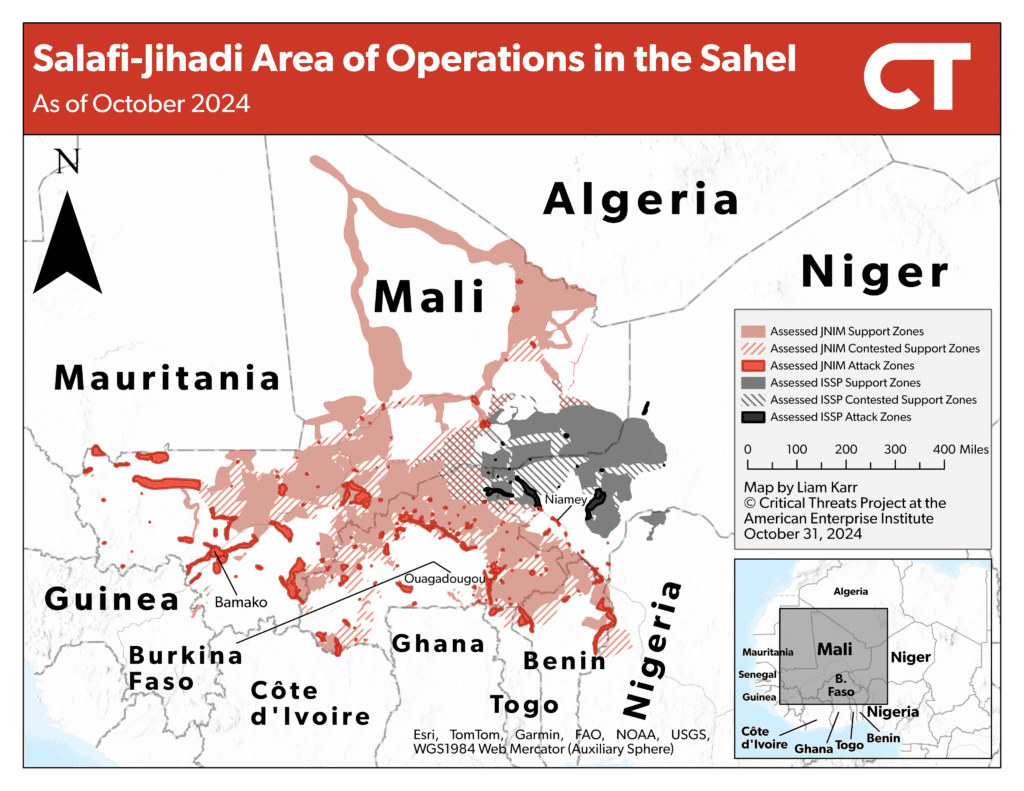
General operating zones in the Sahel
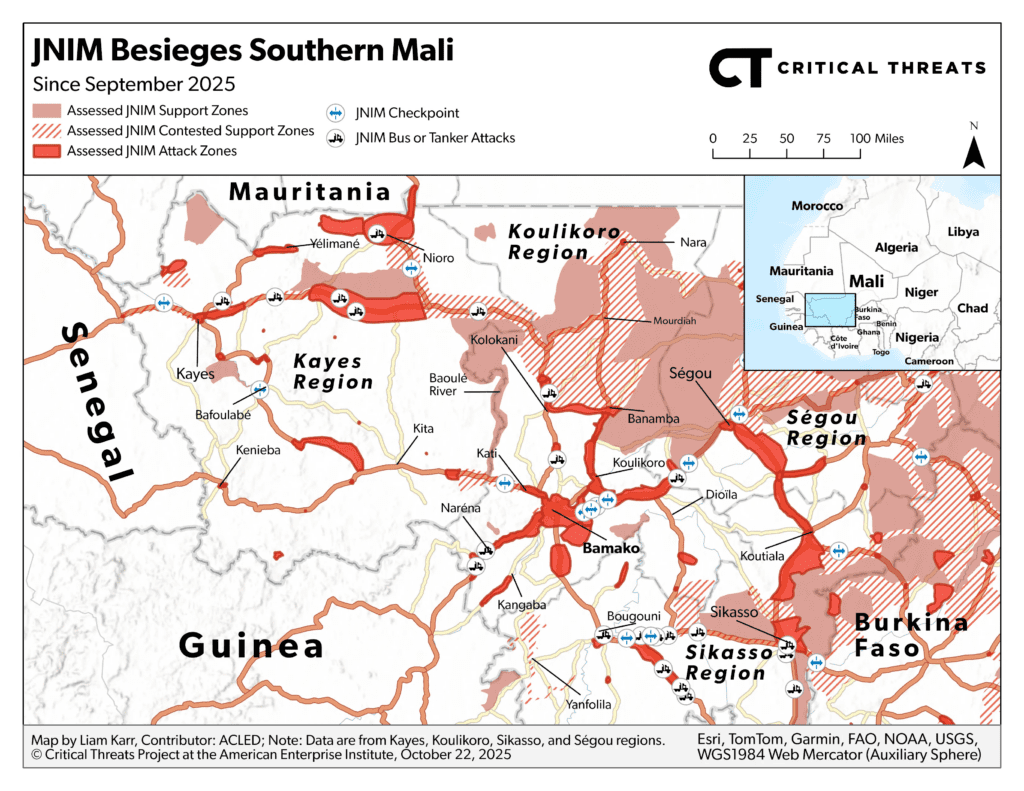
The expansion of the Group to Support Islam and Muslims
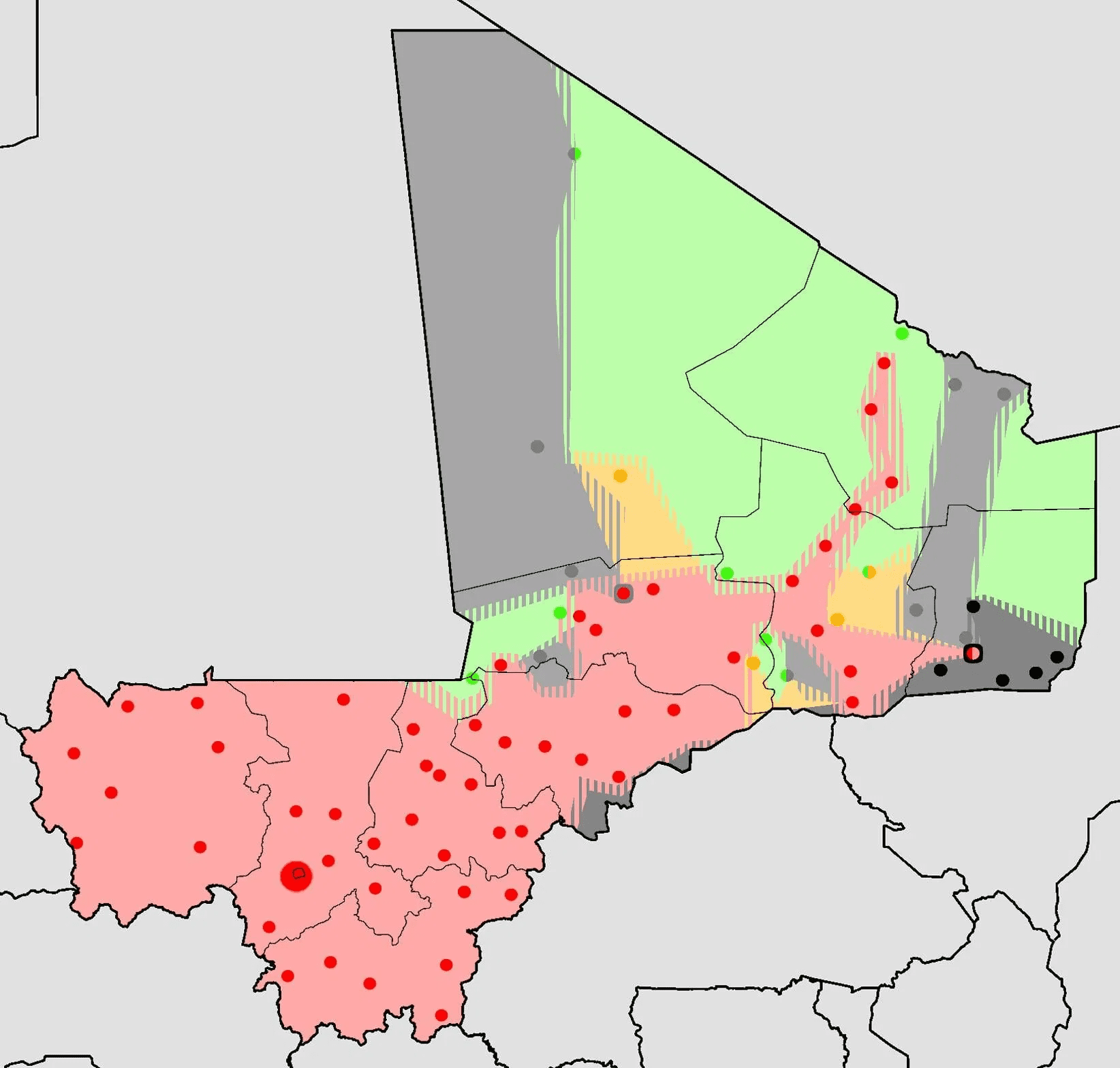
Approximate map of the general military situation
The main strongholds of control of the Islamic State (Ménaka province)
Field data show that the Ménaka region in eastern Mali is among the most prominent strongholds of the Islamic State in the Greater Sahara at present, where its activity has shifted from scattered attacks to imposing a semi-stable field presence in some areas.
The Léré–Gourma area (the border triangle between Mali, Niger and Burkina Faso) is also the most turbulent, witnessing sharp overlap of influence between the organisation and the Group to Support Islam and Muslims, with direct competition over supply routes and local communities.
Eastern Gao region, particularly the surroundings of Ansongo, stands out as strategic corridors and logistical bases, where clashes between the two sides recur.
ACLED data indicate that the organisation's activity is concentrated along several main geographic axes, without this implying fixed military divisions or full administrative control of the ground.
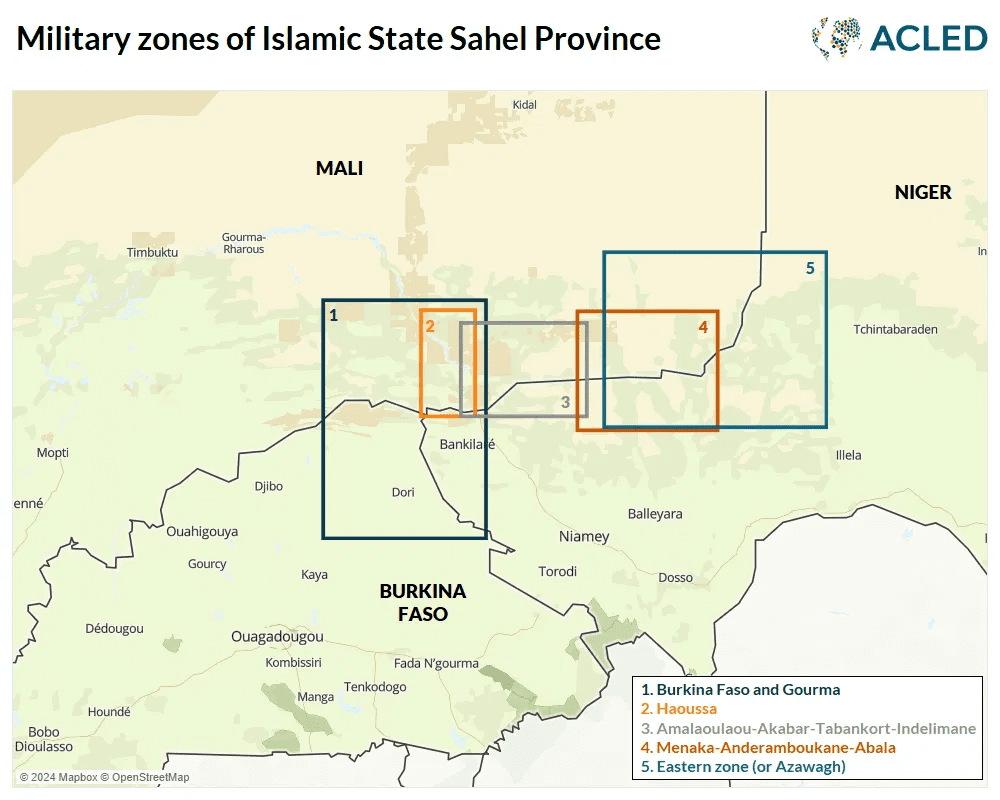
The military zones (in orange and red), showing clearly the concentration of Islamic State influence in the eastern and southeastern part of Mali
Important note: The attached maps show that the conflict has shifted from "traditional fronts" to a "war of attrition and economy", as armed groups focus on cutting off fuel and supply routes to the capital and vital areas.
Azawad movement
The Azawad Liberation Front is not a single, homogeneous organisation but a political-military coalition of several Tuareg factions that share the general objective (the Azawad cause) while differing in their backgrounds and orientations.
First: What does the Azawad movement consist of?
It can be understood as an alliance comprising the most prominent of the following factions:
- National Movement for the Liberation of Azawad (MNLA): one of the most important components, with a national-patriotic character. It led the 2012 rebellion and at that time put forward demands for independence or self-rule.
- High Council for the Unity of Azawad (HCUA): emerged after the 2013–2014 agreements and includes Tuareg figures, some of whom were close to the former Islamist current before moving into political work.
- Smaller armed movements and factions: some tribal or local, joining or withdrawing according to the balance on the ground.
- Joint military and political coordination (CSP): the framework that unifies these factions in their negotiating and field positions, particularly in confronting the Malian army.
Second: The strongholds of Azawadi control (the far north)
Maps show that the Azawadi movements (grouped under the Permanent Strategic Framework CSP-DPA and the Azawad Liberation Front, FLA) fully control the Tinzaouaten area on the Algerian border. This area has become the strongest symbol of their control following the major defeat they inflicted on Wagner mercenaries there.
As for control maps in the Kidal region, there is a discrepancy: the Malian army, backed by Wagner, controls Tessalit, while Kidal has just fallen to Azawad. These are important urban centres and prominent military bases, and they now join the Azawadi movements' control over most of the rural and mountainous areas surrounding the cities, where they wage an ongoing war of attrition and prevent the army from moving freely outside the urban centres.
The Azawadi movements also retain wide influence in the western areas bordering Mauritania, such as the Lerneb region, where these areas are used as launch points for rapid hit-and-run attacks against Malian army barracks.
Recent developments on the map (2025–2026)
Recent maps indicate that the Azawadi movements have begun expanding their "scope of operations" to include areas previously considered calm, using new tactics such as drones. Maps also show "overlap" or "tactical coordination" zones on some fronts against the Malian army, so that the dividing lines between the forces in the north constantly shift.
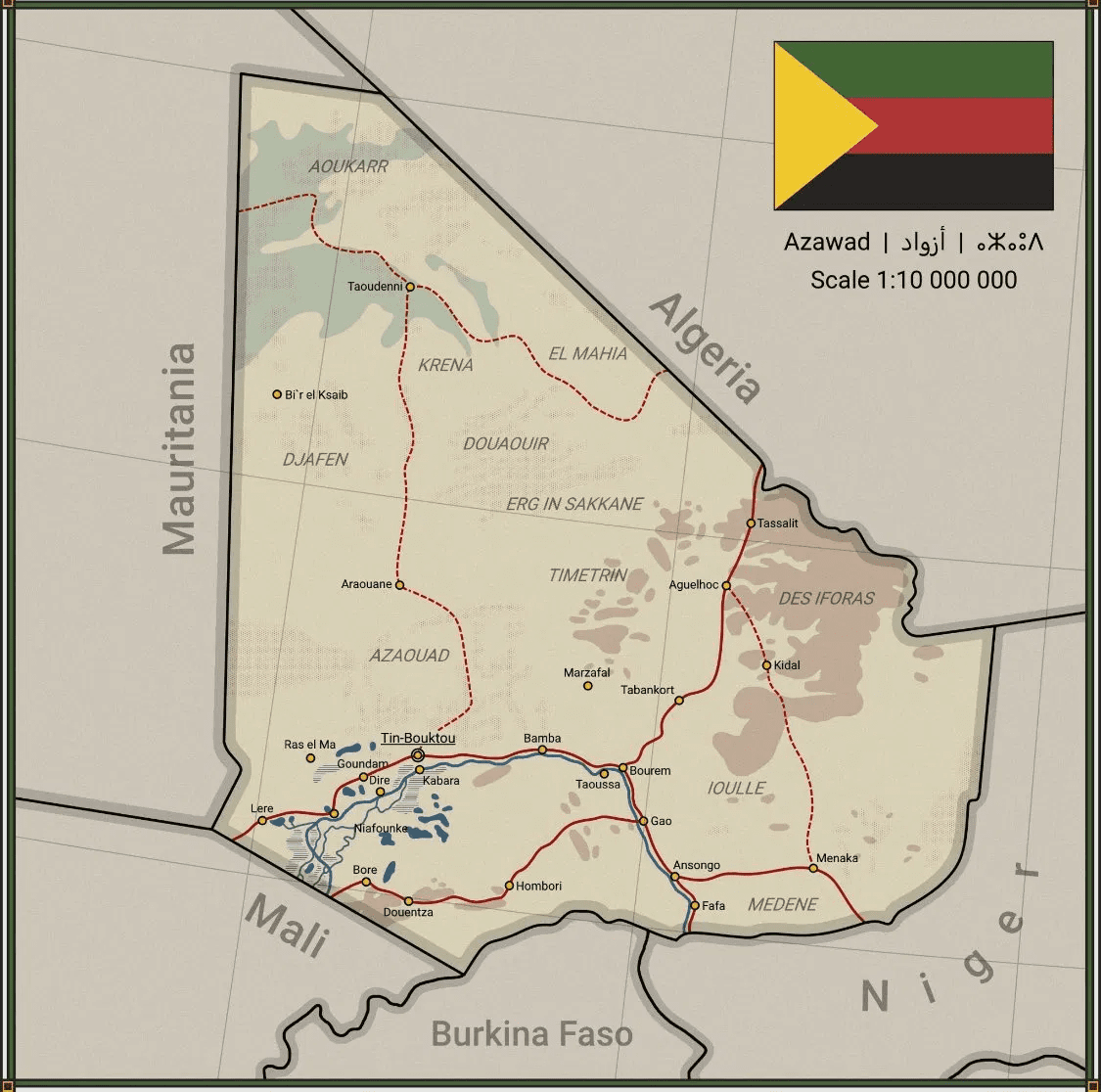
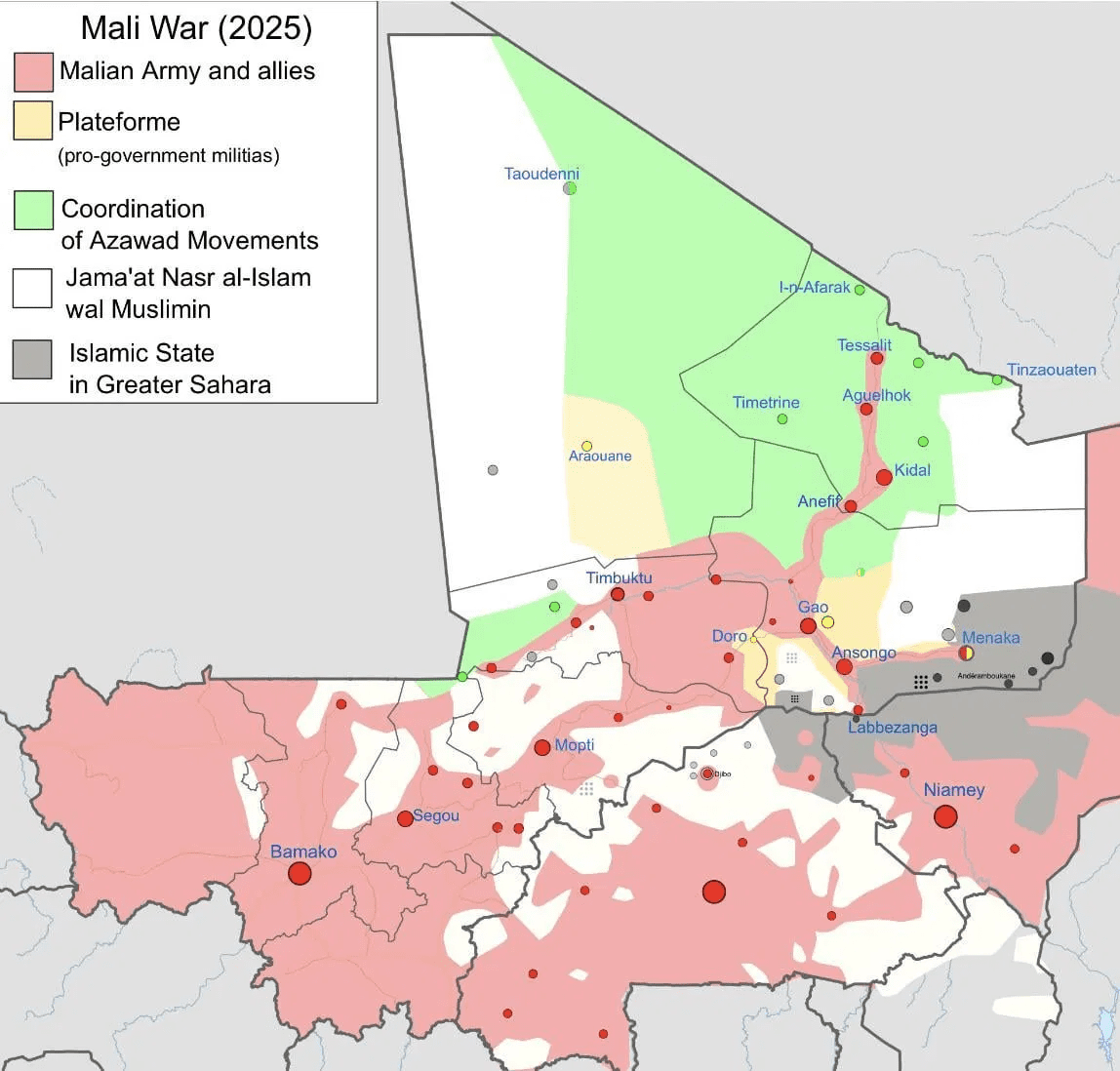
(Green or yellow usually represents the Azawad in these maps), where their influence is concentrated in the northern triangle bordering Algeria and Mauritania.
Third: Are there Azawadi factions with an Islamist orientation?
It must be noted that the Azawadi movement is not one ideological bloc. Within the region there are different currents, the most important being:
- Former Islamist current among the Tuareg: some Tuareg leaders, most notably Iyad Ag Ghali, went through ideological transformations from nationalism to political Islam and then jihadism, which led to the founding of Ansar Dine and later to merging into the Group for Support of Islam and Muslims (JNIM). This current is not currently considered part of the Azawad movement, but it originates socially and ethnically from the same Tuareg environment.
- Tuareg jihadist currents within JNIM: some Tuareg have joined the Group for Support of Islam and Muslims for religious, local or revenge-driven reasons against the state. However, these factions do not adopt the "national Azawad" project, but a transnational one (establishing an Islamic government according to al-Qaeda's conception).
The essential difference
- Azawadi movements (CSP): their project is political/identity-based, demanding self-rule or independence for Azawad.
- Jihadist factions (JNIM and similar): their project is a universal doctrinal one, demanding the establishment of an Islamic state that does not recognise national borders.
Despite partial ethnic overlap (all are partly Tuareg), the ultimate goal is radically different.
It can be said that "Azawad" today is not a single movement but a space where three trajectories intersect:
- the Tuareg national trajectory (CSP)
- the al-Qaeda jihadist trajectory (JNIM)
- changing local tribal trajectories
The ethnic map
The Group for Support of Islam and Muslims is not formed on "ethnic" bases; it is an organisation transcending national identities, but field reality shows clear diversity in its composition:
- Tuareg: some historical leaders within Ansar Dine (which later merged into the group), such as Iyad Ag Ghali. Their presence is most evident in northern Mali (Kidal and its surroundings).
- Fulani (Fulbe): the largest human component within the group today, especially in central Mali. They form the human backbone of the "Macina Liberation Front" led by Amadou Koufa. Their spread in pastoral and rural areas gives them mobility and the ability to remain hidden.
- Desert Arabs: fewer in number, but present in smuggling networks and across the Sahara. They are concentrated in the northern areas and along the borders.
- Other small local groups: such as the Songhai and some mixed communities in the north.
Thus the Group for Support of Islam and Muslims is neither a "Tuareg movement" nor a "Fulani" one, but a jihadist network made up of multiple ethnicities. It also recruits Muslim migrants from all Islamic countries, in line with al-Qaeda's jihadist strategy.
As for the Azawadi movements (the Tuareg), when we say "Azawad," we generally mean the Tuareg movements in the north, the most important of which are:
- Tuareg (the core)
They are the demographic and political foundation of the Azawadi movements. They live in: Kidal, Timbuktu (partly) and northern Gao. - Arabs (partly within the movement): some Arab groups in the north have entered alliances or coordination with the Azawadi movements. However, the relationship is not permanent and is largely pragmatic.
- Songhai (to a lesser degree): they are generally not part of the Azawadi project, and are in other areas or are sometimes local opponents.
Ethnic overlap creates a complex phenomenon:
The same tribe (such as the Fulani or the Tuareg) may have members on more than one side. Loyalty is often local or network-based rather than purely ethnic. Therefore it cannot be said that "this ethnicity is wholly with this organisation."
For its part, the Islamic State in the Greater Sahara does not have a unified ethnic composition; it relies on a flexible structure transcending tribes, based on recruiting local components according to geographic contexts and existing conflicts. Nevertheless, the Fulani emerge as one of its most important human sources in the Sahel region, alongside notable Tuareg presence in the north, especially in the Ménaka and Gao areas, with smaller participation by Arabs and Songhai. In addition, there are migrants coming from other countries around the world. This diversity reflects the organisation's strategy of ensuring its expansion across varied environments.
Wide escalation in the conflict and a qualitative shift in the nature of attacks (April 2026)
In recent days Mali has witnessed one of the most dangerous waves of military escalation in years, as armed groups carried out coordinated attacks that included the capital Bamako and several strategic cities in the north and centre, in a development reflecting the conflict's move from its traditional scope to a wider and more complex level.
A multi-front attack shakes the country
At dawn on 25 April 2026, Mali woke to a series of explosions and heavy gunfire targeting sensitive military sites, including the vicinity of Bamako's international airport and Kati military base, in addition to the cities of Kidal, Gao, Mopti and Ségou. Field reports described simultaneous attacks on army bases and positions in several areas, in what was described as a "large-scale coordinated assault," the largest in years.
Preliminary indications point to more than one party behind these attacks, most notably the Group for Support of Islam and Muslims (JNIM), linked to al-Qaeda, and Tuareg factions within the "Azawad Liberation Front" in the north.
Meanwhile, the pace of security collapse in Mali is accelerating as the fighting reaches the heart of the capital Bamako, where field reports documented the incursion of Group for Support of Islam and Muslims fighters into strategic neighbourhoods and the vicinity of the presidential palace.
In what is the most prominent development, the city of Kati — the regime's fortified military stronghold — was subjected to a large-scale attack that resulted in the destruction of the defence minister's house, amid repeated reports of his arrest or killing, as well as that of the chief of staff.
With fighters tightening their control over the entrances to the capital and its main arteries, Bamako has been left in a state of complete paralysis, while leaked footage indicates that regular forces have lost control of security pockets that until recently were considered beyond the reach of the threat, putting the future of the ruling military council at stake.
Reports speak of indirect coordination between the Support Group and the Azawadis in some theatres of operation, especially in Kidal and Gao, where Azawadi groups announced their control over specific military sites.
Strategic dimensions of the attack
The nature of the recent operations does not appear limited to direct military confrontation, but aims to:
- demonstrate the ability of armed groups to strike the state's strategic depth;
- pressure the capital by targeting supply lines and vital centres;
- redraw the balance of control in the north after years of the state's relative retreat;
- exploit the state's weakness to seize new control and benefit from the intersecting interests of the armed groups, each within its own sphere of influence and movements, in a simultaneous manner;
- an opportunity to wrest the capital from the hands of the Malian state; the fall of the capital would mean the defeat of the state and the end of the war.
All of this comes in the context of the escalation of the "economic and military pressure" strategy pursued by the Group for Support of Islam and Muslims, through targeting trade routes and fuel resources, weakening the state's ability to continue administering remote areas and undermining its interests.
The regional situation and shifting alliances
These developments coincide with the continuing reshaping of the alliance map in the region:
- The Malian government: relies on Russian military support (Africa Corps, formerly Wagner) and on the Alliance of Sahel States (Mali – Niger – Burkina Faso).
- Jihadist groups, the al-Qaeda and Islamic State organisations (JNIM and ISGS): continue to expand their influence in border areas.
- The Azawadi movements move between political rebellion and military action according to changing field conditions.
Despite external support, indications suggest that the Malian state faces growing pressure on more than one front, especially with the repeated deep attacks inside the country.
How does jihadist Salafism cooperate with national-nationalist currents?
The Azawad movement consists of nationalist/separatist movements. Its goal is political: the independence of the Azawad region or the attainment of extensive self-rule. Its ideology is not "transnational jihadism" but a national movement defending the rights of its communities (Tuareg, Arabs and Songhai) in the north. By contrast, the Group for Support of Islam and Muslims (JNIM) is a jihadist Salafist group (the al-Qaeda in the Islamic Maghreb branch). Its goal is to establish an "Islamic emirate" and apply Islamic law according to a transnational vision, and it opposes the Malian state and the foreign presence from a religious doctrinal standpoint.
Are they in "one alliance"?
Officially: there is no declared alliance or joint operations room bringing the two sides together. Rather, in many cases, bloody clashes have occurred between them in past years due to differing agendas.
On the ground: yes, there is "coordination out of necessity" or "non-aggression." What is happening now is described by observers as an "undeclared tactical alliance," in which both sides see the common enemy — the Malian army and the Russian "Africa Corps" — as an existential threat to them.
Geographic division of roles: while the Azawad movement focuses on controlling the major northern cities (such as Kidal and Gao), the Group for Support of Islam and Muslims exploited the army's preoccupation to strike deep inside the country (Bamako and Kati).
Avoiding internal confrontation: in the recent attack on Gao, both sides were observed entering the city, which indicates field understandings to share control temporarily in order to topple the military regime.
How do they come together while differing doctrinally?
This question is the heart of the complexity in the African Sahel, and the reason lies in several factors:
- Tribal and social dimension: many fighters of the Azawad movement and of the Support Group belong to the same tribes (especially the Tuareg and the Fulani). Tribal ties in Mali are sometimes stronger than ideological alignments, which facilitates communication and field coordination between a "cousin" in the nationalist movement and a "cousin" in the jihadist group.
- Military pragmatism: both sides realised that fighting Russia and the Malian army requires freezing internal disputes. The Azawad movements need the Support Group's pressure on the capital Bamako to ease the pressure on them in the north, and the Support Group needs Azawadi influence in the north to secure its supply lines and reach the capital.
- Failure of political solutions: the collapse of the "Algiers Peace Agreement" left the nationalist movements (Azawad) feeling despair about political solutions, pushing them to adopt military options that objectively intersect with the movements of the jihadist groups.
What you see today is not "doctrinal merger" but "military interest cooperation." Both want to topple the regime of Assimi Goïta, but once the regime falls (if it does), the conflict between them is expected to erupt, because the Azawad vision of an independent secular or national state clashes entirely with the Support Group's vision of an independent Islamic emirate.
The future of the conflict in Mali
If we are to read Mali's future realistically, we should not look for a "near resolution" but for parallel trajectories competing within a state that has lost its balance. Given the differing agendas of the Azawadi movements and the Group for Support of Islam and Muslims (JNIM), in addition to the presence of the Islamic State and the military authority in Bamako, we face a scene more likely to fragment than to move towards stability.
The most likely scenarios
Scenario one: "undeclared sharing of influence"
This is the closest scenario in the near term if the Malian regime falls. The north would remain in the hands of the Azawadi movements (quasi-self-rule), while the centre and south would fall to the Group for Support of Islam and Muslims, which, if it took control of the capital, would end the Malian state's influence in the country and establish its Islamic emirate.
This scenario does not require an agreement; the continuation of a fragile balance is enough, while disputed areas remain with mobile and changeable borders.
Scenario two: "temporary forced alliance"
A broader field rapprochement may occur between the Azawad and the Group for Support of Islam and Muslims, not out of intellectual agreement but as military pressure taking the form of operational coordination and geographic sharing to confront any counter-tactic from the Malian government and Wagner, the outcome depending on the ability to rid themselves of the common enemy. But it is an alliance that carries within it the seeds of its own collapse, because the nationalist Azawad project is local and cannot long coexist with a transnational jihadist project. This heralds a coming phase of power struggle between the Group for Support of Islam and Muslims and the Azawadis. However, there is a possibility that this path ends in a political agreement between the two sides and a settlement without fighting.
Scenario three: "internal clash between the temporary allies"
This is a highly plausible scenario in the medium term. Once the financial system weakens, Jama'at Nusrat al-Islam wal-Muslimin is expected to begin expanding into northern regions, especially after consolidating its positions in the capital.
It is also a scenario that remains open to the possibility of regional and international interventions aligning with the Azawadis to prevent the expansion of Jama'at Nusrat al-Islam wal-Muslimin, which would add further complexity and crisis to the situation.
Scenario Four: "The Return of the State and a Frozen Situation"
This possibility requires effective external military support, the rebuilding of the Malian army, and perhaps a political settlement to share the country or a return to a state of suspended conflict. However, the current reality, in terms of the withdrawal of international forces and the complexity of the battlefield, makes this scenario difficult.
Scenario Five: "Total Fragmentation"
This is the worst of the scenarios, but it is not remote. A complete collapse of central authority would be accompanied by Mali's transformation into tribal areas, local emirates and open conflicts without central leadership, particularly with the intervention of other actors such as the Islamic State organisation. Mali would become a quagmire whose wars never end and an arena for clashing projects that show no sign of stopping.
The Decisive Factor for Control
It is not only military strength but each party's ability to administer the territory, not merely to control it, and to win popular support and the capacity to deal with the ethnic and religious diversity the region has.
All these readings remain contingent on the situation on the ground and developments in the map of control. It should be noted that, up to the time of writing this report, Jama'at Nusrat al-Islam wal-Muslimin had not issued any official statement about the field developments, despite local documentation of its fighters entering the Malian capital, Bamako. Nor has the Islamic State organisation shown any field movements amid the new developments.
-- After the publication of this report, the first official statement was issued announcing the alliance of Jama'at Nusrat al-Islam wal-Muslimin with the Azawad, a statement affirming cooperation and field coordination.
References
[1] Al Jazeera Net. (2006). The Azawad and a history of conflict in Mali.
[2] Qiraat Africiya. (2017). A reading of the armed conflict in Mali.
[3] Al-Bayan Magazine. (2023). Tuareg of Azawad and Malian governments: a fierce war and a fragile peace.
[4] ScienceDirect. Identity and Conflict: Evidence from the Tuareg Rebellion in Mali.
[5] Clingendael Institute. The Roots of Mali's Conflict.
[6] Security Council. Jama'at Nusrat al-Islam wal-Muslimin (JNIM).
[7] SSI Army War College. Conflict and Conflict Resolution in the Sahel: The Tuareg Insurgency in Mali.
[8] CSIS. (2021). Examining Extremism: Jama'at Nasr al-Islam wal Muslimin.
[9] Australian National Security. Jama'at Nusrat al-Islam wal-Muslimin.
[10] Al Jazeera Net. (2024). New details on Wagner's defeat in Mali.
[11] Al-Araby Al-Jadeed. (2024). Northern Mali: Tuareg fighters announce the killing of Wagner and Malian army personnel.
[12] Al Jazeera Centre for Studies. (2024). The Bamako events: strength of the attack or weakness of the defence?
[13] Middle East Online. (2025). Mali rules out Bamako falling to Al-Qaeda.
[14] Al Qahera News. (2023). Implications of the formation of the Alliance of Sahel States (AES).
[15] Al Jazeera Net. (2025). Alliance of Sahel States: an African bloc challenging French influence.
[16] International Crisis Group. Mali: Security, Dialogue and Reform.
[17] ACLED. Armed Conflict Data on Mali and the Sahel.


