


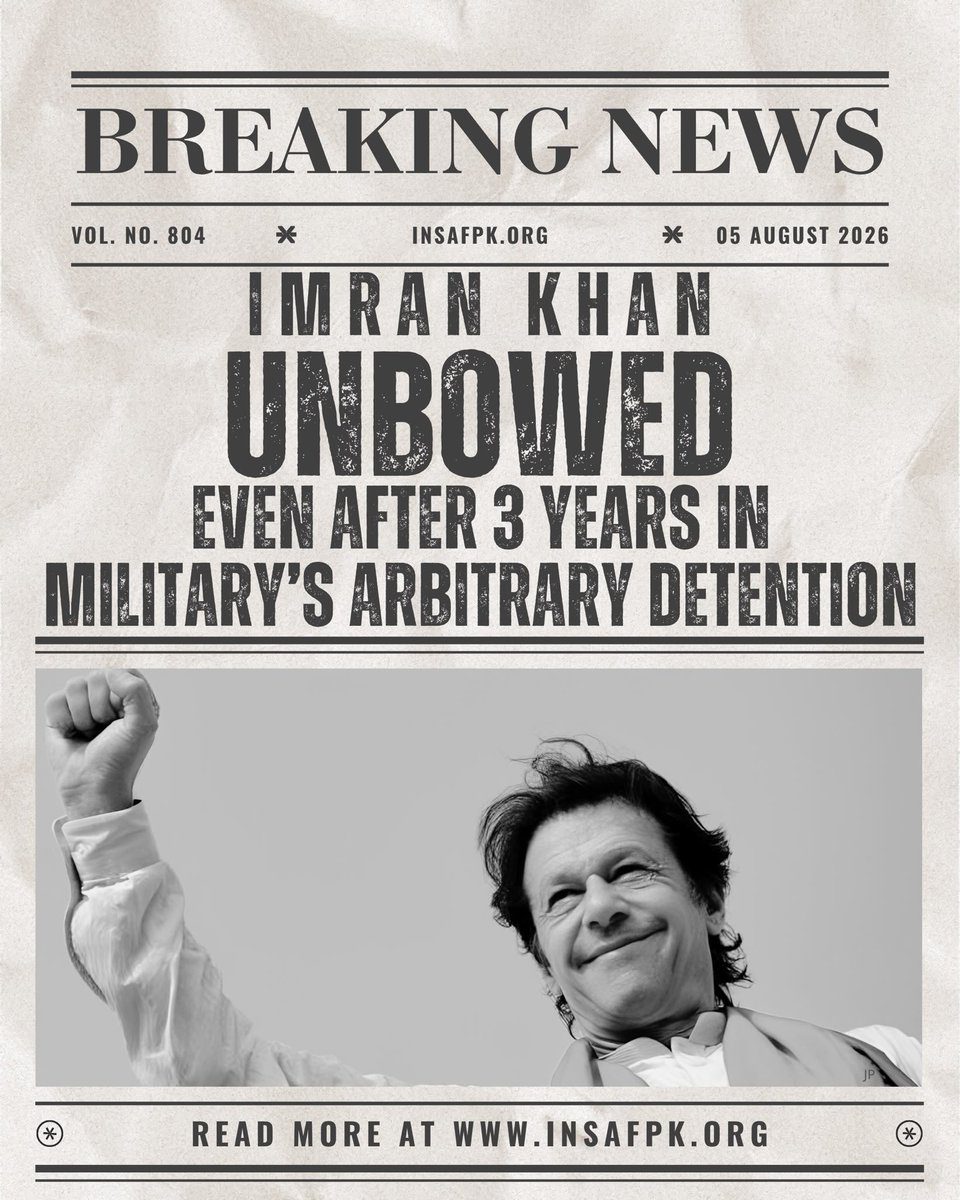
Former Pakistani Prime Minister Imran Khan has entered his fourth year behind bars, as thousands of supporters of his party, Pakistan Tehreek-e-Insaf (PTI), took to the streets in several cities demanding his release, amid mounting criticism over the conditions of his detention and his rights to communicate with his family and lawyers.
Protests were held in several areas of Pakistan on Wednesday, 5 August 2026, by Khan's supporters amid a heavy security presence, marking three years since his imprisonment. His family, his party and human rights organisations have demanded the restoration of his constitutional rights and improved conditions of his detention.
Three Years Behind Bars
Imran Khan, 73, served as Prime Minister between 2018 and 2022, before he was removed from office in a no-confidence vote in April 2022. Khan said at the time that his removal was the result of a conspiracy backed by the army and the United States, which Washington and the Pakistani military establishment denied.
After leading protests against his ouster, he was briefly arrested in May 2023, then imprisoned on 5 August of the same year over cases related to corruption and the leaking of state secrets, charges he rejected and described as politically motivated.
Since then, Khan and his wife, Bushra Bibi, have been convicted in several cases, while the PTI has faced a crackdown that included the arrest of its leaders, and it was barred from contesting the 2024 general elections.
Khan is currently serving a 14-year prison sentence in a corruption case, while his wife was sentenced to seven years in the same case. In December, the two were handed an additional 17-year sentence in a case related to state gifts.
Human Rights Criticism of Detention Conditions
The continued imprisonment of Khan has coincided with growing criticism from international human rights organisations over the conditions of his detention.
Amnesty International said Khan has not met with his family for more than eight months, and has had no effective access to his lawyers since December.
The organisation accused the Pakistani authorities of systematically denying him his right to a fair trial, holding him in solitary confinement for long periods, and restricting his access to medical care and visits.
It also called on the authorities to allow Khan and his wife access to their family and lawyers, provide necessary medical care, and end solitary confinement.
These criticisms follow positions issued by two United Nations mechanisms: in July 2024, the Working Group on Arbitrary Detention concluded that Khan's detention was "arbitrary", while the UN Special Rapporteur on torture, Alice Jill Edwards, warned that the conditions of his solitary confinement, reportedly amounting to 23 hours a day with continuous camera surveillance, may amount to torture.
Health Crisis Adds Pressure
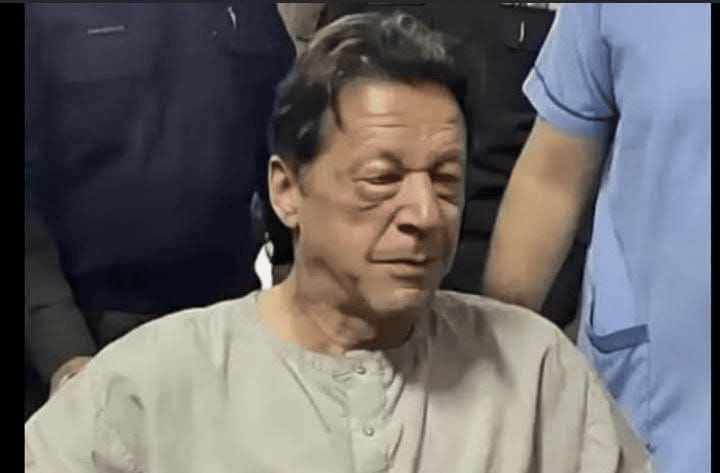
Imran Khan's health has become one of the most contentious issues as he enters his fourth year in prison.
According to his party, Khan was diagnosed in January with a problem in his right retina, and has since received five injections at a government hospital, which the party said were administered without prior notice to his family or lawyers.
The previous week, the Supreme Court agreed to consider a request filed by Khan to transfer him to a private hospital in Islamabad and allow him to receive treatment from doctors of his choice, after the request had been pending before the court since February.
A lawyer specialising in constitutional law said that access to adequate medical care "is not a privilege granted by the state at its discretion", but a constitutional, legal and moral obligation.
Government Rejects the Accusations
The Pakistani government, for its part, rejects the allegations of unlawful treatment of Khan and maintains that the conditions of his detention are subject to judicial oversight.
Minister of State for Interior Talal Chaudhry said that the observations of international organisations do not go beyond the jurisdiction of independent Pakistani courts and the decisions of the competent institutions.
He stated that Khan receives living conditions and facilities that exceed what is normally available to prisoners, pointing to the provision of a dedicated cooking area, exercise facilities and other services.
The government also rejected the idea of reaching a political settlement with Khan, asserting that any reduction of his sentence or his release must come through the judicial process and not through political negotiations.
Is the Army the Key to the Political Crisis?
Analysts believe that Imran Khan's future depends not only on court decisions, but also on the stance of the Pakistani military establishment, which holds considerable influence over the country's political life.
One political analyst said that the continued treatment of Khan as a principal political rival by the army and the ruling parties reduces the state's incentives to facilitate his return to political life, and that current developments may make his release less likely.
Other commentators, however, argue that part of the crisis is tied to Khan's own position, noting that the military establishment is reportedly seeking an apology from him for the events of 9 May 2023, when PTI supporters attacked military installations during protests that followed his arrest.
Khan, however, has not offered an apology or reconciliation with the military establishment.
A Struggle Over Pakistan's Future
The case of Imran Khan does not appear to be merely a legal dispute over corruption convictions. It has become a symbol of a broader political struggle over the independence of institutions and the future of democracy in Pakistan.
The PTI sees the continued detention of its leader as part of a political campaign aimed at removing him from the scene, while the government insists that the cases against him are subject to the law and that he cannot be granted preferential treatment or a political settlement outside the judicial process.
Between the two narratives, the army remains a decisive factor in determining the direction of the crisis, according to analysts who argue that any shift in the calculations of the military establishment could open the way to judicial rulings or a political settlement that changes Khan's situation.
As Imran Khan enters his fourth year in prison, the crisis appears to be more than a case of a political prisoner; it is an ongoing test of judicial independence, the limits of military influence, and the ability of the opposition to function politically in Pakistan. With protests and human rights pressure continuing, Khan's future remains tied not only to the course of the cases against him, but also to the political balances that govern the country.


