


"I Felt I Was a Monster": Israeli Soldiers Speak of "Moral Injury" and Silence
A report in the Israeli newspaper Haaretz recounts testimonies from a number of Israeli soldiers who took part in the war on Gaza, describing a deep psychological condition known as "moral injury," a sense of guilt and shame resulting from carrying out actions that conflict with moral values, or from witnessing such actions without being able to prevent them.
The newspaper's report was written by Tom Levinson:
The article by Tom Levinson
Yuval sits biting his nails, his legs jittering nervously. It is midday in Tel Aviv, and the street is crowded. He glances around from time to time, his anxious eyes sweeping over passersby. He says: "I'm sorry." "My biggest fear is revenge."
But Yuval (a pseudonym, as with all names in this article) was not born into a criminal family, and he is not a criminal. He is 34 years old, grew up in the Tel Aviv suburb of Ramat HaSharon, and became a computer programmer. Until recently, he worked at one of the world's largest advanced technology companies, but he has not gone there for months. "I was in hell, but I didn't realise it," he says.
The hell he describes was in Khan Younis in southern Gaza, when he was a soldier in December 2023. "The airstrikes were constant. A one-ton bomb falls nearby and makes your heart jump out of your chest."
His unit was advancing west toward the city centre. "There was fierce fighting… you work on autopilot. You don't ask questions."
The questions would come to him, and would haunt him, months later. "I don't have satisfying answers; I have no answers at all. There is no forgiveness for what I did. No atonement."
It happened near Salah al-Din Road, Gaza's main highway. A platoon, using a drone, spotted suspicious individuals. Yuval's unit attacked. "I was shooting wildly, as they teach you in basic training."
"When we reached our destination, I realised these were not terrorists. There was an elderly man and three boys, perhaps teenagers. None of them was armed. But their bodies were riddled with bullets; their limbs were falling apart. I had never seen anything like that up close before."
"I remember there was complete silence; no one said a word. Then the battalion commander arrived with his men, and one of them spat on the bodies and shouted: 'This is what happens to anyone who messes with Israel, you sons of bitches!' I was in shock, but I stayed silent because I am a failure, just a coward with no courage."
About three months later, Yuval was discharged from service. He took two weeks' leave and returned to work. "They threw a party for my discharge, applauded me and called me a hero. But I felt I was a monster. I couldn't bear what they said to me. I felt they didn't realise I am not a good person; quite the opposite."
For several months he tried to hold on to his job, fleeing the weight that burdened his heart, but he gave in. His sense of shame grew worse.
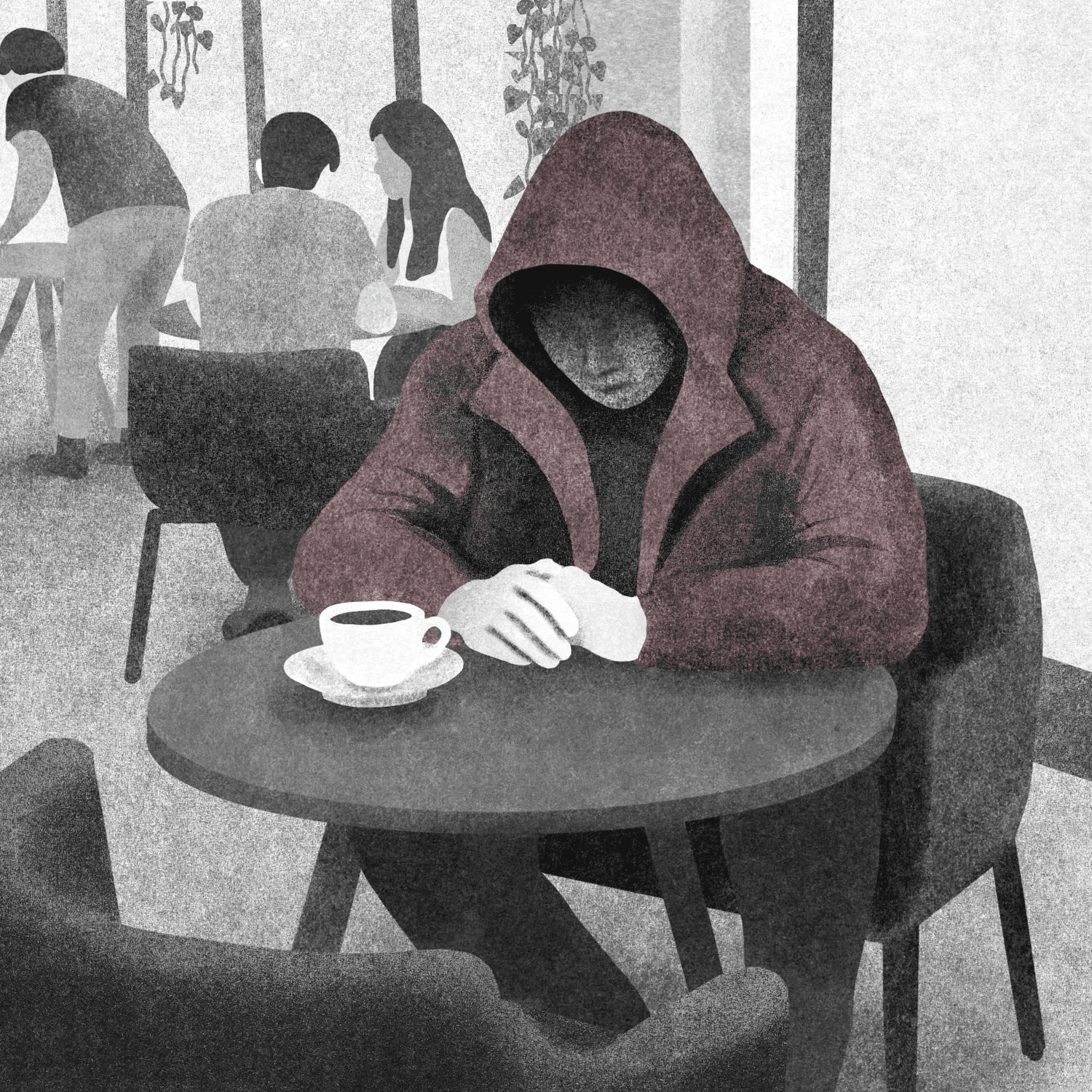
"I try not to leave the house, and if I have to, I wear a hooded jacket so people don't recognise me. I even got rid of the mirrors. I can't bear to look at myself. I have a deep fear that someone will take revenge on me for what I did, even though I know that's impossible. Who could find me in Gaza?" Who would even know it was me?
"Somehow I may want to die, to rid myself of this torment. I'm not going to kill myself because I promised my mother, but I admit I don't know how much longer I can keep going." Two days after speaking with Haaretz, Yuval was transferred to the psychiatric ward.
Last year, Haaretz published a report on soldiers who fought in Gaza and suffered from "moral wounds." A sniper who shot at people asking for help said he suffers from severe nightmares; drone operators who killed civilians described scars that do not heal.
Professor Gil Zalsman, chairman of the Israeli National Council for Suicide Prevention, says: "We are witnessing moral wounds on a wider scale than ever before." "We have observed it in our specialised trauma clinics and in private clinics. We have even seen it among the children of reservists who heard similar stories and are worried about what their fathers did. It has reached a lower level."
The Israeli military and government have not released any statistics, but since October, the phenomenon has become widespread.
Zalsman says that since the ceasefire in Gaza in October, the number of people seeking help for moral injury has been increasing. Some of these patients are sometimes classified as suffering from post-traumatic stress disorder, but although there is some overlap, moral injury differs from it.
According to Professor Yossi Levi-Belz of the University of Haifa, "post-traumatic stress disorder is a fear-based reaction resulting from exposure to a traumatic incident that involves danger to the person or to those around them." Common symptoms include hyperarousal and avoidance.
"Moral injury occurs as a result of exposure to incidents that constitute a fundamental violation of core moral values, whether one's own or those of others, and typically involves feelings of guilt, shame, anger, disgust, estrangement, loss of faith, and a collapse of identity, meaning and a sense of humanity."
Then there is the question of timing, says Levi-Belz, who heads the Lior Tsvati Centre for Suicide and Psychological Pain at the university. "When the war ends, the soldier returns home, and suddenly the world appears much more complex."
Escalating settler attacks in the West Bank: a daily reality threatening Palestinian lives and land\
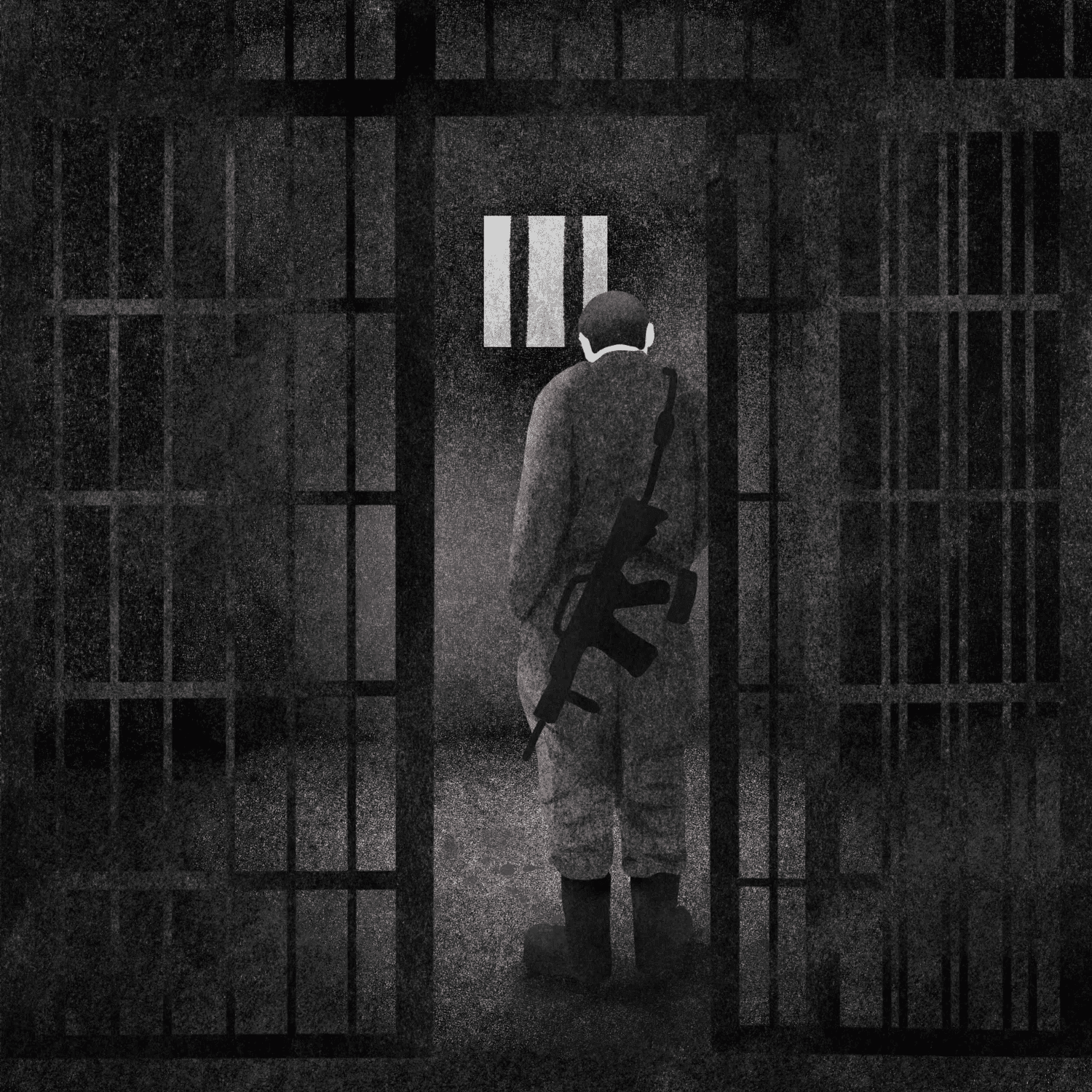
"The distinction between good and evil has disappeared, the world is no longer binary, and he can now look back at the events he went through and realise that some things happened that contradict his beliefs."
Levi-Belz adds that moral injury can occur when a person performs, or witnesses, an act that flagrantly violates their moral principles. The injury can be more severe when the person does not try to stop the other, and when that other is a figure of authority.
Levi-Belz says: "We expect authority figures, such as commanders, to protect us, so in such cases, the injury can cause a serious crisis and profound psychological suffering."
إرهاب في متحف برادو
Maya lives in central Tel Aviv and studies philosophy, particularly the writings of Michel Foucault. During the Gaza war, she served hundreds of days as a human resources officer in an armoured battalion in the reserves.
She says: "There is no connection between my daily life and my reserve service. They are two different worlds, with different people. Frankly, even my behaviour and speech have become different. It is like the story of Dr Jekyll and Mr Hyde."
"During the war, I witnessed the killing of innocents: terrible things that, had I read about them in Haaretz, I would have screamed. But during my reserve service, they passed by me as if they were nothing."
One incident left a deep mark. It occurred at a military position in southern Gaza. Maya says: "I was sitting in the command room. Suddenly, the duty soldiers noticed five Palestinians crossing the line they were forbidden to cross, heading north in Gaza.
"Everyone lost their nerve. Total chaos ensued. The battalion commander ordered them to be showered with fire, despite not being certain whether they were armed or anything similar. A tank began firing on them with its machine gun. Hundreds of bullets."
She says four of the five Palestinians were killed. "A few hours later, a D9 armoured bulldozer buried them in the sand. When I asked why, they said it was to protect them from dogs and to prevent the spread of disease. As for the only survivor, he was placed in a cage at the outpost, and we were told we had to wait for a General Security Service (Shin Bet) officer to interrogate him."
But no Shin Bet investigator came that day. "I spent the night at the outpost, but I couldn't sleep; I was the only girl there. Suddenly, some soldiers called me, so I went with them to the cell. The Palestinian was sitting there, handcuffed and blindfolded, and seemed to be shivering from the cold.
"Suddenly, one of the soldiers took out his penis and began urinating on him. He said: 'This is for Be'eri, you bastard, this is for Nova'" - Kibbutz Be'eri and the Nova music festival, two of the sites attacked by Hamas on 7 October 2023. "No one could stop laughing." Maybe I laughed too.
A Shin Bet investigator arrived the next day. Maya, who was discharged a few weeks later, says: "He stayed with him for ten minutes, and said he was just a man trying to return home to northern Gaza, and that he had nothing to do with Hamas, so they released him." But what she had seen stayed lodged in her mind.
"I felt hypocrisy and filth. I showered three times a day; the image of his helplessness never left me. Thoughts keep troubling me: how could I stand by with my arms folded? How could I, who pretend to be moral, volunteer with refugees and take part in protests, agree to that? How did I not tell them anything, and what does that say about me? I have no answer."
Maya is not alone.
One resident of that area experienced moral trauma. Yehuda also served there, at another time, during his reserve service. He says: "My platoon operated Hummer military vehicles, and we were the initial response unit for the sector."
"There was also a Hummer driven by an officer with an American name. He served there for several months, and whenever he left the division's brigade, he would simply join the next one. He was a strange, suspicious man."
"Whenever he was asked about his background, he would say something different, and if you asked him, he would get angry." It was not clear whether the war had affected him negatively or whether he had been that way before it, but he completed the mission, so no one asked him.
One night, a Palestinian managed to approach the position. Yehuda says: "We set out in my two Hummers. I was driving one, and the American officer was driving the other. We reached the Palestinian, and he immediately raised his hands. It was clear he was unarmed. The officer approached him, waited a few seconds, then shot him without asking him anything and without any provocation.
"I was in shock. Then we returned to the position, I entered the operations room, and I watched, with several officers, what had been recorded from the air by a drone."
One of the older officers said: "This is murder, plain murder," but they decided to do nothing; they completely ignored it. They reported to brigade headquarters that a terrorist had been killed. No investigation into the incident was ever conducted. This officer continued to perform his duties as if nothing had happened, and I did not comment on it. No one mentioned it even during our discharge procedures, as if nothing had happened.
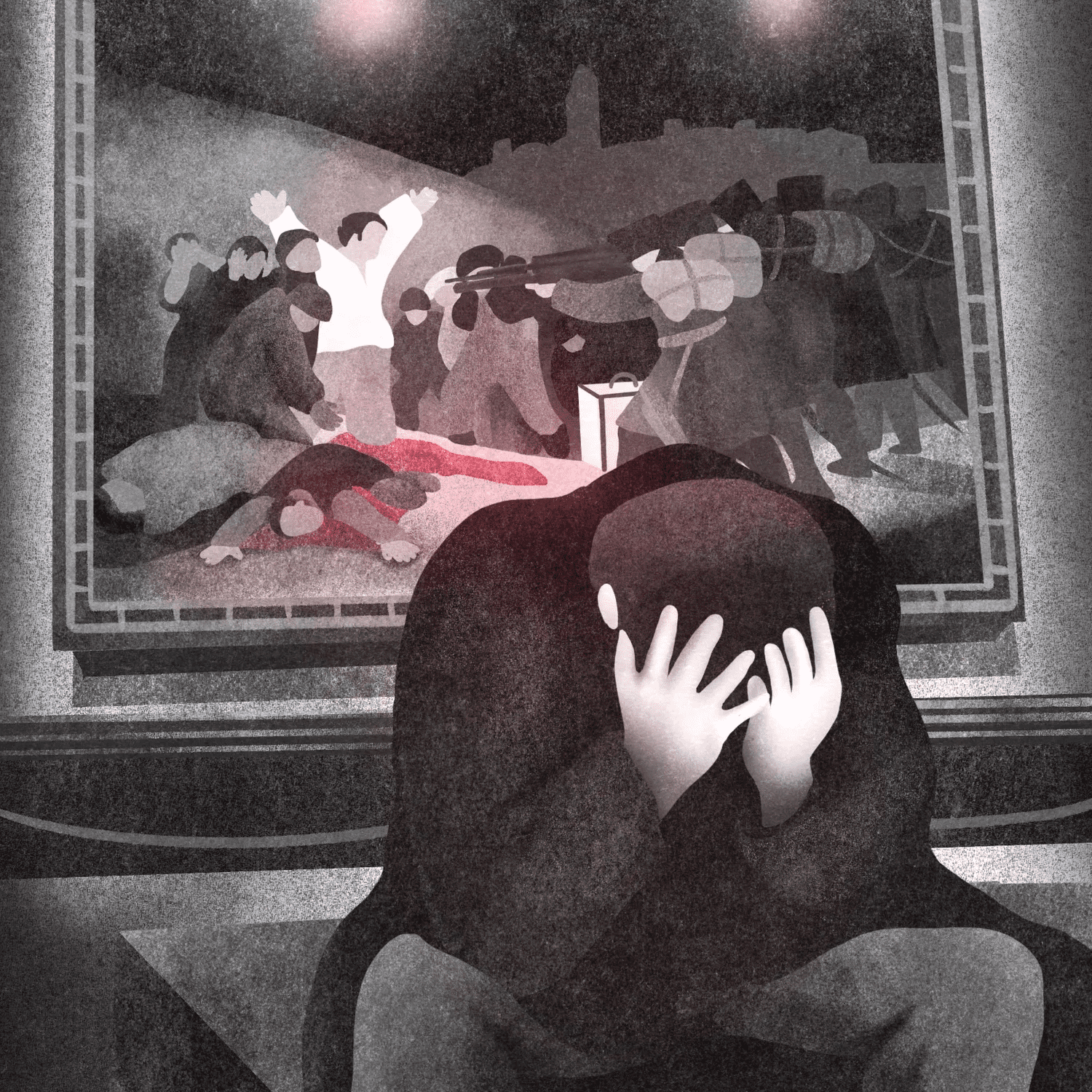
Two months later, Yehuda travelled with his wife to Madrid. One day, they visited the Prado Museum; she is a PhD student in art, a field Yehuda says he knows nothing about. Suddenly he found himself in front of a painting by Goya.
Yehuda says: "I wasn't particularly interested, but suddenly I found myself standing next to a painting of his showing a helpless man raising his hands before armed soldiers. I went up close to the painting, and it reminded me exactly of what had happened. The look in his eyes, the fear, the terror."
I felt I could not stop looking. I began to sweat. It was horrifying, and then suddenly, tears poured from my eyes. I never cry, and I couldn't understand what was happening to me.
My wife looked at me anxiously. She asked me: "What happened? What happened?" - and I didn't know how to answer her. I was shattered. People could not stop looking at me. Try explaining to me why someone breaks down crying in the middle of a museum?
That night, Yehuda promised his wife that he would seek psychological treatment when they returned to Israel. He says: "I'm trying to accept it, but it is hard. The feeling of shame still stays with me. How did I become someone who stands by and does not do the right thing?"
Memories from the Interrogation Room
Some soldiers say their moral wounds stem from the methods used in fighting in Gaza, many of which Haaretz published for the first time. For example, snipers from the Nahal Brigade shot at Palestinians asking for help; they crossed the arbitrary line drawn by the military.
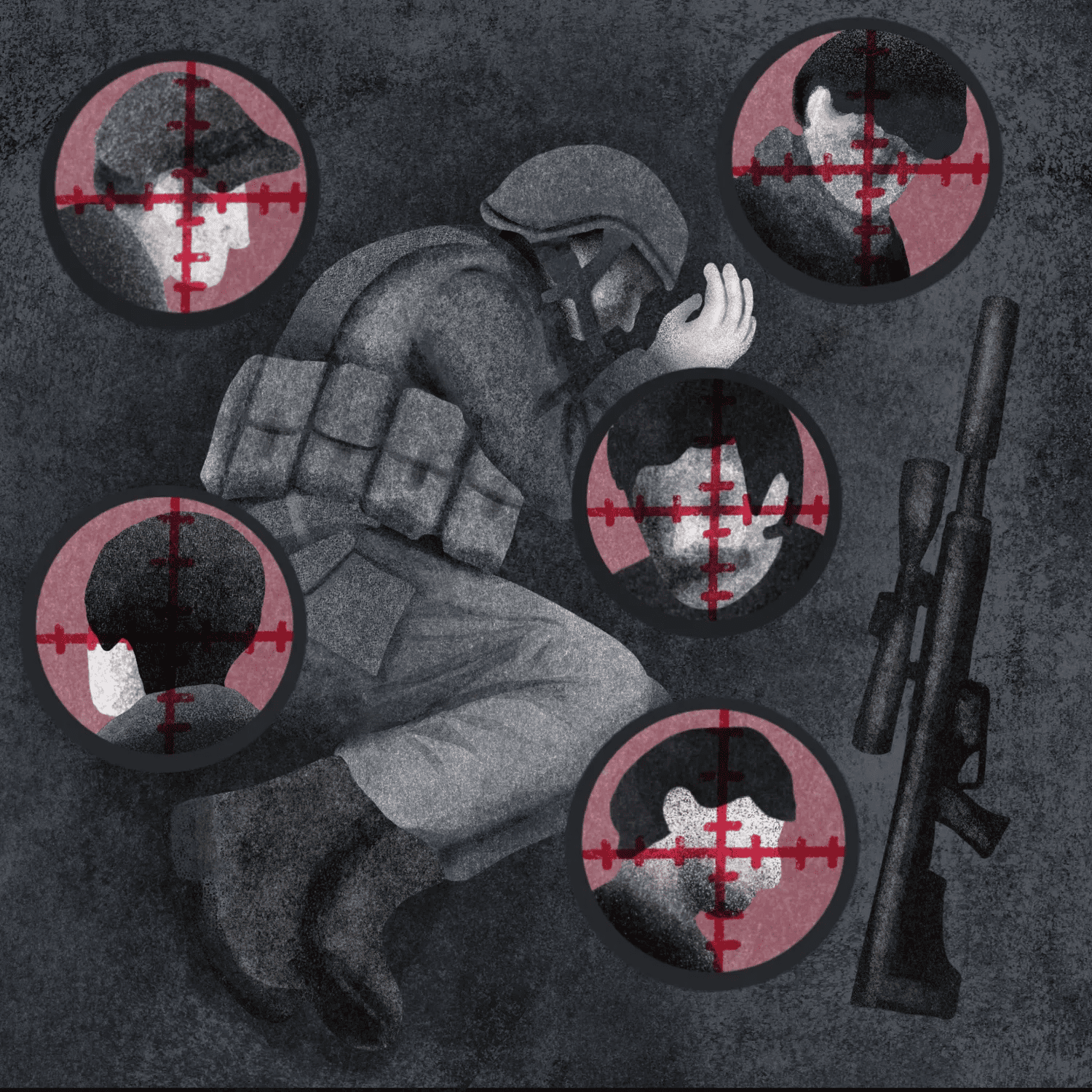
One of them says: "When you shoot through a sniper scope, everything looks close, like in a video game. You don't forget the faces of the people you killed. They stay stuck in your mind."
Another says: "Since my discharge from service, I have suffered from involuntary urination at night; I feel abandoned, that no one can help me. I spent a month in hospital. They tried to explain that I have to accept it, and that the clock cannot be turned back. It's easy for them to say that. They're not the ones who, every time they close their eyes, see a person receiving a bullet to the forehead."
Some soldiers speak of psychological injuries they suffered after seeing Palestinians used as human shields, or after witnessing looting and vandalism. One says: "We would enter Palestinian homes, and people were enjoying the destruction."
"I saw people stealing electrical appliances, gold necklaces, money, everything. Some said all Arabs are Nazis, and that stealing from Nazis is a blessing. I felt disgusted, but I didn't say a word. It hurt me badly to burn photographs of Palestinians or urinate on them. What was the point of that?"
"Once, a soldier noticed I was uncomfortable with it and said: 'What's wrong with you? They won't come back here anyway; their story is over.' I didn't answer, I just nodded my head."
Then there were the operations of Unit 504, whose tasks included interrogating prisoners. "We were on a mission in northern Gaza, and we arrested a Hamas operative."
Eitan recalls: "There was an agent in one of the houses. We were ordered to guard him until the Unit 504 interrogator arrived."
He adds: "They always move in pairs - an interrogator and a combat soldier. When they arrived, we were standing guard at the entrance to the house, and I could hear and see the entire interrogation."
Eitan says that at one point, the interrogator removed the prisoner's trousers and underwear. "He took two plastic cable ties and fastened one to his penis and the other to his testicles. He asked him a question, and when he didn't answer, he tightened the cable ties.
"They repeated the question over and over; there was hysterical screaming. He did not stop screaming, as if his soul were leaving his body. In the end, he spoke; his words poured out, and the interrogator undid the cable ties and put him in a truck. They must have taken him to a detention centre."
Eitan says the screaming has not stopped since. That incident shattered everything I believed about the army, and everything I believed about us, and about myself. If we are capable of doing something so terrible without civilians knowing, what else is going on in the basements? What other secrets are we hiding?
Experts say such psychological injuries can also affect people who engage in combat remotely. Ran, for example, never served a single day in Gaza. He was a reserve Air Force officer at the Defence Headquarters in Tel Aviv, in a unit responsible for planning air strikes.
He says: "After 7 October, everything changed." "Everything I knew about collateral damage evaporated. We would plan and get approval for strikes that we knew would kill dozens of civilians, sometimes more. And it didn't change anything. My cousin was killed at Nova. Revenge and anger blinded my vision, and took complete control of me.
"What happened was horrific. As the days went by, this began to weigh on me. At one moment we were planning a strike in which children would die, and in the next moment we were sitting down to eat a hamburger on Ibn Gabirol Street [a main street in Tel Aviv]." It is a dissonance that could not be contained, and I felt as if a stigma had begun to form on my forehead.
He says the moment of crisis came on 18 March of last year, when Israel broke its ceasefire with Hamas and carried out night-time airstrikes. Hundreds were killed, most of them civilians.
Ran says: "I could no longer bear to go on with this. I felt that if I continued serving, I would be betraying what remained of the good inside me, the person I want to be." He is not alone. Many pilots asked to be relieved of their duties after such a large number of civilians were killed that night. The air force agreed, but asked the pilots to remain silent.
Ran returned home, but could not return to his work. He says: "I became obsessed with looking at the most gruesome images of dead and wounded Palestinians. I still try to recall whether I had a hand in it, whether I am responsible for these images."
My psychiatrist tells me I seem to be choosing to torture myself. He asked me to stop, but I cannot. I feel that I deserve this.
Is it a matter of morality or identity?
Officially, the Ministry of Defence does not recognise a diagnosis of "moral injury", which, as experts point out, has not yet been included in the Diagnostic and Statistical Manual of Mental Disorders (DSM). Therefore, a soldier suffering from a "moral injury" goes to the ministry's rehabilitation department, undergoes a medical examination, and is diagnosed with post-traumatic stress disorder. Although these two conditions can sometimes overlap, they are fundamentally different.
The problem of misdiagnosis is not merely a difference in terminology. Treatment, says Zalsman of the National Council for Suicide Prevention, also differs fundamentally. He adds: "Post-traumatic stress disorder is treated with intensive graduated exposure to the trauma, with the aim of separating the memory of the trauma from the emotional response."
Recovery from moral trauma requires purposeful work towards accepting the act that caused the crisis and reconciling with it. In other words, the person needs to learn to forgive themselves.
But this may soon change. The public committee formed in October to seek solutions for treating disabled soldiers is expected to recommend that the Rehabilitation Department recognise psychological trauma.
According to a sub-committee, "therapeutic protocols must be established, care providers and rehabilitation staff must be trained, and attention must be paid to the direct link between psychological trauma and work, contribution and role in society."
The army has also decided, albeit belatedly, to recognise this phenomenon; the US Army, for example, has had therapeutic protocols for psychological injuries for years. In recent months, and almost without public announcement, Israeli mental health specialists have begun to emerge.
The Israeli army is working on an initial intervention protocol for soldiers suffering from moral injury.
The office of the Israeli army spokesperson has not issued any statement on this matter, and it has remained under wraps, unlike many other steps the army has taken to support soldiers' mental health during the war. The Israeli army has even refused to name this psychological phenomenon "moral injury", preferring the term "identity trauma". The army denied that there were any hidden motives behind the change in name.
But other sources say the opposite. A mental health officer in the reserves says: "There is clearly a socio-political message being conveyed here. If we acknowledge that many soldiers suffer from moral injuries, how does this fit with the stereotype of the most moral army in the world? So they chose a phrase that places the responsibility on the soldier, as if the problem lies in his identity rather than in the actions his commanders sent him to carry out."
Another officer in the army's mental health system said the decision was "to find a temporary solution that allows these soldiers to receive treatment without angering politicians. I was present at a meeting where a senior officer said: 'We cannot call them moral injuries; do we need Channel 14 to hang us from a tree?'", referring to the television channel loyal to Prime Minister Benjamin Netanyahu. "This is the prevailing mood in the army at present."
It is not only the army that refuses to look directly at moral injuries; many soldiers do too. They fear telling their friends how they feel, for fear of being labelled traitors, leftists or weak. Levi-Belz of the University of Haifa says: "This happened with post-traumatic stress disorder, and today it is happening with moral injuries."
The problem is not confined to the junior commander, the brigade commander or even the chief of staff, but extends to society as a whole. The government promotes a binary discourse: either you are with us or you are a leftist traitor, and this affects mainly young people.
A soldier who expresses doubts about what they did in Gaza may fear that his team will see him as a stranger who must be expelled. For such a soldier, this may be the worst thing that could happen, a feeling of total rejection. So, in many cases, they prefer not to talk about it and not to seek help.
Guy, for example, still refuses to share his feelings with other soldiers. He is in the Shaldag special forces unit. Since 7 October, he has spent hundreds of days on reserve duty. In fact, on that ill-fated Saturday, he was called up and ordered to head to Be'eri. The things he failed to prevent there began to haunt him.
Guy says: "I feel a great deal of guilt, and I think there are many like me, but they have decided to direct that guilt elsewhere – towards revenge. Their eyes would light up whenever we went out on a mission."
"When it was discussed that all the terrorists had been killed by the special methods the unit used in the tunnels, people were excited, while I was remembering the Holocaust. I was shocked, but I continued to serve. I thought it would pass."
One operation was at Al-Shifa Hospital in Gaza. He says: "The whole area reeked of death, the smell of corpses. Since then, I can no longer bear the smell of burnt flesh. I became vegetarian."
I remember well the moment I realised the bitter truth, when the smell reminded me of what I had smelled in Be'eri. Then I asked: what have we become? What have I become? Even today, I am afraid to answer this question.
Haaretz


