


The working paper issued by the World Bank under the title "Reducing Fertility in Developing Countries: A Review of Determinants and Policy Levers" (Reducing Fertility in Developing Countries: A Review of Determinants and Policy Levers), prepared by the researcher Rodolfo A. Bulatao (Rodolfo A. Bulatao) in late 1984 and circulated in 1985, is a pivotal document in the history of global population policies.
This paper was not merely an academic study. It served as an operational guide for international institutions and governments in the Global South on how to intervene in the social and biological structures of families in order to achieve macroeconomic objectives.
Study overview | Details |
Original title | Reducing Fertility in Developing Countries |
Lead author | Rodolfo A. Bulatao |
Edition number | World Bank Staff Working Paper No. 680 |
Time context | Background to the 1984 World Development Report |
Geographic focus | Developing countries (with particular focus on Egypt, India, and East Asia) |
The Paper's Central Philosophy: Development as a Tool for Population Control
The study starts from the premise that rapid population growth in developing countries consumes the fruits of development and places pressure on public services, and that intervention to reduce fertility is therefore a strategic necessity. The paper argues that economic development alone is not sufficient to reduce childbearing in the short term, since rising incomes may enable poor families to support more children, which may temporarily raise fertility. On this basis, the paper proposes focusing on specific "policy levers" capable of breaking this pattern, foremost among them education, health, and family planning.
The Conceptual Framework of the Determinants of Fertility and the Factors Influencing It
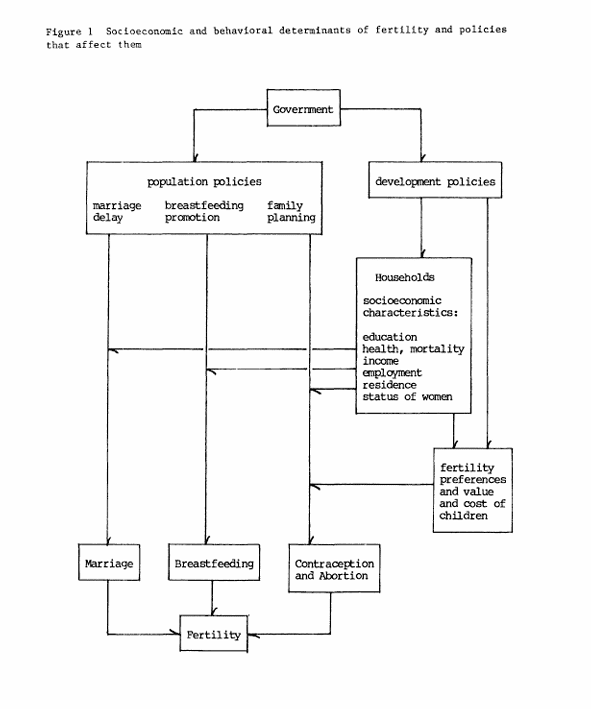
The accompanying figure from the study sets out the conceptual framework of the factors influencing fertility. It shows that birth rates are not determined by a single factor, but are affected by the interaction of government policies with the social and economic conditions of families and the reproductive behaviour of individuals.
At the first level, governments influence fertility through population policies, such as delaying the age of marriage, encouraging breastfeeding, and family planning, alongside development policies that affect education, income, health, employment opportunities, place of residence, and the status of women.
These factors shape families' preferences regarding the number of children and their economic and social value, and they also affect the direct behaviours that determine fertility, such as age at marriage, periods of breastfeeding, use of contraception and abortion, which constitute the direct channels through which fertility levels change.
The figure shows that the relationship between development, population policies, and fertility is interconnected, as economic, social, and public policy factors work in an integrated manner to shape patterns of childbearing within a society.
A Comparison of the Timing of Reproductive Events in Different Societal Patterns
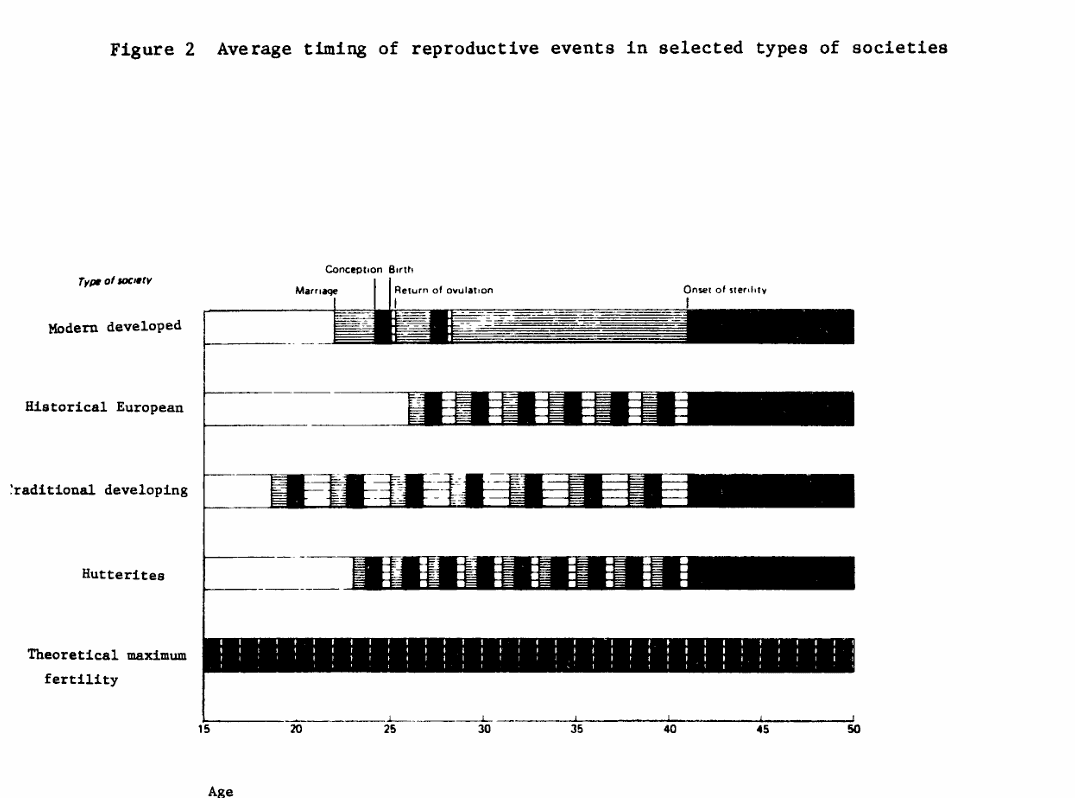
The accompanying figure from the World Bank study illustrates the differences in the timing of reproductive events across five types of societies: modern developed societies, historical European societies, traditional developing societies, the Hutterites (Hutterites), and the theoretical maximum fertility model.
It shows that the pattern of childbearing is affected by age at marriage, the interval between births, the duration of breastfeeding, the return of ovulation after birth, and the age at which women begin to lose fertility.
In modern developed societies, marriage and first childbirth are delayed, and the number of births declines due to the use of family planning methods, whereas in traditional societies births begin at a younger age and recur at shorter intervals, leading to high fertility. The Hutterites, who are used in population studies as a model of natural fertility in the context of limited use of contraception, display a pattern characterised by frequent childbearing extending over most of the years of reproductive capacity.
The figure also presents the theoretical maximum fertility model, which assumes continued childbearing throughout a woman's reproductive period without any behavioural or social constraints, highlighting the influence of demographic and behavioural factors in shaping fertility levels across different societies.
The Effect of Reproductive Behaviour on Fertility Levels
Data from the World Fertility Survey, which covered 29 developing countries, indicate that fertility levels depend not only on the biological capacity to bear children but are chiefly affected by the reproductive behaviour of individuals and families. The study relied on a model comparing actual fertility with theoretical maximum fertility, which assumed that a woman could on average bear 17 children over her reproductive life,
noting that deliberate abortion was not included in the survey data.
The study's findings showed that breastfeeding is the most influential factor in reducing fertility in many developing countries, as it prolongs the period of post-partum anovulation, which lengthens the interval between births and reduces the number of children born over the reproductive lifetime. Delayed marriage shortens the period of exposure to childbearing, while the effect of family planning methods varies considerably between countries depending on the extent of their use and social acceptance.
In the sub-Saharan African countries covered by the study (Ghana, Kenya, Lesotho, Senegal, and northern Sudan), fertility rates remained high, ranging between 5.2 and 7.4 children per woman. Most of the reduction in fertility compared with the theoretical maximum is attributed to breastfeeding, while the effect of delayed marriage was limited, and contraceptive use had only a very slight effect, reflecting heavy reliance on natural factors in regulating childbearing.
South Asian countries (Bangladesh, Pakistan, and Nepal) showed a similar pattern, although Bangladesh was a distinctive case, recording the longest average duration of breastfeeding in the World Fertility Survey, at about 27 months for children who were breastfed, alongside a decline in the average age at marriage for women to about 16 years. Prolonged breastfeeding partly offset early marriage by lengthening the intervals between births, but it did not prevent fertility from remaining at high levels.
In Jordan and Syria, the study recorded the highest fertility rates among the countries included, at 7.6 and 7.5 children per woman respectively. These high levels are attributed to the shorter duration of breastfeeding compared with some African and Asian countries, along with a roughly similar age at marriage and limited impact of family planning methods, which was not sufficient to compensate for the reduced effect of breastfeeding in lowering childbearing.
In the remaining Asian countries, such as Sri Lanka, Indonesia, and Thailand, the effect of breastfeeding in reducing fertility remained evident, while this effect declined markedly in South Korea, Malaysia, the Philippines, and Fiji, as well as in most Latin American and Caribbean countries, where other factors, such as delayed marriage and the use of family planning methods, played a larger role in reducing birth rates.
The study also found considerable variation between countries in the effect of delayed marriage, even within the same region. Its effect was clear in Sri Lanka and Costa Rica, where it approached its level in developed countries, whereas it was limited in many African and South Asian countries due to the continuation of marriage at young ages.
The study concludes that differences in fertility levels among developing countries are not linked to a single factor, but result from the interaction of a set of reproductive behaviours, chief among them breastfeeding, age at marriage, and the use of family planning methods. The relative weight of each factor varies according to social, economic, and cultural conditions, which explains the wide variation in fertility rates between different countries and regions.
Raising the Age of Marriage and Its Effect on Reducing Fertility
Age at marriage is one of the most important direct determinants of fertility levels, as an increase in a woman's age at marriage is associated with a decrease in the number of children she can bear over her reproductive life. This is because early marriage prolongs the period of exposure to pregnancy, allows childbearing during the years of highest fertility, and often deprives women of opportunities to complete their education and enter the labour market, and reduces their capacity for family planning, according to the study. In addition, early marriage shortens the interval between generations, which contributes to raising birth rates at the societal level.
The data show a clear regional variation in the prevalence of early marriage. In South Asia and sub-Saharan Africa, more than half of girls aged 15 to 19 were married or had been married, whereas this proportion fell to about 17% in Latin America and the Caribbean, and to only 2% in East Asia. Large differences also appeared within the regions themselves: in the Middle East and North Africa, the proportion of married women in this age group ranged between 25 and 50% in most countries (according to the study's statistics for 1984), while it reached about 6% in Tunisia and exceeded 70% in Libya.
In South Asia, the average age at first marriage for women was about 16 years in Bangladesh, compared with more than 25 years in Sri Lanka. The study estimated that if Bangladesh had adopted the Sri Lankan pattern of age at marriage, the total fertility rate would have fallen by about 2.2 children per woman, even without any change in other reproductive behaviours.
The study confirms that prevailing marriage patterns in a society also affect fertility, although their impact varies with social practice. While polygamy is widespread in parts of West Africa, where its prevalence averages about 20% among married men, the available evidence does not conclusively establish that it leads to either an increase or a decrease in women's fertility.
By contrast, informal unions or consensual partnerships, which are common in some Latin American and Caribbean countries such as Jamaica, tend to be associated with relatively lower fertility, because they often represent a transitional stage preceding formal marriage. Child marriage, which still persists in some parts of South Asia, contributes to raising fertility, although its effect is smaller than expected, owing to the delayed consummation of marital relations and the weak biological fertility at very young ages.
The study notes that recent decades have witnessed a general trend towards rising age at marriage in developing countries, particularly in Asia, where the average age at first marriage increased by between one and two years over relatively short periods, a rate exceeding that seen in Latin America. South Korea is among the most prominent examples of this transition: the average age at marriage for women rose from 16.6 years in 1925 to 23.7 years in 1975, and this increase played a prominent role in reducing fertility during the early stages of the demographic transition. Sri Lanka and the Philippines also saw similar increases, although they began from relatively high levels since the early twentieth century.
This trajectory differs from the historical experience of Western Europe, where marriage had already been delayed since the seventeenth century as a result of economic norms that required spouses to possess sufficient resources to establish an independent household before marriage. Therefore, when the fertility transition began in the late nineteenth century, delayed marriage was not the principal factor in the decline in childbearing; rather, it came with the spread of family planning methods. In developing countries, by contrast, delayed marriage itself has become one of the most important contributing factors to the decline in fertility.
The study attributes rising age at marriage to a set of social, economic, and demographic factors. Internal and external migration, wars, and sex-ratio imbalances in some societies have contributed to delayed marriage because of the difficulty of finding a suitable partner. The expansion of female education has also played a pivotal role: studies showed that a woman who received seven or more years of education marries on average about 3.5 years later than an uneducated woman, a finding confirmed by studies in Korea, Malaysia, Taiwan, Colombia, and Sri Lanka.
The effect of education operates through several mechanisms. It raises women's opportunities for employment and income, increases their aspirations and their criteria for choosing a life partner, and causes schooling and marriage to compete for the time available during youth, which pushes marriage later. Work in the modern sector reinforces this trend, as employment before marriage was found to delay marriage on average by about 1.5 to 2 years. Residence in urban areas is also associated with later marriage: urban women marry on average about 1.5 years later than rural women, even after accounting for social and economic differences.
Education as a Tool for Undermining the "Investment in Children"
The study cites Egypt to highlight the importance of formal education in undermining the investment in children, where it states: "Over time, fertility differences between educational groups increase, at least in the early stages of the fertility transition. Between 1960 and 1976, for example, the average number of births for women with secondary education in Egypt fell from 85 percent to 65 percent of the average for illiterate Egyptian women. There are, therefore, several factors that tend to create a lag between rising education levels and falling fertility: the natural gap between a woman's enrolment in school and her reaching the average age of childbearing, and the need to complete several years of primary school before a negative effect on fertility is observed. This growing contribution of education to reducing fertility as the fertility transition advances suggests that there is another effect of education that shortens the lag period. Educating children reduces their economic contributions and increases their cost to parents. Education not only prevents children from working on the farm or elsewhere, but also makes them less inclined to undertake manual labour and weakens their attachment to their parents. For these reasons, as this argument goes, children become a weak investment where education is important, and parents should therefore prefer smaller families."
This passage of the study highlights the core of the proposed strategy, in which education is treated not as an abstract human right, but as an effective mechanism for changing the economic logic of the family. This passage can be analysed through the following dimensions:
1. The widening education-fertility gap: The study indicates that the gap in the number of births between educated and illiterate women widens sharply in the early stages of the demographic transition. The Egyptian example (1960–1976), which the study cites as statistical evidence, shows that the fertility of women with secondary education fell to only 65% of that of illiterate women, making education a "locomotive" for reducing childbearing.
2. The concept of "delayed effect": The paper explains why the effect of education does not appear immediately. There is a natural time gap between a girl's enrolment in school and her reaching childbearing age, in addition to the need to complete a minimum number of school years (primary education and beyond) before her reproductive behaviour changes.
3. Turning children from "assets" into "burdens": This is the most consequential point in the analysis. The paper argues that education reduces children's economic contribution on farms or in workshops, and increases their direct cost to parents. Drawing on the arguments of Caldwell, as the study cites, education weakens traditional bonds and makes children a "weak investment." This shift leads parents, rationally, to prefer "smaller families" so as to concentrate limited resources on fewer children.
The Drive to Reduce Fertility: From Analysis to Social Engineering
The paper moves from diagnosing the situation to proposing direct intervention tools that are bold in nature, calling for:
• Use of propaganda: encouraging the preference for small families through media campaigns and financial incentives or economic disincentives.
• Institutionalising family planning: providing contraception and induced abortion as low-cost tools with rapid effects compared with long-term education.
• Targeting the status of women: raising the age of marriage and encouraging women's employment in modern sectors to compensate for their traditional role as mothers.
How Formal Education Changed the Family
The World Bank study considers formal education one of the most influential factors in reshaping the structure of the family and its demographic patterns. Its impact is not limited to raising individual awareness; it extends to changing the system of decisions about marriage and childbearing within the family. The expansion of girls' education leads to later marriage and to greater educational and professional aspirations, which is reflected directly in a lower expected number of children per family, as a result of the rising "opportunity cost" of early and repeated childbearing.
Formal education also strengthens the capacity to access health information and to use family planning methods more effectively, supporting the shift from large extended families to smaller, more nuclear ones. World Bank literature indicates that higher years of schooling, particularly among women, are closely associated with lower fertility rates and changing family patterns in developing countries, through their influence on early marriage and reproductive behaviour. In the same direction, reports by the United Nations Population Fund affirm that education is among the most prominent structural determinants of fertility, as it reshapes individuals' perceptions of childbearing and strengthens family planning decisions across different social contexts.
The Study's Effects Today: "Seen with Our Own Eyes" in the Contemporary Reality
Looking at the reality of developing countries today, the World Bank's 1985 vision has been realised in many respects, but with complex consequences:
The family in most developing countries has shifted from the productive extended model to the consumerist nuclear model, in which the child has become a costly investment requiring long education, which has in fact led to a decline in fertility to unprecedented levels in some societies.
Contemporary impact | Visible manifestation (what is seen) |
The dominance of the "child quality" logic | A decline in quantity in favor of quality, as families spend most of their income on educating one or two children. |
Later marriage | University education and the search for employment became "social contraceptives" that delayed childbearing for many years. |
Breakdown of family production ties | The end of the child's role as an economic helper in rural areas and cities, which turned "support from one's kin" from a source of strength into an economic burden. |
New demographic crises | Countries that were once "developing" (such as Tunisia or some East Asian countries) now face the specter of rapid aging as a result of excessive success in fertility-reduction policies. |
The Invisible Repercussions of the Transformation of Education and Fertility
Although the study convincingly links the expansion of formal education to declining fertility rates through delayed marriage and changing family patterns, this analysis may not sufficiently consider the social and psychological repercussions accompanying this transformation in societies where channels of relationships outside the framework of marriage are closed.
In such environments, delayed marriage does not only reorganise reproductive decisions; it may also create a long transitional period between biological maturity and the beginning of family life, which may be reflected in women's mental health through higher levels of social pressure, a sense of stigma associated with late marriage, and the tension resulting from growing social expectations regarding childbearing at an older age.
Moreover, this transformation is not limited to the individual dimension; it extends to reshaping the very concept of the family, as establishing it becomes a project that is delayed in time and more complicated in health and social terms, amid increasing considerations related to biological fertility and reproductive planning. This may lead to the family's transition from being an early and relatively stable social structure to a model built at later stages of life, where health challenges intersect with economic and social pressures, affecting the nature of relations within the family itself and its long-term stability.
From this perspective, focusing on demographic indicators alone may obscure deeper dimensions related to women's experience within this transformation, and to the redefinition of the meaning of the family in conservative societies, where demographic analysis cannot be separated from the cultural and value structure that gives it its social meaning.
From a broader critical standpoint, it can be said that part of the literature addressing the relationship between education and fertility tends to treat the phenomenon from a purely economic-managerial perspective, focusing on cost and return, individual productivity, and the efficiency of allocating population resources. This perspective intersects with development approaches of a capitalist background that subject the reproductive decision to the logic of "economic feasibility."
However, this centring on economic calculations may lead to a kind of human abstraction of the phenomenon, in which the reproductive and family experience is reduced to quantitative indicators, while the existential and livelihood dimensions linked to psychological stability, emotional need, and the social meaning of the family are marginalised. In this sense, the critical question arises as to whether analysing fertility solely as an economic variable is sufficient to understand the deep transformations in the structure of the family, or whether it overlooks the human dimension that forms the essence of the family experience itself.
What then are the repercussions when the existential purpose of the family in societies is disrupted and it becomes a mere economic instrument within the capitalist system?
In conclusion, the World Bank paper of 1985 is a document bearing witness to an era in which social policies were designed with the aim of "managing human beings" according to economic standards. It reveals how formal education was used as a tool to dismantle traditional family systems and to reshape human reproductive motives, the results of which we live with today in societies' shift towards individualism and intensive consumerist patterns.


