


Amid the ongoing military escalation in the Arabian Gulf, the Strait of Hormuz has returned to the forefront as one of the world's most important strategic waterways and one of the most influential on international energy markets. As fears mount that flows of oil and petroleum products from the Gulf region could be disrupted, a broad debate has emerged over the extent to which the United States and other major consuming countries can avoid the repercussions of the crisis, particularly given the frequent references to American "energy independence."
A number of economic analysts argue that the current crisis has once again revealed a fundamental reality of global energy markets: oil and its derivatives are subject to what is known economically as the "law of one price," meaning that an interconnected global market causes energy prices to be affected by major events regardless of where production takes place or the degree of self-sufficiency any country has achieved.
The law of one price in the oil market
The concept of the "law of one price" holds that similar goods in global markets ultimately tend to trade at close prices once transport costs, quality and technical differences are taken into account. This principle clearly applies to oil and fuel, as producers, traders, refiners and consumers constantly respond to price differences across different regions in order to profit from buying and selling.
Accordingly, any significant shortfall in global supplies leads to higher prices in almost all markets, even in countries that produce large quantities of oil or achieve a surplus in exports.
The Strait of Hormuz: the global energy artery
Before the latest crisis erupted, the Strait of Hormuz was carrying more than 20 million barrels per day of crude oil and petroleum products, equivalent to roughly one-fifth of global consumption. The strait is the main seaborne outlet for exports from the Arab Gulf states and Iran to world markets.
However, with the escalation of military operations and the imposition of restrictions on navigation, the volumes passing through the strait have fallen sharply, causing significant disruption to flows of crude oil and refined fuel to Europe and Asia.
Although some pipelines and alternative routes exist, their capacity is not sufficient to compensate for the shortfall resulting from the disruption of navigation in the strait, a situation that was quickly reflected in global markets.
Why have diesel prices risen more than others?
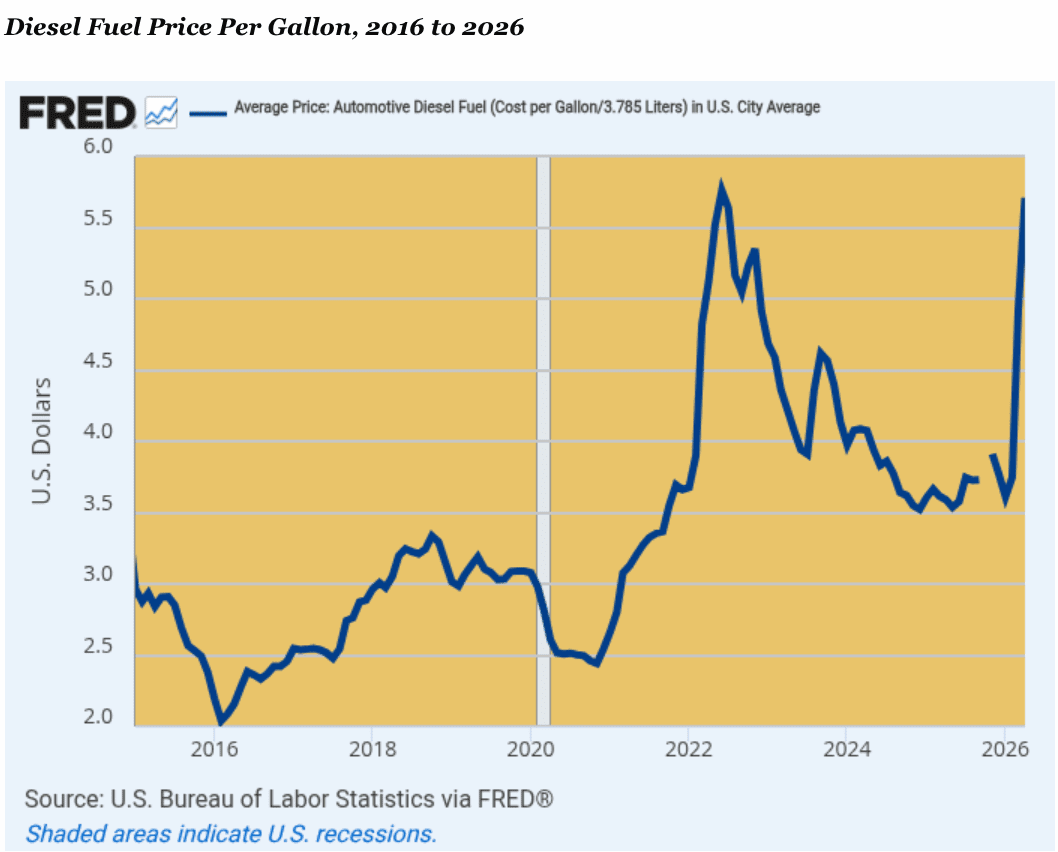
One of the most prominent features of the current crisis is the sharp rise in the prices of diesel and jet fuel compared with other petroleum products.
This is because Gulf refineries depend to a large extent on certain types of medium and heavy crude that are rich in the production of middle distillates, such as diesel, kerosene and jet fuel. These products account for between 50 and 60 percent of the output of many Gulf refineries.
By contrast, American refineries rely more heavily on light crude, which yields higher proportions of gasoline and naphtha, making their capacity to offset the global shortage of diesel relatively limited.
Consequently, the decline in Gulf production and exports has produced a clear global shortage of transport, shipping and aviation fuel, which has caused major price jumps.
Direct repercussions for the American economy
Although the United States has in recent years become the world's largest energy producer and one of the leading exporters of oil, gas and refined products, this has not prevented prices from rising within the American market.
As global demand for American diesel increased to offset shortages in Europe and Asia, US exports rose to record levels, pushing domestic prices upward in step with international prices.
The average price of diesel in the United States exceeded five dollars per gallon in recent weeks, which has had a direct impact on transport, shipping, agriculture and industrial costs.
The American economy relies extensively on diesel fuel, as it is used by millions of commercial trucks, agricultural machinery, construction equipment, railways and inland cargo vessels, meaning that any rise in its price quickly passes through to the prices of goods and services.
Effects extending to global supply chains
The repercussions of the crisis are not limited to the energy sector but extend to various economic sectors.
Rising fuel costs increase the cost of transporting raw materials, food commodities and industrial products, which raises inflation, squeezes corporate profits and reduces consumers' purchasing power.
The shortage of jet fuel has also prompted many airlines to revise their flight schedules and raise ticket prices, particularly in Europe and Asia, which had relied heavily on fuel imports from the Gulf.
Energy markets more interconnected than ever
The current crisis shows that talk of "energy independence" does not mean disconnection from global markets. Even countries that produce enough oil and gas to meet their own needs remain part of an interconnected global network in which prices are determined by the balance of supply and demand at the international level.
For this reason, any major disruption in a strategic region such as the Arabian Gulf is reflected almost immediately in prices in Europe, Asia and North America alike.
An uncertain outlook for the markets
With military tensions continuing and the prospects for diplomatic solutions unclear, energy markets remain exposed to further volatility in the coming months. Experts believe that a prolonged disruption to Gulf exports could trigger a new wave of global inflation and place the international economy before challenges similar to, and possibly more severe than, the energy crises the world witnessed in the 1970s.
Ultimately, current developments confirm that oil remains a quintessentially strategic global commodity, and that the stability of energy markets depends to a large extent on the stability of vital maritime routes, foremost among them the Strait of Hormuz, which continues to represent one of the most important keys to the global economy in the twenty-first century.


