

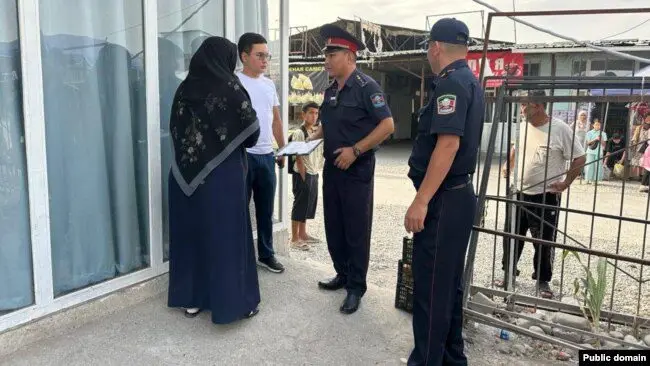
The debate over the wearing of the hijab in schools and universities in Central Asia has resurfaced with the start of the new academic year, after Kazakh authorities warned private schools that they could lose their licences if they allow female students to wear the hijab, at a time when uneven restrictions on religious dress continue in a number of the region's Muslim-majority countries.
Kazakhstan's Minister of Education Goldiz Sulaimanova said during a government briefing on 8 September that state and private schools are required to abide by uniform dress codes, and that permitting the hijab could expose private schools to measures up to revocation of their licence.
The minister added that some private schools had allowed the hijab during the previous academic year, but said that at the start of the current academic year "there are no longer any such schools." She revealed that the ministry is handling the matter in coordination with the National Security Committee and local authorities, pointing to the existence of a joint committee to monitor the application of the rules.
Kazakhstan's restrictions are based on school uniform rules set by the Ministry of Education since 2016, which prohibit the inclusion within school uniforms of elements that clearly indicate religious affiliation. Enforcement of these rules over the past years has led to disputes between authorities and Muslim families demanding that their daughters be allowed to wear the hijab while studying.
Tajikistan: "I was told 'the law is the law'"
In Tajikistan, Radio Free Europe/Radio Liberty reported, citing a Muslim student at Khujand State University who used a pseudonym for security reasons, that a professor reminded her on the first day of classes that wearing the hijab is not permitted inside educational institutions.
Tajikistan imposes broad restrictions on some forms of Islamic dress, while the authorities encourage the wearing of what they describe as traditional national clothing instead of clothing they consider "foreign to the national culture." The government says these policies aim to protect the secular character of the state and counter what it calls extremism, while critics argue that they intrude extensively on individual religious practice.
Uzbekistan too
Radio Free Europe/Radio Liberty notes that Kazakhstan, Tajikistan and Uzbekistan impose restrictions on the hijab in state schools and some official institutions, although the rules and the way they are applied differ from one country to another. Tajikistan and Uzbekistan have also seen campaigns and criticism in recent years related to Muslim women's clothing and men's beards.
Kyrgyzstan exempts the hijab… but bans the niqab
Kyrgyzstan, according to the report, remains the only Central Asian country that does not impose a general official ban on the face-revealing hijab. However, since 2025 the country has banned clothing that prevents facial recognition in public places, a provision that is applied in practice to the niqab. Police have fined dozens of women for wearing it.
The start of the academic year returns the question of the hijab to the forefront of debate in Central Asia, where Muslims make up the majority of the population in most countries of the region, while governments insist on the secular character of the state and subject religious manifestations and activities to varying degrees of oversight. While the authorities present the restrictions as linked to secularism, security and school order, their opponents argue that they severely narrow the space for individual religious expression in countries whose populations are Muslim, particularly for Muslim women and girls.


