


When the Ottoman state moved from the borders of Anatolia into the heart of the Balkans, it needed a city that would serve as a political and military base close to the new fronts of conquest, and Edirne was the city that fulfilled this role. Since coming under Ottoman rule in the 8th century AH/14th century CE, it transformed from an important Byzantine city into one of the greatest metropolises of the Ottoman state, and became its European capital and the seat of its sultans for nearly a century, before the conquest of Constantinople in 857 AH/1453 CE.
Edirne's importance was not only military. In it, Ottoman architecture developed, and mosques, madrasas, caravanserais, markets and palaces flourished. From it set out major campaigns that changed the map of the Balkans. The city then reached another peak under Sultan Suleiman the Magnificent, when the great architectural masterpiece of the Selimiye Mosque rose there.
From Byzantine Edirne to the Ottoman City
Edirne, known in ancient times as Adrianople, was a strategic city in Thrace, founded by the Roman emperor Hadrian around the 2nd century CE, and it later became one of the important cities of the Byzantine Empire.
Ottoman interest in Edirne began early in their expansion into Thrace. Sources mention that Prince Suleiman Pasha, son of Orhan, took part in Ottoman operations in the region in the 1350s CE (the 750s AH), and that these movements opened the way for Ottoman expansion in Thrace.
As for the conquest of Edirne itself, sources and studies differ in dating it, with the years 762 AH/1361 CE, 763 AH/1362 CE, 769 AH/1368 CE and 771 AH/1369 CE all recorded. However, the view that carries considerable weight in modern studies holds that Prince Murad, who later became Sultan Murad I, seized it in 762 AH/1361 CE, with the assistance of Lala Shahin, before his accession to the sultanate.
This date is important because it shows that Edirne entered the Ottoman project at a very early stage of the move into Europe.
Edirne, the State's Capital in Europe
After taking Edirne, the city became a principal base for Ottoman expansion in the Balkans, and gradually became the centre of the state.
Under Sultan Murad I, the state moved from Edirne to consolidate its presence in Thrace, Macedonia, Bulgaria and Serbia, and the city became a meeting point for armies, roads and caravans.
The city's geographical location made it a link between Anatolia and Ottoman territories in Europe, and therefore the move of the state's centre there was not merely an administrative transfer, but an expression of the state's transformation from an Anatolian principality into a power spanning two continents.
The Old Palace and the Building of a New Sultanic Centre
After the conquest, the Ottomans began reorganising Edirne in line with its new status. Sultan Murad I built the old palace, known as Saray Atik, in the area now occupied by the Selimiye Mosque district, and the palace was primarily dedicated to state affairs and the sultanic residence.
Then came Sultan Murad II, who began building the new palace around 854 AH/1450 CE in the Sarayiçi area, on an island between the branches of the Tunca River, and Sultan Mehmed the Conqueror completed it afterwards. This palace became one of the most important centres of Ottoman rule in Edirne, and its use and expansion continued under subsequent sultans.
Thus a new political heart of the state took shape in Edirne, comprising the palace, the army and the administration, while neighbourhoods, markets and religious and educational institutions grew around it.
Mosques and Madrasas: Shaping the Islamic City
The mosque in Edirne was more than a place of worship; it became the axis around which neighbourhoods and endowment institutions formed.
The city saw the construction of a large number of mosques, madrasas, caravanserais, public kitchens and baths, until it became a clear model of the Ottoman city forming around endowed complexes.
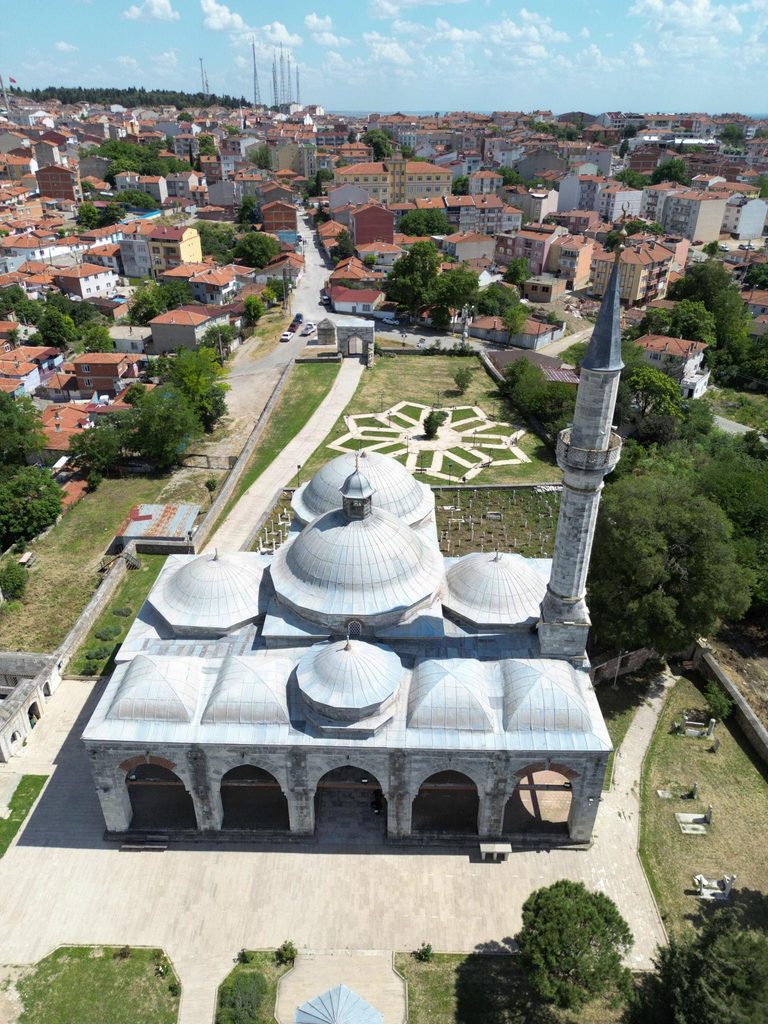
Among the oldest Ottoman mosques in the city is Eski Cami, and then the Muradiye Mosque and its complex were built in the reign of Sultan Murad II. Later, in the mid-9th century AH/15th century CE, a more influential mosque in the development of Ottoman architecture appeared: the Üç Şerefeli Mosque.
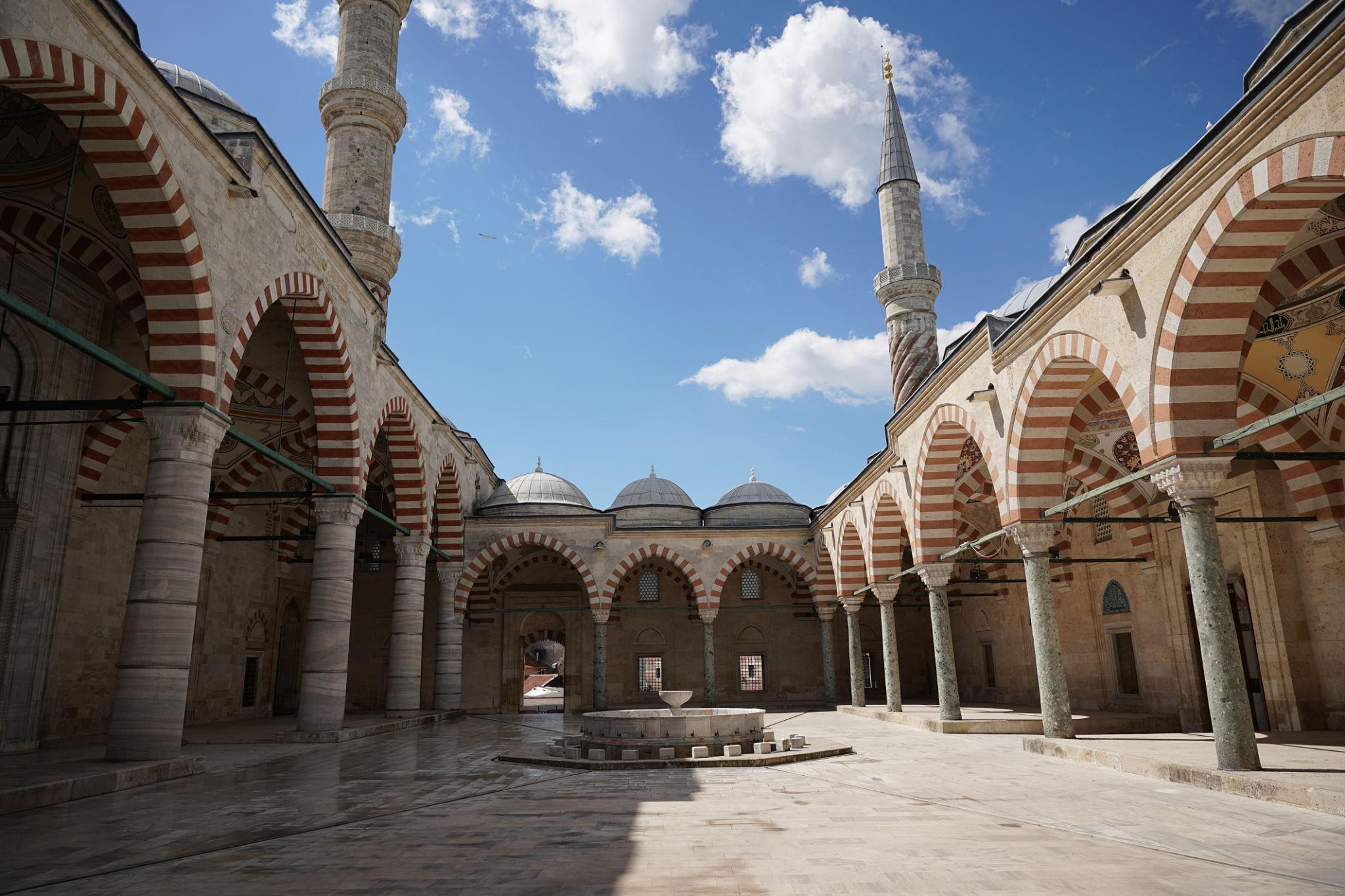
The Üç Şerefeli Mosque and its complex were built between 841 AH and 851 AH/1437–1447 CE in the reign of Sultan Murad II. It is considered an important milestone in the development of Ottoman mosque architecture, especially because of its centrally planned dome, its courtyard surrounded by arcades, and its four minarets.
Edirne Under Murad II
Edirne reached a prominent status under Sultan Murad II, who ruled in two periods: the first from 824 AH/1421 CE to 848 AH/1444 CE, and the second from 850 AH/1446 CE to 855 AH/1451 CE.
During his reign the city witnessed great urban and scholarly expansion, and became an important centre for scholars, judges and teachers.
Among the most prominent structures associated with his era is the Muradiye complex, established around 830 AH/1426 CE, and the Darülhadis complex, in addition to the Üç Şerefeli Mosque, which was completed in 851 AH/1447 CE. Specialised sources indicate that these complexes represent a fundamental stage in the development of the Ottoman complex as an institution.
The madrasas in Edirne were not marginal institutions; scholars, jurists and judges associated with them, some of whom later became among the most prominent scholarly figures of the state.
From Edirne Came the Conquest of Constantinople
Edirne was the city from which Sultan Mehmed II directed an essential part of the preparations for the conquest of Constantinople.
Mehmed II inherited a state whose European centre was in Edirne, and the city was the base of the army, authority and resources that moved towards Constantinople.
In 857 AH/1453 CE, Sultan Mehmed II set out from Edirne at the head of his campaign towards Constantinople, and the campaign ended with the conquest of the city on 29 May 1453 CE, corresponding to approximately 20 Jumada I 857 AH.
Edirne and the Scholars
The city's transformation into a capital helped attract scholars to it from various regions of the Islamic world.
Among the scholars later associated with Edirne was Shams al-Din Ahmad ibn Sulayman, known as Ibn Kemal Pasha, born in Edirne in 873 AH/1468 CE, who became one of the most prominent scholars of the Ottoman state. He taught in Edirne's madrasas and then became Shaykh al-Islam in 932 AH/1525–1526 CE. Sources describe his works as extensive, most of his writings being in Arabic and in the religious sciences.
This figure illustrates how Edirne became a scholarly environment linked to the Ottoman institution, not merely a military capital.
The Selimiye: The Peak of Islamic Architecture in Edirne
After the capital moved to Istanbul, Edirne's status did not entirely decline.
Under Sultan Suleiman the Magnificent and then his son Sultan Selim II, the city became the setting for one of the greatest architectural projects in the history of the Ottoman state.
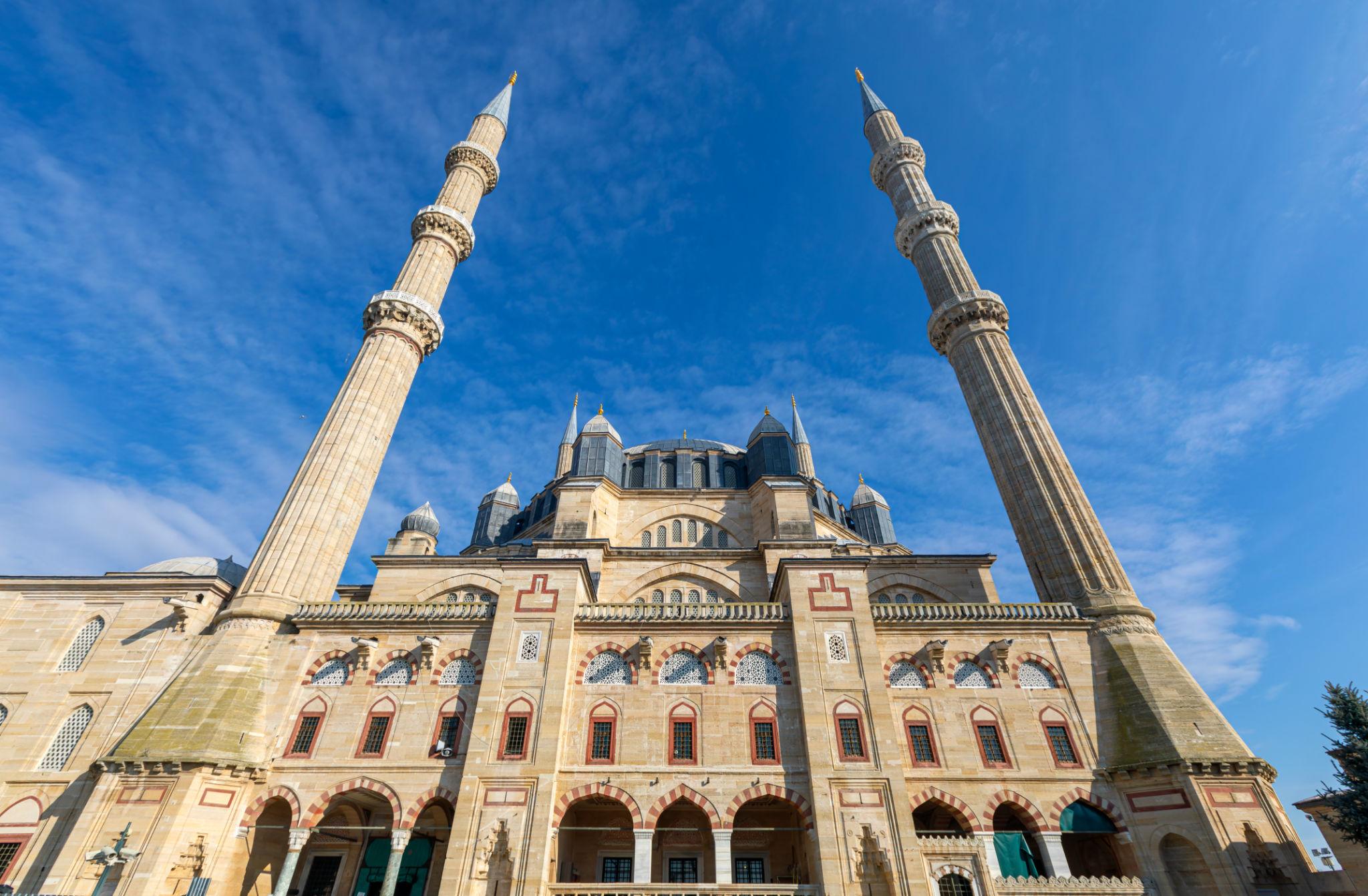
In the reign of Selim II the Selimiye Mosque was built, completed by the architect Sinan in the period 976–982 AH/1568–1575 CE, approximately.
The Selimiye represents an advanced stage in the development of Ottoman architecture, as Sinan made the central dome a clear axis of the building, and placed the mosque atop a raised hill so that its minarets and dome became a prominent landmark on the skyline of Edirne.
The Selimiye is not a monument from the era when Edirne was the state's capital, but rather from a later Ottoman phase, and this distinction is necessary for understanding the city's architectural chronology.
Edirne, Trade and Roads
The city's location helped sustain its commercial prosperity. It lies on the overland routes between Istanbul and central Balkans, and therefore caravans, travellers and armies continually passed through it.
Markets and caravanserais grew around the main arteries, and economic life was tied to the army, the administration and regional trade.
Sultanic endowments also contributed to providing services for residents and travellers, so mosques, madrasas, caravanserais, kitchens and baths emerged as interconnected elements of the urban system.
This model was part of the transformation of Ottoman cities into urban centres relying on a wide network of endowments that provided lasting resources for public, religious and educational institutions.
Edirne in the Late Ottoman Period
Edirne continued to retain its importance after the capital settled in Istanbul, remaining an important sultanic seat. Sultans used it for residence, military journeys and hunting, and it remained a principal administrative and commercial centre in Thrace.
However, its frontier location also made it vulnerable to the wars the Ottoman state fought in Europe, and the city entered difficult periods during the Russo-Ottoman wars and the Balkan Wars.
Nevertheless, its architectural layers remain witnesses to centuries of Ottoman Islamic history, from the early palaces to the sultanic complexes and then the Selimiye.
What Remains of Islamic Edirne?
Today Edirne contains an exceptional collection of monuments that allow the development of the Ottoman city to be traced over more than five centuries.
Among the most important are the Üç Şerefeli Mosque and its complex, the Muradiye complex, Eski Cami, the Bayezid II complex, the New Palace of Edirne, the markets and caravanserais, and the Selimiye Mosque, which represents a highly advanced stage in the history of Ottoman architecture.
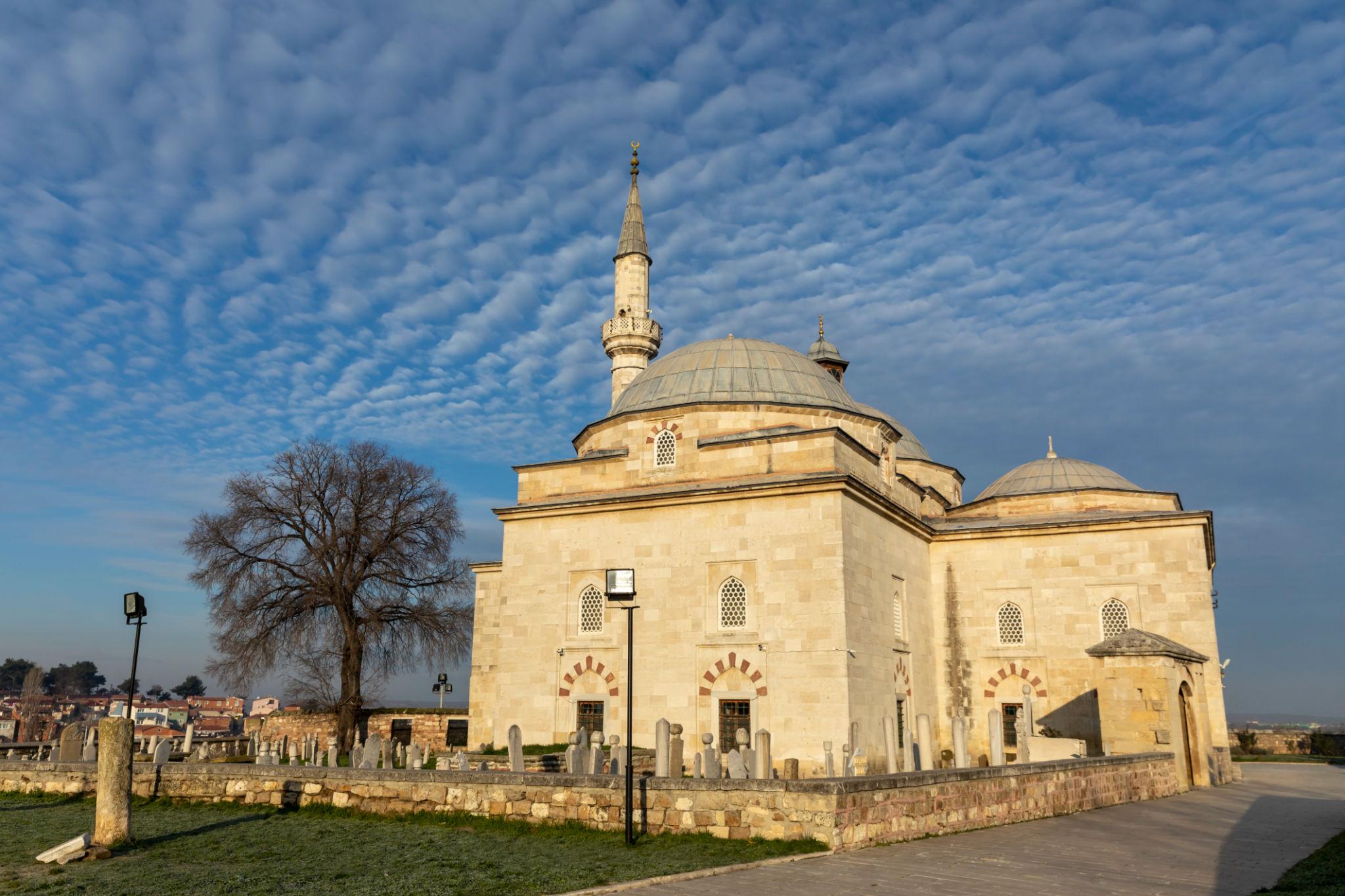
Edirne's value does not lie in a single building, but in the combination of these architectural layers within one city; each mosque, complex and palace carries a different phase in the development of the state.
For this reason Edirne appears in Ottoman Islamic history like a bridge between two stages: the state expanding from Anatolia into the Balkans, and the empire whose capital became Istanbul after the conquest of Constantinople.


