


In northwestern Anatolia, at the southern foothills of Uludağ, Bursa arose as a city with ancient roots, but it entered an entirely new phase when it became part of the Ottoman state in the 8th century AH / 14th century CE. Since its conquest in 726 AH / 1326 CE, the city became a political, urban and commercial centre for the emerging state, and from it the outlines of the Ottoman Islamic capital began to take shape: the mosque at the heart of the city, the madrasa beside it, the market and the caravanserai to serve commerce, the tekke and the public kitchen to serve society, and then the royal tombs that preserved the memory of the ruling dynasty.
For this reason Bursa occupies a special place in the history of Islamic cities. It was not merely a city conquered by the Ottomans; it was the arena in which their first urban model was tested, before the centre of the state gradually moved to Edirne, and then to Istanbul after 857 AH / 1453 CE.
From a Byzantine City to a Centre for the Ottomans
Bursa, known in ancient sources as Prusa, was an important city in the region of Bithynia, and it retained its standing during the Byzantine era.
The capture of the city was not swift. Pressure on it continued for many years, while the Ottomans relied on encircling it and cutting off its supply routes.
Orhan bin Osman took charge of tightening the siege, until agreement was reached to surrender the city in the spring of 726 AH / 1326 CE, and Ottoman forces entered it on 6 April 1326 CE. The sources record the details of the agreement, including the guarantee of safety for residents who chose to leave and the protection of the city from plunder. These details are important for understanding the nature of the city's political transition.
The conquest of Bursa was a turning point in the history of the Ottoman state, as the city became an urban centre better suited to administering the state than the small frontier posts that had preceded it.
Orhan Ghazi and the Building of the Islamic City
After the conquest, the Ottomans did not limit themselves to military control of Bursa; they began to reshape it urbanistically.
Orhan Ghazi established a group of institutions associated with the beginning of the city's Islamic transformation, among them the mosque, the madrasa, the emirate and charitable facilities. Around these institutions a new urban centre emerged and began to expand with the growth of the population and trade.
The sources indicate that Orhan built in Bursa a large architectural complex in the period around 740 AH / 1339–1340 CE, comprising religious, social and commercial elements. "Emir Han" was part of this project and, over time, became an important nucleus for the market district for which Bursa became known.
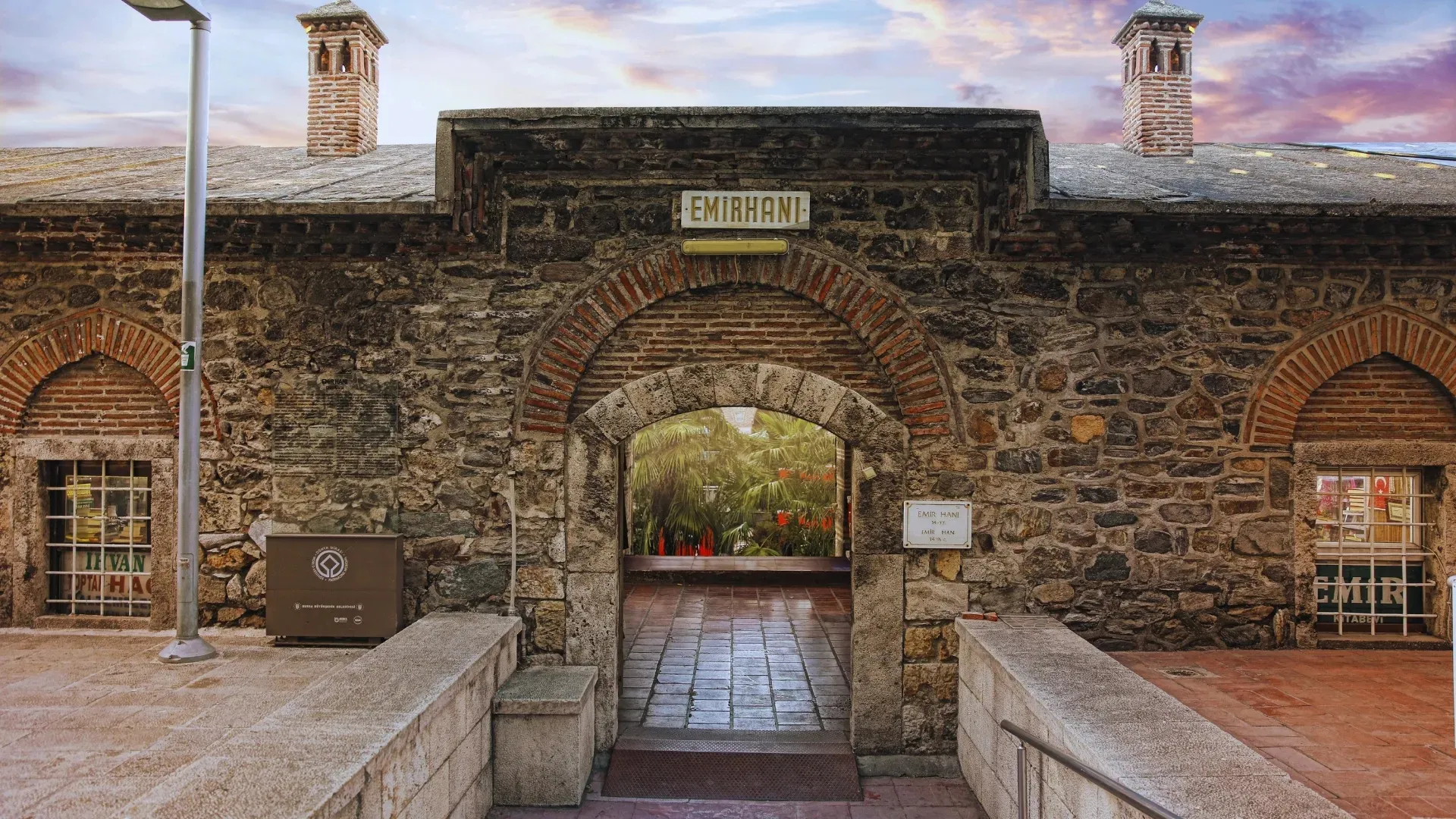
Here one of the most important features of the early Ottoman Islamic city appears: the mosque was not a building separate from daily life, but part of a system that included education, food provision, commerce, lodging and social services.
Bursa, the First Major Capital of the Ottoman State
After its conquest, Bursa became the centre of the Ottoman state and remained so during the first phase of expansion, while the state retained other centres according to military and administrative developments.
During the reigns of Orhan, then Murad I and Bayezid I, the city became a centre for shaping the institutions of the new state.
In Bursa, the outlines of administrative and economic organisation began to appear more clearly, the network of waqfs expanded, and princes and sultans had quarters and architectural complexes bearing their names.
These institutions were not merely political symbols; the waqf provided continuous resources for mosques, madrasas, public kitchens, caravanserais and other facilities, which linked architecture to the economic and social system of the city.
Bursa remained the seat of the state, with the exception of the period of unrest that accompanied the internal strife after the death of Bayezid I, until the political centre of gravity moved to Edirne. The Ottoman sources indicate that the conquest of Edirne in around 762 AH / 1361 CE, though there is a historical disagreement over the precise year, made it an important second centre in Europe, while Bursa remained the principal centre in Anatolia.
Madrasas and the Beginnings of Ottoman Scholarly Life
From the earliest days of Ottoman rule, Bursa was associated with scholarly life. Shortly after the city's conquest, Orhan Ghazi established a madrasa known as the Orhan Madrasa, one of the first educational institutions founded by the Ottomans in Bursa. The earliest Ottoman madrasa usually referred to in the sources is the madrasa of İznik, founded in around 731 AH / 1331 CE, after which the network of madrasas in Bursa developed further.
With the expansion of the state, Bursa attracted jurists, teachers and judges, and its scholarly life became intertwined with the major scholarly network of Anatolia.
The city's scholarly and architectural wealth grew further in the reigns of the later sultans, especially Murad I, Bayezid I, Mehmed I and Murad II.
Architecture Speaks of Different Phases
One mistake to avoid when reading Islamic Bursa is to attribute all its famous monuments to the first period after the conquest. The city's architectural landmarks represent successive phases of Ottoman history.
The Orhan Ghazi complex dates to around 740 AH / 1339–1340 CE, while the Murad I "Hüdavendigar" complex began in the second half of the 8th century AH, the Yıldırım Bayezid structures were erected in the late 8th century AH, and then the Yeşil Mosque complex was built under Mehmed I during the 9th century AH. Specialist studies of Ottoman architecture indicate that these successive complexes contributed to the expansion of the city and the formation of its quarters.
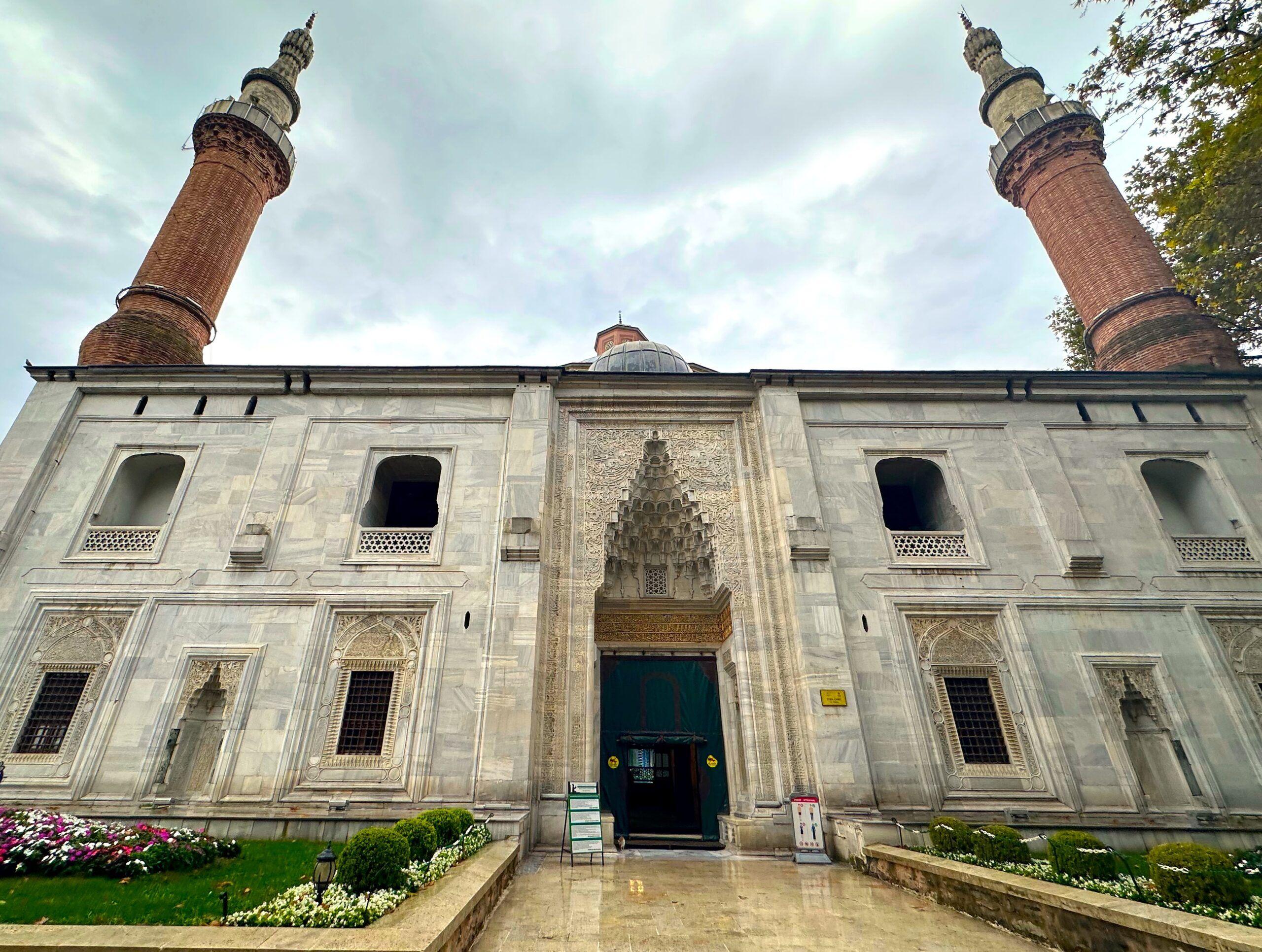
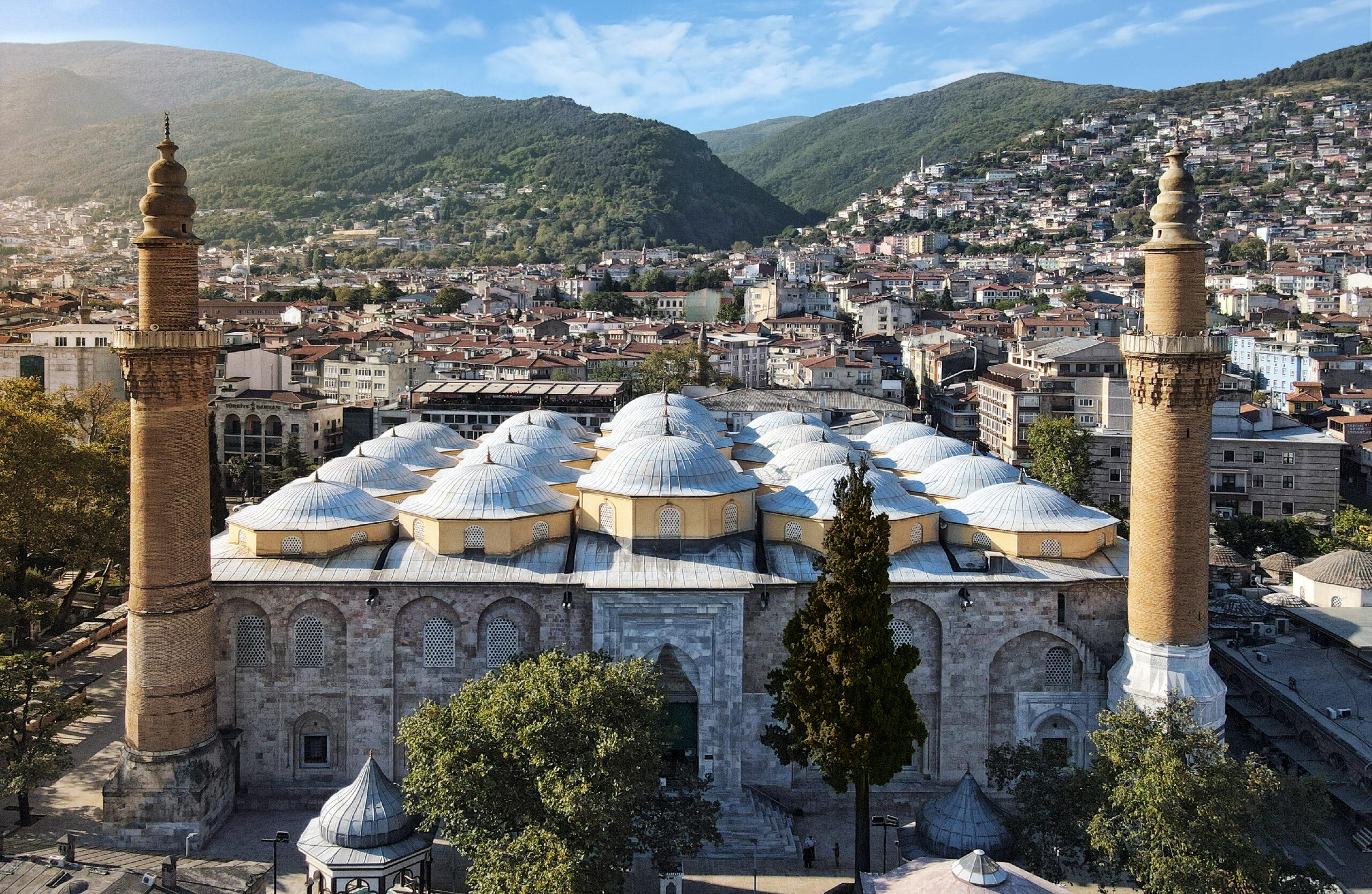
As for the Great Mosque, "Ulu Cami," which became one of Bursa's most celebrated symbols, it is associated with the reign of Sultan Yıldırım Bayezid in the late 8th century AH / 14th century CE, not with the first phase of the city's conquest.
This chronological distinction is important, because Bursa was not built in a single phase; its Islamic layers took shape over more than a century.
Bursa and the Trade Routes
The city's geographical location was one of the reasons for its prosperity. Bursa lies on a network of routes linking eastern Anatolia with the ports of the Sea of Marmara, and connecting roads coming from Iran with central and western Anatolia.
The Tabriz–Erzurum–Tokat–Bursa route became one of the important paths that carried Iranian silk to the city, after which Bursa connected to trade heading to European ports and markets.
Economic studies indicate that silk trade became one of the most important sources of Bursa's wealth, and that Iranian and European merchants, including Genoese, Venetian and Florentine merchants, took part in the commercial activity that flourished in the city. Caravanserais and markets also became an essential part of its economic infrastructure.
"Emir Han" was among the oldest urban caravanserais of the Ottomans and contributed to forming the first nucleus of the market district. The network of caravanserais, bedestens and markets then expanded with the growth of the city.
Thus Bursa's economic identity was tied to three intertwined elements: its location, the caravans, and silk.
From Bursa to Edirne
As the Ottoman state expanded in the Balkans, the political centre of gravity shifted. The conquest of Edirne in the 8th century AH / 14th century CE gave the state a strategic base on the European side, and the city became an important centre for Ottoman operations in the Balkans.
Bursa, however, did not lose its standing; it remained a principal centre in Anatolia, and its religious, educational and commercial institutions continued to develop.
When the Ottomans conquered Constantinople in 857 AH / 1453 CE, the political capital moved to the new city, but Bursa remained one of the most important Ottoman cities and continued to be closely tied to the Ottoman dynasty and to the state's earliest memory.
Royal Tombs and the Memory of the State
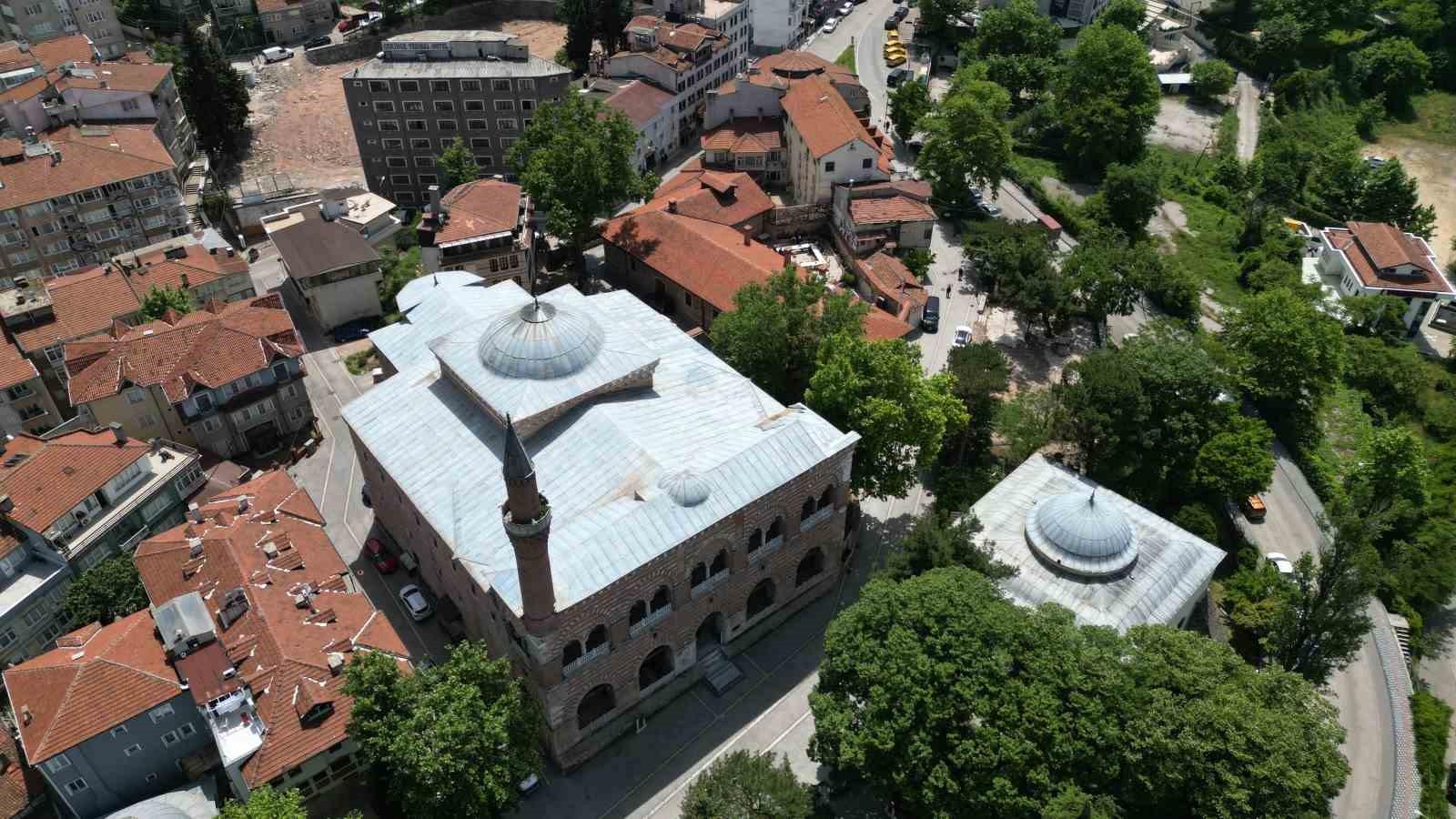
Bursa holds a special status because it contains the tombs of several of the early members of the Ottoman dynasty.
Osman Ghazi was buried in Bursa after its conquest, in accordance with his will, and Orhan Ghazi was later buried beside him. The sources affirm that it was Orhan who moved his father's tomb to the site known within the city after its conquest.
The present buildings of the two tombs were rebuilt in the late Ottoman period after the great earthquake that struck Bursa in 1271 AH / 1855 CE, so a distinction should be drawn between the historical burial site and the current structures, which belong to a later architectural phase.
This point reveals Bursa's nature as a city of Ottoman memory, not merely a city of architecture.
Bursa and the Civilisation of the Waqf
The waqf was one of the most important tools that helped build the Islamic city. Complexes were not isolated buildings but systems comprising the mosque, madrasa, emirate, kitchen, caravanserai, bath and shops, with the revenues of the waqfs allocated to finance these institutions.
This system turned architecture into an integrated social network, so that the city's expansion was linked to the establishment of religious, educational, charitable and commercial institutions.
From this perspective, Bursa can be understood as one of the cities in which the early Ottoman model of the Islamic city appeared clearly: a religious centre, a scholarly centre, a commercial market, waqf institutions, royal complexes, and new quarters arising around them.
Bursa after the Transfer of the Capital
The transfer of the capital to Edirne and then to Istanbul did not mark the end of Bursa's historical role. The city remained an important economic centre, especially in silk production and trade.
Studies indicate that from the 9th century AH / 15th century CE Bursa became one of the principal centres of international silk trade, with its trade routes linked to Iran, the Levant, Anatolia and Europe. The city also remained an important centre for textile and silk manufacturing in the later periods.
Thus the history of Bursa does not end with the departure of the capital; it passed from being a political centre of the emerging state to being one of the most important commercial, craft and cultural capitals of the Ottoman world.
What Remains of Islamic Bursa?
Several layers of architecture remain in Bursa, reflecting the stages of the Ottoman state's development.
Among the most prominent are the Orhan Ghazi complex, Emir Han, the Ulu Cami, the Murad I "Hüdavendigar" complex, the Yıldırım Bayezid complex, the Yeşil Mosque, the Muradiye complex, in addition to the city's markets and caravanserais and the tombs of Osman and Orhan.
Taken together, these monuments reveal the city's development from the capital of the emerging Ottoman state into a broad commercial and cultural centre with extensive connections.
The survival of the network of caravanserais, markets, mosques, madrasas and tombs makes Bursa one of the cities through which the origins and development of Ottoman architecture can be read, not only as an artistic style but as a reflection of an integrated political, economic and social system.


