


When Cordoba fell in 633 AH/1236 CE, and Seville fell afterwards in 646 AH/1248 CE, it appeared that the chapter of Islam in al-Andalus was approaching its end. But al-Andalus did not end at that time.
In the south of the Iberian Peninsula, Granada emerged to become the last major Islamic state in al-Andalus, lasting nearly two and a half centuries, from 635 AH/1238 CE to 897 AH/1492 CE. The Nasrid dynasty was the last Islamic political entity in the Iberian Peninsula, and it made Granada a centre of government, learning, urban development and trade.
From Zirid Granada to the Nasrid Metropolis
The Islamic story of Granada did not begin with the Banu Nasr. The city emerged as an important metropolis in the fifth century AH/eleventh century CE, when the Banu Ziri moved to the city and established their state there after the fall of the Umayyad Caliphate in Cordoba.
During their rule, Granada became the capital of one of the taifa kingdoms, and the city flourished around its congregational mosque, its markets and its walls.
Recent studies of the city's history show that the great congregational mosque of Granada was built in the Zirid period in the fifth century AH/eleventh century CE, and it remained the religious, civic and commercial heart of the city for centuries, until the fall of Granada in 897 AH/1492 CE.
Muhammad ibn Yusuf ibn Nasr: Founder of the Last Islamic State
In the first half of the seventh century AH/thirteenth century CE, the balance of power strongly favoured the kingdoms of Castile and Aragon.
In these circumstances, Muhammad ibn Yusuf ibn Nasr, known as Ibn al-Ahmar, emerged and became the founder of the Nasrid state.
Recent studies confirm that the establishment of the Nasrid state is linked to the year 635 AH/1238 CE, and that Ibn al-Ahmar succeeded in consolidating his authority in Granada, while the major Islamic cities of al-Andalus were falling one after another.
The survival of Granada was not the result of military strength alone. The Nasrid state relied on a complex combination of alliances, diplomacy and economic resources, along with mountain fortifications that made control of its territory more difficult.
Al-Hamra: A City Above the Hill
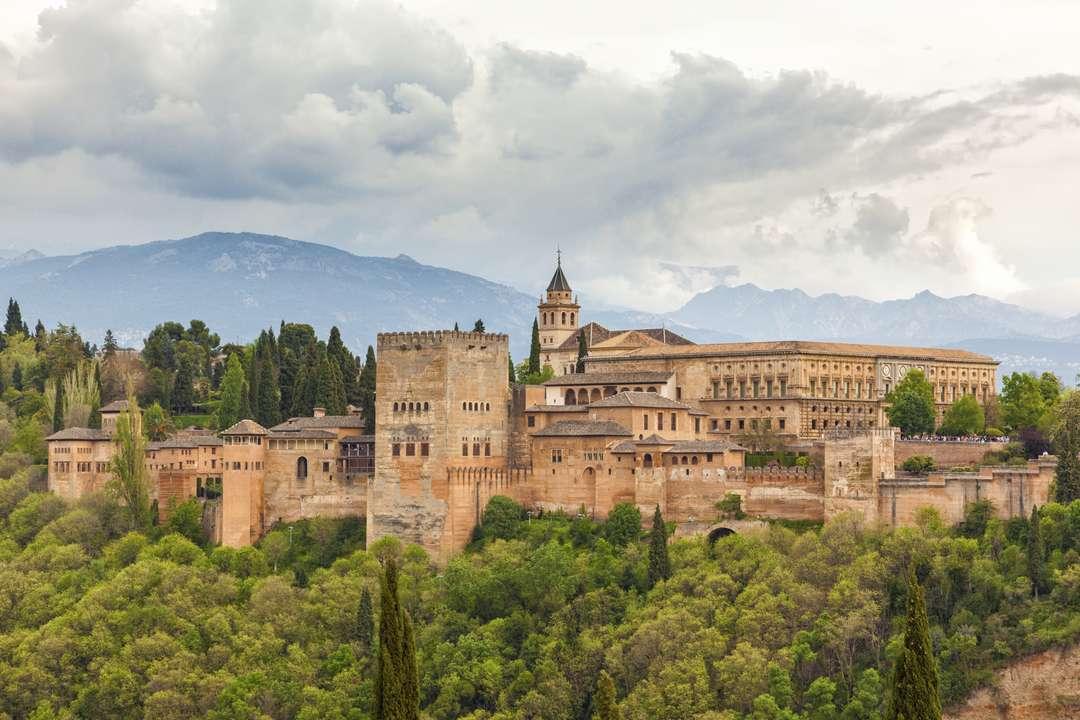
When Ibn al-Ahmar settled in Granada, he recognised that the Sabika plateau overlooking the city could become a centre of government and fortification.
Around 635 AH/1238 CE, he began rebuilding the fortress located there, and it gradually developed into al-Hamra, the royal city that would later become the most famous surviving material symbol of Islamic civilisation in al-Andalus.
Al-Hamra was not a single palace. It was a complete royal city comprising palaces, fortifications, mosques, administrative facilities, quarters for the court retinue, barracks, and an advanced network of water channels.
Over time, al-Hamra was expanded and reshaped under the Nasrid sultans, reaching a stage of architectural and artistic maturity, especially under Yusuf I and Muhammad V during the eighth century AH/fourteenth century CE.
Water: The Secret of Granada's Urban Life
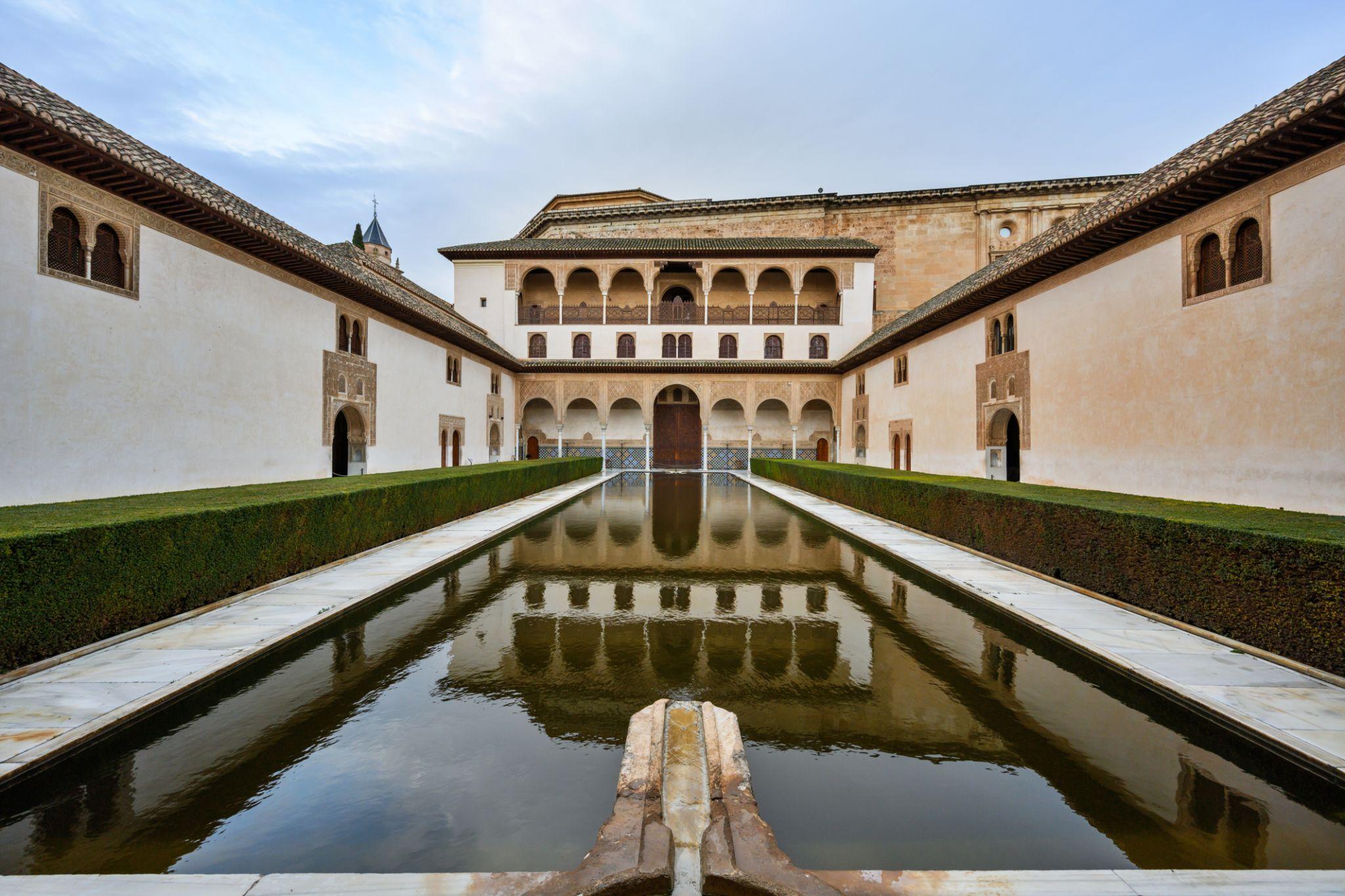
One of the most distinctive features of Islamic Granada is that water was not merely an aesthetic element. It was part of the city's engineering, economy and daily life.
The Nasrids built a network of channels and hydraulic structures to carry water from the mountains to al-Hamra, the palaces and the gardens.
The Darro River and mountain water sources were an important basis for the continuation of urban life, while irrigation systems allowed agriculture to develop in the areas surrounding the city.
In al-Hamra, water became part of the architecture itself: it enters the courtyards, flows through channels, fills pools, and links the buildings with the gardens.
For this reason, recent studies of Islamic Granada devote separate chapters to the history of water as an essential element in understanding the Islamic city, not merely a decorative detail.
A Malikite State and Scholarly Institutions
The Maliki school was the dominant jurisprudential framework in al-Andalus, and its presence continued in Nasrid Granada.
Therefore, Granada was not merely a military state trying to survive the Castilian advance; it possessed a system of mosques, madrasas, judiciary and religious education.
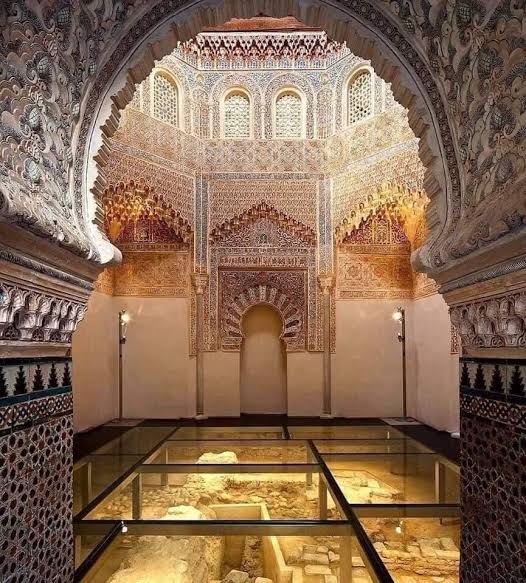
Among its most important institutions was the Nasrid Madrasa, also known as the Yusufiyya Madrasa, founded by Sultan Yusuf I, whose construction was completed in 750 AH/1349 CE.
Inscriptions founding the madrasa show that it was established as a "house of knowledge," and it was linked to the teaching of religious sciences, language and other disciplines. Studies indicate that a number of Granada's most prominent scholars and writers were associated with it, as teachers or students.
Thus Granada can be understood as a true Islamic metropolis: a congregational mosque, a madrasa, a judiciary, a library, a market, a palace, endowments, and scholarly institutions.
Ibn al-Khatib: The Mind of the State and the Pen of the Metropolis
Among the greatest figures of Granada was Lisan al-Din Ibn al-Khatib, born in 713 AH/1313 CE and died in 776 AH/1374 CE.
Ibn al-Khatib was a scholar, writer, historian, physician and statesman, and he held the office of vizier in the Nasrid state.
Recent studies have treated Ibn al-Khatib as one of the most important historians and writers associated with Nasrid Granada, and as part of the network of scholars and writers who shaped its political and intellectual culture. His name is also associated with the Yusufiyya Madrasa and with the scholarly life of Granada.
Ibn Zamrak: Poetry Inscribed on the Walls of al-Hamra
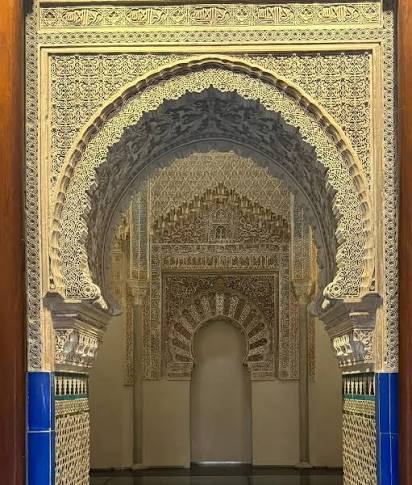
Among the most prominent poets of Granada was Ibn Zamrak, who lived in the eighth century AH/fourteenth century CE. His poetry is linked to the architecture of al-Hamra, where his poems were inscribed on the walls of a number of its palaces and courtyards.
But Ibn Zamrak's value is not in ornamentation alone. He reflects the relationship that developed in Granada between literature, power and architecture, where Arabic writing became part of the political space of the Nasrid state.
Today, a visitor to al-Hamra does not see stone alone; they read on the walls the language, literature and self-image of the state.
Granada: City of Knowledge and Medicine
Granada witnessed a broad scholarly movement in jurisprudence, hadith, language, literature and medicine.
Specialised studies point to activity in the sciences and knowledge, and to the Nasrid Madrasa's association with scholarly, literary and jurisprudential figures, among them scholars of jurisprudence, medicine, language and Quranic readings.
Among the figures of the Granadan milieu was Ibn Khatima al-Ansari, who died around 770 AH/1369 CE, and who was known for medicine and literature.
Ibn al-Khatib himself also exemplified the diversity of knowledge in the metropolis; he combined history, literature, medicine and politics.
Trade: The Silk That Extended the State's Life
The economy was one of the reasons for Granada's ability to endure. The Nasrid kingdom benefited from its geographic position, its fertile agricultural lands, trade through ports such as Malaga and Almeria, and its commercial relations with Mediterranean cities.
Silk was among its most important economic products, alongside sugar, dried fruits and other goods.
A scholarly study published by Brill explains that the economy of the Nasrid state was not merely agrarian, but a diversified system within which crafts, markets and international trade took shape, and silk was among the prominent products that reached European markets.
Granada: The Last Islamic Metropolis
After the fall of Cordoba and Seville, Granada became the last major political centre of Muslims in al-Andalus.
Its survival depended on its ability to manoeuvre between the Christian powers to the north, the strength of its fortifications, its economic resources, and shifting alliances.
Nasrid rule continued from 635 AH/1238 CE to 897 AH/1492 CE, more than two and a half centuries. During this period Granada experienced crises and internal conflicts, and its relations with Castile and Morocco changed, but it remained standing despite the fall of most of al-Andalus.
This exceptional endurance was one of the reasons it became a centre receiving Muslims displaced from the Andalusian cities that had fallen.
897 AH/1492 CE: The Fall of Granada
In the late ninth century AH/fifteenth century CE, the Nasrid state reached its final phase.
Internal strife broke out, then war with Castile and Aragon intensified until Granada was besieged. In 897 AH/1492 CE, Islamic political rule in al-Andalus came to an end with the surrender of the city to the Catholic Monarchs.
This was a pivotal event in the history of Muslims: the Islamic state that had survived in al-Andalus for more than two and a half centuries after the fall of most major cities was thereby brought to an end.
The fall of Granada was not merely a transfer of power; it was the end of a long chapter of Islamic history in the Iberian Peninsula.
Granada After Its Fall: What Remains?
Al-Hamra, the Alcazaba, the gardens, the quarters of the old city, and remnants of baths, mosques, madrasas and markets remain as witnesses to a long phase of Islamic history.
But reading Granada should not be reduced to the palace of al-Hamra. Behind the palace stood a complete Islamic city: markets, educational institutions, judiciary, society, crafts, agriculture, trade networks, a water system, and a class of scholars, writers and jurists.
This is why Granada appears in this series.
A Scholarly Metropolis, Not Merely a Famous Palace
The approach followed by this series is clear: we seek metropolises that shaped Islamic history, and we read them through their states, scholarly and jurisprudential institutions, urban development, economy and monuments.
Within its general religious framework, Granada was an Andalusian Maliki city, in which the sciences of jurisprudence, hadith, language and Quranic readings flourished alongside medicine, literature and other disciplines.
As for Sufi trends and other intellectual currents that appeared in the Andalusian and Maghribi environment, they are part of the study of social history, but the presence of a figure or current in the city does not mean that the metropolis's achievement is attributed to it. What we seek here is the city's general impact on the history of Islam, its institutions, its civilisation and its political and scholarly role.
Thus Granada remains in its proper place on the series' map: an Islamic metropolis with Sunni jurisprudential characteristics, which produced the last Islamic state in al-Andalus and preserved learning, urban development and trade until the end of Islamic rule in 897 AH/1492 CE.


