


Madinat al-Zahra was not merely a magnificent palace built by an Umayyad caliph near Córdoba, as some modern images of it might suggest. It was a vast political and urban project initiated by the Umayyad caliph ʿAbd al-Raḥmān al-Nāṣir li-Dīn Allāh in the fourth century AH/tenth century CE, to become the seat of the Umayyad Caliphate in al-Andalus and the centre of administration for one of the strongest Islamic states in the West.
For this reason, Madinat al-Zahra deserves its place in the series "Hawāḍir al-Islām Through History". Although it did not last long, in its years of prosperity it represented a concentrated image of the strength of the Umayyad Caliphate in al-Andalus, with its palaces and administrative councils, a congregational mosque, gardens, water installations, housing for officials and soldiers, and a network of roads and communications linking it to Córdoba and the rest of the state.
Construction of the city began around 325 AH/936 CE, and building and development work continued under ʿAbd al-Raḥmān al-Nāṣir and his son al-Ḥakam al-Mustanṣir, before the city's political life ended during the civil strife (fitna) that brought down the Umayyad Caliphate in the early fifth century AH/eleventh century CE.
Why did ʿAbd al-Raḥmān al-Nāṣir build a new city?
To understand Madinat al-Zahra, one must return to the history of the Umayyad state in al-Andalus. After the establishment of the independent Umayyad emirate in Córdoba in 138 AH/756 CE under ʿAbd al-Raḥmān al-Dākhil, the Umayyads continued to build their state and to confront internal revolts and external adversaries.
Then ʿAbd al-Raḥmān ibn Muḥammad, known as ʿAbd al-Raḥmān al-Nāṣir, came to power in 300 AH/912 CE, at a time when the emirate was facing serious internal unrest, in addition to threats from the north and from the Fatimid state in the Maghrib.
During his years in power, al-Nāṣir succeeded in reuniting large areas of al-Andalus, subduing a number of centres of rebellion, and restoring a considerable part of the strength of the central state.
Historical documents and archaeological studies indicate that work on the city began a few years after the proclamation of the caliphate, around 325 AH/936 CE, at the foot of Jabal al-ʿArūs to the west of Córdoba.
Madinat al-Zahra: the capital of the caliphate behind its walls
Madinat al-Zahra was not an ordinary city that grew spontaneously around a market or a mosque. It was a royal city planned from the outset.
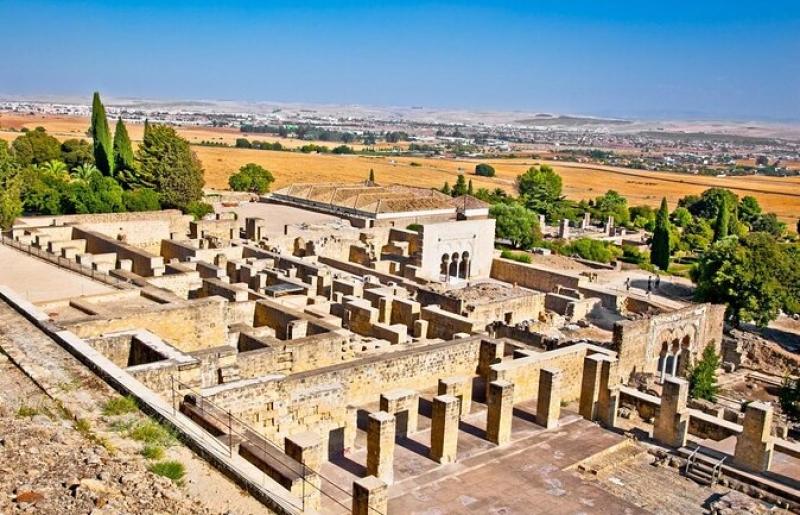
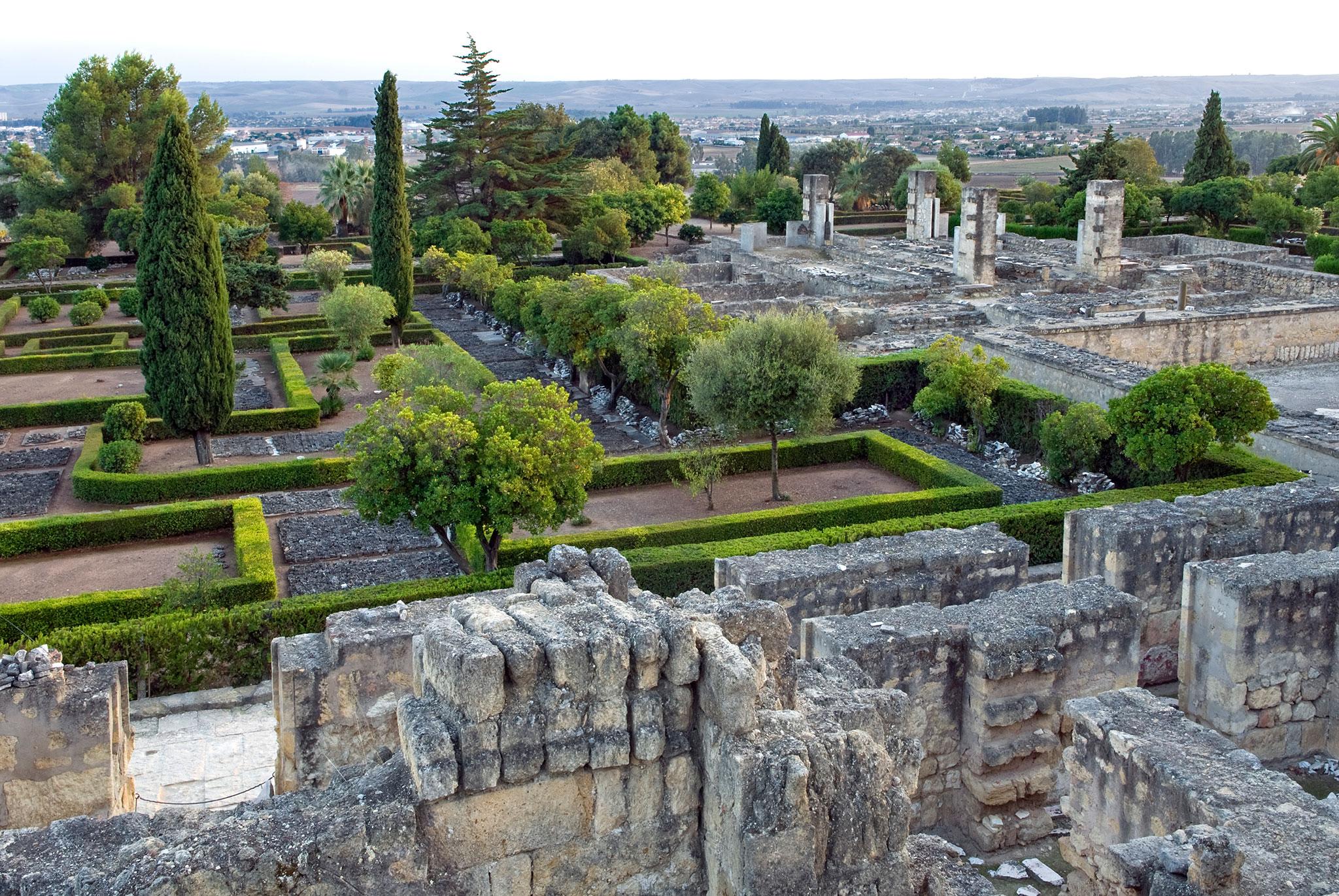
Archaeological studies show that the city was built on terraces stepping down the mountainside, with the royal installations and the upper administrative quarters occupying the elevated part, while the gardens and green areas lay at a lower level, followed by the congregational mosque, the residences of the inhabitants and other installations at the lowest level.
The city was surrounded by walls and contained a network of roads, channels and water installations.
This layout was not merely an aesthetic choice; it reflected a clear order of power within the city: the caliph at the summit, the institutions of government around him, then the gardens and services, then the mosque, the residences of the inhabitants and other installations. Thus the architecture itself became an expression of the structure of the state.
The Caliphal Palace: the political heart of the city
The most important part of Madinat al-Zahra was the royal complex, or the Caliphal Palace, where the political, administrative and protocol functions of the state were concentrated.
Archaeological studies indicate that the upper part of the city contained the palace of the caliph and his heir apparent, alongside the political and administrative institutions and the residences of senior officials.
This means that Madinat al-Zahra was not only a private residence for the caliph, but an actual seat for the exercise of government.
From it, orders were issued, delegations received, the affairs of the state managed, and political figures arriving from within al-Andalus and from abroad were received.
Delegations from the European kingdoms and neighbouring regions entered this royal world, where they found an organised and centralised state with considerable financial, military and administrative resources.
The congregational mosque: religion at the heart of the city
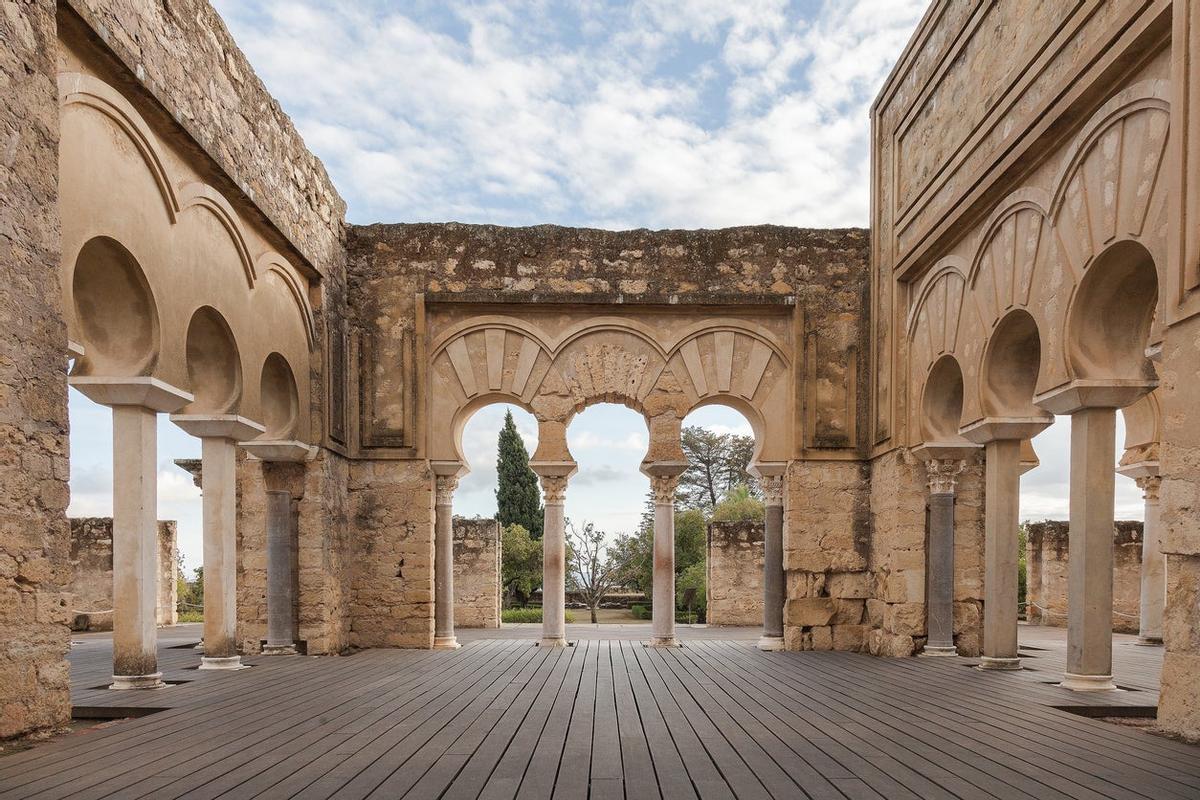
In the city that ʿAbd al-Raḥmān al-Nāṣir intended as the centre of the caliphate, the congregational mosque was an essential element.
Historical accounts point to the speed with which it was completed under al-Nāṣir, and the archaeological remains reveal a spacious mosque with a clear plan and a central position within the city.
In Islamic civilisation, the mosque was more than a place of prayer; it was a space for learning, preaching, judicial matters and public gatherings.
Thus the presence of the congregational mosque at the heart of Madinat al-Zahra confirms that the city was not a palace separate from society, but an Islamic metropolis in which authority, worship, learning and administration intertwined.
The mosque was also part of the picture through which the Umayyad Caliphate sought to present itself as a stable Islamic state with established institutions and a clear political centre.
Water: the engineering of a city on a mountainside
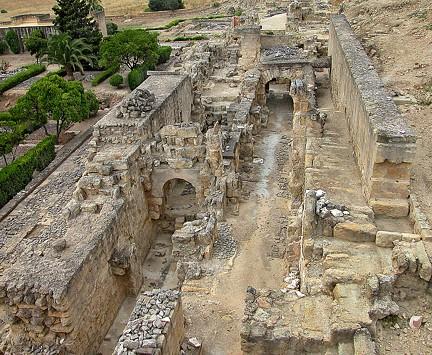
One of the most notable aspects revealing the development of urban planning in Madinat al-Zahra is its water system. The city was built on a mountainous site, and supplying water to the palace, the mosque, the gardens and the inhabitants required a precise engineering network.
Archaeological studies reveal channels, cisterns and water installations linked to an integrated system for conveying and distributing water.
Madinat al-Zahra was also connected by roads to Córdoba, which made the city part of a wider urban system rather than an isolated site on the mountainside.
Modern heritage studies affirm that the remains of roads, bridges and channels remain part of the archaeological value of the site, because they reveal how the city functioned in its own time.
Madinat al-Zahra and the economy: a city requiring an entire state
Establishing a city of such magnitude required enormous financial and human resources. Historical sources mention large figures concerning the number of workers, animals, building materials and expenses, especially since the project was so vast that it required recruiting labourers, craftsmen and engineers, and bringing luxurious building materials from different regions.
This reveals an important aspect of the history of Islamic civilisation: a great city is not sustained by palaces alone, but is backed by an economy, taxation, crafts, transport, administration and a political power capable of financing the project.
al-Ḥakam al-Mustanṣir: the continuation of the project
ʿAbd al-Raḥmān al-Nāṣir died in 350 AH/961 CE, and the caliphate passed to his son al-Ḥakam al-Mustanṣir bi-Llāh, who was one of the caliphs of al-Andalus most attentive to learning and books, and who continued to develop the state and its institutions.
Construction work at Madinat al-Zahra continued during his reign, and the city became more complete, continuing to perform its role as a royal and administrative centre.
It was at this point that the Umayyad civilisation in al-Andalus reached one of its greatest peaks: Córdoba as the centre of urban, economic and scholarly life, and Madinat al-Zahra as the seat of the caliphate and royal authority.
The two cities were linked by a network of roads and installations, so that the area surrounding Córdoba became one of the greatest urban concentrations in the Islamic West.
Madinat al-Zahra and learning in the time of al-Ḥakam al-Mustanṣir
Madinat al-Zahra cannot be separated from the scholarly environment that surrounded it. In the reign of al-Ḥakam al-Mustanṣir, the Umayyad court was linked to a broad movement of collecting and copying books and attracting scholars.
In this period, Córdoba and Madinat al-Zahra became part of a major intellectual centre in which jurists, traditionists, physicians, linguists, astronomers and men of letters gathered.
Here we must distinguish between the city as a centre of government and Córdoba as the largest urban and scholarly centre. Madinat al-Zahra was not a replacement for Córdoba in all its functions; rather, it was part of an integrated urban system led by the Umayyad Caliphate.
Madinat al-Zahra and diplomacy: the image of the caliphate before the world
The city was also a stage for diplomacy. Under the Umayyad Caliphate, al-Andalus became a political power with relations with the European kingdoms, North Africa and the regions of the Mediterranean.
The reception of delegations at the seat of the caliphate carried a political function that went beyond protocol.
A delegation that entered an organised city, reached a magnificent palace and witnessed a precise administrative and ceremonial order faced a clear political message: this is a strong, centralised state with a caliph, institutions, resources and influence.
Madinat al-Zahra was thus a tool of foreign policy as much as it was a seat of internal authority.
Why did Madinat al-Zahra not endure?
Here lies the great paradox: the city that was a symbol of the strength of the Umayyad Caliphate did not live long after the state collapsed.
Towards the end of the fourth century AH/tenth century CE, the state entered a mounting political crisis, then the civil strife broke out in 399 AH/1009 CE, and central authority disintegrated.
During the conflict, Madinat al-Zahra was subjected to sabotage and plunder, and it gradually became deserted.
Heritage sources indicate that the city was destroyed during the civil strife that ended with the fall of the Umayyad Caliphate, while modern archaeological studies confirm that the city flourished only for a short period before being destroyed in the early fifth century AH/eleventh century CE.
Thus Madinat al-Zahra was transformed from the heart of the caliphate into a deserted city.
From a city of the caliphate to a forgotten city
For centuries, Madinat al-Zahra almost disappeared from the geographical memory, its ruins lay buried, and some of its stones and materials were reused in other places.
Systematic archaeological exploration did not begin until the modern era, with excavation work taking up in earnest in the early twentieth century.
Heritage studies indicate that organised excavation began in 1911 CE, and since then the city has regained its standing as one of the most important Islamic archaeological sites in al-Andalus.
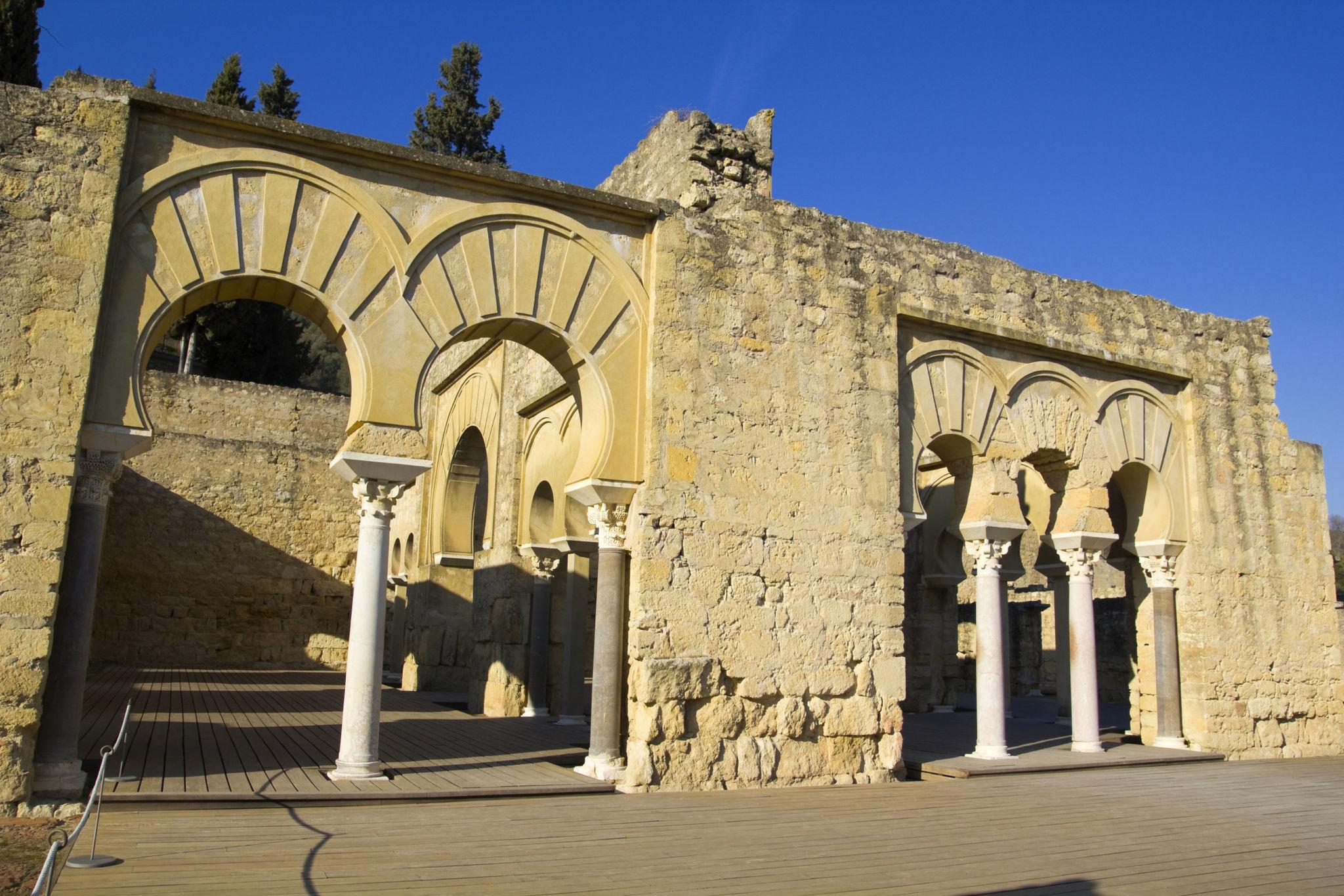
Madinat al-Zahra: what remains of it?
Today, parts of the palaces and halls, the roads, the walls, the channels, the water installations, the congregational mosque, the gardens and the administrative installations remain.
These remains give researchers a rare opportunity to study a royal Islamic city that was built according to a prior plan in the fourth century AH/tenth century CE.
More importantly, the site is not merely a collection of separate ruins; the remains of the city reveal an integrated network of infrastructure and urban fabric, which makes it an important source for understanding urban organisation in the Umayyad state in al-Andalus.
Why does Madinat al-Zahra deserve a separate instalment?
It may be asked: if Madinat al-Zahra is close to Córdoba, why not discuss it within the instalment on Córdoba?
The answer is that Madinat al-Zahra represents something different.
Córdoba was the seat of society, economy and learning, whereas Madinat al-Zahra was the city of the caliphate and the stage of central authority.
Through Madinat al-Zahra one can understand the nature of the Umayyad state at the height of its power: how the caliph managed his state, how a royal capital was designed, how architecture was used to display the strength of the state, and how the palace was linked to the mosque, administration, gardens and water.
Moreover, the fall of Madinat al-Zahra offers another historical lesson: the greatest cities can collapse rapidly when the state that protects them collapses. Neither architecture, wealth nor the grandeur of its palaces could save the city once the caliphate disintegrated.


