

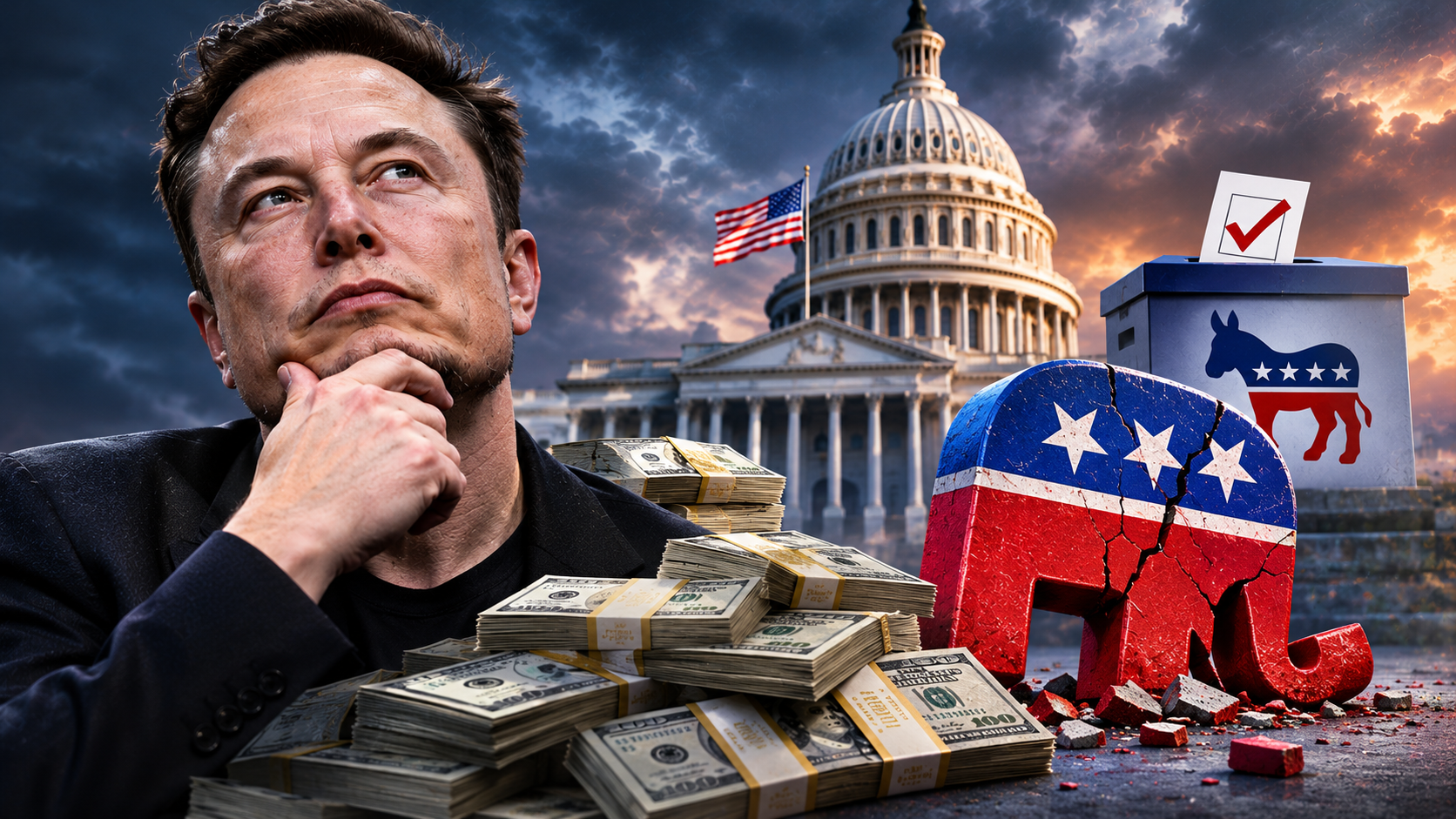
After spending close to half a billion dollars supporting Republicans in the American elections, billionaire Elon Musk found himself facing an electoral outcome far from his bets. According to data reported by Reuters, he injected about $446 million into supporting Republican campaigns, making him one of the most prominent individual donors in this election cycle, yet most of the candidates he backed failed to win the race in their favour.
Texas: The Biggest Bet and a Shocking Result
The state of Texas was the most prominent testing ground for Musk's influence, a state with which his companies and projects have been linked in recent years. He directed large sums to support the Republican candidate Ken Paxton in the Senate race, and contributed to funding intensive advertising campaigns targeting his Democratic rival James Talarico.
However, the result came contrary to what the billionaire wanted, as Talarico won the seat, in one of the most notable defeats suffered by candidates backed by Musk. The losses did not stop there, as the Democrats achieved further gains in the state, including in the race for governor of Texas.
Musk's spending was not merely a passing financial contribution; it represented an attempt to employ wealth, media platforms and digital influence to tip the balance in favour of specific candidates, drawing on his ownership of the platform "X" and his wide presence in American political debate.
Money Raises the Voice, But It Does Not Decide the Ballot Box
The results revealed the limits of the electoral power of huge sums of money. Financing advertisements and expanding the reach of propaganda may give a candidate greater visibility, but it does not guarantee that voters will be convinced by his programme, nor does it prevent the issues that concern them from overshadowing the messages campaigns promote.
The significance of this result stems from the scale of spending seen in the elections, as political advertising spending approached $12 billion, according to estimates reported by American media outlets, in an election cycle marked by unprecedented financial competition.
Will Musk Lose His Influence in Washington?
This defeat does not mean that Musk has lost his capacity to influence American politics. His wealth, economic projects and relations with centres of decision-making give him instruments of influence that go beyond funding election campaigns. However, it raises question marks over how far he can convert this influence into guaranteed political results.
The shift gains further importance as control of both chambers of Congress passes to the Democrats, opening the way to a new phase of parliamentary oversight of the Trump administration, including files related to Musk's companies, their contracts and their government interests. While Musk can pump hundreds of millions into future electoral battles, what has happened shows that owning money and platforms does not mean owning the decision of the American voter. He has bought a wide share of political visibility, but he has not been able to buy the result he wanted.
Texas Reveals the Limits of Musk's Popularity
Musk's loss in Texas was not linked to the volume of spending alone, but also to the image of the billionaire that took shape among segments of voters, after the privileges of his companies and his relations with Republican officials became a central focus of Democratic campaigns. According to a survey conducted by the Associated Press that included more than 5,000 voters in the state, more than half of participants expressed a negative view of Musk, while positive views of him were concentrated more among supporters of the MAGA movement.
The Democrats invested this gap in their campaigns, presenting the contest as a confrontation between the interests of billionaires and the daily needs of citizens, at a time when the costs of fuel, food, rent and mortgages top the concerns of American families. They did not limit themselves to criticising Musk's political spending, but also linked his support for Republican candidates to the government benefits his companies received.
In this context, the Democratic candidate who won the governorship of Texas, Gina Hinojosa, raised the issue of a property tax exemption worth $1.7 billion that she said Musk obtained in the state, while in August his companies received a government grant worth $30 million to establish a semiconductor plant, which is expected to provide around 3,000 jobs.
Excessive propaganda was not immune to criticism from within the Republican Party itself, as Republican Congressman Chip Roy indicated that the intensity of the advertisements backed by Musk had become a burden, after voters grew tired of the repetition of the same messages. This observation reveals that pumping in money can sometimes turn from a tool for strengthening a candidate into a factor that drains his campaign and gives his opponents additional material for attack.
Thus, the message carried by the Texas results was directed not at Musk alone, but at wealthy figures who bet on converting financial influence into electoral influence. Voters may listen to the advertisement, but they do not necessarily give their vote to whoever paid for it.
Sources: Reuters, Associated Press, The Guardian, The Washington Post


