

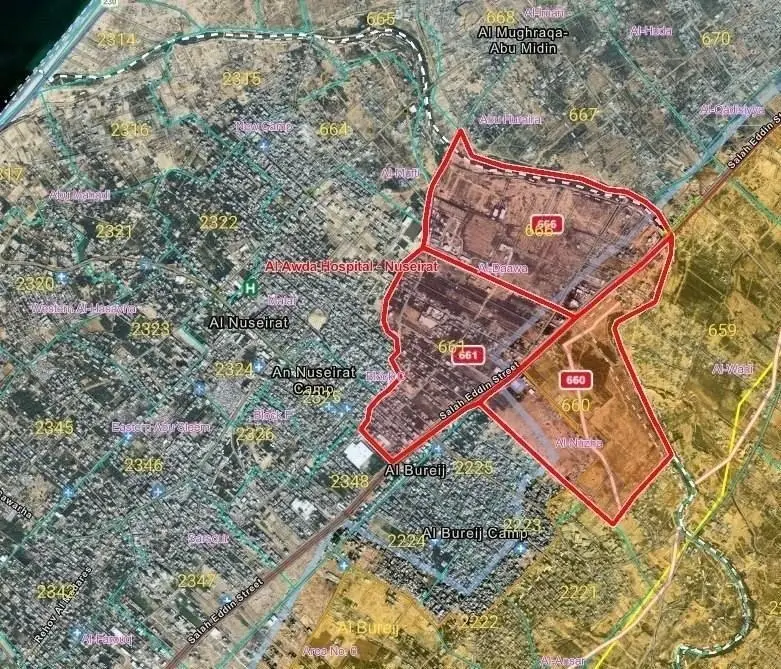
Israeli forces escalated their military operations in central Gaza on Wednesday, 8 Jumada al-Akhirah 1448 AH (18 November 2026), as their tanks and military vehicles advanced into areas west of what is known as the "Yellow Line", alongside artillery shelling, gunfire and the displacement of dozens of Palestinian families.
The Palestinian news agency WAFA reported that Israeli vehicles advanced west of Salah al-Din Road, between the Bureij and Nuseirat camps, amid shelling and gunfire, cutting off the road to the movement of residents and vehicles.
New Displacement and Casualties
The military operation pushed dozens of Palestinian families to flee areas near the Bureij and Nuseirat camps, amid harsh humanitarian conditions and a severe shortage of shelter supplies.
Palestinian medical sources reported on Wednesday that three Palestinians were killed in separate Israeli attacks: one in an air strike near the area of the incursion, and two others in Deir al-Balah and Gaza City.
Reuters quoted displaced people who were forced to leave their tents and temporary shelters once again under gunfire, carrying what they could on bicycles and vehicles.
Withdrawal of Vehicles and Continued Road Closure
The Palestinian agency Sama reported on the morning of Thursday, 9 Jumada al-Akhirah (19 November), that Israeli vehicles had withdrawn from northern Nuseirat camp following bulldozing and demolition operations, while the closure of Salah al-Din Street to citizens' movement continued.
Escalation Beyond the Scope of Military Deployment
The Israeli army claimed that the operation targets the dismantling of a tunnel located west of the "Yellow Line", which, according to its claim, poses a threat to its forces.
In response, the Hamas movement condemned the military operation and the displacement of civilians, considering it a violation of the ceasefire agreement and a serious escalation.
According to WAFA, this incursion is the first of its kind across the "Yellow Line" since the announcement of the ceasefire agreement in October 2025.
Salah al-Din Road is one of the most important transport arteries in the Strip, connecting its northern and southern areas, so its closure adds to the suffering of residents and the difficulty of movement.
A Truce That Has Not Stopped the Bloodshed
According to health authorities in Gaza, at least 1,600 Palestinians have been killed since the ceasefire agreement came into effect.
The new ground operation comes at a time when displaced people are facing the consequences of rain and flooding and the damage to thousands of temporary shelters, amid the continued crisis over the entry of humanitarian aid.
These developments raise concerns about the widening of ground operations and the renewal of forced displacement waves, especially with Israel's continued control over about two-thirds of the Strip's area and the crowding of the population into the remaining areas.


