

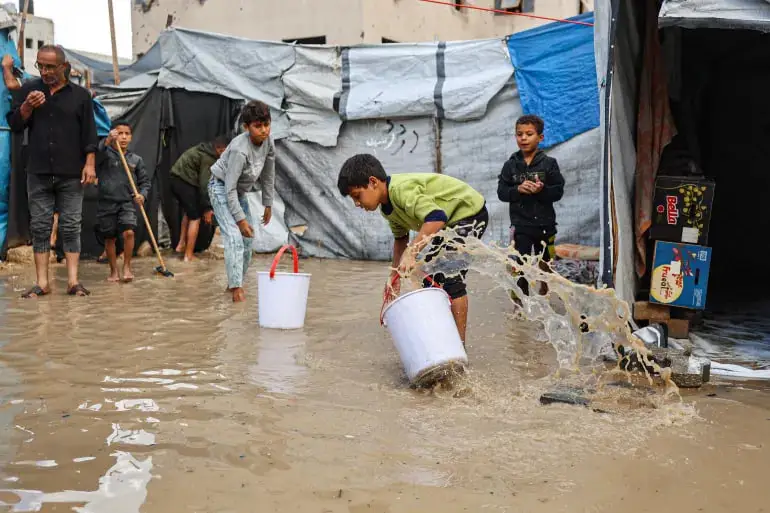
Palestinian infant Kanan Ahmed Areeqiq, nine months old, died from a severe drop in his body temperature inside a displacement tent in southern Gaza, while three Palestinians, including a child, were killed and some 20 others injured in an Israeli strike east of Deir al-Balah on Friday, 13 November 2026, as the shelter crisis deepened following heavy rains.
Medical sources in Gaza announced the death of the infant Kanan Ahmed Areeqiq in the Mawasi area of Khan Younis, the first recorded death linked to cold during the current winter season. According to the Palestinian News & Information Agency (WAFA), the child was transferred on Thursday from Kuwaiti Hospital to Nasser Medical Complex, where he arrived dead, and a medical examination confirmed that the cause of death was a sharp drop in his body temperature.
Media outlets quoted his family as saying that the tent in which they live does not provide adequate protection from the cold and rain, a scene that reflects the fragility of the shelters in which hundreds of thousands of displaced Palestinians live.
Strike east of Deir al-Balah kills and wounds
In a separate field development, medical sources at Al-Aqsa Martyrs Hospital reported that three Palestinians, including a 12-year-old child, were killed and some 20 others, most of them children, were injured in an Israeli strike that targeted eastern areas of the city of Deir al-Balah in central Gaza on Friday.
WAFA reported that the strike hit an area near the Al-Qastal residential towers and that the wounded were taken to Al-Aqsa Martyrs Hospital. The Israeli military, for its part, said it fired on persons it claimed had approached its positions near what is known as the "Yellow Line."
More than 46,000 families affected by rains
The United Nations Office for the Coordination of Humanitarian Affairs (OCHA), in its report issued on 13 November, stated that preliminary reports recorded up to 9 November indicated that more than 46,000 families, estimated at about 226,000 people, were affected by the rains and floods that began on the sixth of the month.
According to the UN report, more than 40,000 shelters were damaged, including more than 9,000 shelters for which preliminary reports indicated they had been destroyed beyond repair, while the reports indicated that more than 5,000 families were sleeping without shelter.
The United Nations warned of the risks of flood water mixing with sewage, the increased likelihood of cold-related illnesses and water contamination, amid a shortage of medical and shelter supplies and restrictions on the entry of aid.
The death of the infant Kanan Areeqiq highlights an additional threat facing children in Gaza: alongside the bombardment and continued displacement, dilapidated tents, cold and rain have become a direct danger to the lives of families who have lost their homes.


