

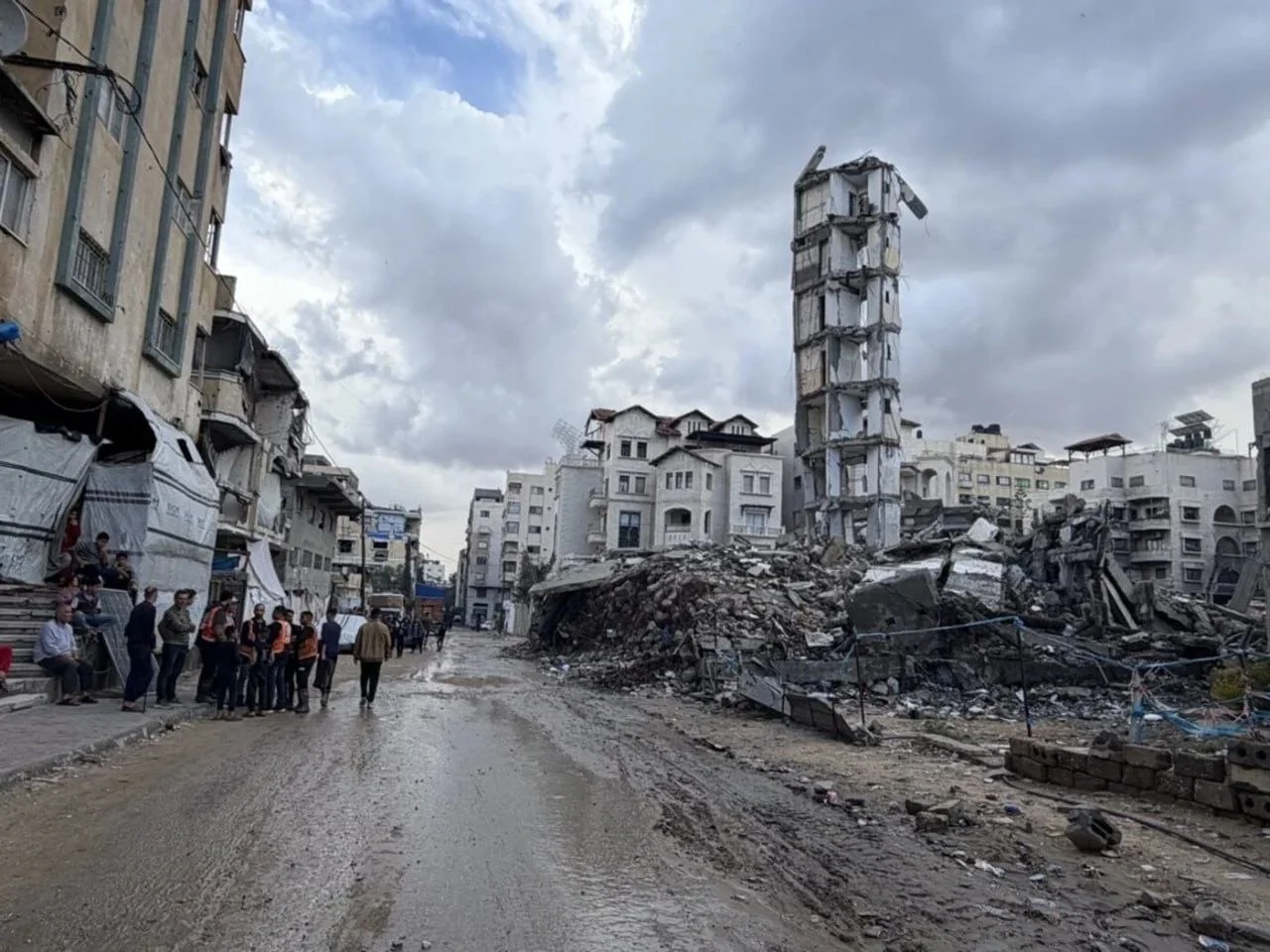
The UN Office for the Coordination of Humanitarian Affairs (OCHA) announced on Monday that more than 26,000 Palestinian families in the Gaza Strip have requested assistance after their tents and belongings were damaged by heavy rain and flooding that has struck the Strip since Friday evening. It warned that stocks of tents, blankets and shelter supplies inside Gaza have almost run out, while more than 150,000 tents outside the Strip await permission to enter.
In a humanitarian report covering conditions up to 17 Jumada al-Awwal 1448 AH (8 November 2026), the office said the storm caused displacement camps to be flooded with water, damaged buildings to collapse, and health facilities and essential services to be disrupted in the Strip's five governorates.
It explained that around 1.4 million Palestinians, nearly 65% of the Strip's population, live in tents or temporary shelters, many of which are dilapidated and do not provide adequate protection from rain and wind.
According to preliminary data collected by UN partners working in managing displacement sites, more than 6,000 family shelters have been destroyed, around 17,400 other shelters have been damaged, and more than 3,900 families have been left without shelter.
Humanitarian agencies estimated that around 600 families were forced to relocate again because of the rain, after losing their shelters or after they became uninhabitable.
The report also said 66 toilets were destroyed and 618 others damaged, increasing health risks in crowded camps, particularly as rainwater mixes with sewage.
The report noted that more than 20,000 families in 222 severely affected displacement sites need urgent assistance, including tents, tarpaulins, bedding, clothing and shelter repair materials.
It stressed that these figures are preliminary and that actual damage may be greater as field assessments continue.
Death of an Infant and Five Displaced Persons Due to Flooding and Sand Dune Collapse
The UN report referred to the drowning of an infant at one of the displacement sites, in addition to the deaths of five displaced persons, including three children and two women, as a result of a sand dune collapsing on tents in the Khirbat al-Birka area west of Deir al-Balah, according to the Palestinian Civil Defence.
Another person was injured in the incident.
Humanitarian agencies recorded the collapse of three buildings, either fully or partially, due to the rain, with no casualties recorded in the collapses of those three buildings themselves.
The United Nations warned of at least 4,000 buildings in the Strip at very high risk, given the extensive damage to buildings during the war.
150,000 Tents Waiting Outside Gaza
Despite the growing needs, the report revealed that more than 150,000 tents purchased by humanitarian organisations and donor countries are located outside Gaza and ready for dispatch, including around 117,000 tents in the Egyptian city of Al-Arish.
Outside the Strip there are also around 300,000 tarpaulins and 500,000 blankets that can be used in the emergency response.
However, the UN office explained that restrictions imposed by Israel on the entry of supplies and equipment, along with a shortage of funding, prevented humanitarian stocks inside the Strip from being reinforced before the storm began.
It stressed the urgent need to obtain the necessary approvals from Israel to bring in shelter materials, heavy machinery, water pumping equipment, spare parts and the oils used to operate equipment.
Response Falls Short of the Scale of the Disaster
By 17 Jumada al-Awwal 1448 AH (8 November 2026), humanitarian partners had assessed the needs of 1,877 families and provided direct assistance to 422 families across 29 displacement sites, as part of the response operations documented in the report.
Humanitarian agencies also distributed tents, tarpaulins, bedding and winter clothing, and began water drainage, debris removal and the opening of drainage channels.
Humanitarian agencies also distributed tents, tarpaulins, bedding and winter clothing, and began water drainage, debris removal and the opening of drainage channels.
However, the United Nations warned that needs far exceed the current capacity to respond, amid rising risks of cold, respiratory and skin diseases, and diarrhoea linked to water contamination.
Medical facilities and health points were also damaged, disrupting some services and delaying the arrival of patients and medical staff due to flooded roads.
The report confirmed that restrictions on Palestinians' access to large parts of the Strip also limit their ability to move to safer areas less exposed to flooding.
This disaster exposes the extent of the fragility of living conditions in Gaza, where hundreds of thousands of displaced people face the risk of losing what remains of their shelter, while essential relief supplies remain piled up outside the Strip awaiting entry.


