

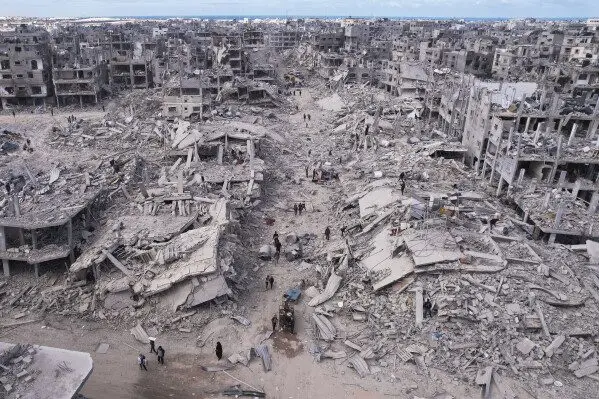
For three years, the war in Gaza has not been an event taking place far from the world's eyes. Scenes of killing, destruction, displacement and the humanitarian crisis have been broadcast almost daily, and the matter has reached the UN Security Council, the International Court of Justice and other international institutions, yet this has not led to an end to the war.
In an article published by academic and political researcher M. Reda Bahnam, he argues that what has happened in Gaza represents a harsh test of the international order, not because of a lack of information or legal instruments, but because of the failure to turn those instruments into measures capable of protecting civilians and ending the war.
In the Security Council, attempts to secure a ceasefire repeatedly ran up against disputes among the great powers and the use of the veto, while international judicial processes took a long time at a time when military operations and the fall of victims continued.
As for the International Court of Justice, since the case brought by South Africa against the Israeli occupation it has issued several provisional measures, while the main case concerning the accusation that the occupation has committed genocide is still going through its judicial stages. Tel Aviv denies the accusation and says its operations target Hamas and are carried out within the framework of self-defence.
The report also highlights the contradiction between the humanitarian positions and the political practices of some Western states: some countries have continued to provide military support to the Israeli occupation, while at the same time calling for aid to be allowed in, for civilians to be protected, and for some aspects of the military operations to be criticised.
Bahnam believes this contradiction has weakened the credibility of talk about a rules-based international order, and has raised a fundamental question:
The test was not limited to political and judicial institutions. Large demonstrations were held in cities around the world demanding an end to the war, but the writer sees that the gap remained wide between popular pressure and government policies.
For Bahnam, the most serious thing Gaza has revealed goes beyond Palestine's borders themselves: when the application of international law becomes tied to the balance of power and political alliances, trust is damaged in the system that is supposed to protect civilians and hold those who commit violations accountable, as some peoples believe.
After three years of war, the question Gaza poses to the world remains: if international institutions are unable to enforce their rules in one of the most documented and closely followed wars of the modern era, what is the value of their existence?


