

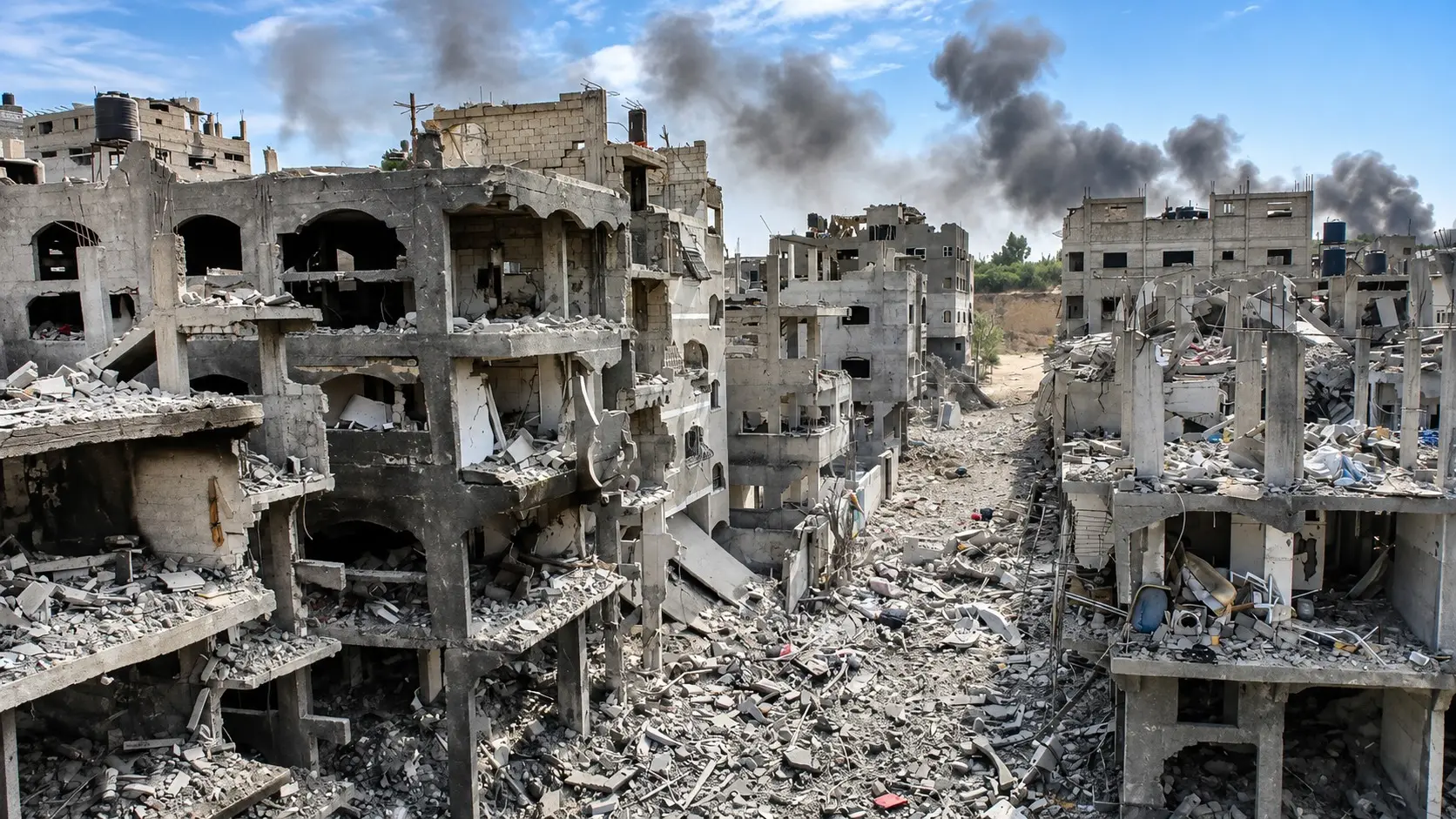
The war in Gaza continues to reveal new dimensions. It is no longer measured only by the number of dead and wounded, by the buildings that collapsed on their residents, or by the neighbourhoods reduced to rubble. There is another war, one that seeps into the air Palestinians breathe, the water they drink, the soil that is supposed to produce their food, and the children in their mothers' wombs. It is the war of pollution, whose effects may remain long after the bombardment stops and military operations end, making it one of the most serious long-term environmental consequences of armed conflict.
A new report prepared by Oxfam in cooperation with the Conflict and Environment Observatory (CEOBS) reveals the widening scope of pollution risks in the Gaza Strip, resulting from the intensive use of explosive weapons, the destruction of buildings and infrastructure, the collapse of water and sanitation networks, and the accumulation of waste and debris.
The report, titled "Environmental War Crimes: How the Israeli Military Assault Turned Gaza into a Toxic Land Threatening Human Survival," concludes that indicators of potential pollution sources cover more than 99% of the Strip's area, while military operations have affected about 78% of Gaza's area, according to spatial analysis based on satellite imagery, damage data, open-source information and scientific research.
99% of the Strip: Pollution Indicators Across Almost the Entire Area
The report's findings place Gaza's environment before a scene that goes beyond the conventional damage of war. Pollution is no longer confined to sites of bombardment or military installations; it is linked to a broad mix of sources of harm that overlap and spread across different environmental systems.
According to the analysis conducted by Oxfam and the Conflict and Environment Observatory, potential pollution sources include unexploded ordnance and explosive residues, heavy metals, industrial chemicals, asbestos released from destroyed buildings, organic pollutants, and biological pollutants associated with sewage and waste.
The risks of pollution are distributed across wide areas of the Strip, with higher levels of potential risk concentrated in Gaza City, Khan Younis, Rafah, Jabalia, and the Salah al-Din Corridor areas, where the intensity of bombardment, the scale of destruction and the multiplicity of pollution sources have converged.
The danger of these pollutants lies in their ability to move between different environmental components. Materials released by explosions or burned buildings may settle in the soil, then be carried by the wind into the air, seep with rainwater into groundwater, or enter plants and crops, creating multiple pathways for human exposure.
The problem does not stop at pollutants that can be seen. Chemicals, heavy metals and explosive residues may be present in areas where no clear signs of contamination appear, which makes scientific testing necessary before land is reused, rubble is removed, or agricultural activity resumes.
61 Million Tonnes of Rubble: Destroyed Cities Carrying Hidden Risks
Rubble in Gaza is no longer merely a witness to the destruction of buildings. It has become a complex environmental issue, containing multiple possibilities of hazardous materials that must be handled according to specialised scientific procedures.
The United Nations Environment Programme (UNEP) estimates that the volume of rubble in the Strip has exceeded 61 million tonnes, an enormous quantity that includes parts of buildings, industrial facilities and infrastructure, and may contain asbestos, industrial chemicals, heavy metals and munitions residues.
An assessment by the UN programme indicates that around 15% of the rubble may be exposed to relatively high risks of contamination with asbestos, industrial waste or heavy metals, if separation and treatment are not carried out effectively during rubble management.
The risks multiply when these materials are exposed to heat, crushing, transport or reuse without prior assessment. Unsafe handling releases dust and polluting substances into the air, transports them to other areas, or incorporates them into construction materials used in reconstruction.
United Nations estimates indicate that the volume of rubble in Gaza is about 20 times the total rubble left by all previous conflicts in the Strip since 2008, reflecting the scale of the challenge facing rubble removal, waste management and the rebuilding of cities.
According to the assessment of the United Nations Environment Programme, rubble removal should not be merely a process of transporting waste. It must include sorting materials, identifying hazards, removing unexploded ordnance, handling hazardous materials, recycling what can be safely used, and disposing of contaminated materials according to environmental standards.
Air: The War's Dust That Does Not Leave the Cities
In Gaza, exposure to bombardment debris does not end when the explosions stop. Destroyed buildings, fires and rubble become continuous sources of dust and pollutants, which can spread with the wind or return to the air through vehicle movement, rubble-removal work and the daily activity of residents.
The report by Oxfam and the Conflict and Environment Observatory warns of rising air pollution risks in Gaza City, Jabalia and the North Gaza Governorate, resulting from the accumulation of pollutants produced by bombardment and the destruction of buildings and facilities, and their redistribution in the air.
Potential hazards include dust from crushed concrete, crystalline silica, asbestos fibres in some older buildings, pollutants from the burning of industrial materials and damaged facilities, as well as munitions residues.
Health impacts vary according to the type of pollutant, its concentration and the duration of exposure. Inhaling dust and polluting substances may lead to irritation of the respiratory system, aggravated asthma and lung injuries, while chronic exposure to certain chemicals and metals may be associated with more serious health disorders.
Children are more vulnerable because of their stage of development, the sensitivity of their respiratory systems, and their higher rate of air intake relative to body weight, in addition to their potential exposure to dust while playing or living near rubble.
A dilemma arises here regarding rubble removal. Reopening roads, clearing rubble and restoring urban life may be urgent necessities, yet they may also become an additional source of exposure to pollutants if they are not preceded by assessment and protective measures for workers and residents.
Water: Pollution Beyond the Crisis of Thirst
The water crisis in Gaza is no longer merely a shortage of quantities available for drinking; it has become a crisis of quality and safety, in light of the destruction of infrastructure, the damage to wells and desalination plants, and the collapse of wastewater treatment systems.
According to the new report by Oxfam and the Conflict and Environment Observatory, an analysis of groundwater testing data conducted in July showed the presence of faecal coliform bacteria in 19% of 79 wells sampled, compared with about 2% of wells reported as contaminated in 2021.
This disparity reflects a worrying deterioration in groundwater quality indicators, but it does not represent a direct comparison between identical samples from the same wells or using a single methodology. It should therefore be treated as an indicator of intensifying risks rather than a uniform measure of change across all the Strip's wells.
The report also points to heightened water pollution risks in North Gaza, Gaza City and Deir al-Balah, where the fragility of aquifer systems overlaps with areas of intensive bombardment, accumulated rubble, damaged infrastructure and leakage of sewage.
With water and sewage networks destroyed, the likelihood of pollutants seeping into soil and groundwater increases, while the accumulation of waste and untreated sewage may contaminate surface and marine water sources.
The report's data indicate that only 19% of sewage pumping stations are still operating, and the partial operational capacity of the sewage network does not exceed 30%. This results in an estimated 40,000 cubic metres of raw sewage flowing into the Mediterranean Sea daily, in addition to some 15,000 cubic metres per day leaking from the collection network through soakaway pits and other seepage routes.
The impact of this crisis is not limited to diseases associated with contaminated water. It extends to the possibility of chemical and biological pollutants moving into the marine environment, affecting beaches, water resources and related activities.
In an earlier report, the United Nations Environment Programme confirmed that Gaza's water and sanitation systems had suffered severe deterioration, and that contamination of groundwater and the coastal environment represents one of the most serious challenges associated with recovery, with systematic testing of water and soil required before the reactivation of systems or the restoration of damaged activities.
Soil and Agriculture: Toxins That May Reach Food
Among the most serious environmental consequences of the war are those occurring away from residents' eyes, within soil exposed to bombardment, fires and the mechanical pressure of military operations, and to whatever chemicals, explosive residues and building components may accumulate there.
Assessments by the United Nations Environment Programme reveal extensive destruction of vegetation cover and agricultural land in Gaza. Remote-sensing data indicate damage to 97.1% of tree crops, 82.4% of annual crops, 95.1% of shrub-covered land, and 89% of grassland or fallow land.
These figures measure the damage to vegetation cover according to remote-sensing assessments; they do not mean that every damaged area has become chemically contaminated.
However, the destruction of agricultural land does not end with the loss of production. It raises concerns about soil contamination with materials from munitions, solid waste, untreated sewage and industrial substances that have leaked from damaged facilities.
The new report notes that the areas surrounding Beit Hanoun and Wadi Gaza, as well as areas northeast of Khan Younis, may be more exposed to long-term retention of pollutants, due to the clay characteristics of some soils that help them hold contaminating materials.
These characteristics mean that resuming agriculture in some areas may require specialised assessments before crops are planted or used for food production, especially if pollutants are capable of moving from soil into plants, water or the food chain.
These risks overlap with the loss of agricultural land, the destruction of orchards, damage to irrigation systems, the destruction of agricultural infrastructure, and the decline of livestock and fisheries, placing the Strip's food system before challenges that extend beyond the current food crisis to the difficulty of restoring productive capacity in the future.
The United Nations Environment Programme affirms that restoring land, vegetation cover and agricultural systems will be an essential part of recovery, but it warns of the need to protect residents from exposure to pollutants during the restoration of food production, which requires systematic soil testing and assessment of materials that may pass into food.
Gaza's Children: From Direct War Hazards to Delayed Harm
If the direct effects of war appear in wounds, fractures, amputations and injuries caused by explosions, environmental damage may impose on residents another course of suffering, whose outcomes do not necessarily appear in the first days or months.
Exposure to heavy metals, certain chemical compounds, organic pollutants and explosive residues may, depending on the nature of the substance, the level and duration of exposure, be associated with harm to the respiratory system, kidneys, liver and nervous system, with certain types of cancer, cardiovascular disorders, and risks to reproductive health.
Concerns are heightened regarding children and pregnant women, as exposure to some pollutants during pregnancy or early development may be linked to harm to neurological or physical development, depending on the type of substance, its dose and the timing of exposure.
These risks multiply in an environment where the capacity to provide medical care, laboratory testing, treatment of chronic diseases and monitoring of cases whose symptoms may appear after years is declining.
Reconstruction: Can Gaza Be Rebuilt on Untested Soil?
As discussion of rebuilding Gaza widens, the issue of environmental contamination emerges as a file that cannot be bypassed in any plan to rebuild cities, homes and infrastructure.
Removing rubble without environmental assessment, reusing destroyed building materials without sorting and testing, or resuming agriculture on damaged land without soil testing may transfer risks from the phase of war to the phase of recovery.
The report by Oxfam and the Conflict and Environment Observatory warns that addressing contamination will be extremely difficult because pollutants are spread across rubble, agricultural land, water networks and soil, in addition to unexploded ordnance that hinders safe access to wide areas.
Recovery requires multiple measures, including:
- Carrying out a comprehensive field environmental assessment to identify pollution sources and their levels.
- Testing soil, water, rubble and damaged industrial materials.
- Removing unexploded ordnance before construction and cleanup work.
- Sorting rubble and identifying hazardous materials, especially asbestos, heavy metals and industrial waste.
- Rebuilding water and sewage networks and treating leaks.
- Monitoring air quality in rubble-removal areas.
- Assessing agricultural land before its reuse for food production.
- Providing protective equipment for workers involved in rubble removal and waste handling.
- Establishing a long-term environmental and health monitoring system.
The United Nations Environment Programme affirms that Gaza's environmental recovery needs science-based planning, risk assessment, sound rubble management, restoration of water and sanitation infrastructure, soil surveys, and addressing the effects of contamination on marine and terrestrial systems.
Environmental Destruction: Will the Environment Become a Permanent Victim of War?
The findings revealed in the report open a wide door for accountability for environmental damage caused by military operations, not only as collateral effects of destruction, but as damage that may affect the basic conditions of residents' lives and continue after the war ends.
The report by Oxfam and the Conflict and Environment Observatory uses the term "environmental war crimes" in its title and analytical framework, pointing to the scale of harm inflicted on the environmental systems necessary for the survival of residents.
In Gaza, the picture goes beyond what can be counted in a report on destroyed buildings or roads. Potential contamination of water, soil and air, rubble containing hazardous materials, the collapse of sewage systems, and damage to agricultural land all make environmental recovery inseparable from the Palestinians' right to life, health, food and water, and to a return to an environment fit for living.


