


School curricula in the Arab world are no longer a purely internal educational matter. Since the late 1990s, specialised institutions have emerged in what is called "Israel" that collect the textbooks Arab children study, translate their texts, and examine their maps, verses, and lessons on history and religion, then classify what they deem "incitement," "rejection of peace," or "hostility toward Israel."
But the story did not stop at academic research.
Reports moved from researchers' offices to the US Congress, the White House, the US State Department, the European Parliament, Western governments, and donor agencies. In the Palestinian case specifically, the matter ended up linking part of the aid and the reforms required to a review of educational materials.
An investigation published by "Arabic Post" (https://ArabicPost.net) on 5 October 2026, after tracing Israeli and Western documents, says it monitored activity covering the curricula of 17 Arab states over roughly three decades, and the activity of ten Israeli institutions and centres alongside governmental bodies and Knesset committees.
But to understand the scale of the story, one must go back to 1998.
The beginning: Oslo and the search inside children's books
In that year, the "Center for Monitoring the Impact of Peace" (CMIP) was established in the entity "Israel," which later became the "Institute for Monitoring Peace and Cultural Tolerance in School Education," known by the acronym IMPACT-se.
The institute's founder, Johanan Manor, explained himself that the initial aim was limited: to monitor whether the Oslo Accords had been reflected in the education of Palestinian children through mutual acceptance, reconciliation, and peace. The scope of the work then expanded to include other countries.
Over the years, the process turned into a vast archive of textbooks. In an institute report dating to 2011-2012, it said its library had come to contain more than four thousand textbooks, and that it had already issued reports on the curricula of the Palestinian Authority, "Israel," Syria, Saudi Arabia, Egypt, Iran, Hamas, and Tunisia.
Later, the monitoring expanded further, and IMPACT-se began publishing periodic studies on Saudi Arabia, Jordan, Qatar, the UAE, Morocco, Egypt, Tunisia, Yemen, Syria, and others, in addition to Palestinian curricula and UNRWA materials. In 2026 alone, it published new reviews of the curricula of Jordan, Saudi Arabia, Qatar, Tunisia, and the Palestinian Authority.
What were they looking for?
IMPACT-se officially says it uses standards derived from UNESCO relating to peace, tolerance, and non-violence.
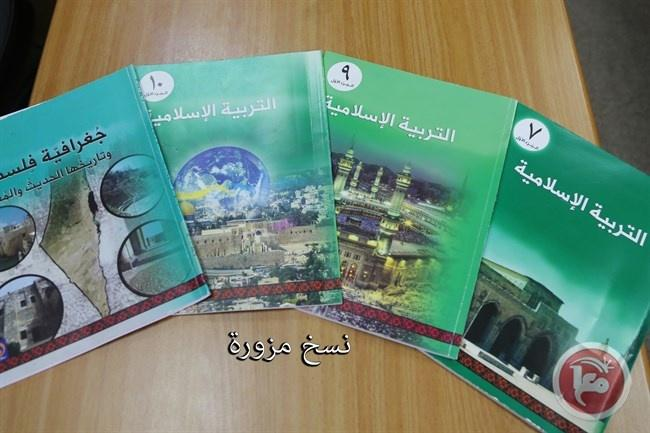
But when reviewing its reports on the Arab world, a nearly fixed set of files under scrutiny appears: the image of Jews and Judaism, how "Israel" and Zionism are described, maps of Palestine, jihad and martyrdom, armed resistance, Jerusalem and the Al-Aqsa Mosque, the Holocaust, relations with non-Muslims, as well as issues of women, minorities, and homosexuality.
The institute says the aim is to identify the materials it considers incompatible with "peace and tolerance," and to work to change them.
Here lies the most important point in this case: what happens after the institute discovers a passage it does not like?
The institute itself: publishing findings and exerting pressure
One of the most revealing documents is not an Arab accusation against the institute, but a report issued by it.
In its annual report for 2011-2012, IMPACT-se explained its mechanism of work clearly: when it sees that books do not comply with the standards it adopts, the findings are published and pressure is exerted to bring about change through communication with decision-makers, the media, and civil society around the world.
In a later archive of the institute, a more direct expression of "pressure on governments" appears, with the changes made to Saudi books presented as an example of the results that can be achieved.
Thus the mechanism becomes as follows:
This cycle can be documented very clearly in more than one case.
Saudi Arabia: from school books to the White House
Saudi Arabia is among the most prominent examples.
IMPACT-se says it has been monitoring the Saudi curriculum since the early 2000s. After the attacks of 11 September 2001, American and Western interest in what is taught in the kingdom increased, especially as most of the attackers were Saudis.
But the institute did not limit itself to issuing reports.
Its archive states explicitly that it presented its report on Saudi books and its policy recommendations to the White House, the National Security Council, the State Department, and the US Congress, and that it presented them to senior European officials.
The institute then began tracking, year after year, what had disappeared from the books.
In its report on 2021-2022, it said that 28 lessons dealing with Jews, Christians, unbelievers, and "violent" jihad had been deleted or substantially amended.
In later reviews, it said that an entire chapter dealing with "Israel" had been deleted, that earlier definitions of Zionism as a racist movement seeking to expel Palestinians and seize Arab lands and Jerusalem's sanctities no longer existed, and that other material on jihad and martyrdom had disappeared or been amended.
The institute also tracked the maps.
It praised the removal, in some maps, of the name "Palestine" that had appeared across the entire area of historic Palestine, while at the same time complaining that the name "Israel" had not been written in its place.
Nevertheless, an important distinction must be recorded: these documents do not prove that IMPACT-se is the sole cause of the reform of Saudi curricula. The kingdom began a broader education reform programme linked to countering extremism, to the Vision 2030 project, and to social and economic modernisation. The institute's own reports acknowledge these internal factors.
Jordan: even the name of Palestine on the map under monitoring
Jordan represents a different model.
IMPACT-se has reviewed hundreds of Jordanian books, and as of August 2026 it was still reviewing new publications; it said its most recent study covered 125 books, including 32 new books.
What does it monitor?
Among its objections are the continued discussion of jihad and martyrdom, the description of Zionism, the books' position on the Jordanian-Israeli peace treaty, the non-teaching of the Holocaust, and maps that name the land Palestine and do not show "Israel."
Palestine: when a report becomes a financial instrument
But the clearest and most consequential example is Palestine.
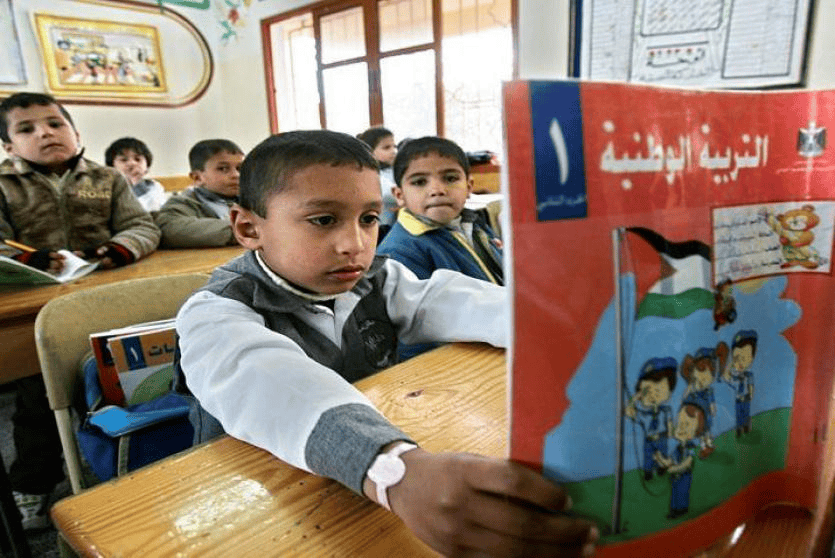
Since the institute's founding, Palestinian books have been its primary target. After the Palestinian Authority issued new curricula, IMPACT-se continued to submit reports to Western institutions accusing the books of encouraging jihad, martyrdom, and resistance, and of rejecting "Israel" and removing it from maps.
The matter then moved to the European Parliament.
In 2020, European Parliament documents showed that MEPs explicitly relied on IMPACT-se reports in pressing the Commission regarding Palestinian books. The Commission responded that it was aware of the institute's reports, but had contracted with the German Georg Eckert Institute to conduct an independent study so that it would have an objective basis for dialogue with the Palestinian Authority.
The German study examined 172 Palestinian books and curricula. It reached a more complex picture: it found a focus on human rights, pluralism, and some UNESCO standards, but it also recorded hostility toward what is called "Israel," problematic material, anti-Jewish references, and glorification of violence in some places, in reference to resistance and jihad.
In other words, it neither fully endorsed the picture drawn by IMPACT-se nor fully exonerated the curricula.
But political pressure continued.
In subsequent resolutions, the European Parliament called for education-related aid to be conditioned on Palestinian books complying with UNESCO standards and on the deletion of material it considers antisemitic or inciting violence. In the 2025 budget, placing 20 million euros in reserve was proposed until tangible positive changes in the curriculum occurred.
By 2024-2026, the review of educational materials had become part of a reform matrix partly linked to European financial support for the Palestinian Authority. A European decision issued in 2026 confirms that direct financial assistance to the Authority is partly linked to achieving reforms that include a systematic review of educational materials.
Here the chain is clearly completed:
An Israeli institution monitors → Western politicians adopt the findings → a European study → parliamentary resolutions → conditions linked to funding and reform.
Not Palestine alone: redefining the "acceptable curriculum"
In the UAE, the institute praised the inclusion of the Abraham Accords in books and the "softening" of material opposed to what is called "Israel." In Morocco it praised the positive presentation of Moroccan Jewish history and culture. In Saudi Arabia it praised the deletion of material on Zionism and jihad. At the same time, it continues to criticise Jordan, Qatar, the Palestinian Authority, and Yemen over material it considers incompatible with its vision of peace and tolerance.
Indeed, IMPACT-se, in cooperation with the Israeli Institute for National Security Studies (INSS), proposed in 2025 a broader concept of "peace education" on an "Abrahamic" basis across the Middle East and North Africa, arguing that the Abraham Accords could serve as a foundation for transforming regional education toward mutual recognition and a reframing of the view of Jews and "Israel."
Here the question becomes larger than deleting an "offensive phrase," as they claim.
It becomes a question of: who holds the authority to define what an Arab child should know about Palestine, "Israel," and the history of the conflict?
Where does the Israeli state itself come in?
It is also important not to portray all these institutions as a single Israeli ministry.
IMPACT-se presents itself as an independent international research and policy institution, and uses standards it says derive from UNESCO. It has an office in London, but it also has an office in Ramat Gan inside "Israel," and it originated in Israel.
Its founder, Johanan Manor, was an Israeli academic and an activist in Israeli-European relations, and coordinated the international campaign to repeal the UN resolution equating Zionism with racism. Among the institute's historic leaders is also Jean-Claude Nidam, whom its report described as a senior official in the Israeli Ministry of Justice who took part in the Israeli negotiating track.
At the same time, there are official Israeli channels independent of IMPACT-se for monitoring Palestinian education, including Israeli ministries, the Knesset, and the Civil Administration. In February 2025, for example, the Knesset Research and Information Center issued a full document on Palestinian books and how they present Jews, Israel, and peace, including the policies of the foreign, education, and security ministries and other governmental bodies on the file.
And what is the problem with using "UNESCO standards"?
In principle, combating racism and incitement to kill civilians is not problematic; these are standards that can be addressed in various curricula.
But the problem begins when the process of "combating hatred" extends to defining the historical and political narrative permitted to be taught.
Is drawing historic Palestine incitement? Is describing "Israel" as an "occupation" material that should be deleted? Is teaching the concept of jihad in itself extremism, or does judgment depend on context? Is speaking of martyrdom and resistance equivalent to incitement to kill civilians? Should an Arab curriculum present Zionism the way "Israel" wants it presented?
These are not merely neutral educational questions; they are political questions directly tied to a conflict that has not ended.
The problem grows when an answer provided by an institution linked to the Israeli political environment turns into reports that reach Western funders capable of withholding money or imposing conditions.
And another question: who monitors Israeli books?
IMPACT-se says it has also reviewed Israeli curricula, not only Arab ones. Indeed, its founding included a comparison of Palestinian and Israeli education, and it has published studies on how Arabs and Palestinians are depicted in Israeli books.
But the balance of power is different.
An Israeli textbook does not depend on Palestinian Authority aid, and no Arab parliament can freeze tens of millions of euros allocated to "Israel" until it changes its curriculum.
Here lies one of the most important angles of the story: the question is not only who monitors whom, but who possesses, after the monitoring, the capacity to turn its report into cross-border political and financial pressure?
What has actually changed?
After nearly three decades of this process, clear effects can be seen in the region.
Texts on Jews, jihad, and Zionism have disappeared from Saudi books, and dozens of lessons have been amended. The Abraham Accords have entered Emirati education. Jewish history has become more prominent in Moroccan curricula. Palestinian books have for years been subject to international scrutiny that has reached the level of funding and reform conditions. Meanwhile, the institute continues to demand further changes from Jordan, Qatar, and the Palestinian Authority.
Thus, over nearly three decades, Israeli institutions have built a wide system for monitoring what Arab children learn, and have deliberately turned the results of that monitoring into political activity targeting decision-makers, governments, and donors; these results have indeed reached the White House, the US Congress, and the European Parliament, and have been accompanied by pressure to change material concerning Jews, "Israel," Zionism, Palestine, jihad, martyrdom, resistance, and maps. In the Palestinian case, the matter has reached the point of linking the reform of educational materials to part of a European funding and reform framework.
This is perhaps the most important aspect of the entire story.
The battle is no longer only over land and borders, nor over what news bulletins say about Palestine; it has extended into the classroom itself: into the map a child sees, the sentence he reads, the history he memorises, and the vocabulary he will use ten years later when he speaks of Palestine, Israel, and the conflict between them.
The question left by three decades of this monitoring is not whether we should say who decides what Arab curricula contain, since that has become clear. It is rather: how do we rescue generations from educational systems whose curricula are controlled by outsiders and adversaries? And how, given these facts, do we preserve the doctrinal, political, and historical memory of an entire generation?
Sources:
Original Arabic Post investigation
Independent Georg Eckert Institute study on Palestinian curricula


