


About 24 kilometres south of Nablus, the village of Qusra appears to be one of the West Bank villages in which geography condenses a long history of conflict over land. But the village's story does not end at its geographic location or the size of its population. Over decades it has become a model of popular resistance to settlement, leading up to the latest chapter of the conflict at Ras al-Ayn mountain.
Thus, the current confrontation appears as an extension of a long path that began decades ago, when the village's residents realised that protecting the land cannot be separated from protecting their very existence.
A village between the mountain and the plain
Qusra lies south of Nablus and covers about 9,200 dunums, but the municipality's structural plan does not exceed 3,100 dunums, while some 6,000 dunums are classified as Area C, where the occupation authorities exercise broad security and administrative control.
The area is marked by terrain that combines mountains and plains, and it is surrounded by a number of towns and villages. Roads linking Nablus with Jericho and the Jordan Valley areas also pass near it.
The village's population is estimated at about 8,000 residents, according to local estimates for 2026, while about 10,000 of its sons and daughters live outside it, most of them in Jordan.
This geography has made agricultural land an essential part of Qusra's economy and identity. Olives, grapes and figs, along with livestock and poultry farming, have historically been the main sources of livelihood for the population.
But control over the land has gradually come to occupy a larger share of residents' lives, as access to parts of their agricultural land has become restricted and the settlements and outposts surrounding the village have expanded.
From an agricultural village to a front line
Qusra's presence in the historical record dates back to the Ottoman era, when it appeared in tax registers in 1596 under the name "al-Qusayr", with 14 households living there at the time.
The twentieth century brought successive political and military transformations to the town, beginning with the period of the British Mandate, followed by Jordanian rule after 1948 (corresponding to 1367 AH), and culminating in the June 1967 war, which placed the West Bank under occupation.
With the establishment of the Palestinian Authority in 1993 (corresponding to 1414 AH), Qusra became administratively part of areas under the Authority's jurisdiction. However, the divisions of the Oslo Accords left large parts of its land within Area C, under the military and administrative control of the occupation.
Settlements encircle the village
Settlement expansion into Qusra's land became prominent in 1981 (corresponding to 1401 AH), with the establishment of the Mejdalim settlement at the village's main entrance.
Over time, other settlements emerged in its surroundings, including Eviatar and Esh Kodesh, while settlement outposts expanded onto sites within the town's land and mountains.
Settlement and military measures came to control about two-thirds of the village's area, that is, nearly 6,000 dunums, which has reduced the space available to residents for farming, building and natural growth.
The matter is not limited to the confiscation of land. The closure of the village's main entrance since October 2023 (corresponding to Rabi' al-Awwal 1445 AH) has forced residents to use alternative routes to reach neighbouring villages and areas.
Hundreds of homes also face the threat of demolition because they are located in areas classified as Area C.
A memory of resistance reaching back to the Mandate
Qusra's confrontation with occupation and settlement is not a recent phenomenon. In 1938, the area witnessed the Battle of Wadi Sabas between Qusra and the village of Jaloud, during the Palestinian revolt against the British Mandate.
Among its prominent participants was Marzouq al-Asmar Odeh, who was martyred after he succeeded in downing a British warplane, alongside a number of the area's sons who took part in the confrontation. After 1967, new forms of resistance activity emerged.
Among the figures who stood out in that period was Muhammad Fāriʿ Kanaan, known as Abu Fāriʿ, a former officer in the Jordanian army who helped form a cell linked to the Palestine Liberation Organization, which contributed to smuggling weapons into the West Bank.
His life ended in the battle of Jamʿain south of Nablus in 1969, after a confrontation with occupation forces.
From the intifada to the guard committees
Qusra also took part in the first Palestinian intifada in 1987, and then in the Al-Aqsa Intifada, which erupted in 2000 (corresponding to 1421 AH).
But the escalation of settler attacks pushed the village's residents to develop a distinctive model of popular resistance.
In the middle of the last decade, the first nucleus of popular guard committees emerged in Qusra, and the idea later spread to other areas of the West Bank.
These committees were not traditional military formations. They were local groups whose aim was to monitor settlers' movements and provide early warning when attacks occurred, using simple tools such as sticks and night-time watch and observation.
The basic idea was that the village would not wait for an attack before acting, but would try to detect the danger before it reached homes and farms.
Direct confrontations with settlers
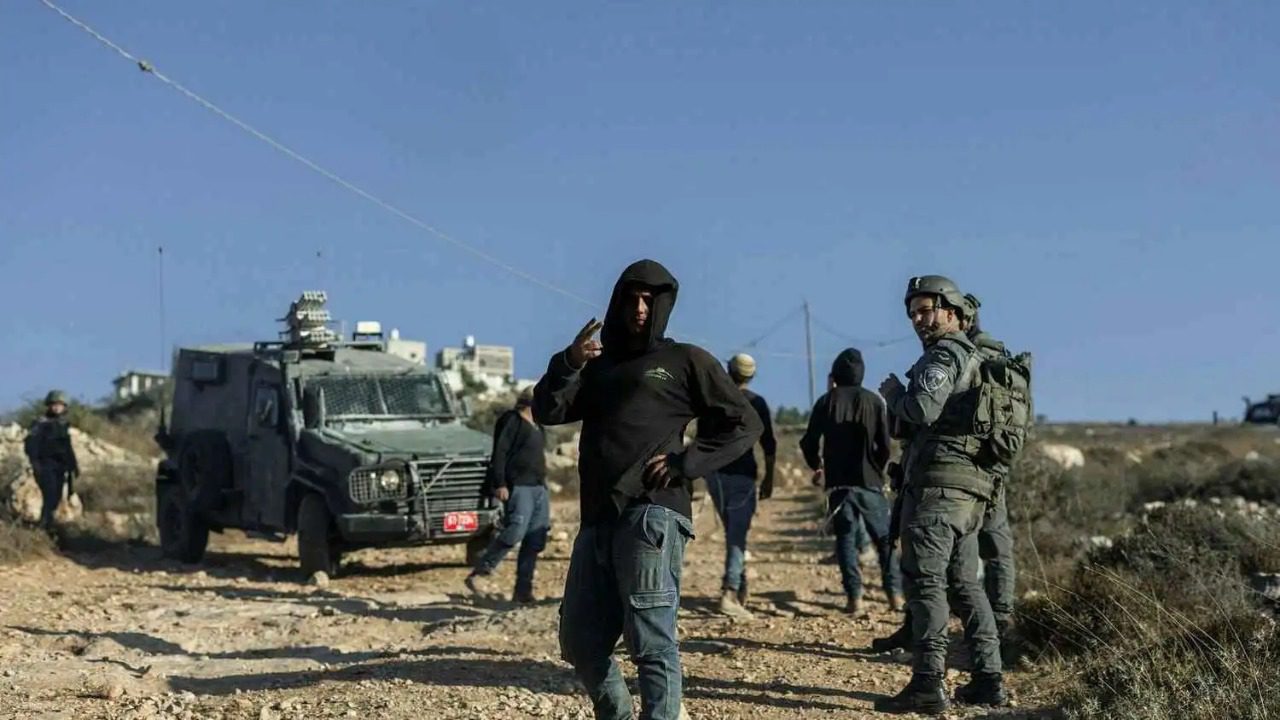
The guard committees became part of Qusra's recent memory, especially as confrontations recurred. In 2014, young men from the village detained 18 settlers who had attempted to attack residents, before handing them over to the occupation army. A similar incident occurred in 2017, when 20 other settlers were detained.
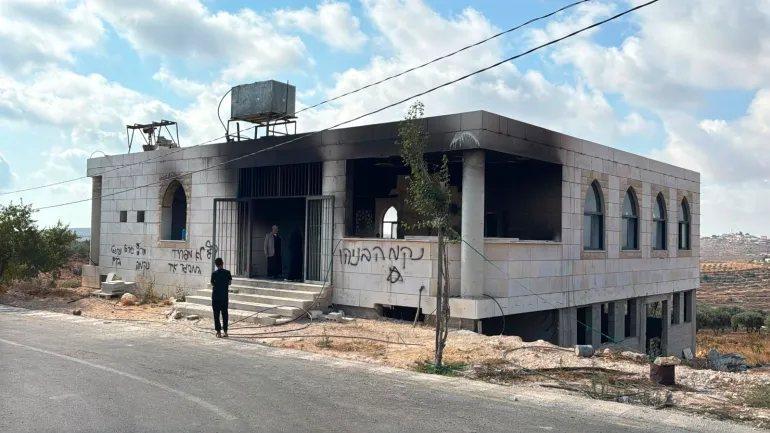
But the confrontations have left a heavy human and material cost. Since the Al-Aqsa Intifada, attacks have resulted in the burning of two mosques and the destruction or burning of 48 homes, fully or partially, in addition to the deaths of 11 of the village's sons, eight of them after the outbreak of the war on Gaza and six killed in a single day during one of the confrontations.
Dozens of residents have also been arrested and injured, while 40 of the village's sons are held in prisons according to the data contained in the report.
Ras al-Ayn mountain: the new battle
If land is the defining issue of the conflict in Qusra, then Ras al-Ayn mountain today represents the most sensitive point of confrontation.
The mountain lies west of the town and is the last large geographic open space available to its residents, especially since settlements have surrounded the village from several directions.
It rises about 950 metres above sea level and covers nearly 700 dunums. From its elevated position it overlooks wide areas of the surrounding villages and the Jordan Valley.
But the mountain's importance is not only a matter of location. It contains an ancient spring that was the main water source for a number of homes in the area, which is why the mountain has historically been tied to residents' daily lives.
In early 2026 (corresponding to Rajab 1447 AH), settlers took control of the spring, a step that increased pressure on residents who depend on the area as a vital space for housing and farming.
From construction to siege
Qusra's residents began expanding construction at Ras al-Ayn in 2000. Then, from 2007 (corresponding to 1428 AH), the village council worked to open roads, extend water and electricity networks and provide basic services.
Over the years, the area gained high real-estate value, but at the same time it became a point of friction with settlers.
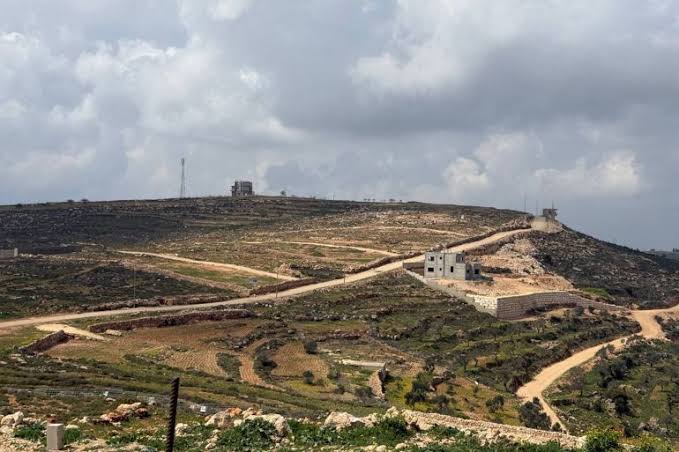
In January 2026, a series of attacks began in the area, including assaults on homes, cutting off water and electricity, and seizing the spring.
Three homes at the heart of the confrontation
The besieged area contains three homes inhabited by three families whose members number more than ten people. As the siege continued, residents faced restrictions on movement and on access to their basic needs, while food, medical aid and water entered only in limited amounts and under international pressure.
Visits by international officials and criticism directed by the US Ambassador to Jerusalem, Mike Huckabee, did not succeed in ending the crisis.
Thus Ras al-Ayn mountain has turned from a space for urban and agricultural expansion into a point of direct confrontation, in which Qusra is once again testing its ability to hold on to its land in the face of settlement expansion.
A battle over land, not only over borders
Qusra's story reveals that the conflict in the West Bank does not revolve only around political lines or negotiating maps, but around daily details closely tied to residents' lives: a home, a road, a water well, an olive tree or a plot of farmland.
The more the land available to residents shrinks, the greater the value of the sites that remain beyond the reach of settlement control.
This is why Ras al-Ayn mountain has become more than a high area west of the village. It is the last space in which Qusra's residents can expand, a historic source of water, and a strategic site that overlooks large parts of the town's surroundings.
Qusra: a memory that does not end
From the Battle of Wadi Sabas in 1938, to the popular guard committees, from the stone-throwing intifada to the Al-Aqsa Intifada, and then to repeated confrontations with settlers, Qusra has continued to reproduce its tools of defending the land according to the nature of each stage.
Today, the battle at Ras al-Ayn mountain does not appear separate from this history. The residents who confronted the British Mandate, then occupation, then settlement, now face a new attempt to change the balance of the land through settlement outposts, military restrictions and siege.
In a village where settlement and military measures control about two-thirds of its land, preserving each remaining dunum becomes an act that goes beyond farming and building, to the preservation of the village's very capacity to survive.
Thus Qusra, in its new chapter at Ras al-Ayn mountain, seems to be fighting the same battle it has known for decades, but with different tools: a battle over land, over water, over the road, and over the right of the Palestinian to remain in the place where his forebears lived.


