For decades, the relationship between the United States and Israel has been presented as one of the most robust strategic partnerships in the world. Unprecedented military and intelligence cooperation, mutual political support, and constant coordination on the most sensitive files in the Middle East have defined it. Yet behind this close alliance, one issue has never left the memory of US security agencies: espionage between allies.
In a development that reveals the scale of growing concern within US security institutions, US media reports said the US Department of Defense has raised the level of warning related to Israeli intelligence activities inside the United States to its highest degree, a rare step that reflects mounting fears over the expansion of information-gathering operations targeting decision-making circles in Washington.
An Intelligence Assessment That Raises Concern
According to current and former US officials, the Defense Intelligence Agency prepared a new counterintelligence risk assessment over recent weeks, which included a internal warning placing Israeli intelligence activity within the category of critical threats.
The assessment appeared in a lengthy analytical document that included maps, data and intelligence graphics addressing Israel's capabilities in human intelligence and technical information gathering.
According to informed sources, US concern centres on possible attempts to obtain information relating to internal discussions on the policies of the administration of President Donald Trump regarding the war with Iran, and the future of security arrangements in the Middle East.
The War with Iran at the Heart of the Picture
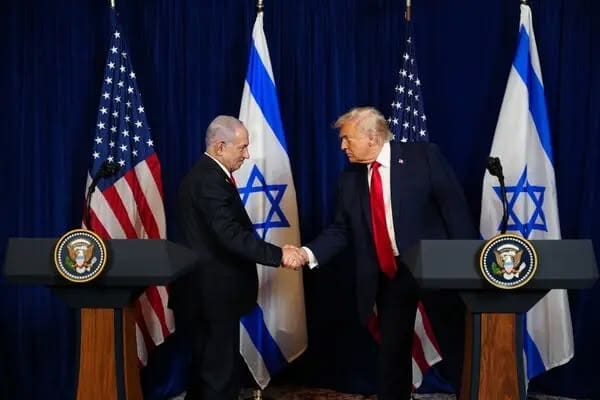
This development does not come in a political vacuum. The relationship between the Trump administration and the Israeli government has witnessed unusual tensions in recent months over the handling of the war with Iran.
While the US president tends to push toward political settlements and diplomatic paths to end the confrontation that erupted between the two sides, the Israeli government continues to express strong reservations about any possible agreement with Tehran.
This question has become one of the most important strategic issues for decision-makers in Tel Aviv, which, according to security experts, explains the importance of the information coming from US decision-making circles.
Tel Aviv Denies, Washington Stays Silent
For its part, Israel categorically rejected the accusations. The Israeli Embassy in Washington stated that the Jewish state does not carry out espionage operations against US officials or government institutions, and described the circulating claims as untrue and politically motivated.
The US Department of Defense declined to comment directly on the reports, while a White House official denied the accuracy of the circulating account, saying it was based on inaccurate information.
Notably, however, the official denial has not stopped the discussion within US security circles about the nature of the complex intelligence relationship between the two countries.
New Precautionary Measures
Despite the continuation of close security cooperation between Washington and Tel Aviv, available information indicates that US defence institutions have already begun taking additional precautionary measures.
US officials stress that these steps do not mean a decline in the level of security partnership, but reflect a growing awareness of the capabilities of Israeli intelligence agencies, which some US security circles describe as among the most active and efficient in the world.
The Ghost of the Pollard Case Returns
For many working in US security agencies, Israeli espionage cannot be discussed without recalling one of the most sensitive cases in the history of relations between the two countries.
In the 1980s, the case of US Navy intelligence analyst Jonathan Pollard shook US security institutions after he was proven to have transferred vast quantities of classified documents to Israel.
Although many years have passed since that crisis, it is still invoked within US security institutions whenever concerns related to Israeli intelligence activity resurface.
The Paradox of Espionage Between Allies
The paradox is that the United States itself is not distant from this kind of practice. Recent history reveals that US intelligence agencies have carried out information-gathering operations on a wide scale, targeting both adversaries and allies alike.
International relations experts therefore see espionage between allies as no exception in the world of politics, but rather part of a complex equation that governs relations between states, however close their alliance may be.
A Crisis of Trust or a Passing Disagreement?
So far there are no indications that these developments will lead to an open political crisis between the United States and Israel. The two countries remain bound by the broadest network of military and intelligence cooperation in the Middle East, and shared challenges, foremost the Iranian file, make a genuine rupture between them difficult to envisage.
What these developments do reveal, however, is that international relations are not built on absolute trust, even between the closest allies.
This is why the current crisis appears less tied to Israel alone, and more to an old rule governing the world of national security: no ally is above suspicion when it comes to strategic secrets.