

Battlefields alone are no longer where the outcomes of wars are determined. Contemporary confrontations extend into the information space, legal institutions and economic and political fields, targeting societies' capacity to endure, their trust in their institutions and the independence of their national decision-making.
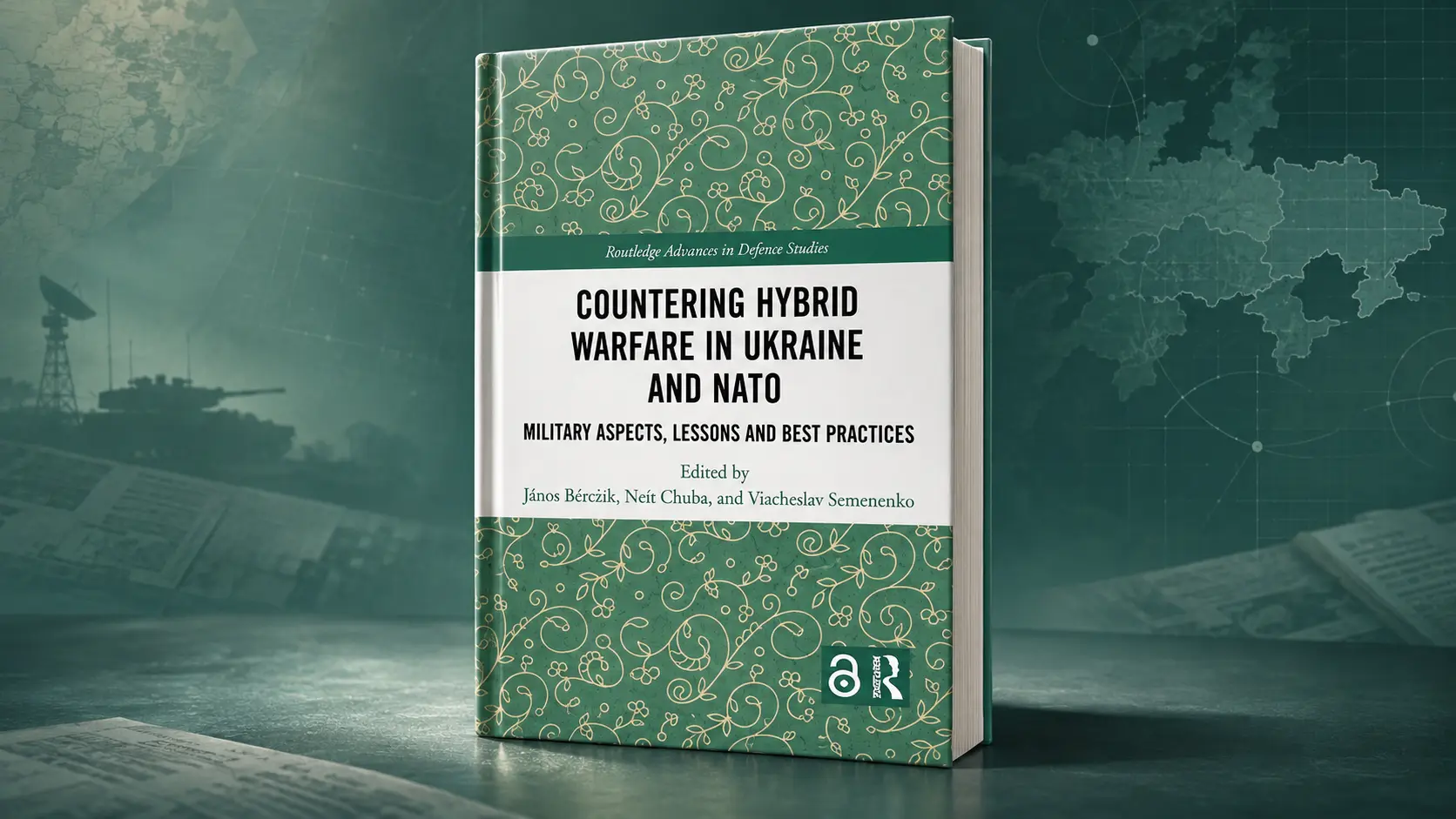
In the context of growing interest in these shifts within Western military institutions, the British publisher Routledge issued in November 2026 a book titled «Countering Hybrid Warfare in Ukraine and NATO: Military Aspects, Lessons and Best Practices» (Countering Hybrid Warfare in Ukraine and NATO: Military Aspects, Lessons and Best Practices), edited by Yanis Bērziņš, Neil Chuka and Viacheslav Semenenko.
The book draws on research conducted within the NATO Science and Technology Organization, with the participation of researchers and military specialists from Ukraine, the Baltic states, Britain, the Nordic countries, Central Europe and the Western Balkans.
Its importance lies in the fact that it does not limit itself to studying the tools of hybrid warfare, but examines how military and civilian institutions respond to them, drawing on the Ukrainian experience since 2014 and on the experiences of other European countries.
Hybrid warfare: where the instruments of power overlap
In military studies, the concept of hybrid warfare refers to the combination of military and non-military instruments within a conflict aimed at achieving political and strategic objectives.
These instruments may include information operations, cyberattacks, economic pressure, political influence and the manipulation of legal frameworks, alongside the threat or actual use of military force.
The distinctiveness of this type of conflict lies not in the tools being entirely new, but in their overlap and their use in ways that make it extremely difficult to separate military confrontation from political and security competition.
A state may face pressures targeting its institutions, its economy and its society at the same time, without all of these pressures being part of an openly declared war.
Hence the difficulty of dealing with hybrid threats within traditional categories that separate internal security, military defence and foreign policy.
Ukraine: an experience that began before the full-scale invasion
The book devotes its first section to the Ukrainian experience of confronting Russian policies and operations since 2014, drawing on contributions from specialists who took part in developing Ukraine's defence institutions.
This phase is of particular importance because it preceded the full-scale Russian invasion of February 2022, and it witnessed shifts in Ukraine's understanding of the nature of the threats it faced.
The book reviews aspects of the development of military legislation and institutions, the organisation of territorial defence, the strengthening of information security and strategic communications, and defence planning and naval operations.
These topics reveal how broad the concept of readiness for war has become: it is no longer confined to acquiring weapons and training forces, but includes the capacity of institutions to adapt to different forms of threat.
Among the most valuable things the Ukrainian experience offers researchers is the opportunity to study the relationship between the crises a state faces before an open war and the readiness of its institutions to confront escalation later on.
Information warfare: when awareness becomes part of the battle
Information security receives prominent attention in the book. One of its chapters addresses three interconnected areas: cyber defence; countering informational and psychological influence on members of the Ukrainian armed forces; and strategic communications in the military field.
The importance of this axis stems from the transformation that modern means of communication have brought to the nature of conflicts, as the flow of information has become part of the environment in which political, social and military positions are formed.
Information that the public receives during crises shapes its understanding of events, its assessment of the performance of state institutions, and its trust in the narratives presented by competing parties.
The informational challenge is not limited to the spread of false news. It may also concern the way accurate facts are presented, selected, taken out of context and employed to build narratives that serve political aims.
Yet countering disinformation should not in turn become a justification for restricting independent journalism or criminalising legitimate criticism.
The ability to protect society from informational manipulation is also linked to making reliable information available, to the transparency of institutions, and to the existence of a media capable of independently verifying conflicting claims.
Law: another arena of conflict
Among the book's notable aspects is its attention to the legal foundations Ukraine adopted in confronting Russia, as well as its study of what the researchers describe as legal manipulation as one of the instruments of hybrid warfare.
This axis opens the way to understanding the concept of «lawfare», which refers to the use of legal tools, procedures and interpretations to achieve political or strategic objectives in the course of disputes.
The struggle on the ground may coincide with a struggle over the legitimacy of control over it, the nature of the authorities in place there, the characterisation of military actions, and the determination of responsibilities, rights and obligations.
For their part, states facing non-traditional threats need legal frameworks that define the powers and responsibilities of military, security and civilian institutions.
Yet the use of law to achieve strategic objectives does not mean that every legal step taken in the context of a conflict constitutes lawfare. A distinction must be drawn between the legitimate resort to courts and international institutions, and the misuse of law for purposes that contradict justice or fundamental rights.
This question is of particular importance in conflicts where issues of occupation, sovereignty, self-determination, protection of civilians and accountability for crimes intersect.
Military signalling: power that influences without being used
In its second section, the book moves on to study several European cases, among them Russian military exercises in the Baltic Sea region and the strategic implications carried by military activity.
Armed forces do not perform only a combat function; their activity may also carry political and security messages that affect the calculations of other states.
One state may treat a particular military activity as part of routine defensive preparations, while another regards it as a potential threat or a means of political pressure.
This question reveals the importance of studying the relationship between declared military capabilities, the intentions that states attribute to their adversaries, and the political context in which military movements take place.
It also highlights the risks of miscalculation, when military signals are interpreted in ways that lead to escalation which the parties do not necessarily seek.
The Baltic states and the Czech Republic: hybrid warfare beyond the Ukrainian front
The book does not confine its study to Ukraine. It widens the scope of research to include European states that differ in their geographical location and in their political and security relations with Russia.
It addresses the British experience within Operation «Cabrit» in Estonia, Russian activities not based on the direct use of military force in Latvia and the Baltic region, as well as hybrid activities that targeted the Czech Republic, according to the assessment of the participating researchers.
These cases allow comparisons between the experiences of states facing direct war and those dealing with pressures and threats that do not necessarily reach the level of armed confrontation.
It thus becomes clear that confronting hybrid warfare is not a matter confined to states living in a state of war; it is also linked to states' capacity to understand the threats they face in times of peace.
The Western Balkans: energy and political influence
Among the axes that deserve particular attention from a Muslim reader, the book addresses Russian influence operations in Kosovo, and the use of energy policies as a tool of strategic influence in Croatia, Bosnia and Herzegovina, Serbia and Montenegro.
The importance of this axis stems from the particularity of the Balkan region, where historical, national and religious divisions intersect with economic interests and the competing relations of international powers.
Examining energy policies in this context helps in understanding one dimension of the relationship between economic dependence and political decision-making independence.
A state that depends to a large degree on an external source to meet its energy needs may become more vulnerable to pressure when its relations with that source are disrupted.
Yet economic dependence in itself is not proof of a hostile strategy. What must be studied is the nature of the existing relations, the terms of the agreements, and the extent to which economic decisions are linked to political objectives.
These studies raise questions worth following up regarding the future of Bosnia and Herzegovina and Kosovo, and the extent to which international competition in the Balkans affects political stability and the security of Muslim communities in the region.
What the book offers for understanding conflicts in the Muslim world
Although the book proceeds from a Ukrainian and Atlantic defence perspective, the topics it addresses allow researchers of the Muslim world to study forms of conflict that do not always appear as direct military confrontation.
In a number of crises experienced by Muslim-majority states, armed conflicts intertwine with foreign interventions, media rivalry, economic pressure, and disputes over political and legal legitimacy.
This approach gains further importance in societies suffering from weak institutions, internal divisions, or heavy reliance on external powers to meet their security and economic needs.
The study of information operations is also significant in environments marked by sharp social polarisation, where the spread of misleading information may deepen divisions and expose civilians to greater risks.
On another level, examining the legal dimensions of conflicts makes clear the importance of documenting violations, protecting rights, and monitoring the legal discourse that parties to a dispute present to justify their policies, a discourse which in turn reveals their inconsistencies.
These are analytical applications of the general framework the book presents, and not findings from independent studies that its authors devoted to the Muslim world.
How should studies issued by NATO-linked institutions be read?
The book derives an important part of its value from the proximity of its contributing researchers to military and defence institutions, and from the access this affords to the experiences and challenges facing those institutions.
Yet this very background calls for reading the book in light of the strategic perspective from which it proceeds.
The book studies Russia as the source of the hybrid threat and focuses on the responses of Ukraine, NATO member states and their partners. It does not offer a comprehensive comparative study of the use of the same instruments by Western or other powers.
It is therefore necessary to distinguish between the data the researchers present, their interpretations of the nature and aims of Russian policies, and the security and political assumptions that govern studies produced by Western defence institutions.
This distinction does not diminish the book's intellectual value; rather, it helps readers benefit from it without adopting all of its assumptions or political judgements.
Studying the literature of major military institutions makes it possible to understand how they think, how they define threats, and the priorities that shape their view of security and international conflict.
Conclusion
The book «Countering Hybrid Warfare in Ukraine and NATO» offers a framework for understanding the transformations that contemporary wars are undergoing, by bringing together military studies, information security, law, and political and economic influence.
Its importance lies in highlighting that confronting modern threats does not rest on the military institution alone, but depends on the capacity of the state, its institutions and its society to deal with multiple, overlapping challenges.
Its themes also reveal the need to move beyond readings that reduce wars to the outcomes of battles and control of territory, and to understand the political, legal, informational and economic environment that shapes the course of conflicts.
Military battles may come to an end, while competition over influence, legitimacy, resources and public awareness continues.
Hence the importance of strategic awareness in understanding contemporary wars, not only when they break out, but also in the phases that precede them, the conditions that help them arise, and the effects they leave on states and societies after they end.
References
- Yanis Bērziņš, Neil Chuka and Viacheslav Semenenko (eds.), Countering Hybrid Warfare in Ukraine and NATO: Military Aspects, Lessons and Best Practices, Routledge, November 2026. Book page on the publisher's website.
- Open-access e-book edition – Taylor & Francis.
- Routledge Advances in Defence Studies series.


