

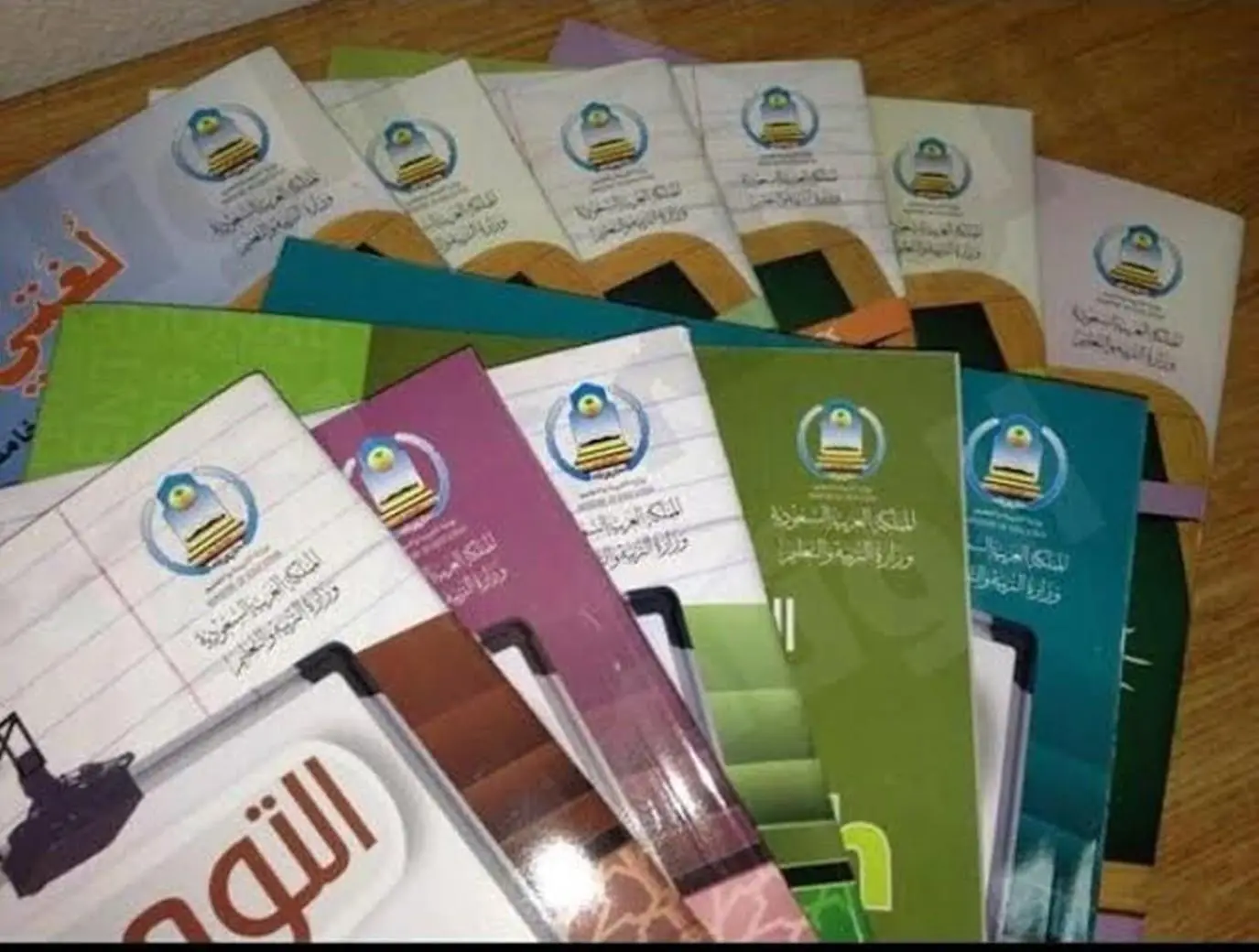
An analytical investigation into the revision of Saudi curricula between 2020 and 2026, and the role of foreign institutions in evaluating their religious, historical and political content.
Rabbi Yehuda Kaplan's welcome of the changes taking place in Saudi school curricula, as US Special Envoy to Monitor and Combat Antisemitism, was not a separate event. It stands within a long history of American and Israeli interest in the content of the textbooks that millions of students in the Kingdom study.
Since the attacks of 11 September 2001, Western interest in Saudi religious education curricula has grown, and specialised institutions have emerged to monitor school textbook content, compare successive editions, and classify their content according to their own standards of tolerance, peace and countering extremism.
Yet a review of the reports issued by these institutions shows that their scope of interest is not limited to content that incites violence or religious hatred. It extends to matters of Islamic creed, jihad and family rulings, as well as the position on Zionism, Palestine, Jerusalem and the recognition of "Israel".
These reviews raise questions that go beyond the development of educational curricula, to the reference frameworks that govern that development, and the boundary between countering incitement and hatred on the one hand, and reformulating religious, historical and political content on the other.
The Washington agreements: what was officially announced?
On 19 November 2026, Saudi Minister of Education Yousef bin Abdullah Al-Benyan witnessed the signing of nine cooperation agreements between Saudi educational bodies and American institutions, universities and companies, during his official visit to the United States.
The announced areas of cooperation include the development of education, curricula, digital content, modern technologies, testing, measurement and assessment.
On 25 November, the Saudi Press Agency published further details on the signing by Education Development Holding Company, represented by the companies "Ta'leem" and "Tatweer for Educational Technologies", of three memoranda of understanding and two letters of intent with five American companies.
Areas of cooperation are distributed as follows:
- McGraw Hill: curricula and educational content.
- Savvas Learning Company: curriculum development and educational resources.
- National Geographic: educational content and resources.
- Google: digital educational technologies and solutions.
- Cisco: modern educational technologies.
The Saudi Ministry of Education places these partnerships within the framework of improving education quality, digital transformation, and benefiting from international expertise.
However, the published official statements do not specify particular religious or political texts to be removed, nor do they indicate the participation of any Israeli institution as a party to the agreements.
Why does an anti-Semitism official welcome educational agreements?
The position of Rabbi Yehuda Kaplan derives its significance from the nature of his official post. He speaks not merely as a religious figure, but as an official in the US State Department, tasked with following up and countering antisemitism at the international level.
In his comment on the Saudi-American educational cooperation, he welcomed Saudi efforts to develop curricula and address content that concerns his office.
But another statement he made before the visit of the Saudi Minister of Education reveals more clearly the nature of American interest in this file.
In an interview published by the newspaper Israel Hayom on 11 November 2026, Kaplan said that the efforts of the US State Department had contributed to removing about 84% of the references he described as problematic in Saudi textbooks.
Kaplan did not clarify the number of texts on which he based this percentage, the time period covered by the comparison, or the detailed criteria used to determine the content concerned.
Accordingly, the percentage represents a statement made by a US official regarding the results of his office's efforts, and cannot be treated as an independent statistic on the scale of changes across all Saudi curricula.
Read Kaplan's interview with Israel Hayom
The roots of the issue: from the September attacks to successive curriculum reviews
American demands to amend Saudi curricula did not begin under President Donald Trump, nor coincide with the emergence of regional normalisation initiatives. They date back more than two decades.
Since 2001, the US Commission on International Religious Freedom (USCIRF) has called on the US government to press Saudi Arabia to amend the content of its school textbooks.
In 2004, the US State Department included Saudi Arabia on its list of countries of particular concern regarding religious freedom.
On 19 July 2006, the State Department announced the results of its discussions with the Saudi government on religious freedom and tolerance, including a Saudi commitment to review curricula and remove expressions that disparage other religious groups.
In 2008, the US Commission returned to criticise some books used at the Saudi Islamic Academy in Virginia, considering that content previously objected to still existed.
Criticism was renewed in 2018, when the Commission issued a study on the middle and secondary stage textbooks for the 2017–2018 academic year.
In 2024, the Commission included curriculum reform among the files it addressed following an official visit to Saudi Arabia in March of that year.
This chronology shows that the review of Saudi curricula was part of US-Saudi relations long before the Abraham Accords, although interest in content related to Zionism and "Israel" has taken on additional political dimensions in recent years.
Who monitors the books Saudi students study?
In this file stands the institute "IMPACT-se", an Israeli research organisation specialising in monitoring and evaluating textbook content according to standards it says are derived from UNESCO principles on peace and tolerance.
The institute's activities are not limited to Saudi Arabia, but include the curricula of a number of Arab and Islamic countries, alongside Israeli and other curricula.
On 29 July 2026, the institute, in partnership with "Monitor Impact", published a report titled "Review of Saudi Textbooks 2024–2026". The report gives an address for the partner organisation in Abu Dhabi, United Arab Emirates.
The review covered 136 textbooks for the 2024–2025 and 2025–2026 academic years, from Islamic studies, Arabic language, history, geography, social studies, life and family skills, critical thinking and literature courses.
It should be noted here that the organisation's use of standards said to be derived from UNESCO does not mean that UNESCO itself prepared the report or endorsed all its judgments and assessments.
Nor does the organisation's documentation of an amendment made to a textbook necessarily prove that it was the party that decided to make that amendment.
Nevertheless, the report provides important material for studying trends of change, especially since it presents illustrated comparisons between different editions of the books, and makes it possible to identify the topics the organisation welcomes removing and those it still criticises the existence of.
Palestine and Jerusalem: when a sentence in a language exercise becomes an objection
Among the most striking aspects of the latest report is that the amendments the Israeli institute records are not limited to history books or Islamic studies, but extend even to the examples used in teaching Arabic grammar.
Removal of the statement on adherence to Jerusalem
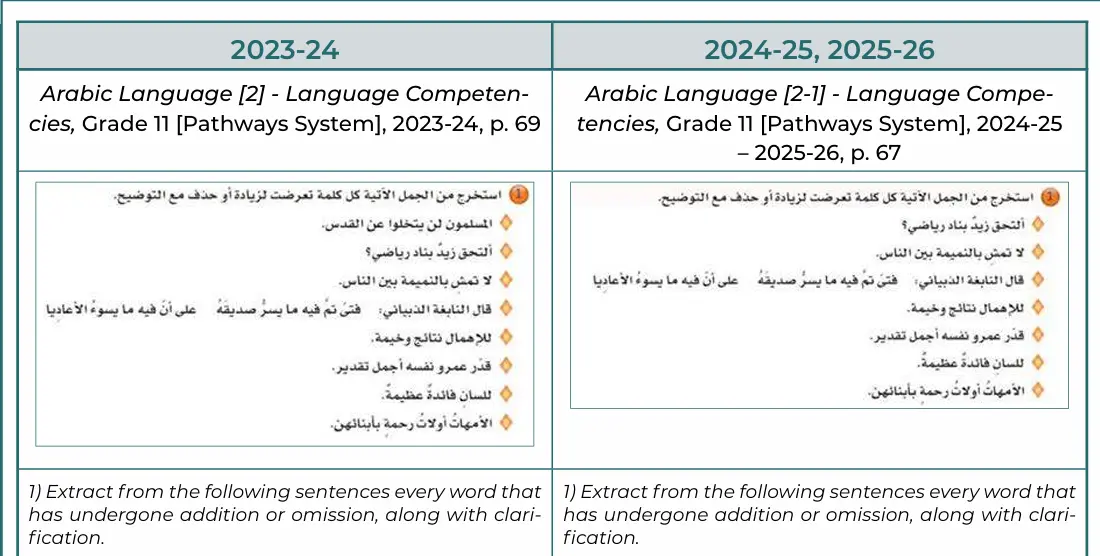
In the book "Language Competencies" for the second year of secondary school, the 2023–2024 edition included a language exercise containing the following sentence:
"The Muslims will never abandon Jerusalem."
In the two subsequent editions, the sentence was removed from the exercise, while other language examples remained.
Example No. 56, page 71 of the report: The 2023–2024 edition, p. 69, included the sentence concerning Jerusalem alongside "Zaid joined a sports club." In the 2024–2025 and 2025–2026 editions, p. 67, the second example remained and the first was removed.
The institute explains the removal of the sentence as the elimination of a political reference that portrays Jerusalem as a site of continuous conflict between Muslims and other parties, especially "Israel".
The significance of this example lies in the fact that the sentence contains no incitement against Jews, calls for no violence against civilians, but expresses the attachment of Muslims to Jerusalem.
Accordingly, welcoming its removal raises the question of the criteria the institute applies in evaluating content: does the matter concern preventing religious incitement, or changing the political and historical discourse about the city of Jerusalem?
Jerusalem holds a special religious status in Islam, and the status of East Jerusalem is an international political and legal question that has not been settled merely by Israel's declaration of sovereignty over it.
From "the Zionist enemy" to "the Israeli occupation"
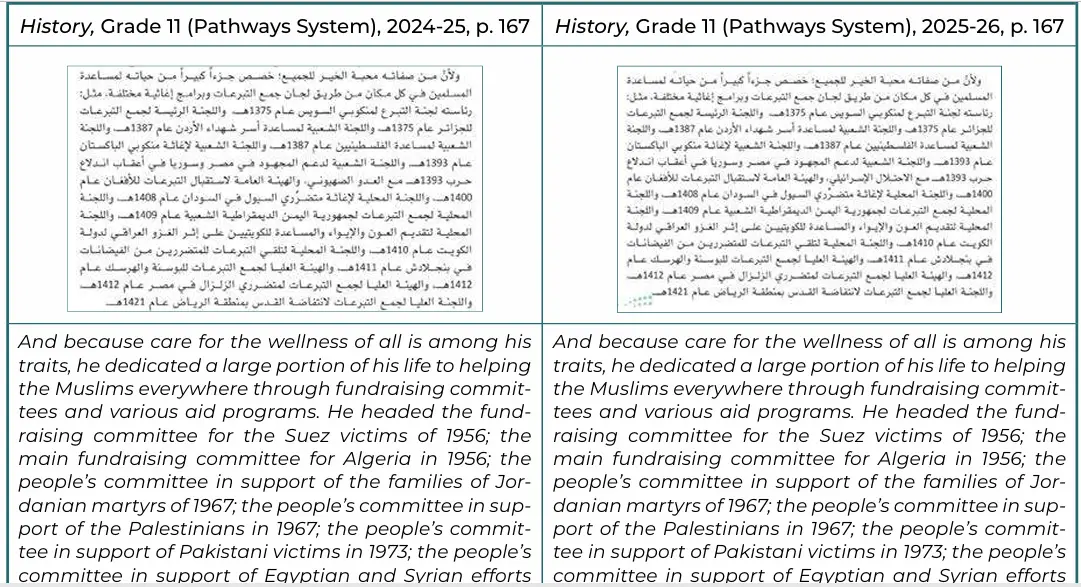
In Example No. 59, the report recorded an amendment in the history book for the second year of secondary school, on page 167, where the phrase "the Zionist enemy" in the 2024–2025 edition was replaced by "the Israeli occupation" in the 2025–2026 edition.
The passage concerns the efforts of King Salman bin Abdulaziz in supporting Egypt and Syria during the October 1973 war.
Comparison view – page 74 of the report
Despite the change in terminology, the historical references to support for the Palestinians and fundraising for the Palestinian intifada remained, as did the image of the former Palestinian President Yasser Arafat presenting King Salman with the Order of Palestine.
This detail is important, because some passages were not subjected to full removal of the history of Saudi support for the Palestinian cause; rather, the change concerns the vocabulary used to describe the Israeli side.
The name of Palestine on maps
In Examples 57 and 58, the report recorded the removal of the name Palestine from a number of maps in the social studies book for the fifth year of primary school.
The reference to Palestine was also removed, while the name of Acre Castle was kept, as part of an amendment to Acre Castle in Palestine.
However, a closer reading of the description of the change reveals that the names of other countries that do not border Saudi Arabia were also removed from the maps concerned.
The name Palestine was not replaced with the name "Israel".
Other maps in various courses still bear the name Palestine without any reference to "Israel", which the report itself lists among the topics that still provoke the institute's objection.
Accordingly, the claim that Palestine has been removed from all Saudi curricula, or that the name "Israel" has been inserted in its place, is not supported by the examples gathered here.
Nevertheless, the institute's welcome of the removal of the name Palestine from maps shows that its evaluation also addresses the question of political recognition and geographical representation, an issue that differs in nature from countering religious hatred.
Zionism: from studying a political movement to reviewing school discourse
The institute's earlier reports addressed amendments affecting lessons on Zionism, including the removal of a lesson titled "The Zionist Danger", and the removal of content describing Zionism as a European racist movement.
Here the need arises to distinguish between Judaism as a religion, and Zionism as a political movement with historical roots and nationalist aims.
Not every Jew is a Zionist, and criticism of the Zionist movement does not necessarily mean criticism of all Jews.
This distinction becomes more important in educational curricula, because the student needs to understand the emergence of the Zionist movement in Europe, the development of its political project, its relationship to the British occupation of Palestine, the displacement of Palestinians, the establishment of the State of "Israel", and the wars the region has witnessed.
Reviewing unsupported historical claims is legitimate and necessary, but the documented critical study of Zionism should not be confused with the concept of religious incitement.
Islamic creed: is the matter one of teaching method or of doctrinal content?
Creed and monotheism curricula represent one of the most prominent areas that have undergone review over recent years.
According to the latest report and the institute's earlier reports, the amendments included material concerning beliefs contrary to Islam, some hadiths on trials and the signs of the Hour, rulings on polytheism, and religious practices associated with doctrinal disputes among Muslims.
The report also recorded a reduction in references to punishments in the Hereafter in some lessons, and the removal of examples that fell within the explanation of matters of polytheism, including practices related to seeking aid from the Prophet's family.
In assessing these changes, three different matters must be distinguished:
First, doctrinal rulings that address the validity or invalidity of beliefs according to the Islamic frame of reference.
Second, descriptions that generalise negative moral traits to entire human groups.
Third, direct incitement to attack, discrimination, or violation of the rights of others.
Islamic texts make this distinction clear, as in the words of God Almighty:
"God does not forbid you from those who do not fight you over religion and do not expel you from your homes – from being righteous toward them and acting justly toward them. Indeed, God loves those who act justly." (Al-Mumtahanah: 8)
And His words:
"And do not let the hatred of a people prevent you from being just. Be just; that is nearer to righteousness." (Al-Ma'idah: 8)
Accordingly, addressing misunderstanding, incitement, or unjust generalisation does not necessarily require abolishing the teaching of doctrinal differences, but may require presenting them within their integrated legal context, while stating what Sharia prescribes regarding justice, the fulfilment of covenants, and the preservation of rights.
Jihad and martyrdom: amendments that went beyond Islamic studies books
Removal of the passage on al-Khansa and her sons
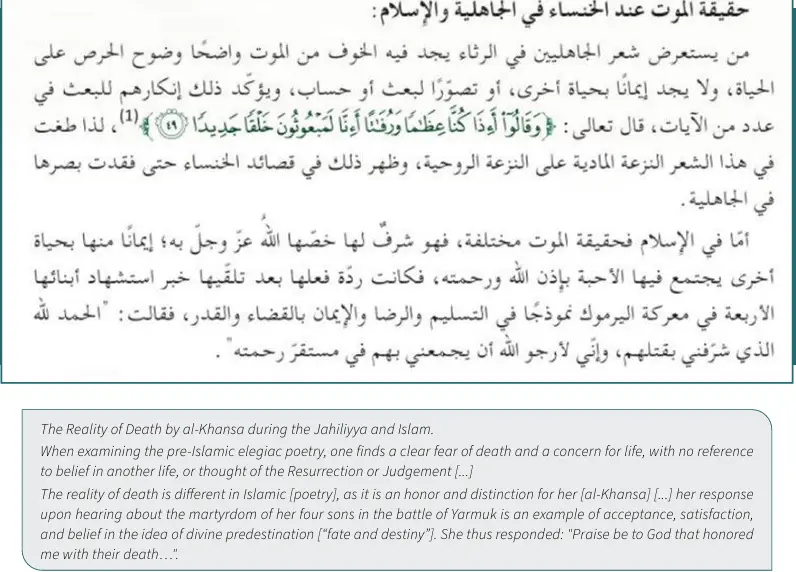
In Example No. 40, the report addressed an amendment in the book "Rhetoric and Criticism" for the third year of secondary school, on page 151.
The lesson presented a literary comparison between al-Khansa's elegy for her brother in the pre-Islamic era, and her attributed stance upon the martyrdom of her four sons at the Battle of Yarmouk after her conversion to Islam.
The passage addressing this transformation was removed from the lesson in the amendment that the report attributes to the 2025–2026 academic year.
Example No. 40 – page 55 of the report
From a literary standpoint, the example dealt with the effect of belief on a person's view of death, fate and patience, whereas the institute read it within the framing of glorifying death in battles.
This difference in reading reveals the importance of the context in which historical and literary texts are placed.
Studying the literature of elegy, martyrdom and sacrifice is not in itself a call to violence; otherwise, objection would extend to large parts of the literary heritage and military history of many peoples.
Amending rules of combat and protection of civilians
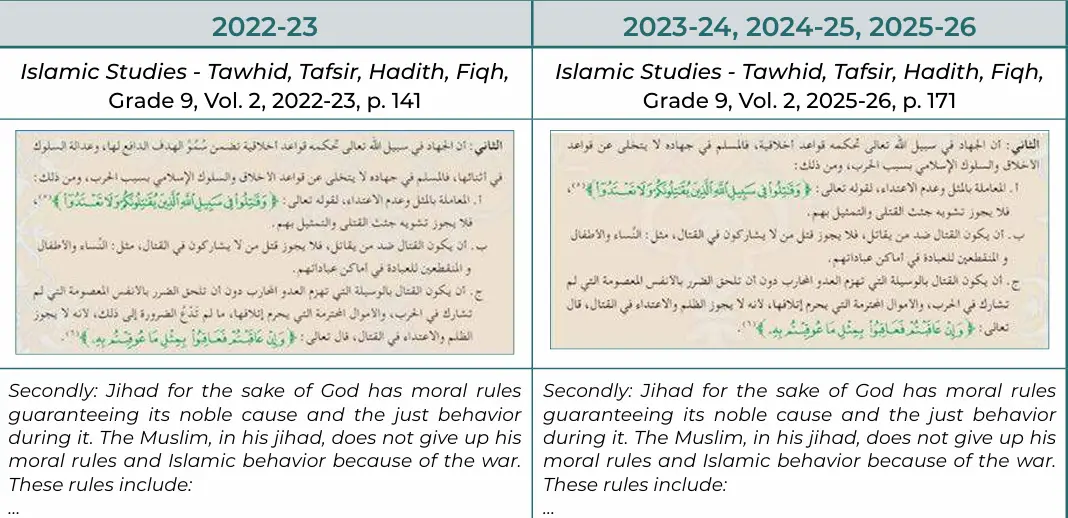
Among the amendments differing in nature from the previous example is what the report records in Example No. 41 concerning the Islamic studies book for the third year of middle school.
The clause related to protecting non-combatants and property that concerned a condition of necessity was removed, while the provisions prohibiting injustice and aggression during combat were retained.
In the 2022–2023 edition, p. 141, the lesson on the rules of jihad in the Islamic Studies textbook for the third intermediate grade included a text stating that harm must not be inflicted on protected lives that did not take part in the war, or on property whose destruction is forbidden, with an exception introduced by the phrase "unless necessity calls for it." In subsequent editions, beginning with the 2023–2024 academic year, this phrase was removed, while the underlying prohibition on harming non-combatants and their property, and the prohibition of injustice and aggression in fighting, were retained.
Example No. 41 – page 56 of the report
Islamic Creed and Loyalty and Disavowal
The changes recorded by the successive reports include:
- Deletion of a hadith about fighting the Jews at the end of time from one of the monotheism (tawhid) textbooks.
- Deletion or modification of content concerning the disbelief of Jews and Christians.
- Removal of some lessons on loyalty to non-Muslims.
- Reduction of texts concerning the otherworldly punishment of polytheists.
- Modification of some examples relating to polytheism, innovation, and practices of seeking help from the Prophet's family and from the graves of saints.
- Modification of the way doctrinal disputes with Shiites and Sufis are treated.
These changes vary in nature: some relate to preventing hostile generalisation against followers of other religions, while others affect the way certain Islamic doctrinal and jurisprudential questions are taught.
Reinstatement of Previously Removed Content
An important detail that should not be overlooked is that the course of the changes was not always in the direction of deletion.
In Example No. 43, the report recorded the reinstatement of a passage concerning jihad and obedience to the ruler in the first secondary grade textbook, after it had been removed from an earlier edition.
This refutes the notion that every religious or military content that was previously deleted has been permanently removed from Saudi education.
It also shows that jihad remains present in some textbooks, although the way it is treated and the controls and contexts associated with it have changed.
Women and the Family: Why a Peace-Focused Institution Reviews Marriage Teachings
The institute's report is not limited to matters of the Arab–Israeli conflict or relations between followers of different religions; it extends to the regulation of marital relations, family roles, and the rulings relating to sexual conduct.
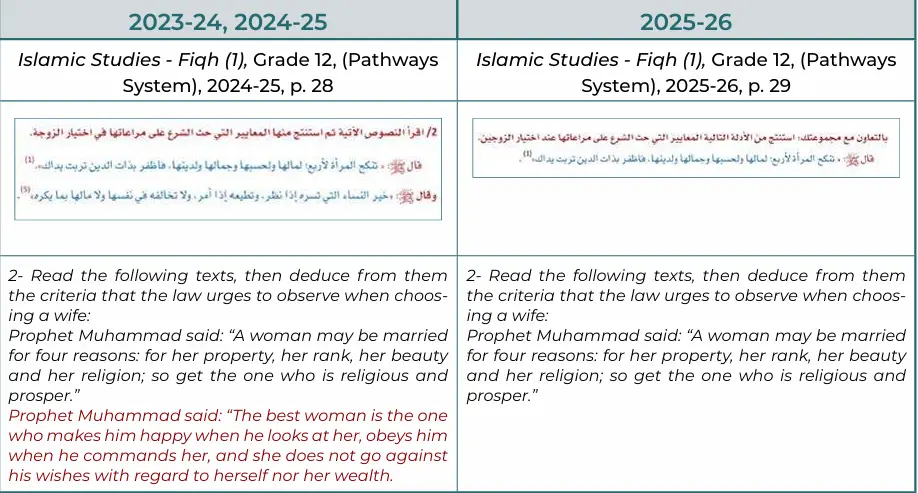
Among the prominent examples it contains is the modification of the lesson "Criteria for Choosing a Wife" in the third secondary grade jurisprudence textbook.
In Example No. 48, page 63 of the report, the activity in the 2024–2025 edition, p. 28, included two hadiths: one on choosing a religiously committed wife, and another on the qualities of a righteous wife, including obedience to her husband. In the 2025–2026 edition, p. 29, the hadith concerning choosing a religiously committed wife remained, and the second hadith was removed from the activity.
Preview of the textbook pages before and after the modification
The institution welcomes this modification as it reinforces a less hierarchical view of the marital relationship.
The report also recorded changes to activities concerning the distribution of household responsibilities between males and females, and the roles of men and women within the family. A question asking students to state the reasons Saudi Arabia rejects the permissibility of homosexuality was also deleted.
This area raises a question about how broad the criteria are that the institution applies in its reviews of curricula.
The relationship between spouses in Islamic jurisprudence rests on an integrated system of rights and duties, including qawama (guardianship), obedience in what is right, maintenance, good companionship, justice, and mercy.
From an educational standpoint, the arbitrary reading of these rulings can be addressed by highlighting their integration and clarifying their legal limits, rather than reducing the marital relationship to a single isolated text, whether by presenting it apart from the other rights or by removing it from the teaching context.
What Still Provokes Objection from Israeli Institutions?
Perhaps the most revealing indicator of the directions of interest in these curricula is the reading of the passages that the report classifies as remaining content, not merely the study of deleted material.
Through these passages one can identify the standards that, in the view of the report's authors, some Saudi textbooks still fail to meet.
- Maps: Palestine appearing without the name "Israel" in some textbooks.
- The Palestinian question: continued description of "Israel" as an occupying power.
- Political history: some content critical of the Zionist movement.
- Creed: continued presence of some rulings relating to polytheism and otherworldly reward and punishment.
- Atheism: its association with moral and social dangers.
- Jihad: its teaching as an organised religious duty under the authority of the ruler.
- The family: continued presence of some traditional conceptions of marital roles.
- World history: the absence of treatment of the Nazi Holocaust in specific lessons on the Second World War.
It must be emphasised that these topics are not an official list of what will be deleted from curricula in the future; rather, they reflect aspects that the report criticises or considers inconsistent with its standards.
It is notable in this context that the institution, in its reviews, brings together very different issues: documenting the Nazi genocide of the Jews is a historical matter; objection to occupation is a political and legal matter; teaching the rulings on polytheism is a doctrinal matter; and regulating marital relations is a jurisprudential and social matter.
These topics cannot all be assessed by the same standard without considering the nature, evidence, and context of each.
The Other Side of the Changes: What Has Been Added to the Curricula?
Fairness in reading the report requires that the study not be limited to what was removed, but also include the content that was added or strengthened.
The report recorded lessons addressing the Prophet's ﷺ treatment of non-Muslims, the fulfilment of agreements, kindness toward migrant workers, confronting racial discrimination, and developing critical thinking.
These meanings are, in their origin, not foreign to the Islamic frame of reference.
Kindness, justice, keeping covenants, gentleness toward the weak, and the prohibition of injustice are principles established by the legal texts, and a Muslim does not need to abandon his beliefs in order to abide by them.
Likewise, developing teaching methods, strengthening thinking and analysis, and equipping students with scientific and technical skills are goals that can be achieved without necessarily conflicting with the preservation of Islamic identity.
Presenting all the modifications as a diminishment of religion is therefore no less reductive than presenting every conservative doctrinal or political content as extremism.
An objective reading calls for examining each modification individually, comparing the original texts, and understanding the educational aims and the soundness of the content from both scientific and pedagogical standpoints.
Why Are Saudi Curricula Included in Counter-Extremism Files?
The roots of this classification go back to Western debates that intensified after the attacks of September 2001, concerning the role of religious discourse and educational institutions in shaping the ideas of perpetrators of violence.
Many American reviews started from the assumption of a link between some content of religious education and the spread of hatred or extremism.
However, establishing the existence of a text in a school book is not on its own sufficient to prove a causal link between that text and the commission of acts of violence.
Violent extremism is a complex phenomenon in which political, social, psychological, economic, and intellectual conditions interlock, and it cannot be explained through curricular content alone.
The term extremism itself also requires a clear definition, especially when it is used to evaluate religious beliefs or political positions.
At the educational level, one can distinguish between:
- Direct incitement to violence and the attacking of civilians without right.
- Unlawful discrimination against people on account of their religious or national affiliation.
- Self-defence and redressing injustice suffered by oneself.
- Political opposition to the practices of a state or an ideological movement.
- Adherence to religious rulings or conservative social conceptions.
These levels do not represent a single phenomenon, and it is not valid to assume that the presence of one proves the presence of the others.
This distinction is necessary when reading reports that use the concepts of moderation, tolerance, and extremism, because these concepts may carry different meanings depending on the political, philosophical, cultural, and ideological frames of reference, and even the pragmatic aims of the bodies that use them.
What Is Israel's Connection to the Saudi Changes?
On the basis of the available documents and statements, three levels of connection can be identified.
The first level: monitoring and assessment. This is established through the reports issued by the IMPACT-se institute, which compare editions of Saudi curricula.
The second level: political and diplomatic influence. This is what is indicated by the statements of the US Special Envoy to Monitor and Combat Antisemitism regarding the efforts of the US State Department in addressing the content of school textbooks.
The third level: direct participation in drafting curricula. This has not been established to date from the published documents concerning the recent educational agreements.
The existence of an Israeli institution that follows the curricula and welcomes their changes does not automatically mean that it holds official authority over their drafting, and an announcement by a US official that his office contributed to changing certain content does not necessarily specify the mechanism through which the influence was exercised.
However, the interest of these bodies in the position on Jerusalem and Palestine and the recognition of "Israel," alongside issues relating to religious incitement, shows that the educational curricula receive political attention that goes beyond purely educational considerations.
The Official Saudi Vision: Modernising Education and Building Human Capacities
The educational transformations in the Kingdom cannot be understood apart from the domestic reform programme adopted by the Saudi authorities within Vision 2030.
The announced educational projects include developing skills, enhancing competitiveness, improving the quality of outcomes, making use of digital technologies and artificial intelligence, and building partnerships with universities and global educational institutions.
These goals represent an important part of the official explanation for cooperation with American companies.
It would be wrong to assume that all Saudi educational agreements with foreign parties relate to religious content or the Palestinian question.
Nevertheless, the existence of announced developmental and technological goals does not prevent raising independent questions about the doctrinal and historical modifications, the bodies that propose them, and the criteria Saudi institutions adopt when approving them.
Technical modernisation of curricula is one matter; reviewing their intellectual and religious content is another, even if the two coincide within a broad educational reform programme.
Six Years of Modifications: A Chronology
- 2020: Publication of broad reviews of Saudi curricula, recording modifications in the creed, jihad, and relations with non-Muslims textbooks.
- 2021–2022: Additional reviews addressing the continued deletion and modification of content the institute had previously objected to.
- 2023–2024: The comparisons expanded to include more historical, political, and social material.
- 2024–2025: Deletion of the linguistic example relating to Jerusalem and changes to some maps, according to the most recent report.
- 2025–2026: Modifications in jurisprudence, literature, and history, including the lesson on choosing a wife, the passage on al-Khansa, and some terms associated with Zionism.
- 29 July 2026: Publication of the joint report by the IMPACT-se and Monitor Impact institutes on 136 Saudi textbooks.
- 11 November 2026: Kaplun announces that 84% of the problematic content, which he says US State Department efforts helped remove.
- 19 November 2026: The Saudi announcement of the signing of nine educational cooperation agreements with US parties.
What Will Be Deleted in the Future?
As of 26 November 2026, the public documents that could be consulted do not contain a detailed list of the texts that the Saudi Ministry of Education intends to delete or modify in forthcoming editions in implementation of the Washington agreements.
Nevertheless, the remaining topics criticised in reports by foreign institutions provide indicators of the files these institutions may continue to press for review.
The most important matters to monitor in the coming period include:
- The way Palestine and Jerusalem are presented in maps and history books.
- The continued teaching of the history of Zionism and the origins of the occupation.
- The content of the monotheism and Islamic creed textbooks.
- The way jihad, its rulings, and its controls are taught.
- Jurisprudential content relating to the family and marriage.
- The appearance of any new content concerning relations with "Israel."
However, it cannot be determined that the Saudi Ministry of Education will adopt these demands, or that the American institutions participating in the agreements will undertake to review the Islamic Studies textbooks specifically.
Resolving these matters requires consulting the texts of the memoranda of understanding and contracts, defining the scope of responsibility of the participating companies, and comparing the forthcoming school editions with the current ones.
Curricula as a Matter of Cultural Sovereignty
The importance of school curricula is not limited to their function of transmitting information and preparing students for the labour market; they also play a role in shaping historical memory, religious and national identity, and the general understanding of the world.
For this reason, states give great attention to the way their curricula present their history, conflicts, values, and beliefs.
In the Saudi case, additional questions arise given the Kingdom's religious standing as host of the two Holy Mosques and the influence of Saudi educational and religious institutions beyond its borders.
It is acceptable to benefit from international experience in developing education, reviewing historical and scientific errors, and improving teaching methods; but the benefit from external expertise should remain accompanied by limits that prevent interference in determining the frames of reference, standards, and aims, especially when reviews touch on matters of creed, historical memory, or political conflicts that are still ongoing.
If a phrase relating to attachment to Jerusalem is classed among the content that is welcomed for deletion, the researcher is entitled to ask what standard underlies that assessment.
If a hadith on marital relations is under review by an institution concerned with peace and tolerance, this calls for understanding the link between the institution's remit and the social standard it applies.
Education is not merely a means of transmitting knowledge and acquiring skills; it is one of the most important pillars for building identity and shaping the consciousness of peoples, drawing on their religion, beliefs, values, and historical and civilisational heritage. Accordingly, undermining these pillars does not simply mean a change in educational content; its effect extends to reshaping the consciousness of generations, weakening their connection to their roots, and stripping them of the foundations that enable them to understand themselves and determine their place in the world.
This may lead to the erosion of identity and the production of generations intellectually and culturally dependent, which draw their standards for viewing their religion, history, and causes from outside their own civilisational frame of reference. This serves neither the natural interplay among nations, nor does it promote civilisational diversity or equality in relations among them; rather, it entrenches the imbalance of power and intellectual dependency.
From this standpoint, imposing external intellectual and political frames of reference on the educational curricula of peoples constitutes a grave violation of the sovereignty and civilisational distinctiveness of states; the independence of educational decision-making is no less important than the independence of political and economic decision-making, and is indeed among its most important long-term guarantees.
Conclusion
The successive reports on Saudi curricula show that the modifications to school textbooks in recent years extend beyond a single domain: they include content relating to the relationship with followers of other religions, the ethical controls of war, creed, jurisprudence, and the family, as well as Palestine, Jerusalem, and Zionism.
American statements also confirm an official interest in following this course, while Israeli reports document the nature of the content whose removal the publishing institutions welcome, and that which they still criticise.
But the available evidence does not establish that the recent educational agreements gave Israeli entities direct authority to reformulate Saudi curricula, nor does it reveal a specific list of the content that will change in the future.
Hence the importance of continued independent monitoring of school textbooks, not through the headlines of foreign reports alone, but by returning to the original Arabic texts, comparing their editions, and reviewing the official justifications for each change.
The matter concerns not only what the student learns today, but also what the coming generation will carry of knowledge about its religion, its history and its causes, and its ability to distinguish between doctrinal difference and hatred, between political criticism and incitement, and between openness to knowledge and abandonment of cultural distinctiveness.
The challenge facing educational institutions is to achieve scientific and pedagogical development and to promote justice and fairness, while preserving scientific accuracy, doctrinal clarity and historical memory, without subjecting these fields to political criteria that are not announced and openly debated.
References and Original Documents
- Saudi Press Agency, 25 November 2026 – details of the agreements with American companies.
- Israel Hayom, 11 November 2026 – interview with Yehuda Kaplan.
- IMPACT-se and Monitor Impact, July 2026 – review of Saudi curricula 2024–2026.
- IMPACT-se – review of Saudi curricula 2023–2024.
- IMPACT-se – review of Saudi curricula 2022–2023.
- IMPACT-se – review of selected Saudi curricula 2020–2021.
- US Department of State, July 2006 – document on US-Saudi discussions on religious freedom and tolerance.
Note: The comparisons between editions are based on the images and texts reported in the aforementioned reports, and not all school editions were compared with independent copies issued by the Saudi Ministry of Education. As for the recent Saudi-American educational agreements, the investigation into them relied on the published official statements, which addressed areas of cooperation and its general objectives, without access to the full texts of the agreements, memoranda of understanding and their detailed provisions.


