


The military escalation between the Houthis and Saudi Arabia has entered a more dangerous phase, with deadly airstrikes inside Yemen coinciding with repeated attacks on energy facilities in southern Saudi Arabia, alongside fierce ground fighting on several Yemeni fronts. The developments bring the war back to the forefront of the regional scene and link it directly to Red Sea security and oil export routes.
The Houthi group said that an airstrike targeted the Central Reform Prison in the city of al-Hazm in Al-Jawf Governorate in northern Yemen on Monday, killing at least seven people, including a child, and wounding seven others.
According to the Houthis' Ministry of Health, the dead included prisoners and a child who was visiting the facility, while among the wounded was a female visitor. Footage broadcast by the group's Al-Masirah channel showed damage to the prison building and the bodies of some of the victims.
The Houthis accused Saudi Arabia of carrying out the strike, but Riyadh did not announce responsibility for it.
The Al-Jawf strike came amid reports of other airstrikes in the governorates of Al-Bayda, Marib and Taiz, where large-scale battles between the Houthis and forces loyal to the Yemeni government, which is backed by Saudi Arabia, have been taking place in recent days.
Field developments indicate that the war is moving toward a new stage of escalation, after the Houthis launched a broad offensive in southwestern Yemen, with attempts to advance toward the areas leading to the western coast and the Bab al-Mandab Strait.
Press reports said the recent clashes have killed hundreds on both sides within a few days, in addition to civilian casualties, making these confrontations among the bloodiest in Yemen in years.
The advance toward Bab al-Mandab carries importance beyond the local battles, as the strait is the southern gateway to the Red Sea and one of the most important maritime trade and energy routes in the world. It is also a vital route for Saudi Arabia amid growing risks facing navigation through the Strait of Hormuz.
At the same time, the escalation has spread into Saudi territory. The Saudi Ministry of Foreign Affairs announced that the Houthi attacks resulted in the injury of 73 civilians, including women and children, in strikes that hit civilian areas, confirming that these attacks caused damage to residents and civilian facilities.

Facilities belonging to Aramco in Jazan, on the country's southwestern Red Sea coast, were hit in a new strike on Monday, according to media reports that spoke of the targeting of the Jazan refinery, whose refining capacity is about 400,000 barrels per day.
The refinery is one of Saudi Arabia's most important energy facilities on the Red Sea coast, and it has been subjected to repeated attacks in recent months since the confrontation between the Houthis and Saudi Arabia resumed.
The Houthis had targeted Aramco facilities in both Jazan and Yanbu during July, before Jazan was hit by another attack in August that caused a fire at one of the company's facilities.
These attacks carry particular significance amid Saudi Arabia's efforts to increase its reliance on the Red Sea coast as an alternative route for energy exports, while navigation in the Gulf and the Strait of Hormuz is disrupted.
The kingdom transports a large part of its crude from its fields in the east to the city of Yanbu on the Red Sea via the East-West pipeline, which allows bypassing the Strait of Hormuz and delivering oil directly to western ports.
However, the repeated attacks on Jazan and Yanbu, coinciding with threats facing ships and oil facilities in the Red Sea, mean that the alternative route on which Riyadh relies has itself become exposed to growing military pressure.
Here the importance of the battles taking place inside Yemen near the western coast becomes clear.
If the Houthis manage to strengthen their positions toward Bab al-Mandab while maintaining their ability to target Saudi energy facilities, Riyadh could face a dual threat: disruption of its eastern exports through Hormuz due to the regional war, and growing risks to the Red Sea route to the west.
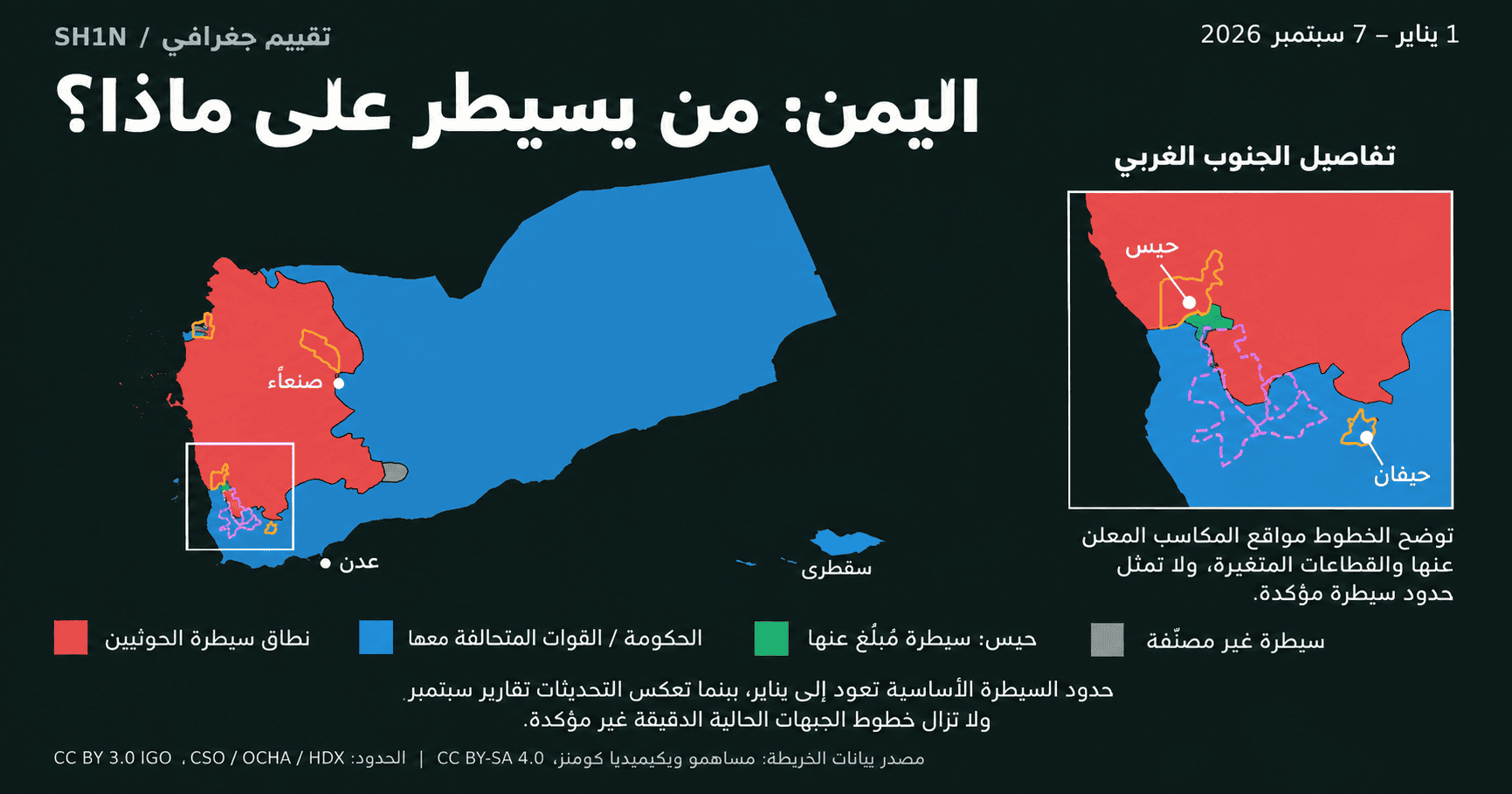
In the same context, the Houthis' military spokesman Yahya Saree announced the downing of several drones that he said Saudi Arabia was operating over Al-Jawf Governorate, and vowed a response to the strike on the prison.
The group also announced operations against arms shipments it said were headed to forces backed by Saudi Arabia inside Yemen.
These developments come after years in which direct confrontation between the Houthis and Saudi Arabia had subsided since the truce of 2022, which halted most air operations and cross-border attacks.
However, the escalation that began in the summer of 2026 effectively ended the phase of relative calm and returned airstrikes, missile and drone attacks, and ground battles to the forefront.
Airstrikes that targeted Sanaa International Airport in July had been one of the most prominent milestones in the return of war, before operations later expanded to Al-Hodeidah, Taiz, Marib, Al-Bayda and Al-Jawf, in parallel with the Houthis escalating their attacks on Saudi territory.
The repercussions of the escalation are not limited to Yemen and Saudi Arabia. The confrontation coincides with a wider war in the region and growing disruption in international maritime corridors, making energy security a central element of the conflict.
With Jazan and Yanbu located on Saudi Arabia's western coast, and Yemeni combat fronts close to Bab al-Mandab, oil facilities, ports and maritime straits have become a direct part of the military calculations of both sides.
The current round thus appears different from many previous rounds of the war: control of Yemeni cities and fronts alone is no longer the focus of the conflict, as pressure on oil export routes, energy facilities and maritime corridors has become an essential element of the confrontation.
With fighting continuing inside Yemen and attacks on Saudi territory recurring, the risk grows that the escalation will turn into a wider war, with the Red Sea, Bab al-Mandab and Saudi energy facilities among its main arenas.


