


Detainees in a Kurdish-controlled camp housing families suspected of affiliation with the Islamic State (ISIS) say they are subjected to night raids and mistreatment.
By Reem Awir
Women detained in Syria's Roj camp have reported escalating violence, intimidation and degrading treatment since the beginning of 2026 CE (1447 AH), according to a recent report that raises fresh concerns about the fate of women and children still held at the country's last major detention centre for foreigners accused of links to the Islamic State (ISIS).
The report, published last month by the Swedish human rights organisation Rehabilitation and Repatriation of Children (RTC), draws on the testimonies of more than 40 women of multiple nationalities held inside the camp between January and May 2026 CE (1447 AH).
The women described armed night raids, severe beatings, gunfire inside the camp, and the separation of children from their mothers. The report said abuses against detainees at Roj camp had increased "markedly in frequency and severity" following the events of January 2026 CE (1447 AH).
UN experts had previously warned that conditions at the Al-Hol and Roj camps may amount to cruel, inhuman or degrading treatment, while Amnesty International has documented allegations of gender-based violence and ill-treatment against detained women.
Even before the recent developments, RTC said women and children held at Roj camp had long been subjected to what it described as "serious and systematic human rights violations".
Roj camp is located near the Iraqi border in Hasakah Governorate in north-eastern Syria and is controlled and administered by the Kurdish-led Autonomous Administration of North and East Syria and the Syrian Democratic Forces (SDF).
The camp, which houses women and children linked to former suspected ISIS fighters, became the country's last major detention camp for foreign families after the collapse of the larger Al-Hol camp in January.
Beatrice Ericson, co-founder of RTC in Sweden, told Middle East Eye: "Over the past few weeks, we have again seen an increase in reports of escalating violence, intimidation and night raids in Roj camp, with reports of hostile night raids in which women are beaten, people are transferred from the camp to other detention facilities, and children are subjected to violence."
Night raids and constant fear
For many women in Roj camp, the fear is not limited to what has already happened but extends to what might happen next.
According to the report, women have consistently said since January that night raids carried out by guards have created "a permanent state of anticipation and anxiety."
Many described living under constant threat, and said they fear leaving their tents during security operations after being warned that they could be killed if they did.
"Today, the soldiers told us that if they shout on the loudspeaker, don't come out, so that we don't leave the tents, otherwise the sniper on the tower will shoot us."
The testimonies also reveal that recent developments have compounded the psychological impact on detainees, particularly because of direct threats to kill their families.
Women reported other forms of mistreatment, including cold water being poured on detainees "to increase their freezing in the harsh winter cold", and verbal abuse by camp staff.
One woman linked the deterioration to the wider instability that followed the SDF's territorial losses earlier this year, when the new government in Damascus led by President Ahmed al-Sharaa regained control of areas of the country that had been administered by Kurdish authorities for most of the Syrian civil war.
She said: "It seems they are venting all their frustration on us, and we can't do anything to protect ourselves."
Middle East Eye has contacted the Syrian government and Kurdish officials for comment.
Women also reported that security raids often went beyond arrests and physical assaults, with their testimonies describing the regular confiscation or theft of personal belongings, including money and phones, during searches.
Many women recounted how their tents and homes were looted, their belongings damaged, and intimidation was widespread, leaving detainees in a state of fear and anxiety.
One woman said: "The night before, the car stopped in front of my tent. They entered my neighbour's tent, took her to the house and beat her."
She added: "We remained completely silent, waiting for the car to leave. It was a terrifying night. When that woman came back, I heard her crying very loudly. The next morning I saw her tent, and I was shocked by what I saw. They destroyed everything in it, and took her money and her phone."
She said: "Last night, they stole the tents again, and took everything, the carpets, blankets, cupboards, and even the food." "Some were beaten again and were asked for their phones."
These incidents have contributed to a growing sense of insecurity throughout the camp, with many fearing they could be the next victim.
One woman said: "You don't know whether you will be their next victim. Honestly, I have never felt this afraid before."
Another woman described what she said was a raid on a neighbour who runs a small shop inside the camp.
She said: "They entered my neighbour's small shop" and "put her children against the wall, pointed a gun at her head, and asked her to give them her phone. But she remained calm."
Alongside security concerns, women reported deteriorating living conditions and difficulty accessing basic services. Testimonies describe worsening electricity cuts, inadequate healthcare, and growing concern about the camp's ability to meet the basic needs of residents.
One woman said: "Everyone is sitting in tents. There is no electricity. The generator was stolen. The entire camp collected donations to buy this generator… but it was stolen."
Women said the deteriorating conditions were increasingly affecting their physical and mental health.
"They are destroying our mental health. Most of the women here need psychological care. This humiliation, belittling us and mocking us has affected us psychologically."
One woman said that a French woman detained in the camp died in April after being denied medical treatment.
She recounted: "She complained of severe headaches and intense pain. They asked her to return to her tent. In the afternoon, she had a heart attack and died."
For many women, the psychological impact of recent months has been no less severe than the physical hardships, with detainees describing their daily lives as marked by fear, insecurity and unpredictability.
One woman said: "It is a horror film. A real horror film. We are living it."
She added: "I am tired of living in constant fear and anxiety." Another said: "Every night is painful."
The fear of becoming the next victim has become part of their daily lives.
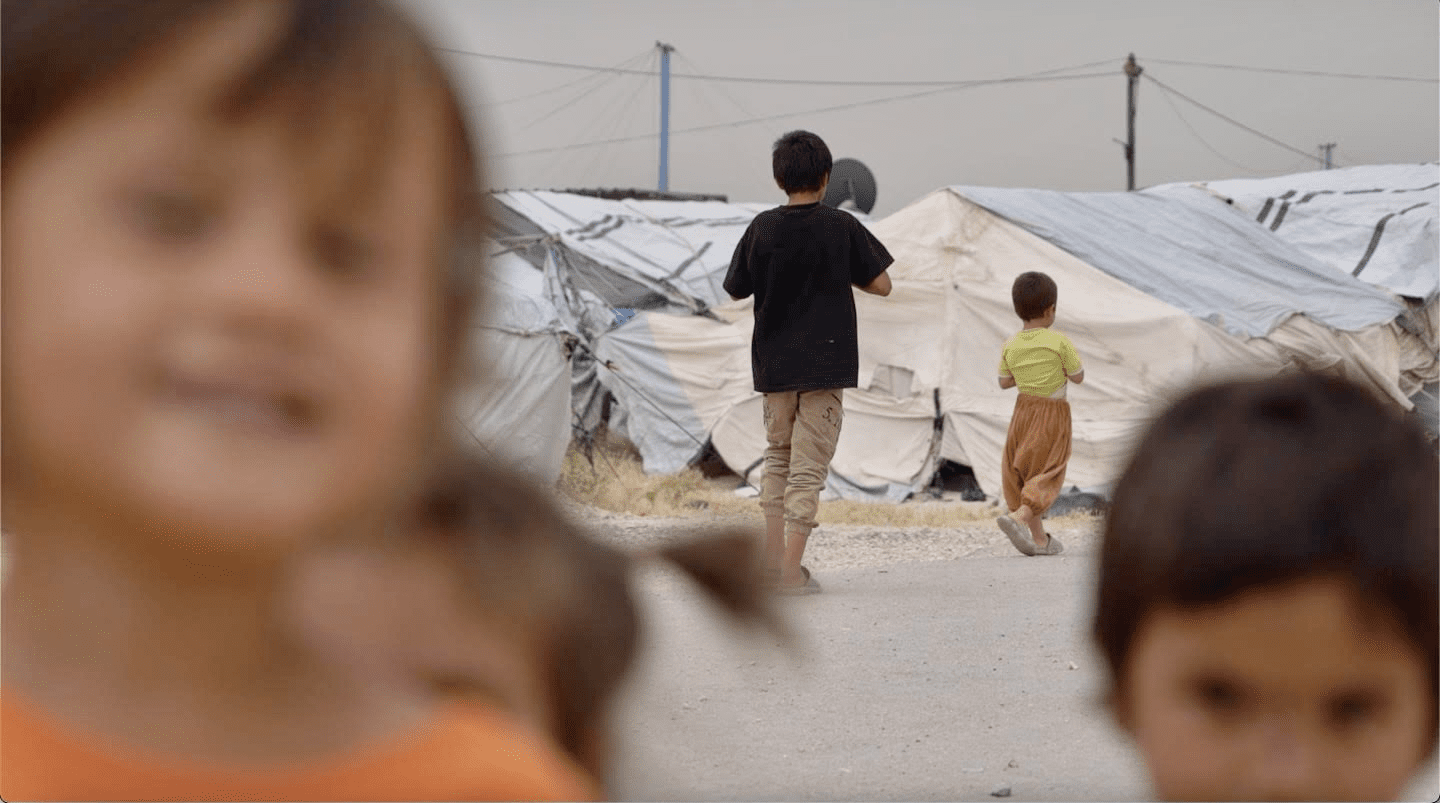
Children make up nearly two-thirds of the detainees at Roj camp (Rehabilitation and Repatriation of Children).
Children growing up behind the walls
The fighting and instability during the January escalation had a profound impact on children, many of whom were already suffering from years of violence, instability and confinement.
One mother described how families prepared for the possibility of death or separation. Fearing that her children could be taken or lost during an attack, she wrote contact details of relatives in their country of origin on their arms so they could be identified if the family was separated.
For many children, violence was not confined to their immediate surroundings. One witness described how a 12-year-old boy was returned to his family with visible bruises from beatings and threats. They would be shot.
Another case was reported in which members of the forces entered a family's tent during a night raid, and a mother and her three daughters, aged between 9 and 16, were reportedly assaulted.
She said: "The two older daughters were severely beaten. The mother herself was also severely beaten with iron rods. They took all the children with them."
Several women described how they were separated from their family members without any explanation. Mothers were reportedly taken to detention centres and returned after days or weeks, while others described similar experiences involving their children.
Some said that family members returned with signs of physical abuse.
"The army took him. He is about 12 years old. He was detained for two or three days. The child is under psychological stress." "There are signs of severe beatings on his body… They told him they would shoot him," one woman recalled.
Others said that children taken from their mothers were in some cases only returned after financial demands were made.
Families who hoped to obtain information about abducted children said their inquiries were met with threats. One such case was described as follows: "We gathered and went to their headquarters… but they attacked us. They said: if you do not leave, we will keep the boys for another ten days."
Ericson said: "Children are experiencing things that no child should have to go through."
"We are not talking about a temporary emergency. We are talking about children who have spent years growing up behind fences. And it seems that the world has gradually become accustomed to this and accepted this situation."
"It is extremely dark for many of these children because they are so young."
Absence of political will
For years, Western governments have argued that the presence of their nationals in the country is unacceptable.
Resolving the issue of citizens in camps such as Roj has been difficult given that these facilities are administered by non-state actors in north-eastern Syria.
But this justification no longer holds, according to the report.
Developments following the fall of the Assad government and the January agreement between Damascus and the SDF have changed this reality, opening new opportunities for citizens to be repatriated.
Ericson told Middle East Eye: "The reason some states are reluctant to take responsibility is a lack of political will, even though these individuals have the right, under international law, to return to their countries."
She added: "We now see that the conditions for the return of third-country nationals have developed more positively than ever."
Ericson said the growing role of the internationally recognised Syrian government in north-eastern Syria would make it easier for states to engage diplomatically on the issue.
She added: "We now place our hopes on the Syrian government to actively participate in resolving this issue."
The matter is no longer one of a non-state actor holding these families, but of the Syrian government, an internationally recognised entity with diplomatic relations with most countries in the world. The solution is on the table; only implementation is lacking.
Ericson also pointed to what she described as an inconsistency in the approach of European governments towards Syria.
She said many expect Damascus to accept Syrian citizens whom they wish to deport from Europe, while refusing to repatriate their own nationals held in camps in north-eastern Syria.
She added: "There is a great deal of hypocrisy."
Ericson argued that the case for repatriation is now stronger than at any point since the camps were established.
"Governments must take responsibility for their citizens. If anyone is suspected of committing a crime, they must be investigated. And if they can be prosecuted, they must be prosecuted. But children should not spend their entire childhood [detained] simply because governments are reluctant to deal with a politically sensitive issue."
The Counter Terrorism Center's report describes the continued non-repatriation of these individuals as one that "perpetuates harm and intergenerational trauma", exposing them "to ongoing violence, deprivation, lack of education and healthcare, and growing risks of exploitation, trafficking and recruitment by non-state actors."
The report notes that "from a counter-terrorism perspective, keeping individuals unlawfully detained in catastrophic conditions does not reduce risk; it in fact generates it."
Ericson warned that this neglect carries serious risks. With aid insufficient and some families unable to afford basic medical care, citing the case of a boy whose treatment cost his family a bill of $1,000 that they could not pay, mothers who have no one abroad to send them money become vulnerable.
She said: "When states fail to take their responsibilities, the risk increases that these women will turn to other actors for help", including ISIS and other armed groups that still show interest in the population. "We need to break this cycle of violence."
According to United Nations figures, children make up 63% of the camp's population, women 35%, and men only 2%.
Despite this composition and the size of the population, only two repatriation operations have been carried out since January, both to Australia, one in April and the other in May.
Middle East Eye.


