

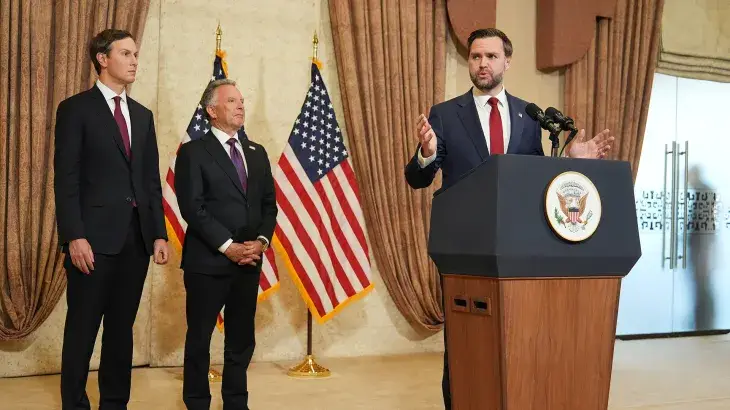
An intensive round of talks between the United States and Iran concluded in Islamabad without reaching an agreement, threatening the future of regional and international stability. The Iranian agency Tasnim indicated that excessive American demands were the main reason for the impasse, while the American side considered Iran's refusal to give up its nuclear programme to be the core point of disagreement.
The American and Iranian delegations left Islamabad.
These talks take place against a tense regional backdrop. In February 2026, a war broke out between the United States, Israel and Iran, which lasted forty days before a fragile truce was announced.
The aim of the Islamabad round was to turn this truce into a lasting agreement, but the failure to achieve this brings the spectre of escalation back to the forefront.
Main Causes of the Impasse
The causes of the failure of the talks centre on a fundamental divergence in the priorities and demands of the two sides. The United States, represented by Vice President JD Vance and Defense Secretary Hegseth, insisted on widening the scope of the negotiations to include not only Iran's nuclear programme, but also its ballistic missile programme and its regional policies. American officials described Iran's refusal to give up its nuclear programme as a major obstacle.
In contrast, Tehran held to its position of discussing only the nuclear file, rejecting its linkage to other issues. Iran also demanded that the war be ended first, in reference to the recent armed conflict. The talks showed that Vance was unable to extract the concessions Washington sought, which led to the stalling of the diplomatic track.
Reports indicated that US President Donald Trump attended the "UFC 327" event in Miami, accompanied by several members of his family, amid a notable reception from the audience. This coincided with JD Vance's announcement that the talks between the United States and Iran had failed despite lengthy negotiations.
Has Iran abandoned Gaza? Ceasefire conditions reveal it
Possible Repercussions and Future Scenarios
With the failure of this round of talks, several possible scenarios emerge that could affect the region and the world. President Donald Trump has threatened to impose a "complete naval blockade" on Iran, which points to a possible economic escalation. There is also a possibility of a return to military operations, perhaps in coordination with Israel, in light of the stalling of diplomatic solutions.
For its part, Pakistan, through its Foreign Minister Ishaq Dar, announced that it would continue its mediation efforts between the two sides, stressing the importance of finding a peaceful solution to the crisis. However, the current situation reflects severe tension, as some analysts view that Iran has played a weak hand skilfully, while the United States misjudged the situation, which could lead to strategic failure.
The failure of the Iranian-American talks in Islamabad represents a dangerous turning point in relations between the two countries and threatens to escalate tensions in the Middle East. While mediation efforts continue, the absence of agreement on core issues leaves the door open to unstable scenarios, ranging from economic blockade to military escalation, which calls for cautious attention to coming developments.


