

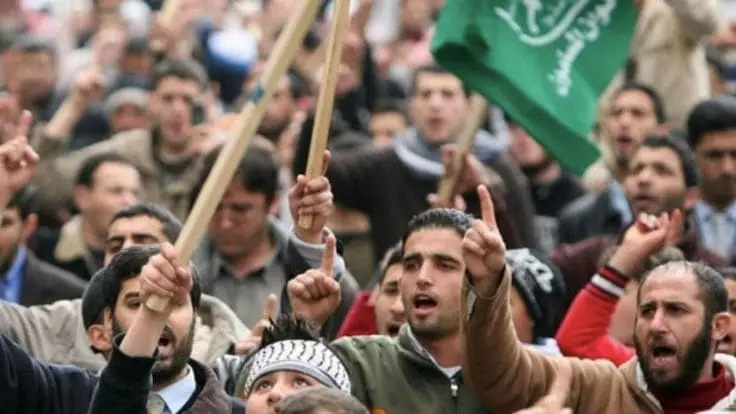
Facing Trump: Will the Muslim Brotherhood Sacrifice the International Organisation?
Journalist and writer Samir Al-Araki published the following article in the newspaper Arabi 21:
The news website "Just the News" reported that US President Donald Trump has decided to declare the Muslim Brotherhood a terrorist group. It added that this "will be done in the strongest and most forceful terms," and that "the final documents are currently being prepared."
This statement is the strongest since the debate on this matter began recently within the United States. A few days ago, Texas Governor Greg Abbott, a Republican, announced that he had designated the Muslim Brotherhood and the Council on American-Islamic Relations as "foreign terrorist organisations" and "transnational criminal organisations." Abbott added that this decision would prevent the two organisations from "purchasing or acquiring land in Texas" and would allow the Attorney General to sue them to shut them down.
Although the decision is specific to the State of Texas and carries no federal status, US immigration and nationality law grants the power of such a designation only to the Secretary of State, after consultation with the Secretary of the Treasury and the Attorney General. Nonetheless, it came amid an eager American climate against the group, particularly in the White House, where Trump attempted to designate the group during his first term but failed.
The Texas governor's decision received the support of hardliners in the Republican Party, such as Senator Ted Cruz, who described it as "excellent and important." Cruz announced his commitment to designating the Muslim Brotherhood at the federal level too, noting that he had already introduced new legislation to confront the group and urged his colleagues in the chamber to pass it quickly.
In parallel with what is happening in the United States, the European continent has witnessed coordinated grassroots campaigns, beginning in mid-November, to press the European Union to place the group on terrorism lists.
The question also extends to how serious the Muslim Brotherhood is about developing a decisive strategy to confront these developments, or whether it will remain silent, waiting for an external intervention to resolve the crisis, as it did in previous crises.
Transnational Organisations
The two terms of former US President Barack Obama represented the golden age for the spread of transnational organisations in the region, particularly after the Arab Spring revolutions and the counter-revolutions against them, and the weakening of central authority in a number of important states in the region.
These organisations were either sectarian in character, operating according to a clear sectarian agenda that extended from Yemen to Iraq and on to Syria, or other organisations emerged from nationalist dimensions and re-established their presence outside the borders of their state of origin. The most prominent example here is the Kurdistan Workers' Party (PKK), which extended its activity from Turkey to northern Syria and Iraq, and at one point nearly succeeded in establishing a separatist entity, were it not for the military operations carried out by the Turkish army beginning in August 2016.
It was clear from the end of the administration of former President Joe Biden, and under the influence of Al-Aqsa Flood, that the new American strategy was heading towards curbing these organisations and ending their work outside their states' borders.
Later, in a separate and unintended context, the fall of the regime of Bashar al-Assad played an important role in reinforcing this strategy, as the Lebanese Hezbollah withdrew from Syria, affected by the strikes it received in Lebanon in the wake of Al-Aqsa Flood, at the same time as other withdrawals by Iraqi armed organisations. In parallel, Turkey was leading an important internal peace process with the Workers' Party, which is expected to lead to the dismantling of the organisation's bases in Syria and Iraq.
This strategy will work to restore the standing of central authorities in states that witnessed a state of fragmentation during the past decade, such as Syria, and this explains one aspect of American interest in strengthening Damascus's authority in the face of internal rebellion movements, whether from the Syrian Democratic Forces or in the Suwayda area.
Although the Muslim Brotherhood organisation was not of the same kind as those organisations in thought or conduct, it shares with them the fact that it is a transnational organisation, given the presence of branches in many countries of the world, and the existence of what is known as the "International Organisation," which is supposed to coordinate the work of these branches, even if that is not effectively the case on the ground.
Between the Brotherhood and Al-Sharaa
This debate extended to a comparison, which I consider natural, between the behaviour of the American administration towards Syrian President Ahmed al-Sharaa and the figures of his administration, and its behaviour these days towards the Muslim Brotherhood. The question that now arises is: why did the Trump administration lift financial sanctions on al-Sharaa and his interior minister Anas Khattab, after removing their names from terrorism lists, at a time when moves are accelerating to add the Muslim Brotherhood to those lists?
In my view, the origin of the comparison is an error in characterising the two cases, or placing the Brotherhood case alongside that of President al-Sharaa.
Ahmed al-Sharaa, or what was known as "Abu Muhammad al-Julani," succeeded in moving from the jihadist organisational stage, from the first day of entering Damascus, following his announcement of the dissolution of Hayat Tahrir al-Sham, and his pledge to dissolve the remaining organisations and armed factions so that they would not pose a threat to the states of the region or to global stability, as happened with al-Qaeda in the Afghan experience during the first term of the Taliban.
Al-Sharaa's political conduct indicated his readiness to take practical and serious steps towards integration into the regional and international systems, so that he could have sanctions on Syria lifted and begin reconstruction. This conduct on al-Sharaa's part prompted the United States to reposition itself with regard to him, moving from a wanted man with a bounty of millions of dollars to a head of state received at the White House after sanctions against him were lifted.
Regional Support
Nor can we overlook the large regional support that the administration of President al-Sharaa received, particularly from Turkey, Qatar and Saudi Arabia. These three countries have made, and continue to make, painstaking efforts to rehabilitate al-Sharaa and his government, and this is acknowledged by Trump. On more than one occasion Trump acknowledged that he lifted sanctions on Syria based on intensive intervention by these three regional states.
This support was not an act of charity so much as a necessity to achieve geostrategic interests that these states consider important for the region, and essential for reorganising its situation after forcing Iran and its armed organisations to withdraw from Syria.
By contrast, the Muslim Brotherhood still suffers within the region, in light of the openly declared hostility of influential regional powers that see the organisation as their primary enemy. It is in these states' interest for the United States to take the initiative to designate the organisation on terrorism lists; indeed, some of them may have sought to hasten such a decision in Washington.
From here, the Muslim Brotherhood must recognise that the duty of the moment for it is to seek to build an effective strategy to confront these expected measures.
Facing the Storm
Despite the history of the Muslim Brotherhood, which approaches a century, the organisation has been observed to fail in confronting the major crises it has faced, whether through proactive steps that contribute to dismantling the crisis or at least reducing its negative repercussions.
The organisation has adopted the approach of leaving the crisis to run its fated course, doing what it wishes within it until it ends by itself, even if that takes twenty years, whatever the human and material losses. The organisation still follows the same strategy to this day in confronting the major crises it has faced since the Arab Spring revolutions. But this crisis, which looms on the horizon, should not be handled in the same way, otherwise the repercussions of such decisions will not be easily recovered from by the organisation, whether at the level of its mental image as a "moderate and peaceful" group, as it describes itself, or at the level of the future of the organisation's investments or those of its affiliates around the world.
From here, the organisation must move to dismantle and end the work of the transnational "International Organisation," especially since it has no real presence on the ground, given the divergence of the Brotherhood's own positions on many regional files, such as relations with Iran and Hezbollah, or the stance on the Houthis and the war in Yemen, among others.
Moreover, the existence of such an organisation has given the organisation's opponents the opportunity for further extremely harsh measures, without the "International Organisation" providing the Brotherhood with protection and prevention from these severe security blows.
Returning from the international state to a "national" state may help the organisation avoid the effects of this new onslaught. The organisation also needs to redefine itself so that it returns to being a proselytising, educational group working in the field of upbringing and reform, since the events of successive decades have proven its inability to achieve the cosmic vision that its founder, Hassan al-Banna, dreamed of, namely the return of the caliphate and leadership of humanity up to the "mastership of the world."
In conclusion, the region is undergoing a delicate political process to reorganise its affairs, in which priority will go to central authorities and not to any group or organisation, whatever its size. Will the Muslim Brotherhood succeed in reading the scene and then dealing with it in an appropriate manner?


