


EU–Turkey Migration Deal: A Mixed Record Ten Years On
The agreement, formally known as the "EU-Turkey Statement," aims to prevent large flows of migrants from the Turkish coast to Greece and Europe.
In fact, around 860,000 migrants took this route in 1436 AH (2015 CE). At the peak of that year, Greece recorded a record 10,000 arrivals per day.
The "EU-Turkey Statement" stipulated that anyone arriving on the Greek islands from Turkey irregularly could be returned to Turkey without the possibility of applying for international protection. The agreement also included a "one-in, one-out" scheme: for every Syrian returned to Turkey from the Greek islands, another Syrian would be resettled from Turkey to the European Union through a "humanitarian corridor."
As part of the agreement, the European Union provided six billion euros to Ankara, part of which was used to fund stricter border control measures by the Turkish police.
Ten years after its signing, the European Commission considers the agreement successful because it "contributed to reducing irregular migration to the European Union," the Commission stated.
"The EU-Turkey Statement of 1437 AH (2016 CE) remains in force as a framework for cooperation on migration along the Eastern Mediterranean route. For the period 2021-2027, the European Union has allocated nearly 5.5 billion euros to support refugees and host communities in Turkey, in addition to supporting Turkey's border management capacities."
Ankara currently hosts four million refugees, including more than three million Syrian refugees.
The agreement has already led to a decline in the number of irregular arrivals, according to statistics published by the United Nations High Commissioner for Refugees. Sea arrivals to the Greek islands in the Aegean Sea decreased in the years following the agreement: 30,000 migrants arrived by sea on the Greek islands in 1438 AH (2017 CE), compared with 173,000 in 1437 AH (2016 CE).
Irregular arrivals then fluctuated between 1438 and 1446 AH (2017 and 2025 CE), without reaching the level seen between 1436 and 1437 AH (2015 and 2016 CE). For example, 42,000 migrants arrived in Greece by sea irregularly in 1446 AH (2025 CE), while 54,000 arrived in 1445 AH (2024 CE).
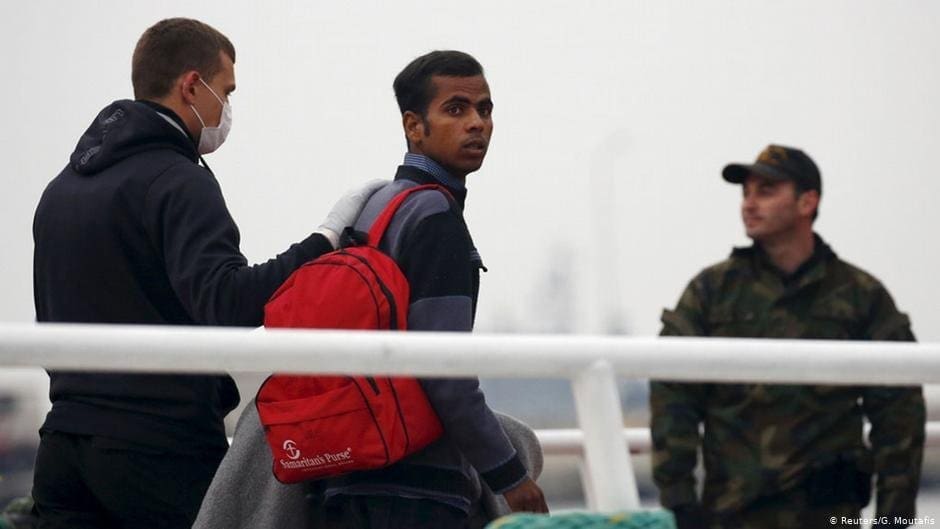
On the Turkish side, Ankara appears to have fulfilled its obligations under the agreement. Starting in 2016, its borders became nearly sealed, and the Turkish police began a large-scale campaign of arrests of migrants attempting to enter the European Union.
In the following years, arrests continued at a steady pace: 225,000 migrants were intercepted in 2024, and 160,000 were detained in 2025.
"This Turkish wall has achieved its goal." "This deal was successful for the European states that demanded a wall be built outside their borders. This Turkish wall has achieved its goal," said Semih Akgünol, professor at the University of Strasbourg and director of the Turkish Studies department.
"There was also a degree of 'success' for the migrants who remained in Turkey. Despite discrimination, racist rhetoric sometimes issued by authorities, and their fragile status under 'temporary protection,' millions of Syrians who came to Turkey have roots there. They have children under the age of ten. They are children born in Turkey, and they are an integral part of the Turkish people today."
Didier Billion, deputy director of the IRIS institute, affirms that "the agreement was successful, at least in security terms, according to the statistics." He adds: "Just before the agreement, the number of refugees attempting to cross the Aegean Sea was estimated at around 3,500 per day. After 18 March [the day the agreement was signed, editor's note], the number dropped to about 40 refugees per day."
In an interview with Le Monde in 2019, Jean Marco, director of international relations at the Institute of Political Studies in Grenoble and a specialist in Turkish affairs, said: "The agreement had a deterrent effect."
However, Brussels was forced to make concessions "to maintain the continuity of this agreement," Akgünol says. He adds: "The European Union had to overlook human rights violations in the country and the issue of arbitrary arrests."
Deterrence, Containment and Offshoring Migrants Beyond the EU's Borders
Non-governmental organisations remain critical of the agreement. Médecins Sans Frontières, a humanitarian medical organisation, stated in a recent press release: "The agreement reshaped EU migration policy by introducing deterrence, containment and the offshoring of migrants beyond the EU's borders."
Many NGOs criticise the difficult living conditions of migrants and the delays in processing asylum applications in the various reception and identification centres scattered across the Greek islands.
Akgünol said: "This agreement can be considered a humanitarian failure. The Aegean Sea has become a graveyard. Migrants take great risks to avoid security forces and ultimately reach Europe."
Médecins Sans Frontières also strongly criticised the agreement, considering that it inspired similar partnerships.
The European Union has signed agreements with other countries to prevent or reduce the arrival of irregular migrants: a new agreement with Libya in 2017, another with Tunisia in 2023, and a third with Egypt in 2024.
The agreement was already described as a "monumental failure" in 2021, according to Amnesty International on its fifth anniversary.
Turkey has on many occasions used the migration agreement as a political pressure card against the European Union. Over its dissatisfaction with the EU over discussions on disbursing the funding promised in 2020, Ankara opened its borders. Tens of thousands of migrants crossed into Greece within days, finding themselves stranded at the Kastanies border crossing between Turkey and Greece.
Source: InfoMigrants.


