


The European Union has announced its intention to establish a Maritime Rescue Coordination Centre (MRCC) in the eastern Libyan city of Benghazi, as part of its efforts to curb irregular migration across the Mediterranean Sea. The move, however, has also drawn human rights warnings that strengthening the Libyan authorities' capacity to intercept migrant boats could lead to more forced returns to Libya.
EU Ambassador to Libya Nicola Orlando said on Thursday, 30 July 2026, that the procedures necessary to establish the centre had been completed, within the framework of Operation IRINI, funded by Italy and Malta, following a meeting with officials from forces affiliated with Khalifa Haftar and representatives of Malta and the European Union.
The centre is expected to coordinate maritime search and rescue operations in eastern Libya. In practice, however, its role may extend to coordinating the interception of migrant boats heading towards Europe, particularly towards Italy and Greece, which could increase their return to Libyan territory.
A centre in an area outside the control of the Tripoli government
The project carries particular political sensitivity, as it will be located in Benghazi, which is under the influence of Khalifa Haftar's forces and the eastern authorities, while the European Union officially recognises the Government of National Unity in Tripoli as the internationally recognised executive authority.
Nevertheless, over the past year the European Union has intensified its contacts with the authorities and powers controlling eastern Libya, as part of its efforts to curb migration flows across the Mediterranean.
The idea of establishing a similar centre in Libya dates back to 2017, but its implementation was delayed for years due to the political and security divisions the country has suffered.
Orlando said the centre, alongside the training programmes provided by Operation IRINI and the EU Border Assistance Mission in Libya (EUBAM Libya), would strengthen Libya's ability to carry out search and rescue operations at sea in accordance with international standards and human rights.
Controversial European cooperation with the Libyan coast guard
The step comes within the context of long-standing European cooperation with the Libyan authorities in the fields of border control and migration.
Operation IRINI was launched in 2020 as a European military mission aimed primarily at monitoring the arms embargo imposed by the United Nations on Libya, but it also includes monitoring oil smuggling and combating human trafficking networks.
European entities have also taken part in training the Libyan coast guard and navy, a cooperation that has been widely criticised by human rights organisations, which accuse the Libyan coast guard of committing abuses against migrants, including illegal interceptions and returns and the use of violence.
Human rights organisations warn that increasing Libya's capacity to intercept boats could lead to more returns of migrants to Libya, where, according to human rights reports, migrants may face arbitrary detention, exploitation, ill-treatment and other abuses.
Libya as a main gateway for migration to Europe
Libya remains one of the most prominent departure points for migrants seeking to cross the Mediterranean to Europe, benefiting from the political and institutional divisions the country has experienced since the fall of Muammar Gaddafi's regime in 2011.
The weakness of state institutions, the spread of corruption and the multiplicity of authorities have created a conducive environment for human trafficking networks, while sea migration routes from Libya to Italy and Greece have become among the most dangerous in the region.
In recent months, Tobruk in eastern Libya has also seen migrant boats set off towards the Greek island of Crete, indicating the growing importance of eastern Libya on Mediterranean migration routes.
The European Union affirms that its cooperation with the various Libyan parties aims to improve maritime rescue operations, combat smuggling networks and reduce deaths at sea, while committing to protect migrants, refugees and asylum seekers in accordance with international standards.
Human rights organisations, however, see that cooperation with the Libyan authorities, particularly in the area of intercepting boats, raises a fundamental question: do migration prevention policies actually save lives, or do they lead to the return of people to a place where they may face serious abuses?
Rescue of 14 migrants off Libya coincides with the announcement
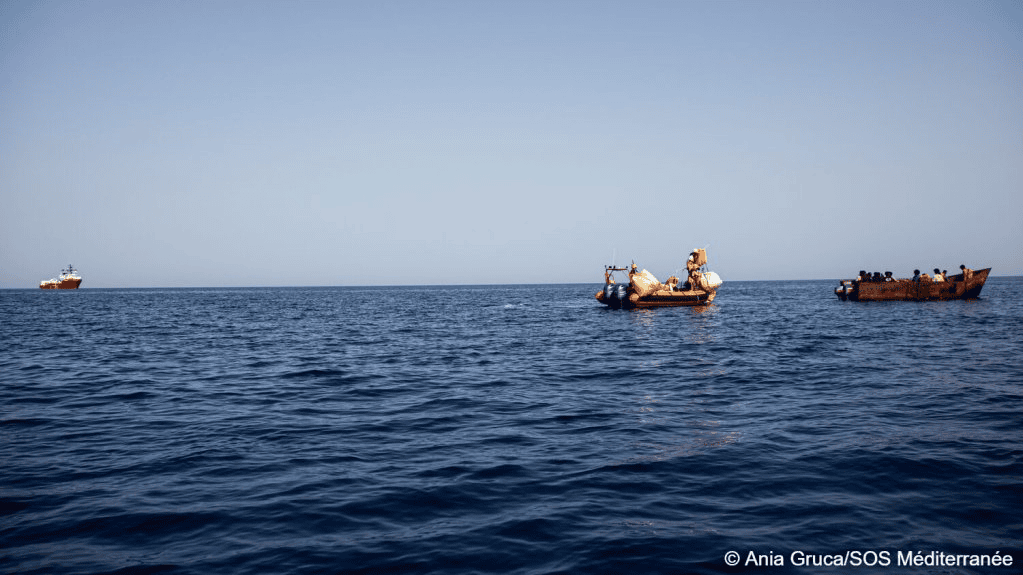
In a development that illustrates the ongoing risks on this route, the humanitarian rescue ship Ocean Viking, on Friday, 31 July, rescued 14 people who were aboard a dilapidated rubber boat within the Libyan search and rescue zone.
SOS Méditerranée, the organisation that operates the ship, said the survivors include three women and a girl, and that most of them came from Sudan, South Sudan and the Horn of Africa region.
The rescue operation followed the ship receiving an alert from Alarm Phone, after which the crew moved through the night to the last known position of the boat. Upon arrival, the rescue team found the boat in poor condition, without an engine, and none of its passengers wearing a life jacket.
The organisation said the survivors had spent a day and a night at sea and were suffering from exhaustion and prolonged exposure to fuel fumes, but their condition is stable and they are receiving medical care and assistance on board the ship.
Ocean Viking is expected to arrive at the Italian port city of Brindisi on Monday.
The rescue operation, coinciding with the European announcement of the Benghazi centre, reflects a clear paradox in Mediterranean migration policy: while the European Union seeks to strengthen Libya's capacity to manage search and rescue operations and intercept boats, humanitarian organisations continue to carry out rescues of migrants facing extremely dangerous conditions at sea, amid ongoing disagreement over whether European cooperation with the Libyan authorities provides greater protection for migrants or facilitates their return to Libya.


