


Ethiopian army base secretly backing Sudan's RSF
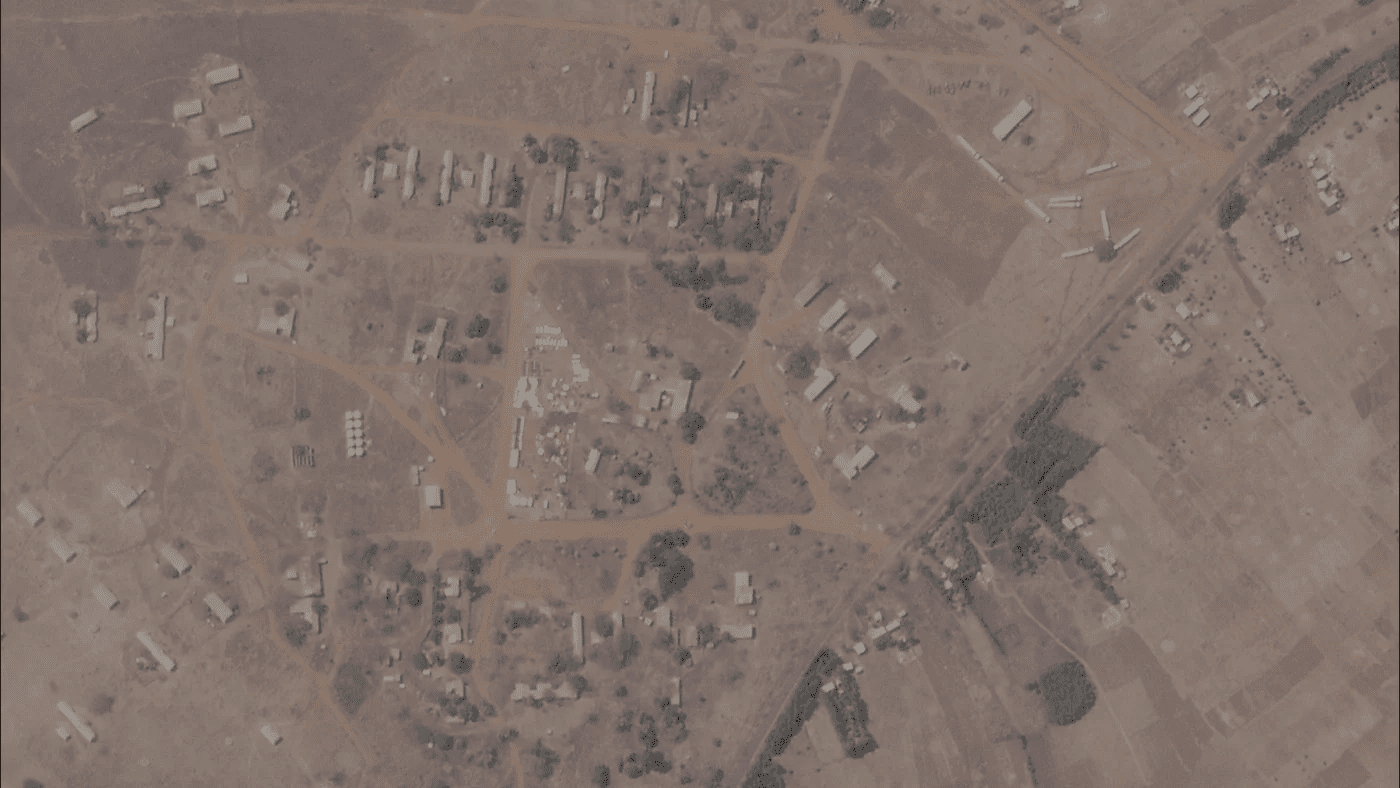
The Ethiopian army base in Assosa provides support to Sudan's Rapid Support Forces (RSF), as shown in an image dated 29 March 2026 (images © 2026 Planet Labs/Analysis Yale HRL)
Middle East Eye has revealed that Ethiopia is providing covert support to Sudan's Rapid Support Forces from a military base in the Benishangul-Gumuz region.
Satellite images analysed by the Yale School of Public Health's Humanitarian Research Lab, and seen exclusively by Middle East Eye, show large-scale activity over several months consistent with allegations of military support to the RSF at a base of the Ethiopian National Defence Forces on the outskirts of the western city of Assosa.
From December to the end of March, while the RSF was carrying out intensive cross-border attacks on Sudanese army positions in Blue Nile state, car transporter trucks entered and left the Assosa base carrying armoured vehicles, while tents capable of accommodating up to 150 fighters were erected and supplies were distributed.
In February, 200 technical vehicles were seen at the base. Unarmed technical vehicles were fitted with weapon mounts capable of carrying heavy machine guns, and similar vehicles to those seen in Assosa were seen during RSF battles in Blue Nile.
Satellite images, first seen by Middle East Eye and published in a report by the Yale Humanitarian Research Lab later the same day, together with photos and videos posted online, link the car carriers and other vehicles seen in Assosa to the port of Berbera in Somaliland, which hosts a base run by the United Arab Emirates.
Video footage of fighting in and around the Sudanese border town of Kurmuk, just 100 kilometres from the Ethiopian military base, shows armoured vehicles of the same colour, size and armament as those seen in Assosa. The town fell at the end of March after fierce fighting by the RSF and its allies from the Sudan People's Liberation Movement-North.
Nathaniel Raymond, executive director of the Yale Humanitarian Research Lab, told Middle East Eye: "Since last autumn, allegations have spread that Ethiopia has allowed the RSF to launch its attacks on Blue Nile from Ethiopia."
He added: "This report is the first visual evidence that these allegations are true. And it is worse than initially feared. The Ethiopians are not just helping the RSF, they are doing it from an actual Ethiopian military base."
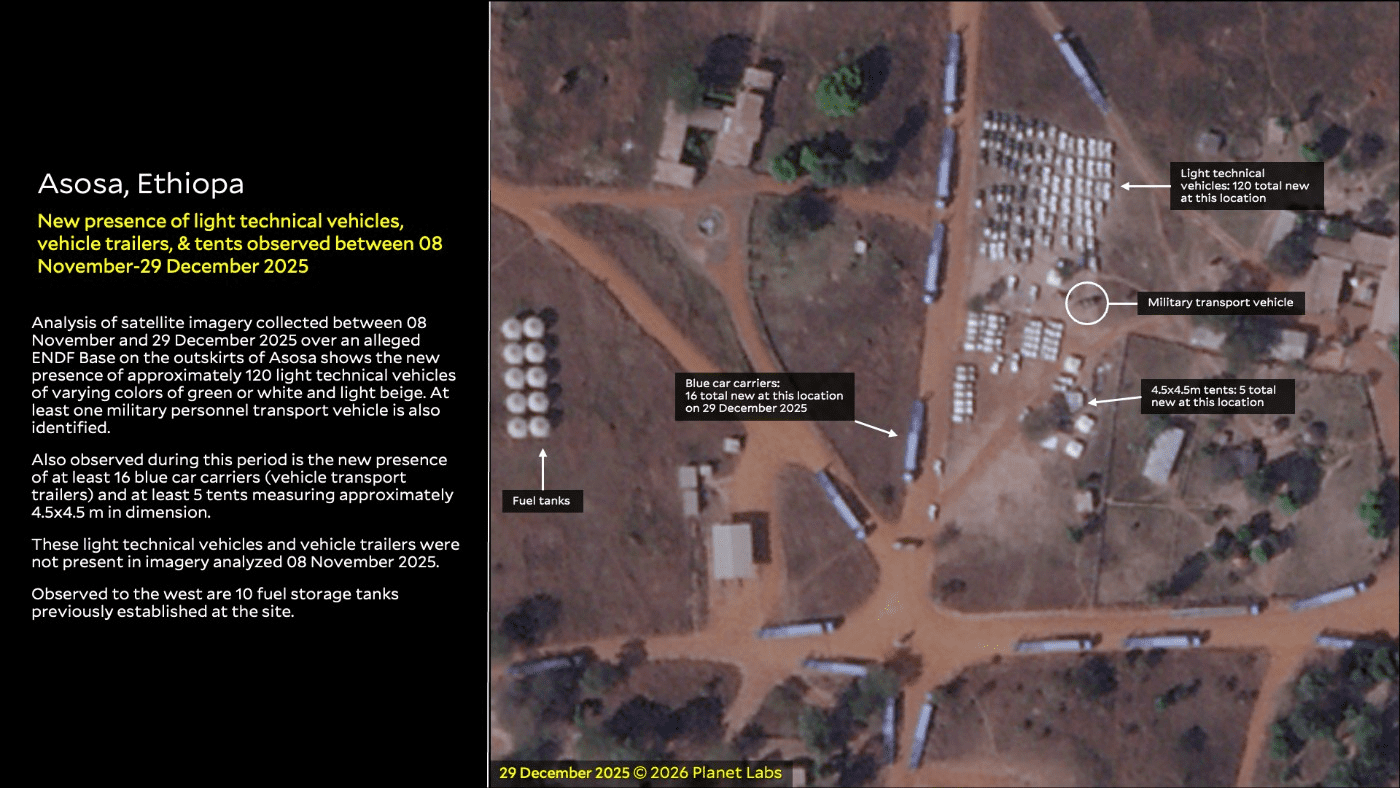
Satellite images of the Assosa base
Military vehicles at the Ethiopian army base in Assosa (image © 2026 Planet Labs / Analysis Yale HRL)
Multiple sources, including current and former Ethiopian army officers, Sudanese military and intelligence analysts, a European diplomat and a former adviser to the Ethiopian Foreign Ministry, confirmed to Middle East Eye the existence of a base used by the RSF in the remote, war-torn Benishangul-Gumuz region, though its exact location had remained closely guarded.
Sources told Middle East Eye that the United Arab Emirates, which still denies supporting the RSF despite mounting evidence, had a decisive role in Ethiopia's entanglement in the Sudan war, which broke out between the Sudanese Armed Forces and the RSF in April 2023 and has led to the world's largest humanitarian crisis, with hundreds of thousands killed and more than 11 million people displaced from their homes.
A United Nations fact-finding mission recently concluded that the RSF committed genocide when it seized El Fasher, the capital of North Darfur. Civilians who fled the city told Middle East Eye that RSF fighters raped, executed and looted men, women and children who were trying to escape.
A former adviser to the Ethiopian government told Middle East Eye: "Many in the Ethiopian Foreign Ministry and elsewhere believe that the UAE has been dictating decisions in Ethiopia regarding the Sudanese government, the RSF and Eritrea over the port of Assab for at least two years."
The RSF, the office of Ethiopian Prime Minister Abiy Ahmed and the Ethiopian Foreign Ministry did not respond to Middle East Eye's requests for comment.
Abdulkhaleq Abdulla, an Emirati academic and former adviser to UAE President Mohamed bin Zayed Al Nahyan, recently criticised the UAE being singled out over its support for the RSF, noting that the Sudanese paramilitary forces "receive support from Uganda, Ethiopia and Chad". The Sudanese Armed Forces, the RSF's opponent, receive most of their military support from Turkey and Egypt.
Attacks on Sudan launched from Ethiopia
According to the Yale Humanitarian Research Lab, RSF support from the Assosa base dates back to 8 November of last year at the earliest, when satellite images showed 15 cargo trucks arriving at two sites.
Afterwards, commercial car transporter trucks not belonging to the Ethiopian National Defence Forces were seen repeatedly at the Assosa base, unloading technical vehicles, 200 of which were seen at the site in February, vehicles the Ethiopian army does not use. The Yale Humanitarian Research Lab identified 14 other Ethiopian National Defence Forces bases in the area and found no similar activity at them, suggesting the Assosa base is an outlier.
Publicly available videos posted in early November show car transporter trucks allegedly carrying white and brown technical vehicles from Berbera, the port in the breakaway region of Somaliland that hosts an Emirati base, to RSF fighters operating from bases in Ethiopia.
The car carriers appear in satellite images of the Assosa base dated 18 February and 29 March, and their colours and dimensions match those seen in the videos. Other video footage shows these carriers heading towards Assosa east of the town, carrying white technical vehicles that match those seen in the videos.
The same technical vehicles appear in images and videos taken during the fighting in and around Kurmuk, a Sudanese border town just 100 kilometres from the Assosa military base. The RSF and allied fighters seized Kurmuk, where fierce fighting took place, at the end of March.
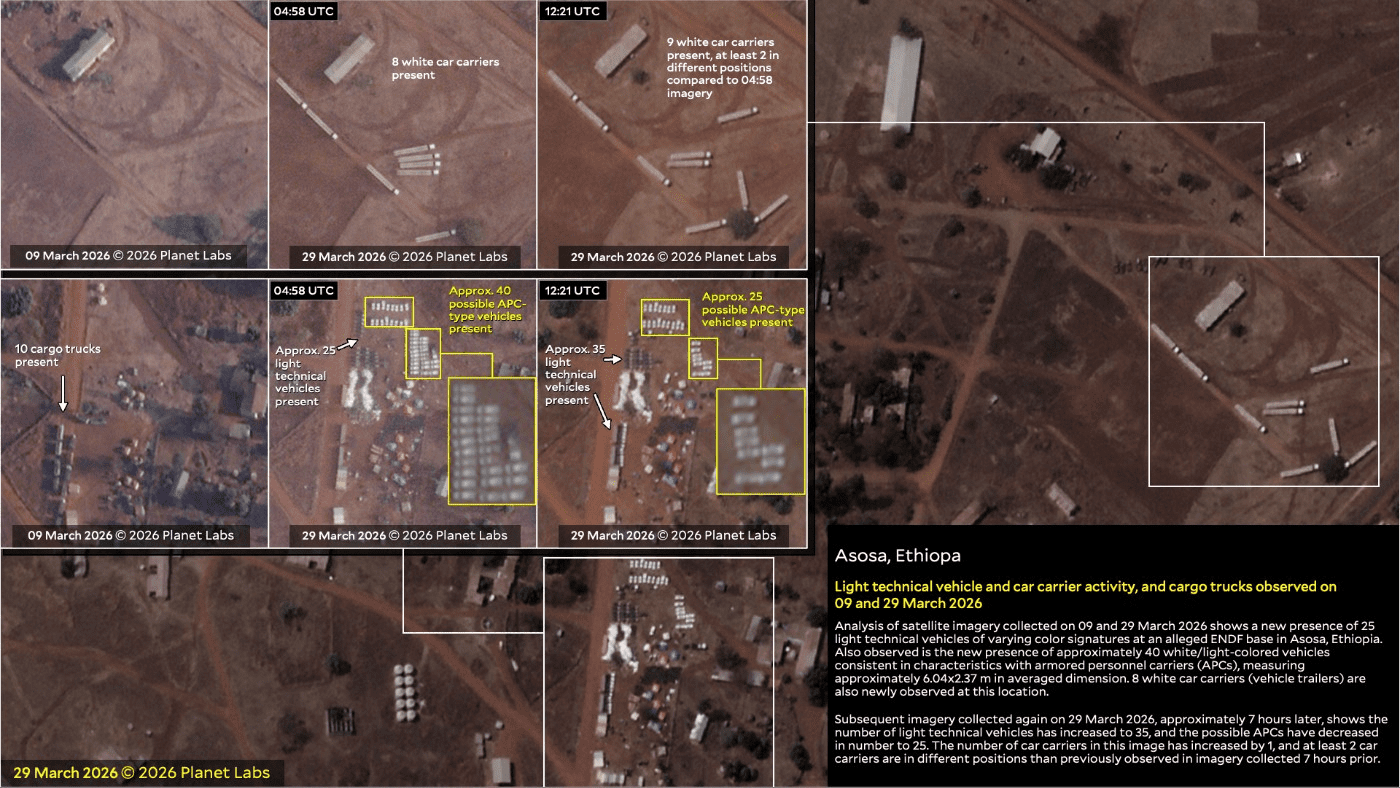
Satellite images of Assosa 2
Technical vehicles and cargo trucks seen at the Ethiopian army base in Assosa (image © 2026 Planet Labs / Yale HRL Analysis)
During the same period, despite the direct impact of the war on Iran on the UAE, flight tracking data shows several UAE-operated Ilyushin-76 cargo aircraft flying from Abu Dhabi to various airports in Ethiopia, including Bahir Dar in the Amhara region, about 300 kilometres from Assosa.
At Assosa airport, the Yale HRL observed transport aircraft during February and March. A 20-metre helicopter, probably an Mi-17, was seen from 18 February. A cargo plane, probably a C-130, which the UAE operates a fleet of, was seen from 9 March.
As the vehicles were leaving Assosa for Kurmuk, the Ethiopian army was carrying out an intensive deployment of troops, vehicles, tanks and drones northwards to Tigray, more than 1,500 kilometres away, where the conflict between the Ethiopian government and the Tigray People's Liberation Front (TPLF) remains active, and where an invasion of Eritrea could be launched.
UAE doubles down on support for Ethiopia
At the same time as the vehicles were seen travelling from Berbera to Ethiopia, tensions were rising between the Somali government in Mogadishu and Abu Dhabi over the UAE's support for Somaliland and Puntland, another breakaway region that hosts a major Emirati base at the port of Bosaso.
Both Berbera and Bosaso were part of a network of Emirati bases, developed in cooperation with Israel and the United States, which formed a control ring around the Red Sea and the Gulf of Aden. They are also part of the Emirati supply lines that reach the RSF in Sudan.
On 26 December of last year, Israel, the UAE's main ally, became the first state to formally recognise the sovereignty of Somaliland, and serious discussions began about establishing an Israeli base in Berbera.
On 12 January, Somalia cancelled all agreements with the UAE, including those concerning the ports of Berbera and Bosaso. With the UAE's interests in Somalia greatly complicated, its relationship with Ethiopia has become more important than ever.
Since Abiy Ahmed became Prime Minister of Ethiopia in 2018, economic, security and military ties between Ethiopia and the UAE have grown markedly.
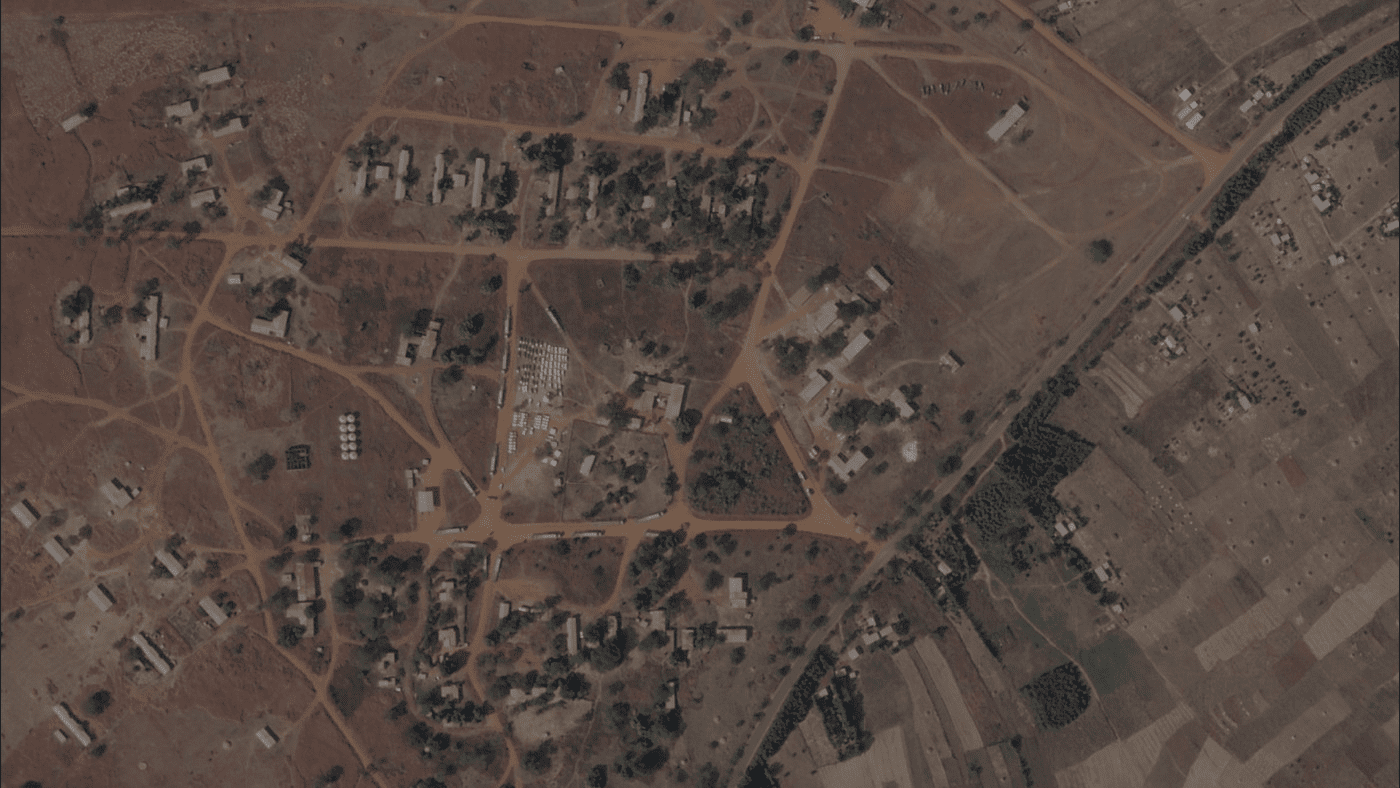
Assosa, 25 December
Vehicles can be seen at the Assosa base on 29 December 2025 (image © 2026 Planet Labs / Analysis Yale HRL)
Jalil Harchaoui, an analyst specialising in North Africa and political economy, told Middle East Eye in the wake of the dispute between the UAE and Saudi Arabia: "Addis Ababa will remain committed to its relations with the UAE."
Therefore, the Emiratis are focusing their military operations on Ethiopian territory, and are preparing for a large-scale offensive after Saudi moves disrupted other assembly areas.
Gutu Gebrilwel, a researcher and political analyst specialising in the Horn of Africa, identified two main issues facing the Ethiopian government.
He told Middle East Eye: "First, there are the broader and more obvious geopolitical dynamics, and the network of alliances linking Ethiopia's aspirations with those of the UAE, and therefore the RSF, against the aspirations of Eritrea and Egypt, among other states."
He added: "Second, the dilemma of internal security. Tensions between Addis Ababa and Burhan date back to at least 2020, and to the Tigray war, when Burhan supported the Tigray People's Liberation Front," referring to Abdel Fattah al-Burhan, commander of the Sudanese Armed Forces and de facto ruler of Sudan.
He continued: "Last year, Abiy Ahmed sent a high-level delegation to Sudan, where they tried unsuccessfully to persuade Burhan to abandon his support for the Tigray People's Liberation Front. These are the main issues."
What are Ethiopia's real motives for intervening in Sudan?
Among the attendees of this high-level delegation was Getachew Reda, an adviser to Abiy Ahmed, who said in a Facebook post that Ethiopia could not "stand idly by" in the war raging in Sudan, and that it should not be attacked "for seeking to protect its strategic interests in the context of the Sudanese conflict".
On 3 March, the Sudanese government, which supports the Sudanese Armed Forces, publicly accused Ethiopia of involvement in the war.
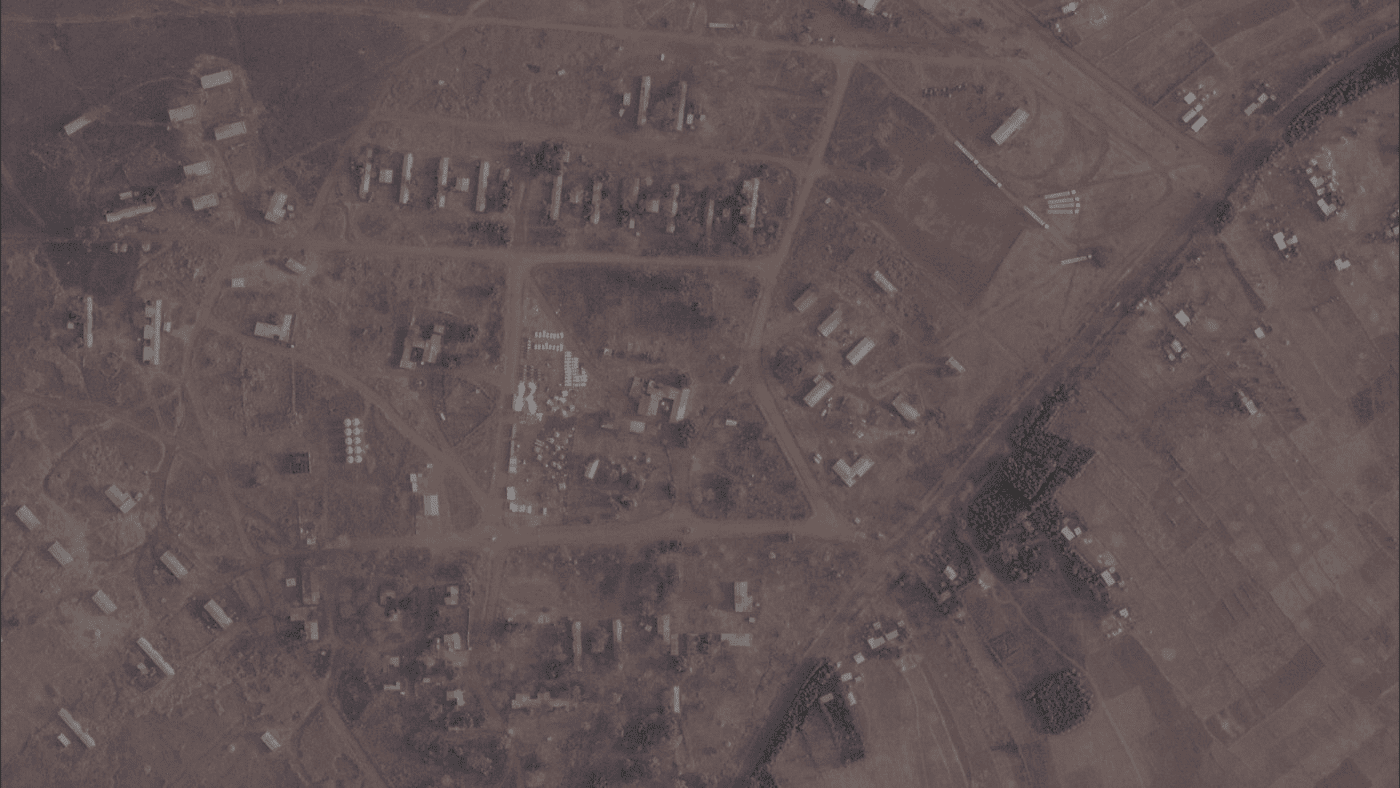
Assosa, 26 March
Vehicles and tents, and possibly armoured personnel carriers, can be seen in Assosa on 29 March 2026 (image © 2026 Planet Labs / Analysis Yale HRL).
On 25 January, the RSF launched a large-scale attack on Sudanese Armed Forces positions in Blue Nile state.
At the time, a Sudanese intelligence source told Middle East Eye that the RSF and allied fighters had come from South Sudan and Ethiopia, both of which border Blue Nile state.
From the end of December until the last week of March, troop gatherings were observed at a base where logistical support operations, which the Yale Humanitarian Research Lab described as "consistent with intensive military support operations", took place, including tents and heavy vehicle traffic.
Multiple commercial "Conex" shipping containers arrived and supplies were distributed. Between five and fifteen tents capable of accommodating up to 150 people were also erected. This type of activity was not observed at other Ethiopian National Defence Forces bases in the region.
Commercial transport vehicles, unlike those used by the Ethiopian army, were repeatedly seen arriving at and leaving the Assosa base.
In satellite images dated 27 March 2026, a white car transporter truck loaded with at least two light-coloured cars can be seen on the main road east of Mendi, 95 kilometres southeast of Assosa, on the main road heading east.
Mendi also lies on routes linking Ethiopia from east to west, as well as Berbera in Somalia. In the east. The car carrier seen on this road follows a blue transport vehicle carrying a standard shipping container.
Images from March show as many as 40 possible armoured personnel carriers. According to the Yale Logistics Research Lab, unarmed technical vehicles were fitted with heavy machine gun mounts. In images from February, objects measuring 1.6 metres long, consistent with .50-calibre machine guns, can be seen lined up on the ground near the vehicles fitted with mounts.
The Assosa base also contains multiple fuel tanks. This means that, unlike the alleged RSF base identified by Reuters in the neighbouring Manji area of Benishangul-Gumuz region, it is capable of supporting large-scale refuelling operations for these vehicles.
The white and dark-coloured technical vehicles, whether fitted or unfitted, visible in the satellite images match those used by the RSF in its combat operations in Blue Nile, which continue to this day.
The Yale Logistics Research Lab states in its report: "Assosa is a major logistics hub for activities consistent with military assistance provided by the Ethiopian National Defence Forces to the RSF."
"The site is strategically positioned to provide supplies, fuel, housing and vehicle maintenance" for the RSF inside Blue Nile state, and "the observed activity there is consistent with the Assosa base performing these tasks for the benefit of non-Indonesian National Defence Forces personnel who appear to be present there during the five-month period covered by this report."
By Oscar Rickett and Zecharias Zelalem for Middle East Eye


