

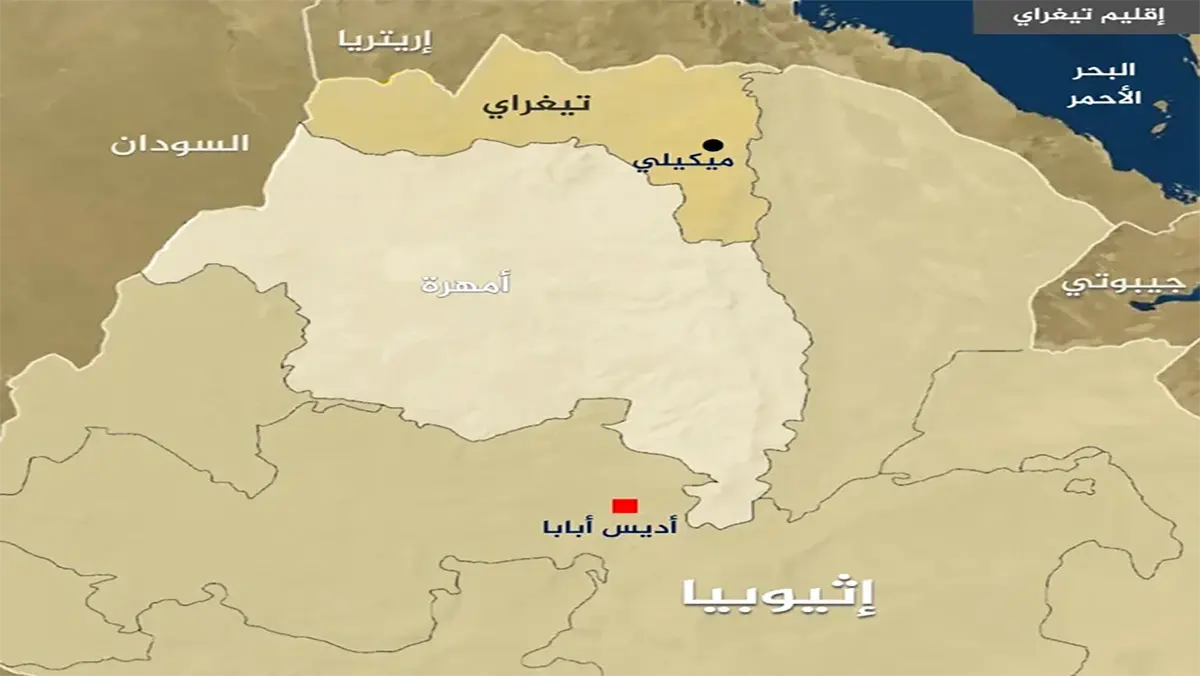
The war in northern Ethiopia is moving toward a more dangerous phase, with reports of artillery exchanges between Ethiopian and Eritrean forces near the border town of Badme, renewed fighting inside the Tigray region, and allegations of forced conscription of civilians in the capital Addis Ababa and the Oromia region. With conflicting information about control of the border areas and the possible involvement of additional armed factions, concern is growing that Ethiopia's internal conflict could turn into a regional confrontation that reignites one of the most volatile areas of the Horn of Africa.
In a military assessment published by the Critical Threats Project (CTP) on Friday, 13 November 2026, researcher Michael DeAngelo, with contributions from Alexander Brown, tracked developments in military operations on the northern, western and central fronts in Ethiopia between 10 and 13 November.
The security review reveals that Ethiopian government forces are facing simultaneous military pressure from the Tigray Defence Forces, affiliated with the Tigray People's Liberation Front, amid reports of clashes with Eritrean forces near the shared border.
However, the authors of the report stress that a number of field reports, particularly those concerning the involvement of armed factions and control of border towns, could not be independently verified.
First: Badme returns to the heart of the Ethiopia-Eritrea confrontation
The border town of Badme is the most prominent point of tension identified in the report, not only because of the recent clashes but because of its highly sensitive military and political history.
This small town was one of the main sparks of the Ethiopia-Eritrea War, which broke out in 1998 and lasted until 2000, and which resulted in the deaths of tens of thousands on both sides.
Despite subsequent agreements and a decision by the Boundary Commission to place the town within Eritrea, the area has remained one of the most sensitive points in relations between the two countries.
According to the Critical Threats Project, reports of the new clashes around Badme began on 9 November, days after Ethiopian and Eritrean forces had reinforced their military presence in the area.
Field sources spoke of confrontations involving Ethiopian government forces and Tigray Defence Forces, alongside Eritrean units, but researchers were unable to determine whether some of the clashes took place inside Ethiopian or Eritrean territory.
Between 11 and 13 November, reports emerged of artillery exchanges between the Ethiopian and Eritrean armies around the town, along with allegations that Ethiopian forces used drones to attack Eritrean positions.
These accounts agree on the rise in military tension, but they do not yet allow the scale of losses or responsibility for all the strikes to be determined.
Who controls Badme?
This specific question remains disputed.
Accounts by specialist conflict-monitoring sources reported that Ethiopian forces took control of the town on 12 November, while the newspaper Addis Standard quoted a resident as saying that Ethiopian troops had been present inside it since that date.
However, the Armed Conflict Location & Event Data Project (ACLED) reported on 13 November that Badme was not under the control of either army, noting the presence of Eritrean intelligence personnel there.
This contradiction means that the announcement of Ethiopian control over Badme cannot be treated as a settled fact.
Nonetheless, the mere return of clashes to the town's vicinity carries serious significance, as it brings the confrontation between Ethiopia and Eritrea back to the location historically linked to one of the bloodiest wars between the two countries.
Second: The Raya front — renewed fighting and the possible entry of new factions
On the northern axis extending between Raya, Zalambessa and Dalul, the military assessment records clashes between Ethiopian forces and Tigray Defence Forces.
Raya lies north of the city of Edaga Hamus, close to the Eritrean border, which gives it importance in determining the nature of military movements along this axis.
According to the report, fighting resumed around the town on 7 November, and clashes recurred between 9 and 11 November.
Accounts of the outcome of the confrontations differed.
While ACLED reported that government forces had retaken Raya, the Tigray Defence Forces announced that they had repelled government forces and inflicted heavy losses on them.
The report does not provide independent evidence that resolves these conflicting accounts.
The most significant development, however, is reports of fighters from the "Amhara National Movement" and the "Afar Revolutionary Democratic Unity Front" fighting alongside Tigrayan forces.
These formations belong to an opposition armed coalition comprising actors with differing interests and backgrounds, raising questions about the possibility that the confrontation could extend beyond the traditional conflict between the Ethiopian government and the Tigray People's Liberation Front.
The Ethiopian radio station Wazema reported local residents' claims that these factions had taken part in the fighting.
However, the Critical Threats Project stressed that it had been unable to verify these claims.
If the involvement of additional formations in the fighting is confirmed, this may indicate the widening of armed alliances opposed to the government, further complicating the conflict and making it harder to contain within a single front.
At the present stage, the participation of these factions in the recent fighting remains a possibility supported by field accounts, rather than a conclusively established fact.
Third: Fighting extends into mountainous areas inside Tigray
Military developments are not confined to the Ethiopia-Eritrea border. The report records additional clashes in the mountainous areas of central Tigray.
According to field monitoring sources, government forces clashed with Tigray Defence Forces on 11 November near the Simema area, about 32 kilometres south of the city of Axum.
These clashes come in the context of a conflict that has continued since mid-October over areas surrounding the region's urban belt.
The main cities, such as Axum, Edaga Hamus, Shire and Mekelle, hold military and administrative importance, as they serve as centres of roads, services and government institutions.
Fighting near them means that the dispute over the ability to administer the region and secure lines of communication between its different areas continues.
These developments also show that the conflict in Tigray is no longer confined to the confrontation near the border with Eritrea, but extends to internal areas where military operations could lead to further displacement and disruption of services.
However, during the review period the institute did not record significant military developments in the Afar and southern Tigray axes, which shows that the widening of confrontation does not necessarily mean all fronts are ignited at the same time.
Fourth: Forced conscription sparks growing anger in Oromia and Addis Ababa
Beyond the military fronts, the report records an internal development no less serious: growing allegations that Ethiopian security forces are forcibly conscripting civilians and sending some of them to combat zones.
On 12 November, the Ethiopian newspaper Addis Standard and the Canadian newspaper The Globe and Mail carried testimony from residents of the Oromia region and the capital Addis Ababa, who said that family members and other young men had been taken into military service without their consent.
The Canadian newspaper quoted two residents of the capital as saying that their sons had been sent to the Tigray combat fronts.
In Jimma, one of the largest cities in Oromia, protests broke out on 9 and 10 November, amid residents' anger over practices they said included forced conscription, arbitrary arrests and extortion of citizens.
According to a report published by Addis Standard on 12 November, the protests erupted following the killing of a former soldier, but quickly widened to reflect accumulated grievances related to the security situation and the practices of local authorities.
Residents said the conscription issue was not the only cause of the protests, but part of a broader state of discontent over arrests, economic pressures and poor administration.
These allegations did not appear for the first time in November.
The Ethiopian Human Rights Commission had previously received complaints about forced conscription, and Ethiopian media outlets had published reports of young men being detained in Oromia during 2024 and 2026.
For its part, the regional authorities in Oromia had previously rejected earlier allegations of widespread forced conscription, describing them as untrue.
The new report does not provide a reliable count of those forcibly conscripted, and its authors were not able to independently verify all the testimony.
However, the repetition of complaints, and their link to local protests, indicate that the continuation of the war has begun to exert internal pressures that extend beyond the areas of direct fighting.
The seriousness of these practices, if confirmed, lies in the fact that the war consumes not only military resources but also reaches families and cities far from the fronts, doubling feelings of resentment toward the authorities.
Fifth: Divisions within the Tigray interim administration
The confrontations coincide with political and administrative turmoil within the Tigray region.
Following the resumption of fighting in September, the interim regional administration moved to arrange its institutions and redistribute posts, but this process faced disputes over appointments, governance mechanisms and civil servants' salaries.
The Critical Threats Project referred to reports that 11 prominent members of the Simret party, which holds influence within the interim administration, resigned on 11 November over internal disagreements.
Sources also spoke of the appointment of a new administrative official for the western zone disputed between Amhara and Tigrayan communities.
The institute was unable to independently confirm all these developments.
Nevertheless, the coincidence of administrative disputes with military confrontations reveals the difficulty of establishing stable authority within the region.
The local government faces the task of restarting institutions and services at a time when fighting continues, and political disputes overlap with conflicts over land and military loyalties.
This adds to the fragility of any future political arrangements, because halting the fighting alone will not be sufficient to address disputes over administration, representation and control of contested areas.
Sixth: Mutual accusations among Ethiopia, Eritrea and Sudan
The report warns that the war has become surrounded by growing regional tensions, particularly with the exchange of accusations between Addis Ababa, Asmara and Khartoum.
Getachew Reda, adviser to Ethiopian Prime Minister Abiy Ahmed on Horn of Africa affairs, accused Eritrean President Isaias Afwerki and Sudanese Sovereignty Council Chairman Abdel Fattah al-Burhan of supporting Ethiopian armed groups.
He alleged that Eritrea and Sudan contribute to arming some factions and coordinating their operations, including providing assistance in carrying out drone attacks inside Ethiopia.
These accusations were made during a meeting Getachew held on 11 November with the Special Envoy of the United Nations Secretary-General for the Horn of Africa, Xia Huang.
Hmm, the Eritrean government presented an opposing account.
On 11 November, Eritrea's Minister of Information, Yemane Gebremeskel, accused the Ethiopian authorities of adopting a war agenda with regional dimensions.
The following day, Eritrea's Ministry of Information issued a statement accusing Ethiopia of invading Eritrean territory.
The parties are thus exchanging accusations of escalation and interference in internal affairs, while it is difficult to independently verify all claims concerning military support and cross-border movements.
The accusations concerning Sudan carry particular significance, as the country has been engaged in a wide internal war since April 2023, and any possible link between the two conflicts raises concerns about the emergence of a broader network of alliances and confrontations in the Horn of Africa.
However, the appearance of these accusations does not in itself prove that Sudan has become a direct party to the Ethiopia-Eritrea war.
Seventh: G7 warning and US diplomatic involvement
The continued escalation has raised growing international concern.
In a joint statement issued following the G7 foreign ministers' meeting in Paris, the ministers expressed their deep concern over the deteriorating security situation between Ethiopia and Eritrea, and warned of the possible spread of the confrontation to the wider region.
They called on all parties to exercise restraint and to turn to diplomatic solutions, while protecting civilians and ensuring access for humanitarian aid.
They also stressed that any further escalation could threaten regional security and international trade flows, including navigation in the Red Sea.
On 10 November, five Democratic members of the US Senate Foreign Relations Committee sent a letter to Secretary of State Marco Rubio, urging him to intensify diplomatic efforts to reduce tensions between Ethiopia, Eritrea and Ethiopian armed factions.
The senators stressed the need to avoid including the Eritrean port of Assab in any mediation arrangements that could grant Ethiopia sea access, out of concern that this would heighten tensions over sovereignty and access to the Red Sea.
They also called for dissuading regional states from providing support to Ethiopian armed factions.
These moves show that international concerns are no longer limited to the internal conflict in Tigray, but now include the possibility of new states becoming involved in a confrontation that could affect security in the Red Sea and the Horn of Africa.
Eighth: Civilians face the risk of a repeat of the Tigray catastrophe
These developments occur in a region that has not yet recovered from the humanitarian effects of the war fought between 2020 and 2022.
In a humanitarian study published by Refugees International on 13 November, the organisation warned that a renewed war threatens to repeat the abuses, displacement and collapse of services seen in Tigray during the previous war.
The study drew on a survey of 452 households with young children, conducted in four areas during August and September 2026, before the latest military escalation.
The findings showed that six in ten displaced households surveyed reported that one of their members had gone to sleep hungry in the previous month, while about eight in ten households said adults had reduced their own food so that children could eat.
A mid-upper-arm circumference screening showed signs of acute malnutrition among 23% of the children surveyed in displacement sites, of whom 4% showed signs of severe acute malnutrition.
The organisation stressed that the results of this sample should not be generalised to the entire population of Tigray, but that they reveal the fragility of conditions in the areas covered by the research.
It also reported, citing health officials, that more than 250 ambulances had stopped working due to fuel shortages, in addition to the disabling of hundreds of vehicles used in field health services.
These conditions mean that any new expansion of fighting could strike a community already suffering from shortages of food, medicine and essential services.
The war here does not begin from a stable situation, but from an accumulated humanitarian crisis that years of relative calm have not been able to end.
Ninth: Is the Horn of Africa heading toward a wider regional war?
The military assessment identifies indicators that call for concern, but it does not establish that a comprehensive regional war has become inevitable.
The current indications point to continued fighting between Ethiopian forces and Tigray forces, reports of artillery exchanges with Eritrea, and attempts by other factions to join the fighting, alongside growing political and diplomatic disputes.
The crisis could develop in more than one direction.
The confrontations could continue as a limited war inside Tigray and along the border areas, with exchanges of strikes and accusations, without a declared all-out war between Ethiopia and Eritrea.
A major military incident or a high number of casualties could lead to an expansion of operations and the involvement of additional forces.
International and regional pressure could also succeed in de-escalating the situation and imposing interim arrangements to separate the warring forces.
However, these paths remain analytical possibilities rather than settled outcomes.
The most important factor in the coming phase will be the parties' ability to control military movements near the border, prevent more armed factions from joining, and maintain channels of communication that allow incidents to be handled before they turn into a wide confrontation.
Conclusion: Badme as a warning bell for a war that could extend beyond Tigray
The military review issued by the Critical Threats Project shows that the seriousness of the situation in northern Ethiopia is no longer confined to the continuation of the internal war, but lies in its growing entanglement with the tension between Ethiopia and Eritrea.
The return of shelling to the vicinity of Badme recalls a previous war that drained both countries for years, while the fighting near Rama and Axum points to the continued struggle for control within Tigray.
At the same time, allegations of forced conscription and the protests in Oromia and Addis Ababa raise questions about the social and political impact of expanding military operations.
The mutual accusations between Ethiopia, Eritrea and Sudan increase the risk of the conflict spreading across borders, even if not all claims concerning military support and direct intervention have been substantiated.
The greatest danger is that these shifts coincide in a region that has not recovered from its previous war, and whose population already lives under the burden of displacement, hunger and shortages of services.
Therefore, the question raised by recent developments concerns not only who controls Badme or Rama, but whether the warring parties will be able to contain the confrontation before Ethiopia and Eritrea return to an open war, with civilians in the Horn of Africa paying the price of a new conflict whose repercussions extend beyond borders and military fronts.


