


El Niño on the Horizon: A Global Climate Phenomenon and Its Implications for the Middle East and North Africa.
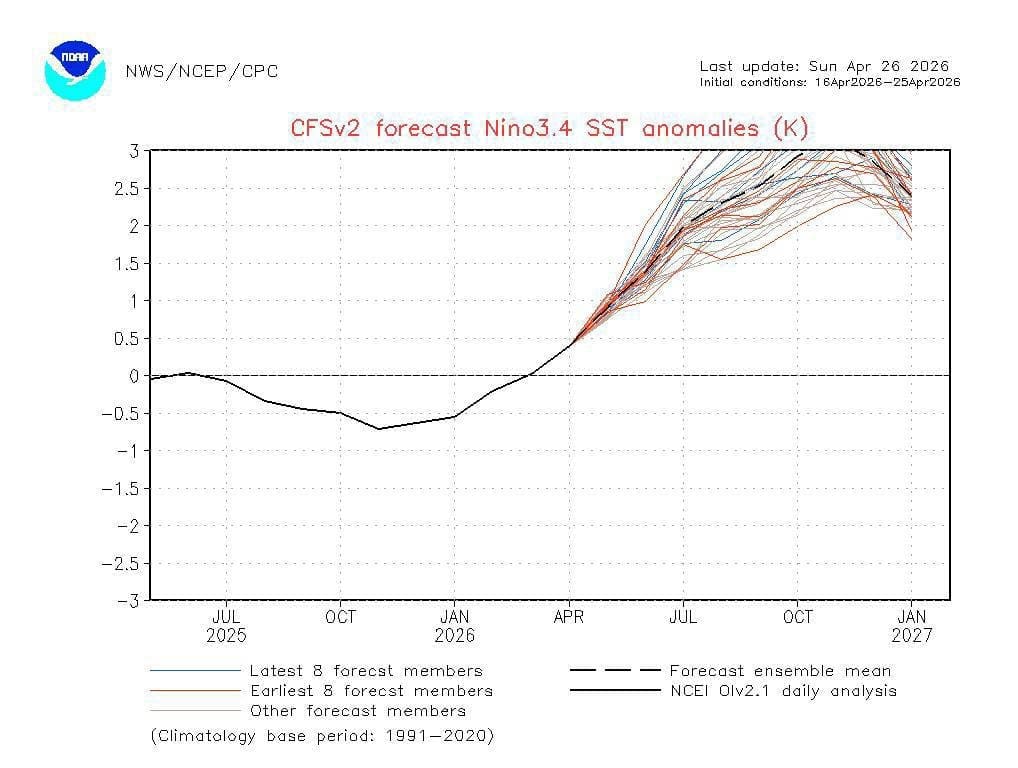
The chart issued by the U.S. climate forecasting centres (NOAA – CFSv2), tracking sea surface temperature anomalies in the Niño 3.4 region of the central Pacific, shows a clear rise during 2026 that could reach more than +2°C, indicating the development of a strong El Niño whose effects extend into early 2027.
What is the El Niño phenomenon?
El Niño is a natural climate phenomenon resulting from an unusual rise in the temperature of the tropical Pacific Ocean. It disrupts wind patterns and ocean currents, and consequently causes wide-ranging weather changes around the world. This phenomenon is one of the most important drivers of global climate variability.
Global impacts
Historically, El Niño years have been associated with: heavy rainfall and flooding in parts of South America and East Africa; drought and wildfires in Australia and Southeast Asia; a warmer-than-usual winter across large parts of the Northern Hemisphere; and changes in hurricane activity, with the Atlantic season weakening and the Pacific season strengthening.
The Middle East and North Africa: an indirect but tangible impact
Despite the geographical distance, the Middle East and North Africa are affected by El Niño through shifts in pressure and atmospheric circulation patterns:
- A notable rise in temperatures, particularly in summer and autumn, and an increase in heatwaves.
- Rainfall variability: a tendency towards drought or delayed precipitation in the eastern Mediterranean and the Maghreb, alongside the possibility of heavy local rainfall or flash floods in the Red Sea region and the Horn of Africa.
- Increased extreme events and atmospheric instability, which compound the challenges to agriculture and water security.
Forecasts for 2026–2027
Based on the chart, El Niño is expected to peak in the second half of 2026, making this year a likely candidate to be among the hottest globally, with climatic effects continuing into 2027. In a region already suffering from water scarcity and rising temperatures, this period may require greater preparedness for managing resources and adapting to weather variability.


