

One year after the Rapid Support Forces (RSF) took control of El-Fasher, capital of North Darfur State in western Sudan, research findings published by the Humanitarian Research Lab at Yale University revealed a sharp decline in signs of life within the city. No notable human or vehicle activity was detected at any of the nineteen hospitals included in the assessment, while indications of activity appeared at only one main market out of the nine markets analysed.
The Lab, part of the Yale School of Public Health, published its situation report No. 81, titled "El-Fasher, One Year Later," on Wednesday, 28 October 2026. The report coincided with the first anniversary of the RSF's takeover of the city on 26 October 2025, following a siege that lasted approximately 18 months.
The study extends a series of investigations in which the Lab has used satellite imagery and remote sensing technologies to monitor war-related abuses in Sudan and to document the impact of military operations on civilians and civilian infrastructure.
Vegetation growth reveals the absence of residents
Among the most significant findings announced by the Yale Lab was the detection of unusual growth of vegetation in parts of El-Fasher in the months following the city's fall.
The researchers considered these changes an indicator supporting their assessment of the absence of residents, animals and vehicles from areas of the city, following the mass killings that the Lab documented after the RSF takeover.
The Lab described El-Fasher as having turned into a "ghost city," in reference to the marked decline in the usual signs of human activity within it.
This finding carries particular importance because analysing changes in vegetation cover allows researchers to infer a decline in human land use, especially when compared with earlier images of the same areas. However, this indicator alone is not sufficient to determine the number of victims or missing persons, or to conclude the fate of all residents who left the city or remained in it.
19 hospitals without notable activity indicators
In the healthcare sector, the Lab announced that analysis of satellite imagery showed no indications of human activity or notable vehicle movement at any of the nineteen hospitals included in the assessment, one year after El-Fasher's fall.
The researchers also observed, at five hospitals, indicators consistent with the presence of burning sites for materials or waste during the past year, along with visible disturbances in the ground surface at three hospital sites.
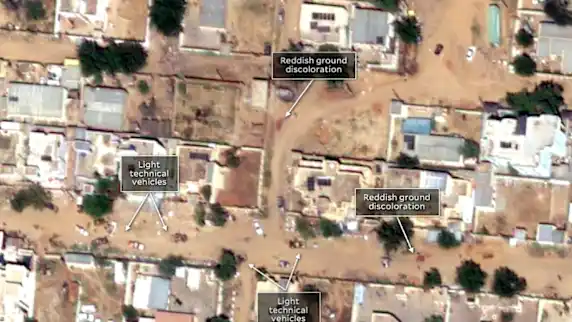
At El-Fasher Teaching Hospital, a comparison of images taken between 30 October 2025 and 7 October 2026 showed piles of burnt materials and white objects, as well as the burning of two vehicles that were visible in earlier images, and the appearance of two other light vehicles inside the hospital compound.
These observations alone do not establish the nature of the burnt materials or the causes of the soil disturbance. However, they constitute indicators that require independent field investigation, particularly in light of earlier allegations against the Rapid Support Forces of committing widespread violations against civilians and medical facilities.
One market out of nine
The Lab's findings showed that the central market in the Darja Al-Oula neighbourhood was the only main market among nine major markets assessed where indications of activity appeared.
A comparison of images of the central market taken in March and November 2025 and September 2026 revealed damage to two buildings. Later images then showed new tents and temporary structures and vehicle movement, indicating an expansion of activity in this area.
By contrast, images of the livestock market showed a continued absence of activity indicators up to 25 September 2026, following the decline that came after the RSF takeover of the city.
This disparity reflects the contraction of commercial activity observed within El-Fasher, without necessarily meaning that all forms of trade have stopped or that residents are absent from the city's other neighbourhoods.
From siege to mass killing
The new findings are not separate from the long record of investigations the Yale Lab has conducted on El-Fasher, from the siege until its fall in October 2025.
In a report published by the university on 19 February 2026, the Lab explained that its earlier monitoring work helped document mass killings that targeted civilians, especially from non-Arab communities, including the Zaghawa and the Fur.
The Lab noted that, through satellite imagery, it identified approximately 150 clusters of objects whose visual characteristics are consistent with human bodies, with some showing signs of burning and burial.
It also documented the construction by the Rapid Support Forces of earth berms around El-Fasher, which contributed to trapping civilians inside the city and restricting their ability to flee.
The United Nations Independent International Fact-Finding Mission for the Sudan drew on evidence gathered by the Lab in its investigation, which concluded in February 2026 that the Rapid Support Forces committed genocide against non-Arab ethnic communities during the siege and capture of El-Fasher.
Destruction of farming communities and starvation of residents
In a separate study published on 10 March 2026, in cooperation with the NASA Harvest initiative, the Yale Lab documented the destruction by the Rapid Support Forces of 41 farming communities around El-Fasher between 31 March and 12 June 2024.
The researchers concluded that the attacks contributed to emptying these communities of their residents, disrupting the planting season and undermining the food sources on which the city had depended.
Satellite images showed grass growing in abandoned residential and agricultural sites, alongside a major decline in agricultural activity, reinforcing the researchers' conclusions regarding widespread displacement and the disruption of livelihoods.
The study considered the deliberate destruction of farming communities to have been linked to a strategy of starving the population during the siege, in line with the findings of the UN investigation into crimes committed against the people of El-Fasher.
Where did the people of El-Fasher go?
The new findings raise a question that goes beyond the scale of material destruction: what has become of the city's residents, whose daily life is no longer evident in satellite imagery?
The observed absence from markets, hospitals and residential areas may be linked to displacement, killing, detention or other wartime conditions. However, determining the fate of each group requires additional evidence, independent testimony and access to the city.
The importance of satellite investigations lies in their ability to detect material changes even in areas that journalists and humanitarian organisations find difficult to enter. Yet they cannot, on their own, identify victims or establish all the criminal circumstances.
Nor does the decline of activity in hospitals and markets alone prove the disappearance of all residents. Rather, it provides strong indications of the extensive collapse that has afflicted civilian life in El-Fasher.
One year after the city's fall, the study refocuses attention on the need to uncover the fate of the missing and detained, to secure access for humanitarian aid, and to enable independent investigation of the sites of possible abuses.
The importance of this evidence extends beyond documenting what happened in El-Fasher to preserving a record that can be used in future investigations and accountability processes, particularly as access on the ground to large areas of Darfur remains difficult.
Between a city that once teemed with markets, hospitals and residential neighbourhoods, and satellite images that today reveal wide areas where signs of life have receded, the humanitarian tragedy of El-Fasher remains open to a question that investigations have not yet resolved: where are its residents, and what has become of those whose whereabouts have been unknown since the city fell?
Sources


